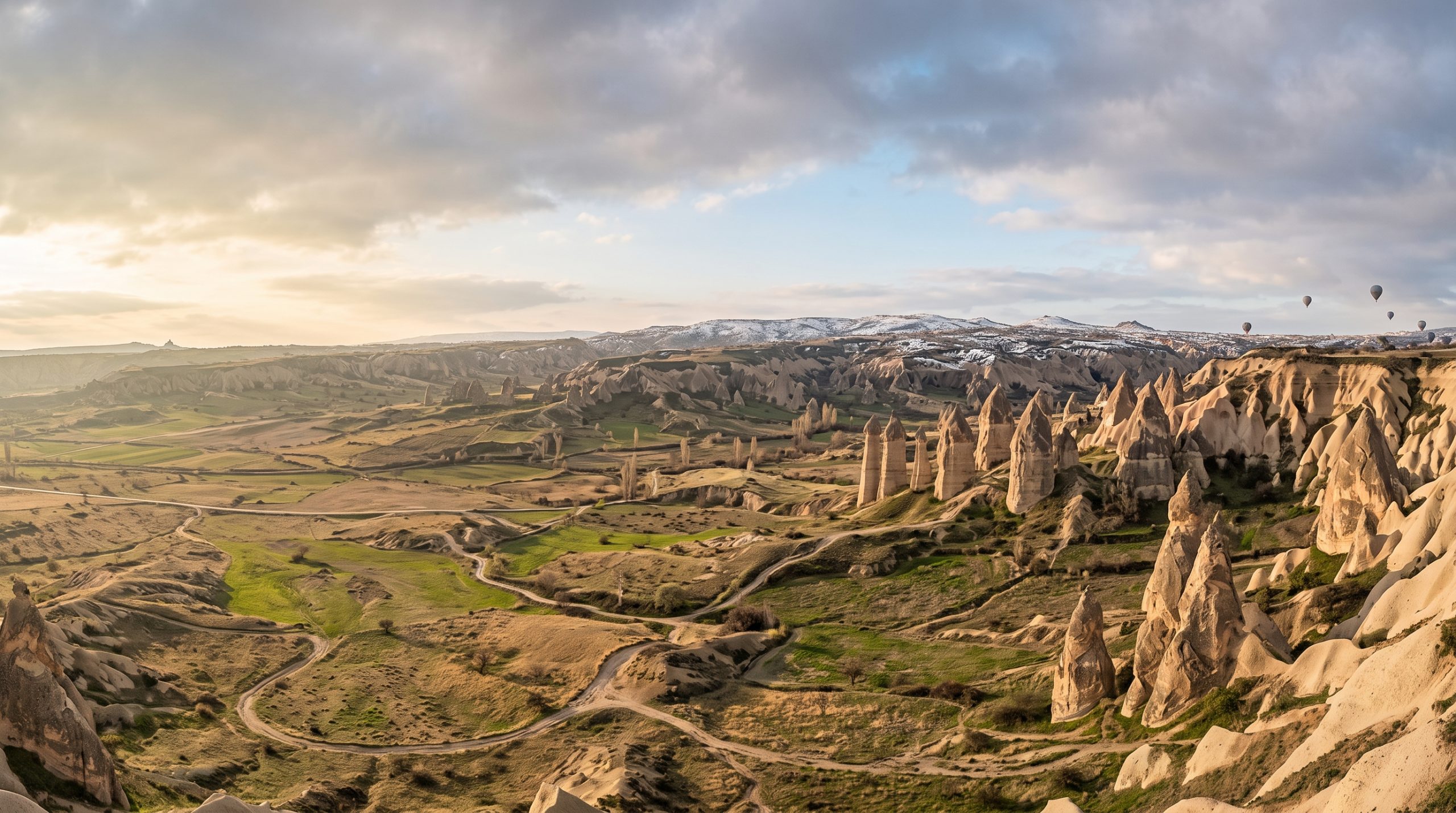
On June 14 the sun clears the ridge above Göreme at 5:16 in the morning. On January 5 it does not arrive until 8:00. Those two times, two hours and forty-four minutes apart, decide more about a Cappadocia elopement than any venue on your shortlist.
The other thing that decides it is a single daily launch. Balloons fly here once, at first light, and clearance is settled before dawn by aviation meteorologists rather than by any one operator, so every basket in the region is either up or waiting together. Build the morning around that and choosing a month stops being a matter of taste.
What follows is twelve months in the valleys with the numbers attached: temperature, rain, sunrise and sunset for the middle of each month, when the color arrives, when the crowds arrive, and the months we would move you out of.
The Cappadocia window that disappears first
Late September into the third week of October. Mornings are cool and settled, afternoons sit in shirtsleeves, balloon clearance is at its most dependable, and valley color lands in the second half of October. Mid-October gives you sunrise at 6:50 and sunset at 18:03, which is a workable day rather than a sprint.
Twelve months, and what each one does to a sunrise
Sunrise and sunset below are for the fifteenth of each month at Göreme. Türkiye stays on UTC+3 all year, so there is no clock change to shift your morning forward or back.
| Month | Conditions | Sunrise / sunset | Crowds | Our verdict |
|---|---|---|---|---|
| January | Coldest month, highs near 6°C (43°F), humidity at its annual peak around 72%, snow possible | 07:57 / 17:43 | Lowest of the year | Hold two mornings |
| February | Cold, often sharply clear between systems, snow still on the cards | 07:31 / 18:18 | Very quiet | Winter at its most graphic |
| March | Unsettled and windy; Ramazan Bayramı falls on March 20 to 22 in 2028 | 06:52 / 18:47 | Domestic surge over the holiday | We would push you to April |
| April | Wettest month of the year, about 63 mm across roughly 13 rainy days, highs near 18°C (64°F) | 06:04 / 19:17 | Building steadily | Green valleys, honest rain risk |
| May | Warm days, cold nights, the busiest month at the region’s open-air museums | 05:29 / 19:45 | Peak | Superb light, plan early |
| June | Hot, dry and long; earliest sunrise of the year on June 14 | 05:16 / 20:07 | High | Best evenings, hardest alarms |
| July | Hottest month, highs around 32°C (90°F), almost no rain | 05:29 / 20:05 | Peak | Dawn and dusk only |
| August | Driest month, roughly 4.7 mm over about 5 rainy days | 05:55 / 19:36 | Peak | Reliable flying, dead middays |
| September | Warm, dry and settled, nights cooling off from mid-month | 06:22 / 18:50 | Falling after the first week | Our first choice |
| October | Mild and clear, poplars and vineyards turning late in the month | 06:50 / 18:03 | Second-busiest of the year | The best color of the twelve |
| November | Cool and often overcast, winter museum hours begin | 07:23 / 17:28 | Low | Quiet, short warm hours |
| December | Shortest day of the year on December 22, at 9 hours 27 minutes | 07:51 / 17:20 | Low until New Year | Low sun all day long |
The windows that move: color, snow and the bayram calendar
Three things in Cappadocia arrive on their own schedule, and two of them move by a week or more from one year to the next.
Autumn color is the narrowest. It lives on the valley floors rather than the rock, in the poplar lines and the vineyard terraces below Çavuşin and along the Red Valley, and it usually holds through the second half of October. A warm September pushes it into the first days of November. A cold snap strips it in four days. If color is the reason you are coming, the third week of October is the date to aim at, with the understanding that you are aiming at a target that drifts.
Snow is a probability, never a booking. January and February are the two months where a white morning is realistically on the table, and even then most mornings in those months are simply cold and bare. We will happily plan a January elopement, and we plan it so the photographs work on dry rock, with snow treated as the version that arrives if it arrives.
The bayram calendar is the one nobody outside Türkiye sees coming. Ramazan Bayramı falls on March 20 to 22 in 2028 and March 9 to 11 in 2029; Kurban Bayramı runs May 27 to 30 in 2028. Both move roughly ten or eleven days earlier each year, and both fill Göreme and Ürgüp with domestic travelers. It is a good week to be in the region and a difficult week to have the Love Valley overlook to yourselves at eight in the morning.
March and July, and where we send couples instead
March is the month we most often talk people out of. It carries the wind of late winter without the graphic snow of January, the valley paths are soft underfoot after the thaw, and in 2028 and 2029 the Ramazan holiday lands squarely inside it. Mid-April onward gives you the same green with far better odds, and by the last week of April the mornings are workable without gloves.
July is the other one. Not because it fails, because it succeeds too narrowly: flying odds are excellent and rain is almost absent, but with highs around 32°C the middle of the day is unusable for anything except shade, and the valleys are at their busiest. September buys you the same reliability with air you want to stand in.
If your date is already fixed in one of those months, that is not a problem to solve so much as a shape to change. A July elopement here works beautifully as two separated blocks, ceremony at first light and dinner and portraits from 18:30 onward, with the four hottest hours spent somewhere cool with the door shut. A March date works when we weight it toward interiors, rock-cut rooms and high ridges rather than valley floors. Tell us the date you have and we will tell you honestly what that month gives, and which fortnight nearby would give you more.
What the light does between 5:16 and 8:00
Cappadocia is a low-sun landscape. Tuff rock is pale and slightly porous, and it takes warm light like a screen, which is why every frame you have seen from here was made within about ninety minutes of sunrise or sunset. What changes across the year is how long that window lasts and where it points.
In June and July the sun comes up hard and climbs fast. You get a genuine hour after 5:16, then the light flattens out until late afternoon, and the reward is a very long evening: sunset at 20:07 in mid-June, with usable color until nearly nine. Ceremonies go in the evening block. In December the sun never gets high at all. Sunrise at 7:51, sunset at 17:20, and in between a whole day of raking light across the chimneys, which is the single most underrated thing about a winter date here. The trade is a total of 9 hours 27 minutes of daylight at the solstice against 14 hours 52 minutes in late June.
The shoulder months split the difference in the most useful way. Mid-October gives you a dawn block, a soft middle, and a second warm hour from about 17:00, so a ceremony at 16:30 sits inside good light rather than chasing it. Our published elopement galleries and films will show you what those hours look like on the rock at each end of the year, which is a faster way to choose a month than any table.
The short windows are also why we send two people. On a Cappadocia morning the balloons are up for roughly an hour, once, and there is no second take. One person cannot shoot the vows and hold the wide film frame of the whole launch rising behind you at the same time, so a dedicated photographer and a dedicated filmmaker work the same minutes from different angles, and both of you get the moment rather than a compromise of it. The two shapes of coverage, and what each includes, are set out on our coverage and pricing page.
Gate times, soft paths and the drone hour
Access shifts twice a year. The Göreme Open-Air Museum runs summer hours from April to October, 08:30 to 19:00 with last entry at 18:00, and winter hours from November to March, 08:30 to 17:00 with last entry at 16:00. Read that against the sunset column above and one thing is obvious: the gate always closes before the good light. In December it closes twenty minutes ahead of sunset, in June more than an hour ahead. So we build ceremonies and portraits on open valley ground, terraces and rock-cut interiors we can hold at the right hour, and treat the museum as a daytime visit rather than the center of the day.
Valley footing is the other seasonal variable. The Red, Rose and Pigeon Valley paths run on soft volcanic dust that turns to clay after spring rain or a thaw, so between November and April we favor ridge tracks and the stone-cut sections, and we hold a firm-ground alternative for every soft one. Aerials work on a different clock again: drone flights here need registration with the civil aviation authority and authorization from the Nevşehir governor’s office, and they stay clear of the sky entirely while balloons are operating. We confirm both permissions in advance and schedule the drone work for after the last basket is down.
If you already have a month in mind, or two months and no way to choose between them, send us a message and we will tell you what that fortnight actually does in the valleys.
How we build a balloon-proof morning before you arrive
Weather planning here is not optimism, it is a document. Before you fly we have a timeline with a named primary location for each block and a named alternative chosen by wind direction and cloud base, not by convenience, plus a ceremony hour that can move by ninety minutes without unraveling anything else in the day.
The balloon morning gets its own logic. We put it on the first available morning of your stay rather than the last, so a morning that does not clear still leaves you options, and we ask for at least three nights in the region. Between November and March we ask for more. Because clearance is decided centrally before dawn, you know where you stand very early, and the alternative first-light plan is already written: a ridge above Çavuşin, a terrace with the chimneys behind it, or a rock-cut room with the door open to the weather.
Rain is the easiest of the three to work with, because interiors here are extraordinary and there are hundreds of them. Wind is the one that reshapes a day, and it does it by direction rather than strength, which is why the alternatives are chosen in pairs facing opposite ways. Our elopement planning fundamentals cover how the whole timeline gets assembled, and the regional destination guides go deeper on the ground itself.
Common questions
Will the balloons fly on our elopement morning?
Across the year, roughly two mornings in three get clearance. September and October are the strongest run; in midwinter it drops below half. We plan the balloon morning early in your stay so a grounded morning is not the end of it, and we design a version of the day that stands up entirely without them.
How many nights should we hold in Cappadocia?
Three nights from April to October, four or more from November to March. The extra nights are not padding, they are extra sunrises. Since the launch decision is made once a day before dawn, every additional morning in the region measurably improves your odds of standing under a sky full of balloons at first light.
Is January too cold to elope in Cappadocia?
It is cold, not unworkable. Highs sit near 6°C and mornings start below freezing, so we shoot in short deliberate blocks with a warm room minutes away and keep the outdoor ceremony tight. In exchange you get the latest sunrise of the year at 8:00, near-empty valleys, and light that stays low all day.
When does snow actually settle in Göreme?
January and February are the realistic months, with a chance either side of them. Snow that stays on the chimneys through sunrise is uncommon enough that we never build a day around it. We plan for bare rock, and if the ground goes white overnight we rewrite the morning on the spot.
How early will we be up in June?
Around 3:45. Sunrise on June 14 is 5:16 and the balloons inflate before that, so a first-light ceremony means a start in full dark. June pays it back at the other end: sunset at 20:07 gives you a second long block for dinner and portraits with no rush in it.
Do Turkish public holidays change the best date?
They change the crowds, not the light. Ramazan Bayramı is March 20 to 22 in 2028 and March 9 to 11 in 2029, Kurban Bayramı is May 27 to 30 in 2028, and both shift about eleven days earlier each year. We either avoid those weeks or move your hours earlier so the viewpoints are yours.
Can you fly a drone over the valleys for our film?
Where it is permitted, yes. Aerial work in Cappadocia requires registration with the civil aviation authority plus authorization from the Nevşehir governor’s office, and drones stay grounded while balloons are flying. We confirm the permission and the time window before we plan any part of the film around it.
Start with the month, then the morning
If you want one answer: the last week of September, with the third week of October a very close second. If your heart is set on snow, February. If you want the longest evening of the year, mid-June, and set the alarm for 3:45 without complaint.
Tell us the month you are circling, or the week you cannot move, and we will come back with what that period gives you in the valleys and the timeline we would build around it. From the first reply onward, the process stays in writing, at whatever hour suits your time zone, starting with a reply and a brochure within a day. Dates are currently open across the 2027–2029 seasons now, and planning begins once the contract and retainer are in place.
Check your date with us and we will start with the sunrise time and work outward from there.