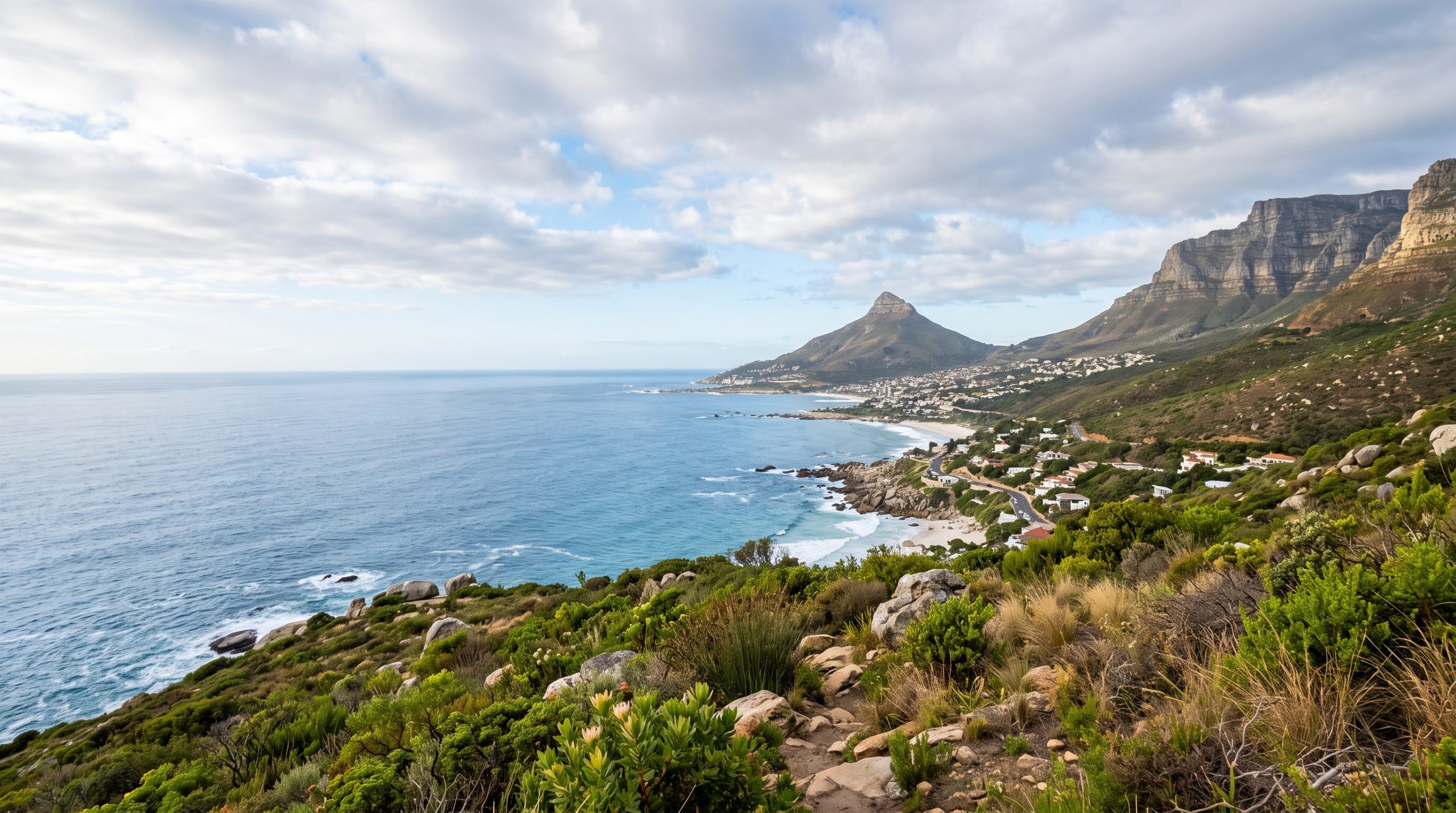
Stand on the Lion’s Head saddle at 6:45 on a mid-March morning and the city bowl is still in shadow while the Twelve Apostles are already lit down the Atlantic side. That split lasts about twenty minutes. It is the clearest reason we keep steering couples toward the back end of the Cape summer rather than the middle of it.
Cape Town runs on a southern calendar, and that catches out almost every American couple we plan for. December is high summer and high season at once. June is wet, green and close to empty. The wind keeps its own timetable, the whales and the wildflowers keep theirs, and none of it lines up with the months you grew up with.
What follows is the year as we actually build days from it. Sunrise and sunset for the fifteenth of every month, the rainfall behind the reputation, the natural windows narrow enough to move a date for, and what we do when the southeaster comes up anyway. If you are still at the stage of working out the shape of the whole thing, our guide to planning an elopement covers the fundamentals that sit underneath the calendar.
The month we would book if the date were ours
March. The heat of high summer has eased, the southeaster has lost its edge, and the January holiday crowds have gone home. On 15 March the sun rises at 6:45 and sets at 19:07, so you get a workable dawn and a long evening without a 4am alarm. Mid-February to mid-April all works.
Cape Town month by month, with the times we build from
Sunrise and sunset below are for the fifteenth of each month in South African Standard Time, which sits at UTC+2 for the whole year. South Africa does not run daylight saving, so a 19:53 sunset in December is exactly that, every December, and a timeline written in January still holds in July.
| Month | Conditions | Sunrise and sunset | Crowds | Our verdict |
|---|---|---|---|---|
| January | Hot and dry, 11.3 hours of sun a day | 05:50 to 20:00 | Highest of the year | Huge light, no elbow room |
| February | Driest month, 19 mm across 4 rainy days | 06:21 to 19:40 | Busy, easing late | Reliable, book far ahead |
| March | Warm, wind softening | 06:45 to 19:07 | Thinning fast | Our first choice |
| April | Mild, first fronts arrive | 07:08 to 18:25 | Quiet | Winelands at their best |
| May | Cool and green, rain building | 07:31 to 17:54 | Very quiet | Dark coast, early finish |
| June | Wettest, 126 mm across 13 rainy days | 07:49 to 17:44 | Emptiest | Whales arrive, day is short |
| July | Coolest at 17°C, cableway maintenance | 07:50 to 17:55 | Empty | False Bay and shelter |
| August | Drying out, Postberg opens on the 1st | 07:26 to 18:16 | Building | Flowers and whales together |
| September | Spring, changeable, green everywhere | 06:47 to 18:37 | Hermanus fills up | Best month after March |
| October | Warming, southeaster returning | 06:06 to 18:58 | Moderate | Strong all-rounder |
| November | Southeaster at its most insistent | 05:35 to 19:27 | Building | Fine light, plan for wind |
| December | Longest days, earliest sunrise on the 5th | 05:30 to 19:53 | Peak on every path | Brilliant and very busy |
Windows narrow enough to move a date for
Three things in the Cape year run on their own clock rather than ours. If one of them matters to you, it should set the month before anything else does.
Southern right whales, June to December
The whales come north from Antarctic water into Walker Bay and stay from June through December, with September and October the peak, when mothers and calves sit close inshore. Hermanus is roughly two hours east of Cape Town along the coast road, and the cliff path runs about 12 kilometers above the water, which means the animals are visible without a boat. The dates are stable from year to year. The crowd is not: the town’s whale festival lands in late September and fills the seafront for a weekend, so we work the early mornings either side of it.
Postberg wildflowers, 1 August to 30 September
SANParks opens the Postberg section of West Coast National Park for two months only, from 1 August to 30 September, and the flowers peak around mid-August to mid-September. Gates open at 09:00 with last entry at 16:30, which rules out both ends of the day and makes this the one Cape morning we plan around the middle hours instead of the edges. The blooms track the sun and stay shut under cloud, so the forecast matters more here than anywhere else on the peninsula. The park’s own advice is to come on a bright weekday, because weekend queues build at the gate.
The fortnight around the December solstice
The earliest sunrise of the year falls on 5 or 6 December, and the December solstice carries 4 hours and 32 minutes more daylight than the June one. That is an enormous working day. It is also the fortnight when every viewpoint on the peninsula is at its fullest, which is a trade rather than a problem, and one we solve with start times rather than with different locations.
If your date is already fixed in June or July
June is the wettest month, with 126 mm falling across about 13 rainy days and the sun up for under ten hours. July is the coolest at around 17°C. Neither of those numbers stops a good day, and we run winter dates every year, but they do change the shape of one.
If your dates can still move, September is the swap we suggest. Sunset shifts from 17:44 to 18:37, the whales are at their peak, Postberg is open, and the whole Overberg is green from the winter rain. That is nearly an hour of extra evening for no loss anywhere else.
If the dates cannot move, we build the day inward instead of outward. Ceremony in the middle hours when the light is at its most usable, coastal work on the False Bay side where the peninsula takes the edge off a northwesterly, drives kept under an hour, and the front used as weather rather than waited out. Winter here delivers a green, empty, high-contrast coast that summer never gives you. Tell us the week you have and we will tell you honestly what it can hold. Our destination guides go deeper on the regions around the city if you want to see what else is reachable in a winter day.
What the light does between the two solstices
The swing is bigger than most couples expect from a city at 34 degrees south. On 15 June the sun rises at 07:49 and sets at 17:44. On 15 December it rises at 05:30 and sets at 19:53. That is the difference between a day you can start after breakfast and a day that demands an alarm most people would not set voluntarily.
The angle matters more than the length. In June the sun never climbs high, so the warm light is generous and lasts, but the mountain throws its shadow across the city bowl early in the afternoon and the Atlantic seaboard loses the sun before the clock says it should. In December the sun is hard overhead from mid-morning until late afternoon, which is why we treat 9am to 5pm as travel and lunch time and put the real work at the two ends.
Winter is where having a photographer and filmmaker on the same team stops being a nicety. When the usable warm window at the coast is forty minutes long, two people working it at once cover ground that one person has to choose between: stills of the vows while the film records the sound of them, wide landscape frames while the close work continues. In February the same evening runs for hours and there is room to move slowly. You can see how both ends of the Cape year look in our published elopement galleries and films, which is a faster way to judge a month than any forecast. What each of our full-day experiences covers is set out on the pricing page.
What shuts in winter, and when it opens again
The Table Mountain Aerial Cableway closes once a year for maintenance in the second half of July. The 2027 shutdown ran from 28 July to 3 August and the 2028 one from 27 July to 9 August, so the safe assumption is a one to two week gap starting in the last week of July, with the reopening in the first half of August. The hiking routes stay open throughout, though the summit and lower station facilities close with the cars. We do not build a day that depends on the cableway in any month, because it also stands down in strong wind, but late July is the one stretch where the answer is fixed in advance.
West Coast National Park changes its general gate hours for the flower season, running 07:00 to 18:00 in August and staying open until 19:00 in September, while the Postberg section keeps its own shorter hours. Inside Table Mountain National Park, the fee-paying sites at Cape Point, Boulders, Silvermine, Tokai and Oudekraal each charge a daily conservation fee, and a Wild Card does not cover commercial photography or filming. Those permits are separate, they carry their own fees, and they go through the park’s permit office with real lead times attached. We handle the research and the applications as part of planning; the permit fees themselves sit with you.
How we build Cape Town around the southeaster
The southeaster, the wind Capetonians know as the Cape Doctor, blows from spring into late summer, roughly September through March, and is at its most insistent in November. In winter the pattern flips and the wind arrives from the northwest ahead of a cold front. Knowing which of those two you are dealing with is most of the planning, because they shelter opposite sides of the peninsula.
When the southeaster is up, moist air lifts off False Bay, climbs the eastern slopes and pours over the top as the tablecloth, which is beautiful from Bloubergstrand and useless if you are standing in it. On those days we move into the Clifton coves and the western side, which sit in the lee of Lion’s Head, or inland into the Winelands valleys where the wind arrives softened. When a northwesterly comes through in winter we do the reverse and cross to False Bay, working Simon’s Town, Boulders and the eastern slopes at Kirstenbosch.
So the plan is written before anyone gets on a plane. Two locations held for every hour of the day, chosen by wind direction rather than by preference. A ceremony hour that can move by ninety minutes without touching anything else in the timeline. Aerial work booked against a permit and a stated time window, confirmed before we design the film around it. None of that is improvisation on the morning. It is a document you have in your hands weeks before you fly.
If you have a month in mind and want to know what it actually gives you, Send Us a Message with the dates and we will come back with the light times and a shape for the day.
Common questions
Is December too crowded for a Cape Town elopement?
December has the longest days of the year, with the earliest sunrise on 5 or 6 December and sunset near 19:53 by mid-month. It is also the busiest month on every path in the peninsula. We solve that with hours rather than with lesser locations. A 5am start puts you well ahead of the first arrivals, and the 8pm light is still entirely yours.
How much does the southeaster really affect the day?
It blows from roughly September through March and peaks in November, but it rarely holds all day at full strength. We set the ceremony hour at the calmer end, hold a location in the lee of Lion’s Head, and keep the Winelands valleys as the inland option. In practice the wind changes where we stand, not whether the day happens.
Can we build whale season into the elopement day?
Yes, and we would rather give it a morning than squeeze it between two coastal locations. Southern right whales are in Walker Bay from June to December, peaking in September and October when mothers and calves come close to shore. Hermanus sits about two hours east of Cape Town, so it works best as its own chapter of a two-day or longer plan.
When exactly do the West Coast wildflowers open?
SANParks opens Postberg in West Coast National Park from 1 August to 30 September each year, with the peak around mid-August to mid-September. Gates open at 09:00 and last entry is 16:30. The flowers open toward sunlight and stay closed under heavy cloud, so we build these mornings around a bright forecast and treat the timing as a two-week window rather than a fixed date.
Will the Table Mountain cableway be running when we need it?
It shuts once a year for maintenance in the second half of July and reopens in early to mid August. In 2028 that ran from 27 July to 9 August. The hiking routes stay open throughout. Outside that window it operates subject to wind, which is why we always plan a summit hour that works whether the cars are turning or not.
We can only travel in July. What does that day look like?
Short, green and quiet. Mid-July sunrise is 07:50 and sunset 17:55, so there is no punishing alarm and the warm light sits at both ends of a compact day. We work the False Bay side and the Overberg, keep every drive under an hour, and treat the passing fronts as light rather than as something to sit out.
Choosing a month, then shaping the day around it
If your dates are open, book March and we will build outward from a 6:45 sunrise. If they are fixed, tell us the week and we will tell you what that week in Cape Town genuinely offers, and where in the Western Cape it lands best. We are taking dates for 2027, 2028 and 2029.
The planning stays in writing from the first message onward, at whatever hour suits your time zone. Send us your dates and you will have a reply and our first brochure back within 24 hours, then a tailored proposal, and planning begins once the contract is signed and a 30% retainer is paid. Check Your Date and we will tell you what the light is doing that week.