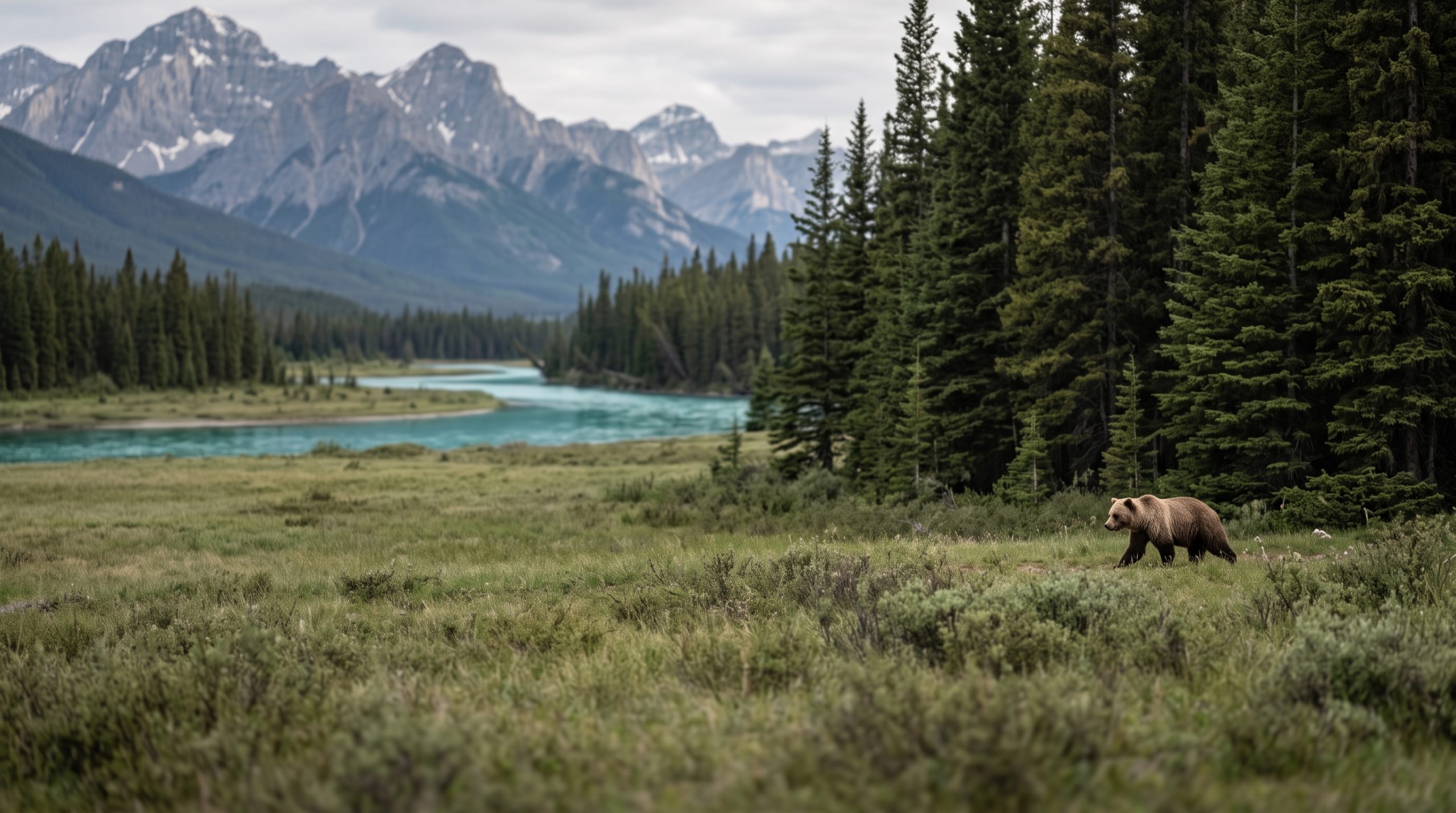
The thing that surprises couples on the Lake Minnewanka shoreline in August is not the bears. It is the sign at the trailhead. From July 10 to September 15 every year, parties on the restricted trails there have to travel as a group of four or more, with no more than three metres between any two people. The two of you holding hands is not a group of four.
Buffaloberries are the reason. Minnewanka sits on the edge of one of three grizzly core areas in Banff National Park, ground where female grizzlies raise their cubs, and the berry crop that ripens through late summer is the food that matters most to them. The group size rule exists so that bears hear people coming from a long way off, and so they are not displaced from prime food at the point in the year they need it most.
None of this makes Banff hard to elope in. It makes it a park with a published calendar, which is far easier to plan around than a place that keeps its rules verbal. Below is what actually applies to a ceremony here, where the map will mislead you, and how we build a day so that a bear on the shoreline at six in the morning changes the location and not the morning.
Four rules that decide where you can stand
Four things govern a Banff ceremony: a minimum group of four on restricted trails from July 10 to September 15, one hundred metres of distance from any bear, a cap of twenty participants on ceremonies inside the national park, and no drone flying without a Parks Canada permit. Everything else is planning.
July 10 to September 15, the window everyone wants
The Lake Minnewanka seasonal trail restriction runs July 10 to September 15, the same dates every year. On the trails it covers, hiking parties must number four people or more, and the maximum distance between any two people is three metres. Parks Canada gives two reasons for it: public safety, and keeping grizzlies from being pushed off a critical food source at the one time of year they cannot afford to lose it.
Read that as a planner and something useful falls out. A couple on their own does not meet the requirement. A couple with a celebrant and two of us does, at five people, moving as one loose knot rather than strung out along the path. The team you have booked is part of how you reach the ground you actually want.
The dates are the awkward part, because they sit almost exactly over the weeks most couples can travel. Late July on the Minnewanka arm is warm, green and long in the light, and it is also peak berry season on the slopes above the water. We would rather say that at the planning stage than on the morning.
Minnewanka’s window is fixed and published. Elsewhere in the park, area restrictions come and go through the season as the crop ripens and animals move, and they appear in the park bulletins rather than on any map you have open in a tab. That is why our Rockies timelines get read twice: once when we build them, and once at first light on the day itself. If you are still choosing between mountain locations, our destination elopement guides are the place to start narrowing it down.
One hundred metres, and how the hour bends around it
Parks Canada’s distances are simple. Stay at least 100 metres from bears, wolves and cougars. Stay at least 30 metres from elk, deer, moose and bighorn sheep. On an open lakeshore, 100 metres is a polite sideways adjustment. On a narrow path through willow, 100 metres is the entire path.
Elk are the animal you are far more likely to meet, particularly in and around the townsite, and 30 metres feels much closer than it sounds when you are trying to hold a ceremony line on a meadow edge with a bull grazing at the far end. The answer is never to fit a longer lens and creep in. It is to have somewhere else to be.
So every Banff ceremony hour we plan carries a named second location, scouted, with its own approach and its own parking or drop-off. Not a vague sense of somewhere down the road. A specific meadow or shoreline we have stood on, with a drive we have actually driven, so that the decision at six in the morning takes ninety seconds rather than twenty minutes of guessing.
No aerials over the park, and what the film is instead
Under the Canada National Parks Aircraft Access Regulations, launching, landing or operating a drone inside Banff National Park requires a Parks Canada permit, and the superintendent issues those for a short list of purposes such as resource management and public safety. Private filming is not on that list. There is no aerial of you over the Minnewanka shoreline, and it is worth knowing that before a film gets planned around one.
What we make instead is a ground film. Long lens compression down the lake, movement through larch and scree, the sound of wind and water carried properly rather than added later. You can see how our mountain work resolves in our published stories and films. Where aerials genuinely matter to a couple, we plan them for legal ground outside the park boundary and tell you which part of the route can carry them before anything is booked.
Moraine Lake: the morning you cannot drive away from
Moraine Lake Road is closed to personal vehicles year-round. Every route planner still draws it as a road, and it is one, for Parks Canada shuttles, Roam public transit, licensed commercial operators and visitors with an accessibility hang tag. A rental car is not on that list, and arriving at 3am does not change it. This is the single most common piece of outdated planning we untangle for couples looking at the Rockies.
The shuttles run from the Lake Louise Park and Ride at the ski resort. Reservations open in the spring at 8am Mountain Time, and forty per cent of the seats for the whole operating season are released in that first window. The remaining sixty per cent come out on a rolling basis, again at 8am Mountain Time, two days before each departure date. A ticket is valid only for the date printed on it, and whichever lake you pick when booking is the lake your first shuttle takes you to.
Here is what that means for bear planning. At Minnewanka, or down on the Bow Valley floor, an area restriction or an animal on the trail means we drive a quarter of an hour and carry on with the plan. At Moraine you arrived on a bus. Your plan B is the next bus, and your celebrant is on the same timetable as every other person at the lakeshore that morning.
That is not a reason to leave Moraine out. It is a reason to decide early what Moraine is for. We usually build it as a first-light visit or a portrait stop with shuttle times written into the timeline, and put the vows somewhere we can reach and leave by vehicle. Lake Louise is easier in one way, since the lakeshore and the community stay open all year, though parking there is limited and paid at the lakeshore through shuttle season, which is why the Park and Ride still ends up in most of our Lake Louise mornings. And the Lake Louise shoreline at ten in the morning in July is a queue under flat light, which is exactly how it photographs.
Arches, quiet music and the food you were going to carry in
Parks Canada’s conditions for a wedding ceremony in Banff National Park are short and specific. A maximum of twenty participants. Temporary props kept small and limited to a wedding arch, a registration table and a chair. No tents or temporary shelters. Quiet music, with acoustic instruments such as guitar, flute or harp given as the examples. No release of live animals. A valid park entry pass for every participant, and a thorough clean up of the site immediately after the ceremony.
Those read like conservation housekeeping, and they are, but several of them are wildlife management in different clothes. A site with one chair and no shelter can be cleared in four minutes when the ground needs to be given back. A twenty person cap keeps a party small enough to move as one group under a trail restriction. Nothing gets staked, tied or left.
Food is the part couples underestimate. Anything carrying a scent, from the charcuterie board to the cake to the cold bottle in the bag, is an attractant on ground where animals are feeding, and the whole management approach in these parks rests on attractants staying under human control. Bring it sealed, keep it packed, open it back at the vehicle or in town, and leave the site cleaner than you found it. Ceremony flowers travel out with us in the same load as the gear. The licence side of the day, and the order things happen in, sits in our guide to planning an elopement.
What we change when the berries are ripe
Planning, permit research and the timeline are part of every experience we run, and in Banff that work takes a particular shape. We read the park bulletins when we build the plan and again on the morning of. We keep the ceremony hour clear of a shuttle departure rather than adjacent to it. We hold a second location with its own approach. We put the walk-in on ground where four people can stay within three metres of each other without anyone scrambling in a dress.
Team shape matters more here than it does in a place you can drive across in ten minutes. On the Expedition, a photographer and a filmmaker work the day together, which means one can go ahead and look at the meadow while the other stays with you and keeps the morning unhurried. Two sets of gear, two vehicles where the ground needs them, professional audio on the vows, and a colleague in reserve back at base. On a long Rockies day that redundancy is the difference between adapting and abandoning.
Guest numbers do not change what we charge. They change permits, access and how long it takes to move twelve people along a trail, which is a timeline question rather than a pricing one, and the shapes of coverage we work in are set out on our pricing page.
If you already know the week you can travel, that is enough to begin with. Send Us a Message with your dates and the kind of ground you want under your feet, and we will tell you what the Banff calendar is doing in that window.
Common questions
Do we need a group of four for a Banff elopement in August?
On the restricted trails at Lake Minnewanka, yes, between July 10 and September 15: four people minimum, and no more than three metres between any two of you. A couple, a celebrant and two of us makes five, so most of our days meet the requirement without anyone extra coming along.
Can we get married at Moraine Lake if we cannot drive there?
Moraine Lake Road is closed to personal vehicles year-round. You reach the lake by Parks Canada shuttle from the Lake Louise Park and Ride, by Roam transit, or with a licensed commercial operator. Reservations open in spring, and the rest of the seats release at 8am Mountain Time two days ahead.
Can you fly a drone at our Banff ceremony?
Not inside the park. Launching, landing or operating a drone in Banff National Park needs a Parks Canada permit, issued for a narrow set of purposes that does not include private filming. Where aerials matter to you, we plan them for legal ground outside the park boundary instead.
What happens if a bear is at our ceremony spot that morning?
We move, and the hour carries on somewhere else. Parks Canada asks for 100 metres of distance from bears, so the location changes rather than the plan. Every Banff day we build carries a second site we have already stood on, with its own approach and its own drive.
How many people can we bring to a ceremony in the national park?
Twenty participants is the maximum for a ceremony in Banff National Park, with props limited to a small arch, a registration table and a chair, and no tents or shelters. If your list runs longer than twenty, tell us early and we will look at venue ground with you.
Can we have champagne and a picnic at the ceremony site?
Keep it sealed and take it out with you. Food scent is the one attractant entirely within your control, and Parks Canada requires the site cleared thoroughly straight after the ceremony. We usually put the toast at the vehicle or back in town, which has the side benefit of warming everybody up.
Which months sit outside the group-of-four window?
The Lake Minnewanka restriction runs July 10 to September 15, so June and October dates fall outside it. Bears are on the landscape either side of those dates and other areas can pick up restrictions at short notice, so we plan a June morning with the same second location in reserve.
Tell us the week you have
Banff rewards couples who plan around the animals rather than hope to dodge them. Give us your travel window and we will map the ground: which trails carry a group requirement on your dates, where the second location sits, what the shuttle release window means for a Moraine morning. All of it runs in writing, so the plan is in front of you rather than in your memory, and the first reply with our brochure reaches you within 24 hours. We are booking 2027, 2028 and 2029. Start Your Story.