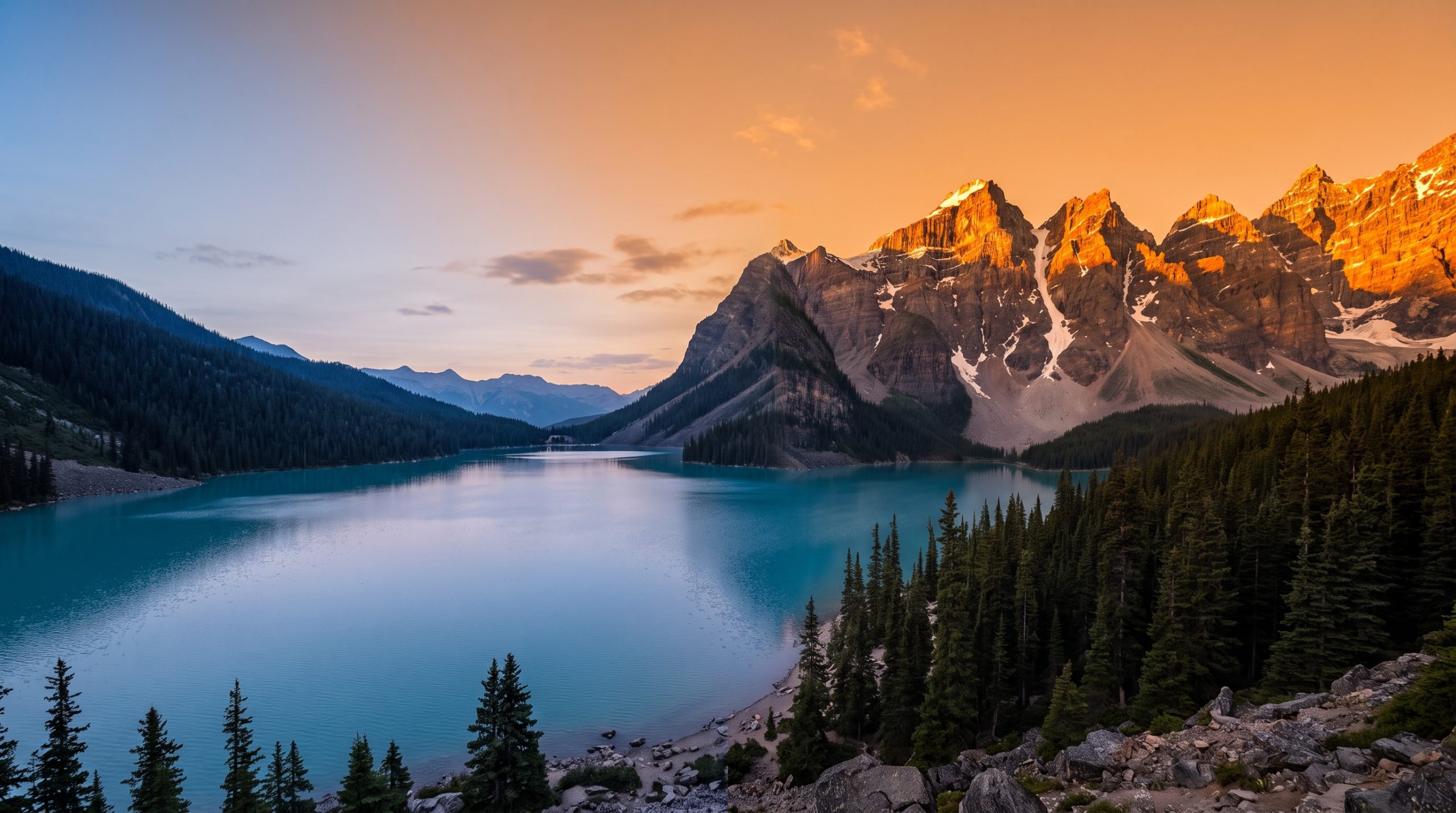
At 4:40 a.m. in the last week of June, the Bow Valley is not dark. The sky behind Cascade Mountain has already moved from charcoal to grey to a thin copper line, and the marsh at Vermilion Lakes is glass. Official sunrise in Banff is 5:27 a.m. By then you have been out for the better part of an hour, in a down jacket over your dress, and the best frames of the morning are already made.
Banff hands you close to eighteen hours of workable light in late June and under eight at the December solstice. That one difference reshapes everything else: where you sleep, when you eat, if the ceremony sits before or after the first coaches arrive, and how many places are honestly reachable between waking and dark.
What follows is a real day, hour by hour, built on this valley’s light rather than a template. It also covers the parts a mapping app will not tell you. The lake road you are not allowed to drive. The parking lot that starts charging at 3 a.m. The 17 km of parkway closed to your car for eight weeks of early summer.
Sunrise 5:27 a.m., dark at 10:49 p.m.
In late June, Banff’s sun rises at 5:27 a.m. and sets at 10:02 p.m., with usable twilight from 4:40 a.m. until 10:49 p.m. Call it eighteen hours. A full day here opens before dawn on the valley floor, goes deliberately quiet through the flat middle hours, and finishes on high ground long after most dinners have ended.
A late-June day, hour by hour
This is the shape we build most often for a June or July date: based in the Banff townsite, ceremony in the morning, second half of the day higher up. Times are Mountain Time, taken from the light.
| Time | Where you are | Why that hour |
|---|---|---|
| 3:45 a.m. | Room in Banff, dressing | Layers on, coffee in a flask. Dressing before the drive, never after |
| 4:30 a.m. | Vermilion Lakes, minutes west of town | Civil twilight is already working. Still water, no wind, empty pull-offs |
| 5:27 a.m. | Same shoreline | Official sunrise. Light reaches Rundle’s face long before it reaches you, and that gap is the picture |
| 6:20 a.m. | Two Jack Lake and the Minnewanka loop | A second, wholly different lake while the day-use areas are empty |
| 7:30 a.m. | Back in town, breakfast | Warm up, dry socks, change layers. A full morning is already done |
| 9:00 a.m. | Ceremony location | Vows, rings and signing, before mid-morning traffic reaches the lakeshores |
| 11:30 a.m. | Off the clock | Overhead light, full lots, wind on the water. This is when you sleep |
| 4:00 p.m. | The Lake Louise corridor, or north onto the Icefields Parkway | The second half starts with a transfer, not a rush |
| 8:30 p.m. | High ground, long light | Golden hour runs long here, and improves the closer you get to ten |
| 10:02 p.m. | Sunset | The peaks go pink well after you would have quit in most countries |
| 10:49 p.m. | End of civil twilight | Last usable frames, then stars. Bed at midnight |
The midday gap is deliberate, and it is the part couples push back on. Between roughly 11 a.m. and 4 p.m. the light comes straight down, every day-use lot is full, and the lakes have traded stillness for chop. Better to hand you four hours back than to spend them making pictures that look like midday.
What the two ends of a mountain day look like once they are finished is easier to see than to describe, and the galleries and films we publish are gathered in our stories and films. Highlights reach you five days after your date, and the full gallery or film follows within three weeks.
Where the map lies on the road to the lakes
Three of the most photographed places in this park are governed by rules no mapping app knows about, and each one has cost couples a morning.
Moraine Lake Road is closed to your car
Since 1 June 2023, personal vehicles have not been permitted on Moraine Lake Road. Access is by Parks Canada shuttle, Roam public transit, a commercial operator licensed for that road, or an accessibility exemption. The Parks Canada shuttles run from the Park and Ride at Lake Louise Ski Resort between about 8 a.m. and 6 p.m., early June to early October, so the first bus of the day leaves hours after sunrise in midsummer. Sunrise at Moraine means a licensed sunrise shuttle, booked as its own item in the plan. Reservations open in spring, a further block of seats goes online at 8 a.m. two days before travel, and there are no walk-ons. The road opens to vehicles in early June once snow clearing allows and closes again in mid-October, so a mid-May or late-October date cannot include the lake.
The Bow Valley Parkway has a gate in early summer
Highway 1A between Banff and Lake Louise is the slow, generous way through that corridor, and for part of the year its eastern end belongs to cyclists. In 2028 the 17 km between the Fireside day-use area and Johnston Canyon is closed to public vehicles from 30 April to 25 June, then again from 1 September to 6 October. The western 31 km, Johnston Canyon out to the Whitehorn Road junction near Lake Louise, stays open throughout, and the cycling program runs through 2030. So a June morning leaves Banff on the Trans-Canada and joins the parkway at the Castle Junction interchange.
The Lake Louise lakeshore lot charges before dawn
Paid parking at Upper Lake Louise runs from 3 a.m. to 7 p.m. across the summer season, roughly mid-May to mid-October, charged per vehicle per day rather than by the hour. That 3 a.m. start tells you everything about when the lot fills. An average of 1,200 vehicles a day parked there in 2023, and two to three thousand a day were turned away once it reached capacity. So we plan on the shuttle or on transit and treat a lakeshore spot as a bonus. Allow around forty Canadian dollars for the day if you do drive in, since the rate has been raised more than once.
The airport drive is a travel day, not a shooting morning
Calgary International to Banff Avenue is roughly 144 km on Highway 1, signed at about an hour and forty minutes. Add the rental desk, the gate queue in July and one stop for water, and the honest figure from wheels down to hotel key is closer to three hours. We schedule nothing on an arrival day.
The same day in late September, and in December
Light behaves so differently across a Banff year that the June solstice carries 8 hours and 42 minutes more daylight than the December one. These are the numbers we plan from.
| Date | Sunrise | Sunset | What it does to the day |
|---|---|---|---|
| Late June | 5:27 a.m. | 10:02 p.m. | Two enormous ends, four empty hours between them |
| Mid-July | 5:44 a.m. | 9:52 p.m. | Almost identical to June, warmer water, busier roads |
| Mid-August | 6:29 a.m. | 9:04 p.m. | A humane alarm and a proper evening |
| Mid-September | 7:17 a.m. | 7:57 p.m. | One continuous day, no forced break. Our usual recommendation |
| Early October | 7:49 a.m. | 7:11 p.m. | Gold on the higher trails, last weeks of the Moraine road window |
| December solstice | 8:44 a.m. | 4:37 p.m. | 7 hours 53 minutes of low, soft light. Two or three close locations, not five |
Mid-September is the month we suggest most often for a single day. A 7:17 a.m. sunrise and a 7:57 p.m. sunset hold together without sending you back to bed, the larches on the higher trails turn late in the month, and everything is still open to vehicles. December is a good alternative rather than a compromise: the sun sits low enough that the light never hardens, and you can wake at seven and still be first at the water. Tell us which of those days you want, and if the week you are holding fits the other one better, we will say so. Our destination guides answer the same question for other places on your list.
Basing yourselves for a 4 a.m. alarm
Where you sleep decides how early you wake, and in a valley this narrow the difference is large.
| Base | Getting there | What it suits |
|---|---|---|
| Banff townsite | 144 km and an hour and forty minutes from Calgary International | Vermilion Lakes, Two Jack, Lake Minnewanka and Tunnel Mountain are all short pre-dawn drives. Food at odd hours |
| Lake Louise | Continue west on the Trans-Canada past Banff | Puts you beside the Park and Ride for the Moraine and lakeshore shuttles. Quiet evenings, fewer places open late |
| Canmore | About an hour and twenty minutes from Calgary International | Outside the park, more accommodation choice, an extra dark drive west each morning |
We usually place the day itself on your second or third night here, once jet lag is behind you and you have seen the water in person. If you are earlier in the process than timings, our notes on how to plan an elopement set out the order to make decisions in.
Aerials, ceremony permission and who signs what
Drone use is prohibited in Canada’s national parks, and inside the Town of Banff drones are not permitted at all, partly because of the heliports operating nearby. Flying an unmanned aircraft in Banff National Park needs written authorization from the superintendent. So we plan a Banff film with both feet on the ground: stabilized movement through trees, long lenses across water, and on an Expedition, proper audio on your vows. Drone footage is part of what we do where it is legal and appropriate, and this park is not one of those places. If a film that opens from the air matters to you, say so early and we will be straight about where it is possible.
Permission for the ceremony depends on a boundary. Inside the Town of Banff, the town books its own venues and locations, and those can be reserved up to 18 months ahead. Outside the townsite, which includes places people assume are in town such as the Sulphur Mountain gondola, Tunnel Mountain and the Norquay lookout, you are with Parks Canada, and a wedding ceremony registration goes to them. Parks Canada treats commercial film production as a separate stream and takes no applications for commercial film projects in Banff, Kootenay or Yoho between 1 June and 30 September, which is worth knowing: no crew gets special access here in high summer.
Every business, guide and vendor working in this park holds a Parks Canada business licence, and each contractor holds their own. That one is ours to carry, not yours to chase. Permit and registration fees are yours, the research and the applications are ours. The Adventure covers one full day with a dedicated photographer or filmmaker from $4,900 and The Expedition puts both on the ground together from $7,900, with everything each includes set out on our pricing page.
How we build slack into the day
A Banff day fails on transitions rather than on locations, so the timeline we write has air in it. The ceremony hour never sits next to a shuttle departure or a gate time. Every location carries a named alternative about fifteen minutes away that works in wind or low cloud, chosen in advance rather than in the moment. Start times run earlier than the light strictly requires, because the pull-off you want may already have three cars in it.
On an Expedition, the photographer and filmmaker often run two vehicles, which sounds like an administrative detail until 5 a.m. One of us can leave Vermilion Lakes early, reach the ceremony location and confirm the ground and the light, while the other stays with you for the last of the sunrise. Two full sets of bodies, lenses and batteries are on site from the first frame, which matters when the nearest camera shop is back in Calgary. There are eight of us, so every date on the calendar has a colleague in reserve.
Tell us the month you are holding and the two or three things you want this day to contain, and we will send back an hour-by-hour version of the above built on your date and your sunrise. Send Us a Message.
Common questions
How early do we have to wake up for a Banff sunrise in June?
An alarm between 3:30 and 4 a.m. Usable twilight begins around 4:40 a.m. and sunrise is at 5:27 a.m., and with a valley-floor location minutes from the townsite that puts you in position by 4:30 with light to spare. Dressing happens before the drive.
Can we drive ourselves to Moraine Lake for sunrise?
No. Personal vehicles have not been allowed on Moraine Lake Road since 1 June 2023. Parks Canada shuttles start around 8 a.m., well after sunrise from June through September, so a sunrise there means a licensed commercial sunrise shuttle booked in advance. There are no walk-on seats.
Is the Bow Valley Parkway open if we elope in June?
Partly. In 2028 the eastern 17 km between the Fireside day-use area and Johnston Canyon is closed to public vehicles from 30 April to 25 June, and again from 1 September to 6 October. The western 31 km toward Lake Louise stays open, reached from the Trans-Canada.
Does everyone in the car need a Parks Canada pass?
Yes, if you stop anywhere inside the park, which includes every viewpoint and lakeshore. You can buy daily admission or an annual Discovery Pass, and a family or group pass covers up to seven people arriving in a single vehicle. Buying before you reach the gate saves time in summer.
Can we have drone footage over Lake Louise or Moraine Lake?
No. Drone use is prohibited in Canada’s national parks and not permitted inside the Town of Banff either, so a Banff film is built entirely from the ground. If aerials are central to how you imagine your film, tell us in your first message and we will be honest about which destinations allow them.
How many days should we allow in Banff for a one-day elopement?
Four nights is the shape that works. Fly in two days ahead so the arrival day carries any delays, use the middle day to see the water and collect anything you have booked, hold the elopement day itself, and keep the day after loose in case we move you for weather.
Is there enough light for a December elopement in Banff?
Yes, though the day is a different shape. At the December solstice sunrise is 8:44 a.m., sunset is 4:37 p.m., and you get 7 hours 53 minutes of daylight that never climbs high enough to go harsh. We plan two or three locations close together rather than a tour of the valley.
Choose the month, then we write the clock
Banff rewards specifics. Tell us the week you are looking at, say if you want the two-ended June day with a long sleep in the middle or the single continuous day mid-September gives you, and tell us what you want to be standing on for your vows. Every inquiry gets a reply and an initial brochure within 24 hours, then a tailored proposal, and planning begins once the contract is signed and the 30% retainer is paid. All of it happens in writing, on your own hours, which is the only sane way to work across time zones. We are booking 2027, 2028 and 2029. Check Your Date.