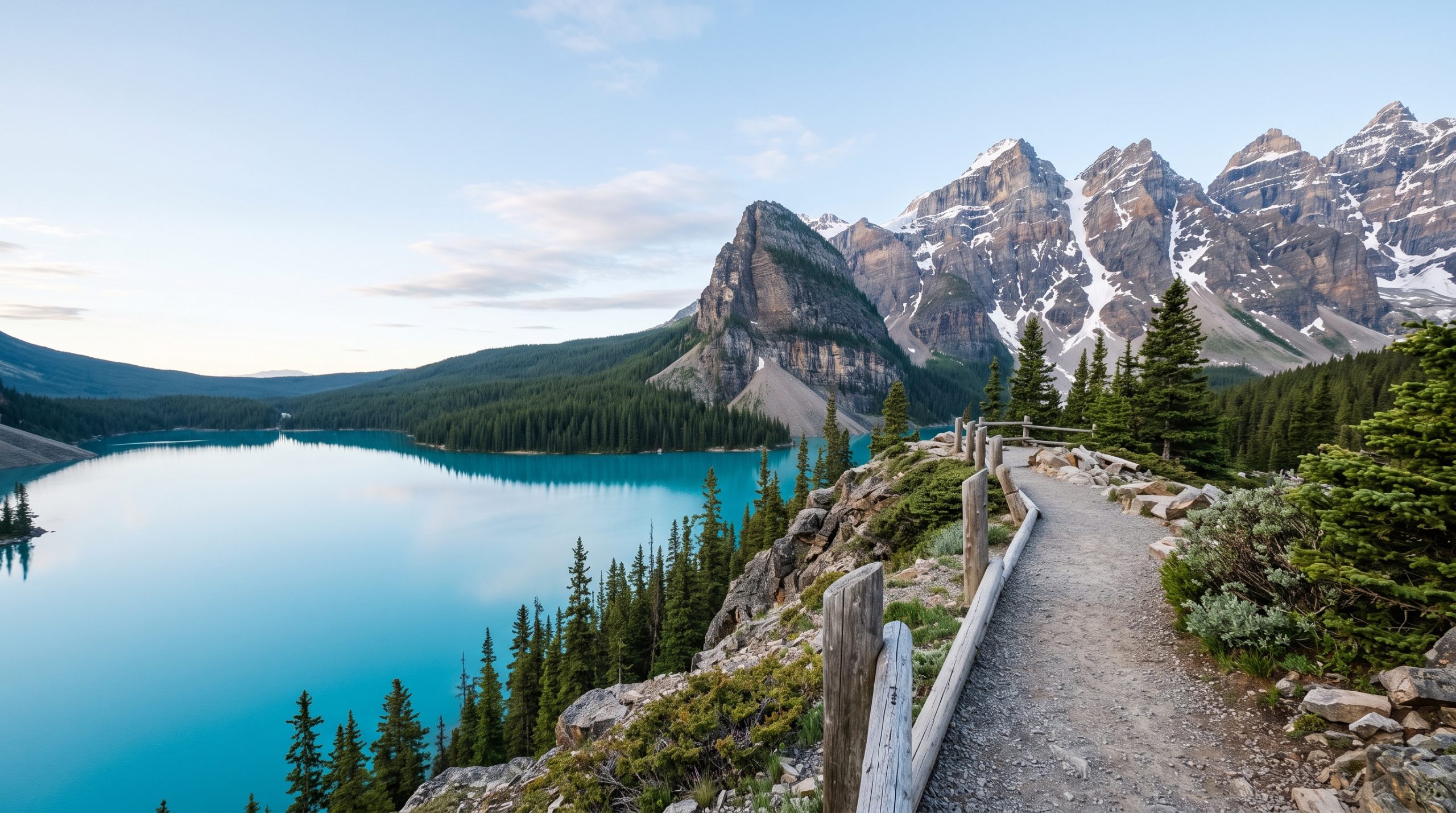
Two offices decide how a Banff elopement actually goes, and neither of them is the one couples worry about first. Alberta Vital Statistics governs the marriage. Parks Canada governs the ground you stand on. Once you have those two separated in your head, the rest of the paperwork is a morning’s work and a folder of documents.
The good news comes early. Alberta asks less of a visiting couple than almost any jurisdiction we work in. The province states it flatly: no residency or citizenship requirements, no period of time that has to pass between arriving in Alberta and being issued a licence, no blood tests, and a ceremony may take place the same day the licence is issued. A couple can land in Calgary on a Tuesday and be legally married beside Two Jack Lake on Wednesday morning.
The park side is where the real constraints live, and they are not the ones people expect. No amplification. No tents. Every person present needs a valid entry pass. Drones are prohibited in Canada’s national parks, full stop. Everything below comes from the offices that issue it, and it is written in the order you will actually need it.
The two offices that govern a Banff elopement
Two offices govern a Banff elopement. Alberta Vital Statistics issues the marriage licence through a registry agent, for a $40 government fee, valid three months, with no residency requirement and no waiting period. Parks Canada governs the ceremony site itself and asks you to register the wedding and meet its published conditions on park ground.
Alberta asks less of you than you are expecting
On the difficulty scale we use internally, Alberta is straightforward. Not fiddly, not out of reach, genuinely straightforward. There is no notice period to serve, no document to have sworn, no consulate step, and no residency clock. Both of you walk into a registry agent office together with the right things in hand, and you walk out with the licence.
What that means practically is that the legal side of the day is not the part that needs six months of runway. The parts that need runway are the officiant, the two witnesses, the location, and the hour you choose to stand there. Those are planning problems rather than legal ones, and they are the ones we spend our time on. If you are still at the stage of working out the shape of the whole thing, our guide to planning an elopement from scratch covers the sequencing before you get anywhere near a registry counter.
The document chain, in the order you collect it
Every figure in this section is in Canadian dollars. Work through these in sequence and nothing doubles back on itself.
- Confirm you are both free to marry. You cannot be currently married, to each other or to anyone else. If either of you has been divorced, Alberta wants the final document, such as a Certificate of Divorce or a Decree Absolute, and the registry agent wants the document itself rather than a copy of it.
- Sort your identification. Both of you need acceptable government photo identification. For a visiting couple the passport already in your bag does the job.
- Collect your parents’ details. The application asks for the full names and birth places of both sets of parents, including a parent’s maiden name. This is the item couples reliably do not have on them, and it is worth a text message home a week early.
- Choose your officiant. Alberta recognises two kinds of ceremony and both are equally legal. A civil ceremony is performed by a marriage commissioner appointed by the Alberta Government. A religious ceremony is performed by a clergy member registered with Vital Statistics.
- Line up two witnesses. In a civil ceremony each of you declares two legislated statements in front of your intended spouse, both witnesses and the marriage commissioner. Two people have to be physically standing there.
- Register the ceremony with Parks Canada. For a wedding on park ground outside the Town of Banff, Parks Canada publishes a wedding ceremony registration form along with the conditions your ceremony has to meet.
- Collect the marriage licence. Both of you attend an Alberta registry agent office in person. The government fee is $40 and each agent adds its own service fee, so the total at the counter varies from office to office. There is no waiting time and the licence is issued to you there.
- Hand the full document to your officiant before the ceremony. What you receive is a two-part document. The top part is the Registration of Marriage and the bottom part is the marriage licence, and the whole thing goes to whoever is performing your marriage.
- Order the certificate afterwards. Your officiant submits the Registration of Marriage portion for registration. Once the marriage is registered you can order a marriage certificate through any Alberta registry agent for a $20 government fee per document, plus that agent’s service fee.
Two things stand out about that list. Only one item in it carries an expiry date, and for couples arriving with English-language documents, nothing in it asks for an apostille or a sworn translation of anything.
We are photographers and filmmakers, not lawyers. Rules change and individual circumstances differ, so confirm the detail with the relevant registry office or your own consulate before you book flights.
Turn the Banff ceremony hour into a permit-and-licence calendar
The real minimum in Alberta is startling. There is no minimum notice at all. A licence can be issued and a ceremony performed on the same day, which means the legal floor for marrying in Banff is measured in hours rather than months.
The comfortable minimum is different, and it is set by two clocks running in opposite directions. The licence is valid for three months from the date it is issued, so it cannot be collected any earlier than three months out. Meanwhile, if you want a friend or an unregistered clergy person to marry you, Alberta asks for the temporary marriage commissioner application at least three months in advance. Those two facts squeeze the whole legal process into the final quarter before the date, with one exception that has to be started well before it.
What we work to is simpler. We fix the date, the region and the ceremony hour six to twelve months out, because that is what governs light, access and availability. The licence step sits in the last week or two, deliberately. Collecting it early is the one way to make an easy process difficult.
| Step | Governing office | Timing that actually binds you |
|---|---|---|
| Marriage licence | Alberta Vital Statistics, issued through a registry agent | Valid three months from issue, no minimum notice, ceremony can be the same day |
| Marriage commissioner or registered clergy | Alberta Vital Statistics | Confirmed as soon as the date is fixed |
| Temporary appointment so a friend can marry you | Alberta Vital Statistics | Application submitted at least three months in advance |
| Ceremony site outside the townsite | Parks Canada | Wedding ceremony registration completed before you travel |
| Ceremony site inside the townsite | Town of Banff | Larger events need an application no less than 90 days ahead |
| Park entry for everyone attending | Parks Canada | A day pass runs until 4 p.m. the day after you buy it |
| Marriage certificate | Alberta Vital Statistics | Ordered after the marriage has been registered |
What the park asks of a wedding standing on its ground
Parks Canada’s wedding conditions are short, specific, and much more interesting than a permit fee. They shape the day more than anything on the Alberta side does.
The park is a public place. Exclusive rights to an area are not permitted and areas cannot be cordoned off, which means nobody is clearing Vermilion Lakes for you and nobody should be trying. All participants must possess a valid national park entry pass. The daily adult rate for the Rocky Mountain parks currently sits at around $12, youth 17 and under enter free, and a day pass runs until 4 p.m. the day after purchase, which is why a pass bought the afternoon before covers a sunrise ceremony without anyone queuing at a gate at 5am.
Tents and temporary shelters are not permitted. Weddings are not permitted in campgrounds. Releasing live animals, doves and butterflies included, is out. Nothing gets tied to the trees, deadwood and bark and branches are not fuel, and a thorough clean up of the site is required immediately afterwards. On vehicles, Parks Canada asks you to keep traffic to a minimum, carpool or use public or group transportation, and park in designated lots only. Parking at the popular destinations fills quickly, and there are live parking and traffic updates worth checking on the morning itself.
Then the rule that changes the sound of the whole ceremony: public address and amplification systems are not permitted. Parks Canada suggests quiet music instead, naming a guitar, a flute or a harp. So your vows carry exactly as far as the wind lets them, which is often about two metres beside Bow Falls. On an Expedition day the filmmaker runs professional audio for the vows where conditions allow, and that is not a luxury in a place with no PA and a valley wind. It is the difference between having your words and remembering that you said some.
Drones are prohibited in Canada’s national parks. There is no aerial permit to chase, so we build the film out of ground-level movement, long lenses and elevation you walk to. If aerials genuinely matter to you, tell us at the inquiry stage and we will talk about what is possible outside the park boundary. You can see how mountain ground reads on film and in a gallery across our published elopement stories, which is a more useful answer than any description we could write here.
One more thing about the park’s own advice, because it is the single most useful sentence Parks Canada publishes for couples. It tells you to choose a less popular location, or a time earlier or later in the day, to avoid congestion. That is the park itself telling you to go at dawn. We have been arguing the same point for years and it is pleasant to have it in writing from the landlord.
The small things that catch people at the counter
None of these are hard. They are simply the details that turn a fifteen minute errand into a second trip.
- Do not fold the licence. The Registration of Marriage portion becomes the permanent legal record and is archived, so the document has to stay in good condition and unfolded. It travels flat, in something rigid, not in a back pocket.
- Do not laminate anything. Altering or laminating a Vital Statistics document makes it invalid. People do this with the best intentions, usually to protect it on a mountain.
- Both of you have to be at the counter. The licence is not something one person collects while the other picks up the flowers.
- The $40 is not the total. That is the government fee. Registry agents each set their own service fee on top, so ask your chosen agent for the all-in number rather than budgeting for forty.
- You cannot interpret for each other. If either of you needs an interpreter or translator, Alberta places the responsibility on the couple to provide one, and the two people applying are not allowed to fill that role for each other.
- The three-month window runs from issue, not from application. Collect the licence too early and it expires before the date, and you start again with a new application and a new fee.
- An Alberta licence only works in Alberta. That matters if your trip crosses into Yoho or Kootenay, which are minutes away over the British Columbia boundary and governed by a different province.
- The townsite boundary is not where people assume. Several well known spots sit outside the Town of Banff even though they feel like Banff, Sulphur Mountain among them, and that changes which office answers your question.
There is a vendor-side layer too, and it is worth knowing it exists even though it never lands on your desk. Parks Canada requires a business licence for every business, company, guide or vendor operating in Banff National Park, and each contractor and sub-contractor needs their own. Parks Canada and the Town of Banff issue those separately depending on where you are standing. Parks Canada also publishes a seasonal restriction worth flagging to anyone bringing a production crew: Banff, Kootenay and Yoho do not accept applications for commercial film projects between June 1 and September 30, which is a rule about film productions rather than about a couple exchanging vows, and one more reason the licensing side of any mountain film starts months out rather than weeks.
Treat the quoted fees and processing windows as the version used to build this timeline. Re-check the current amount and deadline with the issuing office before you lock in flights or appointments for banff elopement permits.
Sign at home and keep the Rockies for the vows
Plenty of couples sign at a courthouse at home and then hold the ceremony itself on a ridge above the Bow Valley, and in Alberta that is a genuine preference rather than a workaround, because the legal route here is easy enough that nobody is forced into it. Couples choose it because their families want to be in the room for the signing, or because they would rather the mountain morning belong entirely to the two of them with no document in it.
What changes: no registry agent, no $40, no three-month clock, no officiant requirement and no need for two witnesses. You write the ceremony you want and there is no legislated wording anywhere in it.
What does not change: everything else. Parks Canada’s conditions are about the gathering on the ground, so the entry passes, the no-amplification rule, the clean up and the parking guidance all still apply. And the day itself is identical. We have never once been able to tell, watching it back, which couples were signing something and which were not. If you are weighing the two routes, our destination elopement guides are a good place to see how the shape of a day changes from region to region. Tell us which version you actually want and we will build the timeline around it. Check Your Date and say what you are picturing.
Common questions
Do we need a permit to elope in Banff National Park?
For a ceremony on park ground outside the Town of Banff, Parks Canada publishes a wedding ceremony registration form and a set of conditions the ceremony has to meet. Larger gatherings move onto a heavier special event licence process. Inside the townsite, the Town of Banff is the office that answers instead.
How long is an Alberta marriage licence valid for?
Three months from the date it is issued, and it is only valid for a marriage that takes place in Alberta. There is no waiting time and the ceremony can happen the same day. Most couples we work with collect it in the week before the date.
Can we get married in Banff the same week we fly in?
Yes. Alberta has no residency or citizenship requirements, no period that has to pass between arriving and being issued a licence, and no blood tests. The parts that need lead time are your officiant and the Parks Canada registration, not the licence itself.
Do our two witnesses have to be people we bring with us?
Two people have to be physically present, because the legislated declarations are made in front of your intended spouse, both witnesses and the marriage commissioner. Couples travelling alone bring friends, ask their commissioner what they can arrange, or work it through with us during planning. Raise it in your first message rather than on the morning.
Can you fly a drone at our Banff elopement?
Not in the park. Parks Canada states that the use of an unmanned air vehicle, also known as a drone, is prohibited in Canada’s national parks. We build the film around ground-level movement and elevation you can walk to. If aerials matter a lot to you, say so early and we will look at what is possible outside the park boundary.
Does everyone at the ceremony need a park pass?
Yes. Parks Canada requires all wedding participants to hold a valid national park entry pass. The daily adult rate for the Rocky Mountain parks currently sits at around $12, youth 17 and under are free, and a day pass runs until 4 p.m. the day after you buy it, so one bought the afternoon before covers a sunrise ceremony.
How do we get our marriage certificate once we are home?
Your officiant submits the Registration of Marriage portion of your licence for registration. Once the marriage is registered you order the certificate through any Alberta registry agent for a $20 government fee per document, plus that agent’s service fee. It is not something handed to you at the ceremony.
Can a friend marry us in Alberta?
Only if Alberta Vital Statistics appoints them a temporary marriage commissioner, and that application should be submitted at least three months in advance. A clergy person who is not registered to perform marriages in Alberta can seek the same temporary appointment to perform a civil ceremony.
Where our job starts, and where yours does
We are not lawyers and we do not file your paperwork. What we do is everything around it. We hold the date against officiant availability, build the timeline around the light rather than around the office hours, choose ceremony ground that suits the number of people you are bringing and the parking that exists, research the permits and tell you exactly which office to write to, and carry a weather alternative for every location on the plan. On an Expedition day there are two of us on the ground from the start, a photographer and a filmmaker, which quietly solves a surprising number of small problems on a mountain at 5am. Coverage and what each experience includes is set out on our pricing page.
Everything with us happens in writing, which suits a subject like this one, because paperwork questions deserve an answer you can re-read rather than one you half remember. Send us the date you are circling and the version of the morning you keep picturing, and we will come back with the shape of it, including which parts of the legal chain sit where. Dates are currently open across 2027, 2028 and 2029. Tell Us Your Story.