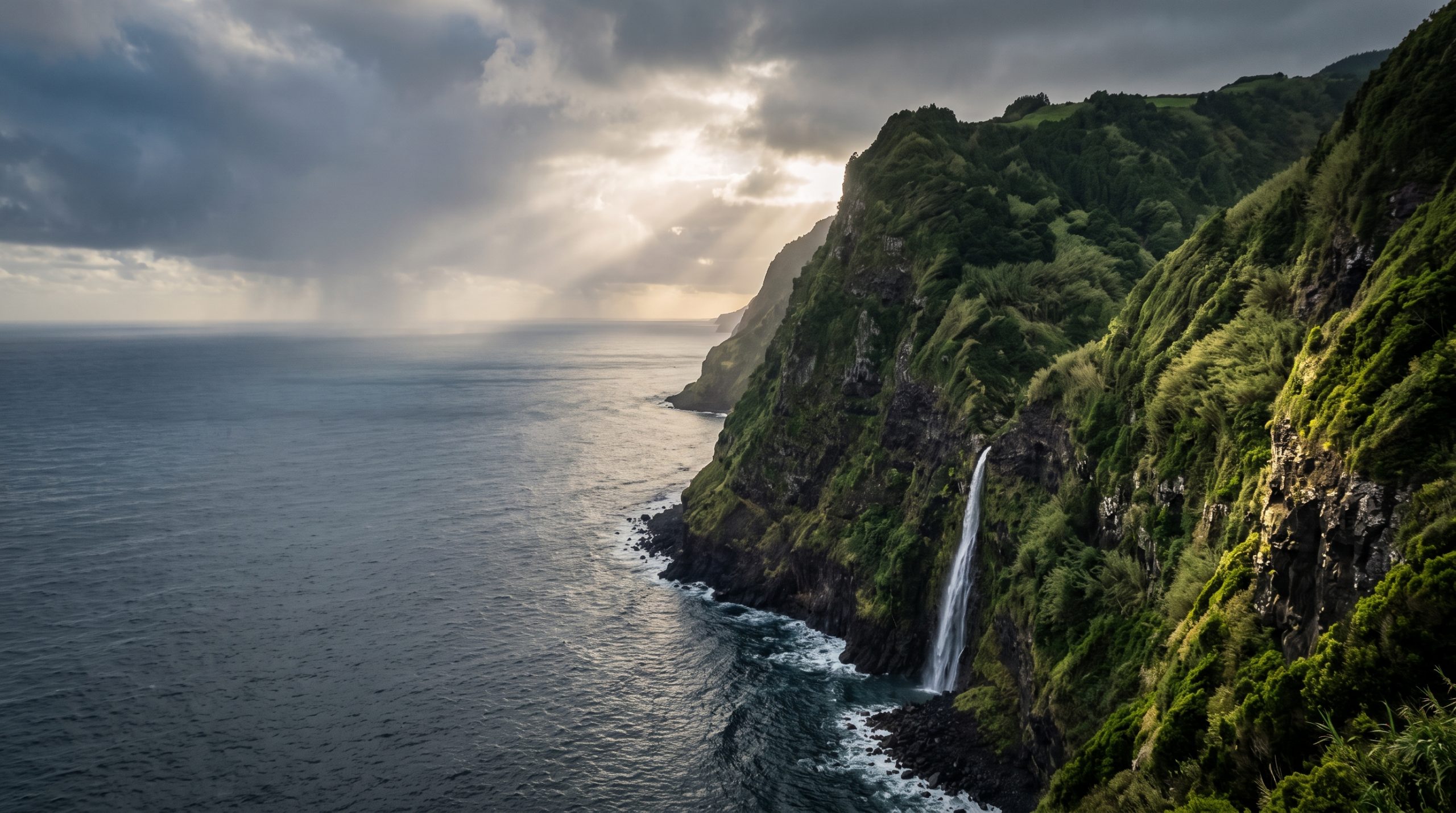
The earliest sunrise of the year in Ponta Delgada falls in mid-June, at 6:18 in the morning. The latest sunset arrives a couple of weeks after it, at 9:10 at night. Between those two numbers sits a day carrying close to fifteen hours of workable light, five hours and fourteen minutes more than the shortest day in December, and that gap is the first thing we plan around when a couple writes to us about a film in the Azores.
What neither number tells you is when the light is usable inside the Sete Cidades caldera. The rim is high enough to catch cloud and hold onto it. On a good morning Lagoa Verde reads green against Lagoa Azul and the whole crater opens out below the viewpoint at Grota do Inferno, which is a climb of barely a kilometer from the road. On another morning you are standing in the cloud looking at a hydrangea hedge an arm’s length away. Both of those mornings can produce a film. Only one of them can be booked in advance, so we plan for both.
We are eight people, four photographers and four filmmakers, and São Miguel is one of the islands where we most often send two of us. This page covers what that costs, what the day actually looks like from a 5:40 start until dinner at ten, and which euros get paid on the island rather than to us.
What an Azores elopement film costs to book
An Azores elopement film starts at $4,900 for The Adventure: one full day with a dedicated filmmaker, plus location design, a timeline built around real light and real drive times, permit research and weather alternatives. Team travel to São Miguel is included. Highlights reach you in five days and the finished film in three weeks.
From the crater rim at first light to the west coast at 9pm
A June day on São Miguel hands you two separate hours of good light with a long flat middle in between. We treat them as two different films and use the middle to move, eat and change.
We meet at 5:40, before there is anything to look at. The drive west and the walk up above Sete Cidades take the dark with them, and what you get for it is roughly forty minutes of light filling the caldera before the sun clears the eastern rim and flattens the whole scene. Visitor guides tell people to be at the viewpoint before nine. That advice is generous. In July there is a queue on the platform well before half past eight, and a queue is not something you can work around with a dress and a tripod. We are usually walking back down as the first vans pull in.
The signing tends to sit mid-morning, and the reason is administrative rather than photographic. The civil process runs through a Conservatória do Registo Civil, and the state’s own fee explains the shape of the morning: €120 for the marriage process at the registry office, €200 when it is celebrated away from the office or outside normal working hours. Registrars keep office hours and office hours have no opinion about light. So we put the legal part where the registry can actually be, and we put the words you have written for each other somewhere else entirely.
Late morning belongs to Lagoa do Fogo, 575 meters up, sitting inside its own crater and covering around 1,360 hectares. Parking on the rim is small and it fills, and in high summer a shuttle serves the viewpoints instead of private cars. That is a reason to be there at eight rather than eleven, or a reason to save the whole crater for a morning when Sete Cidades is closed in and Fogo is not.
Then the island goes quiet for us for three or four hours. Lunch somewhere with a roof, a change of clothes, the tea rows above Gorreana if the sky is doing something interesting, the hot water at Furnas if it is not. Every drive on São Miguel takes longer than the map suggests, because the roads climb and turn and there is always a tractor. We build that into the timeline rather than pretending it away.
The second light belongs to the west end of the island, which faces the right way for the sun going down into open water. Mosteiros and the coast around it give you black lava, white surf and a horizon with nothing on it. In late June that light does not finish until after nine, which means dinner at ten and a film that carries two completely different color palettes inside the same day.
Four dates on the calendar do most of the arguing about when to come.
| Point in the year | What the sun does in Ponta Delgada | What that does to the day |
|---|---|---|
| Mid-June | Sunrise at 6:18 am, the earliest of the year | Pre-dawn start, long flat middle, two strong light windows |
| Late June | Sunset at 9:10 pm, the latest of the year | Vows can sit late in the afternoon and dinner runs to ten |
| Late October | Sunrise at 7:58 am, the latest of the whole year, just before the clocks go back | First light without a night alarm, and a calmer single-arc day |
| Early December | Sunset at 5:25 pm, the earliest of the year | One continuous low-light day, finished before evening |
When the caldera is full of cloud at 6am
This is the question that keeps couples off these islands, and the straight answer is that cloud on the high rims is normal rather than unlucky. IPMA’s 1991 to 2020 normals put the driest and warmest months at July through September, and the wettest from October to February. Rainfall is not even across the archipelago either. Santa Maria stays under 800 mm a year, São Miguel sits above 900 mm, and Terceira reaches 1,000 mm.
What we do about it is unglamorous and it works. Cloud here usually sits high, which means sea level is often clear when the rim is not. Every Azores timeline we build carries a low plan alongside the high one: the lava coast in the west, the laurel valleys in the east, a lane walled in by hydrangeas, the tea rows above Gorreana. Both plans are written before you get on a plane, with drive times attached to each. We watch the forecast through the week beforehand, we decide the night before, and we decide again at 5am with the couple, in writing, so nobody is guessing.
If your date is one fixed day in February and it has to be the crater, tell us that in the first email and we will be honest about what February usually gives us and what the alternatives look like that week. If your dates are flexible by even 48 hours, we build the flexibility into the plan and pick the better morning. And if you want the surest version of all, an Odyssey spreads photography and film across two to seven days, which turns weather from a risk into a choice about which day to use.
Wind, water and two cameras on one crater rim
Wind is a sound problem here long before it is a picture problem. It comes off the Atlantic, climbs the outside of a caldera wall and arrives at the rim with nothing left to break it. Vows spoken up there sound wonderful to the two of you and, recorded badly, sound like a hairdryer for the rest of your lives.
This is where photography, film and planning from one team stops being a slogan and starts being the reason the morning works. On The Expedition, our filmmaker carries professional audio for the vows, so the microphones go on before the walk up, not after somebody notices the noise. The filmmaker picks a pocket ten meters down the inside of the rim where the wall kills the breeze, and the photographer already knows to work from the upwind side so your hair moves toward the lens rather than across your face. Neither of those decisions costs anybody anything when the two people involved work for the same team and planned the hour together. Both become a negotiation in front of you when a photographer and a separately hired videographer meet for the first time in a car park at 5:40 in the morning.
There is also the arithmetic of that forty-minute window. A photographer wants stillness at the end of a movement. A filmmaker wants the movement itself. Handled by one team, you walk the ridge once and both cameras get what they need from the same walk. Handled by two vendors who have never worked together, you walk it three times, and on a one kilometer climb with light that is changing by the minute, three walks is the entire morning.
Aerials over the twin lakes are the frame everybody pictures before they arrive, and they are included where they are legal, safe and appropriate. In the Azores that means working inside Portugal’s national drone rules, respecting the additional protections over sensitive island landscapes, and knowing that filming requests in the region now run through the state’s Filmar em Portugal service on the ePortugal platform. We confirm airspace and authorization first, then plan the film around what is genuinely available, which is a very different thing from arriving with a drone and hoping.
Because there are eight of us, there is always a second camera on the ground and a colleague in reserve. If you want to see how that looks finished, the stills and the films from the same days sit together in our published elopement stories, including Atlantic mornings that started under cloud.
Send us the week you are considering and the shape of day you have in mind, and we will tell you what the light does in that week before you commit to anything. Check Your Date
What travels with us, and what arrives after
Every experience, on every island, carries the same working parts:
- Destination and location design for the island, or islands, that suit the day you actually want.
- Planning and a custom timeline built around light, tide, opening hours and honest drive times.
- Permit research and logistics guidance, including which locations need written authorization and who issues it.
- Weather alternatives and a backup plan attached to every block of the day.
- Drone footage where it is legal, safe and appropriate.
- Professional audio for vows and other meaningful moments on The Expedition, where conditions allow.
- Team travel worldwide: flights, accommodation and ordinary travel for the assigned team, with no European or long-haul distinction.
- Highlights delivered in 5 days, and the full gallery or film in 3 weeks.
Guest count does not change what we charge. Twelve people on a rim road changes access, permits, transport and the timeline, and all four of those are planning problems rather than invoice lines.
Where coverage starts, and the euros paid on the island
There are two ways into a single day and one way into a longer trip. The Adventure is one full day with one dedicated photographer or one dedicated filmmaker, at the figure named near the top of this page. The Expedition, from $7,900, puts a dedicated photographer and a dedicated filmmaker on the same day, working together, and adds professional audio. The Odyssey runs two to seven days across one or several islands as a custom proposal, which is more practical in the Azores than most people expect: the ferry from Horta on Faial across to Madalena on Pico takes thirty minutes and runs every day of the year. Current figures for all three live on our coverage and pricing page.
Team travel is included in the Azores exactly as it is everywhere else we work. Getting our team to Ponta Delgada or Horta is our cost, not a line on your proposal. What you pay on the ground is the island’s own set of costs, and by the standards of premium destinations they are small.
| Paid on the island | What it currently runs |
|---|---|
| Tourist tax on São Miguel | €2 per night, capped at three nights, across Ponta Delgada, Ribeira Grande, Lagoa, Vila Franca do Campo, Povoação and Nordeste |
| Civil marriage process | €120 at the registry office, €200 celebrated away from it or outside normal hours |
| Permit and landowner fees | Set by the authority, venue or landowner; the research and the guidance are ours |
| Your inter-island travel | Atlânticoline ferry tickets or inter-island flights, depending on which islands you want |
| Hospitality and vendors | Accommodation, celebrant, florals, hair and makeup, dinner, activities |
| Unusual transport | Private boats, helicopters, 4×4 charters and mountain guides, where a location needs one |
How an Azores film enquiry moves from email to hold
- You send the inquiry form with your month, your islands if you have picked them, and the shape of day you are imagining.
- We reply within 24 hours with our initial brochure and first questions about light, access and travel.
- We build a tailored proposal around your date: coverage, locations, the timeline logic and the permits involved.
- You sign the contract and pay a 30% retainer, which is the point the date becomes yours.
- Planning begins in earnest, and the remaining payment schedule is set out in the proposal.
- We shoot the day, then highlights land in 5 days and the full gallery or film in 3 weeks.
We are currently taking Azores elopement bookings for 2027 through 2029. If you are earlier than that and still deciding between countries, our guide to planning an elopement covers the fundamentals worth settling before you fix on a destination.
Couples who get the most out of these islands
The Azores reward a specific kind of morning. The couples who leave with the strongest work are the ones who are honestly happy to be on a rim road at six, comfortable walking a kilometer on wet basalt in decent shoes, and relaxed about a plan that can change over breakfast. Green, water and weather is what these islands are good at. If what you picture is dry heat and hard shadow on rock, that is a different part of the world, and our destination elopement guides will point you at it.
If a pre-dawn start is not your idea of a good morning, say so in your first email. Late October gives you a 7:58 sunrise and a day that begins in daylight and finishes with a long soft afternoon rather than a sharp window at dawn. If you want the driest, warmest stretch, that is July through September. If you want two islands instead of one, the ferry timetable rather than the sun will set the rhythm of the trip and we will build it that way. We would much rather rearrange the day around how you like to travel than hand you a template with a 5am alarm buried in it.
Common questions
Is a film-only day cheaper than photo and film together?
Yes. The Adventure covers one full day with one dedicated professional, and you choose whether that person is a photographer or a filmmaker. The Expedition puts both on the day at the higher of the two figures above. There is no half-day option on either.
What happens if Sete Cidades is in cloud on our morning?
We move to the low plan that was written alongside the high one. Cloud on São Miguel usually sits above sea level, so the lava coast, the laurel valleys and the hydrangea lanes are often clear when the rim is not. We decide the night before and again at 5am, in writing.
Do you charge extra because the Azores are a long flight for your team?
No. Team travel is included worldwide, which means flights, accommodation and ordinary travel for the assigned team. There is no European or long-haul distinction in our coverage, so a São Miguel day costs what the same day costs anywhere else.
Can we legally marry in the Azores, or is it easier to sign at home?
Both work, and plenty of couples do the paperwork at home and hold a ceremony with a celebrant on the island. The civil route runs through a Conservatória do Registo Civil and carries a state fee of €120 at the office, or €200 celebrated elsewhere or outside normal hours. Your proposal sets out the path for whichever you choose.
Can you fly a drone over the crater lakes?
Aerials are included where they are legal, safe and appropriate. In the Azores that means Portugal’s national drone rules, the extra protections over sensitive island landscapes, and filming requests routed through the state’s Filmar em Portugal service. We confirm the airspace and any authorization before the film is planned around it.
Does the price change if we bring twelve guests?
No. What changes is access, permits, transport and the timeline, because a rim viewpoint at sunrise absorbs two people more easily than fourteen. We plan the day around the group you are bringing, and the coverage figure stays where it is.
How far ahead do we need to hold an Azores date?
We are currently taking Azores elopement bookings for 2027 through 2029. Holding a date early mostly buys planning room: permit research, landowner permissions and inter-island logistics all go better with months rather than weeks behind them.
Can we film on two islands in one trip?
Yes, and the Azores are unusually good for it. The Horta to Madalena ferry crosses the channel in thirty minutes daily all year, Faial to São Jorge takes about two hours, and inter-island flights cover the longer hops. Two or more islands is Odyssey territory, quoted as a custom proposal.
Writing to us about an Azores date
Everything on our side happens in writing. You send the form with your month, the islands you are drawn to and the rough shape of the day. We reply inside 24 hours with an initial brochure, and the proposal that follows is a document you can read twice at your own kitchen table before anything is decided.
Tell us the week you are looking at and we will tell you what the sun does that week on São Miguel, where the cloud tends to sit, and what your 6:20 in the morning could look like. Tell Us Your Story