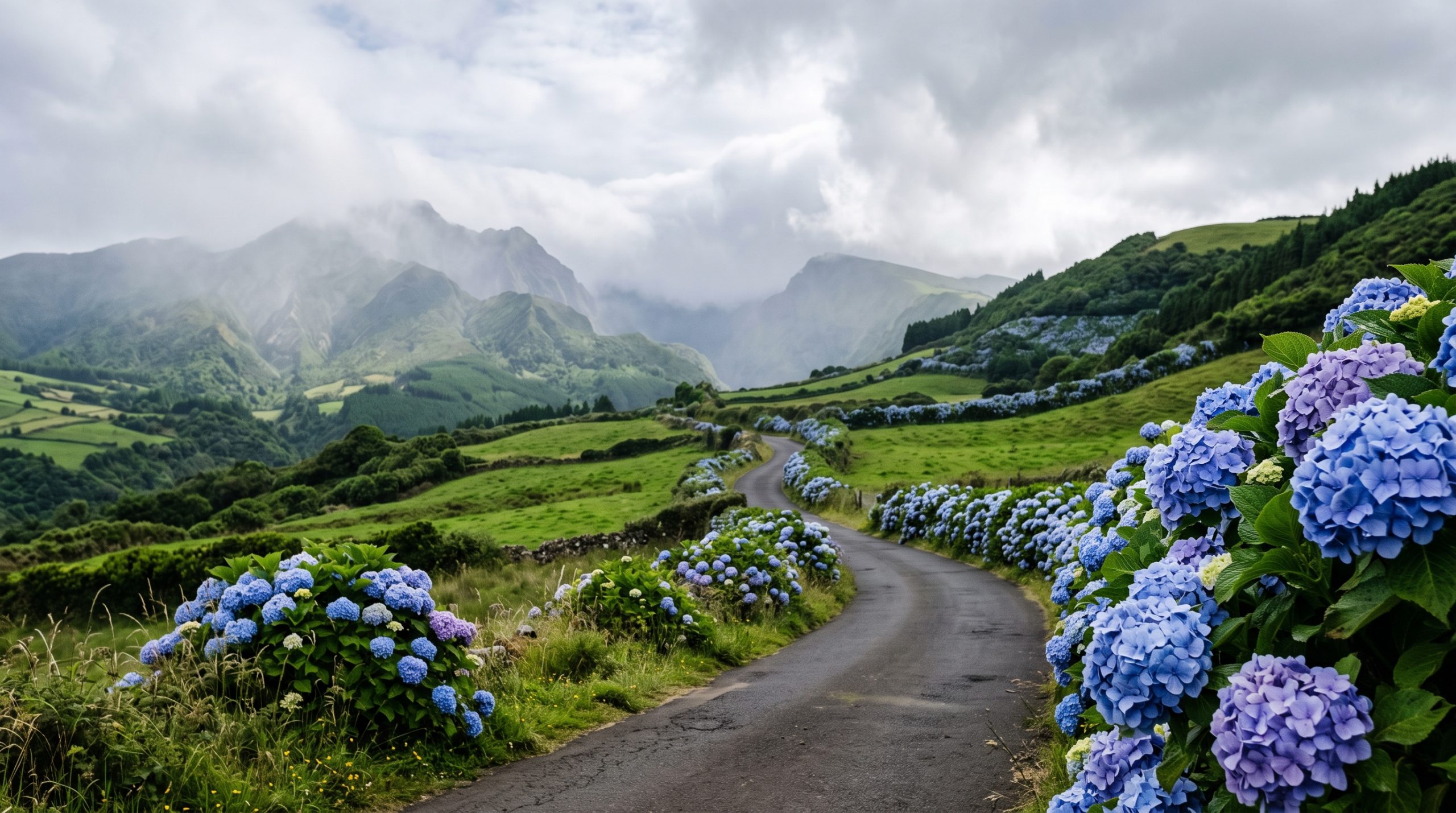
The hedges here are not a garden. On São Miguel they are a fence, and that is the whole reason they run for kilometres instead of sitting in a bed. Hydrangea macrophylla arrived in the nineteenth century and got put to work dividing one pasture from the next, and the volcanic soil is acidic enough to push most of it blue rather than pink.
The first heads open on low ground in the second week of June, pale and green at the edge, easy to mistake for leaf from a moving car. By the first week of July that same hedge reads as one solid band from a hundred metres away, which is the frame almost every couple has in mind when they write to us. Then altitude complicates it. The rim road above Sete Cidades sits at roughly 600 metres and runs two to three weeks behind the coast, so a week that is fully open down at Mosteiros can still be half-closed on the crater.
So the date question and the road question are one question. Ponta Delgada holds its latest sunset of the year on 28 June, at 9:10 pm, which buys you vows at eight in the evening with the blue hour still running past half past nine. Below is the month-by-month version, the roads with room to stand, and the odds we would actually quote you.
The hydrangea window we would choose first
The first three weeks of July. Low-ground hedges are fully open, July is the driest month on Ponta Delgada’s long-run averages at 25 mm, and sunset still falls after nine, so an eight o’clock ceremony is comfortable rather than rushed. For crater rims and the western islands, shift to late July and the first half of August.
Month by month, and what the hedges are doing
Sunset times are for Ponta Delgada. Every rim road and caldera in the table runs roughly 4 degrees cooler than the coast, and cloud forms up there first.
| Month | The hedges | Light | Crowds | Our verdict |
|---|---|---|---|---|
| January | Bare stems, deep green everywhere else | Sunset 5:48 pm mid-month, day length 9 h 51 m | Empty roads | Coast and Furnas, not the rim |
| February | Bare stems, first leaf breaking late | Sunset 6:22 pm mid-month | Quiet | Workable, and we build it differently |
| March | Leaf, no flower; coolest average lows of the year near 14 °C | Sunset 6:37 pm on 1 March | Quiet | Waterfalls at full volume |
| April | Bud forming, nothing showing | Sunset 8:19 pm mid-month | Building at Easter | Green island, no blue |
| May | Earliest coastal hedges show colour in the last week | Sunset 8:56 pm on 28 May | Pre-season | Our pick if blue is a bonus |
| June | Opens second week low down, often solid by the last week | Latest sunset of the year, 9:10 pm on 28 June | Rising fast | Late June is strong |
| July | Full at sea level, climbing to the rims | Sunset 9:02 pm on 20 July; driest month at 25 mm | Peak; July now runs past 630,000 overnight stays | The window we book first |
| August | Past best at sea level by mid-month, prime at altitude and on Flores | Sunset 8:42 pm on the 10th, 8:14 pm on the 31st | Peak, easing in the last week | High ground and the west |
| September | Heads fading and turning, still readable in the west | Sunset 7:59 pm on the 10th | Drops off after the first week | Best trade of the year |
| October | Rust and dry heads, good texture up close | Sunset 7:06 pm mid-month | Quiet | Craters and coast |
| November | Cut back or bare | Sunset 5:32 pm mid-month | Very quiet | South coast afternoons |
| December | Bare; wettest month at 154 mm | Earliest sunset 5:25 pm on 6 December, shortest day 9 h 36 m | Quiet | One long low hour, near the sea |
How far the dates move, and how altitude buys you time
Between years the whole window slides by seven to fourteen days, on winter rainfall and spring warmth rather than on anything you can look up in advance. A warm, wet spring can have the coast solid by 20 June. A cool one leaves the north side of São Miguel patchy into July while the south side is already full.
That is why we plan two elevations for any hydrangea date, not two backup viewpoints at the same height. Sea level, around 300 metres, and the rims at 500 to 900 metres open in sequence, so a ten-day lag changes which road we drive rather than whether the day works. Flores is the far end of that logic: its interior sits high and wet, and its best hedges usually come in the first ten days of August, when São Miguel’s coastal roads have already gone soft.
We give probabilities, never a promise. Book the middle two weeks of July on São Miguel and the hedges are close to a certainty somewhere on the island. Book 12 June and you are betting on a warm spring, which is a fine bet if you also love a green caldera in mist.
Four roads we keep going back to
The Sete Cidades rim, but not at eleven in the morning
The rim road is the picture: hedge on one side, the twin lakes a few hundred metres below on the other. It is also where the coach traffic lands mid-morning at Vista do Rei, and the caldera is frequently white with cloud at ten and completely clear by seven in the evening. We work it at either end of the day and use the pasture gates and pull-offs a few minutes along the rim, where two cars fit and nobody is trying to get past you during vows.
Lagoa do Canário, for couples happy to walk ten minutes
A gravel track leaves the main road and drops into cryptomeria forest with hydrangea along both edges, and the viewing platform over Grota do Inferno is a short walk in from a small parking area. That walk is the filter: it strips out most of the day traffic, and it means guests need shoes they can actually walk in.
Faial’s crossing, with Pico doing the work behind you
Faial earns the name Ilha Azul on the road that climbs out of Horta towards Cabeço Gordo at 1,043 metres. The field divisions across the middle of the island are hydrangea rather than wire, so the hedges stack in layers instead of lining one route. The Horta to Pico ferry runs year-round and takes about 30 minutes, which makes a two-island day possible in summer.
Flores, when São Miguel has already peaked
Flores is a flight and a commitment, and in the first half of August it holds the densest hedges left in the archipelago. Fajã Grande, the interior lakes and the roads to the western viewpoints stay saturated long after the eastern islands have turned.
Almost every hedge worth standing beside is a boundary between two working pastures, and Sete Cidades and Lagoa do Fogo both sit inside protected land. We ask, in writing, weeks ahead, and we clear the spot with the park and the parish as well as the landowner. The research and the paperwork are ours, and what sits on your side of the line is set out on our pricing page. Aerials run on a permission and a window, so we confirm both before we build any part of the film around a hedge line from above.
The February date, and what we would swap it for
February and March give you the greenest island of the year and no flower at all. The stems are cut back or leafless, the day is short, and the wettest stretch is just behind you: December averages 154 mm at Ponta Delgada against July’s 25 mm. If your dates are open and hydrangeas are the point, we suggest the last week of May, when the coast has its first colour and the roads are still empty, or the second week of September, when the hedges hold at altitude and the crowds have already collapsed.
If February is already fixed, tell us early and we will design for February rather than around it. Winter light is on your side: the sun sets to the southwest at about 241 degrees in mid-December, lighting the south coast head-on, and it holds the low warm band for around 66 minutes against July’s 60. We move the ceremony hour down to the sea, work Furnas and the thermal valley in the middle of the day, and keep the walking off the rim.
Where the light lands, June to December
The islands sit far enough north for the sunset to travel a long way around the compass. In mid-June the sun drops at roughly 301 degrees, well into the northwest, which is why Mosteiros and the northwest of Flores hold the last light in high summer. By mid-September it is near due west at about 277 degrees. By mid-December it is at 241 degrees, and the south coast becomes the only sensible place to finish a day.
The low, warm band itself is steadier than people expect. The sun spends about an hour below 10 degrees of altitude before it sets, in every month of the year. What changes is when: 8:02 pm to 9:02 pm on 20 July, 4:19 pm to 5:25 pm in mid-December. Mid-July also hands you a day that opens at 6:37 am and stays usable until nearly 9:35 pm, so summer dates can be paced slowly, with a long gap for lunch and a swim.
That one warm hour is the reason we send a photographer and a filmmaker together on the Expedition. On the rim there is a single pass of light, the cloud can arrive from one direction and leave from another, and vows do not repeat. One person recording sound and movement while the other reads the hedge line and the horizon means nothing gets traded away. You can see how a July rim road and a September coast actually look, in stills and on film, in our published stories and films. Highlights reach you in five days and the full gallery or film in three weeks.
If you already have a week in mind and want to know what the hedges will be doing, Check Your Date and we will tell you what that week has historically given us.
Ferries, cloud and the plan written before anyone lands
Access changes more by season than by month. Atlânticoline is the only inter-island ferry operator: Horta to Pico and Flores to Corvo run all year, while the lines stitching Terceira, Graciosa, São Jorge, Pico and Faial together are seasonal, run in spring and summer, and are timetabled closer to the season. São Miguel and Santa Maria are flight connections in practice, so an eastern-group pairing is built around air schedules rather than harbours. Our destination guides go island by island on what that means for a timeline.
The weather plan is not optimism. Before anyone flies we write named alternatives for each hour of your day, chosen by wind direction rather than by preference: a north-facing rim gets swapped for a south-coast headland when the wind swings, a forest track replaces an exposed crater when the cloud base sits at 400 metres, and the ceremony hour itself is allowed to move by two or three hours inside the day. On São Miguel the useful habit is simple. Rim in the early morning or late evening, coast in the middle, and the reverse if the cloud does something unexpected, which it does.
Common questions
When do the hydrangeas actually peak in the Azores?
On low ground, the first three weeks of July. Flowers start opening in the second week of June, hold through July, and go past their best at sea level around mid-August. Crater rims and the higher interiors peak two to three weeks later, which puts Flores and the Faial caldera in the first ten days of August.
Are there hydrangeas in the first week of June?
Some, and rarely enough to carry a whole day. Early June usually gives you green heads with colour just breaking on the warmest coastal hedges. It is a beautiful week for waterfalls and empty roads, with sunset already past nine. If the blue line is the reason you are travelling, the last week of June is the earliest we would commit to.
Can we hold a ceremony on the roadside at Sete Cidades?
Yes, with the right spot and the right hour. We avoid the busy viewpoints at the coach hours and use gateways and pull-offs along the rim where there is room to park and stand safely. Because the caldera sits inside protected land and the hedges belong to working farms, we clear the location with the park, the parish and the owner in advance.
Is the second half of August too late for the hedges?
Not if you go up or go west. Sea-level hedges start browning around mid-August, while the rims above 500 metres and the interior of Flores are at their best, and August is the warmest month at Ponta Delgada, averaging 21.7 °C. We put late-August dates on high ground and the western islands.
What happens if the caldera is full of cloud on our date?
We move the hour, not the plan. Sete Cidades and Lagoa do Fogo often clear between six and eight in the evening after a white morning, so we hold that slot and use the forest tracks and the coast while the cloud sits. Every hour of your timeline has a named alternative chosen by wind direction before anyone lands.
São Miguel, Faial or Flores for the hedges?
São Miguel for July and for the widest choice of roads within an hour of the airport. Faial for layered hedges across the island’s middle and Pico standing in the background, 30 minutes away by ferry. Flores for early August, if you want the densest blue in the archipelago and are happy with a longer travel day to reach it.
How far ahead do we need to book a July date?
Further ahead than any other week of the Azorean year. We are currently booking 2027, 2028 and 2029, and the first three weeks of July go first, because they are also the archipelago’s busiest weeks for accommodation and vehicles. Send your dates and we will tell you honestly what is still open.
Choosing your week for 2027 and 2028
One line to act on: hold the second or third week of July for São Miguel, and the first ten days of August if Flores or a caldera rim is the picture in your head. Tell us the week you are weighing up and what you want the day to feel like, and we will either confirm it or point you at the month that fits it better. The whole planning process stays written and easy to revisit, at whatever hour suits you: a reply and an initial brochure inside 24 hours, a tailored proposal after that, then a 30 percent retainer and planning begins. Our planning fundamentals cover the rest of the sequence. When you are ready, Start Your Story.