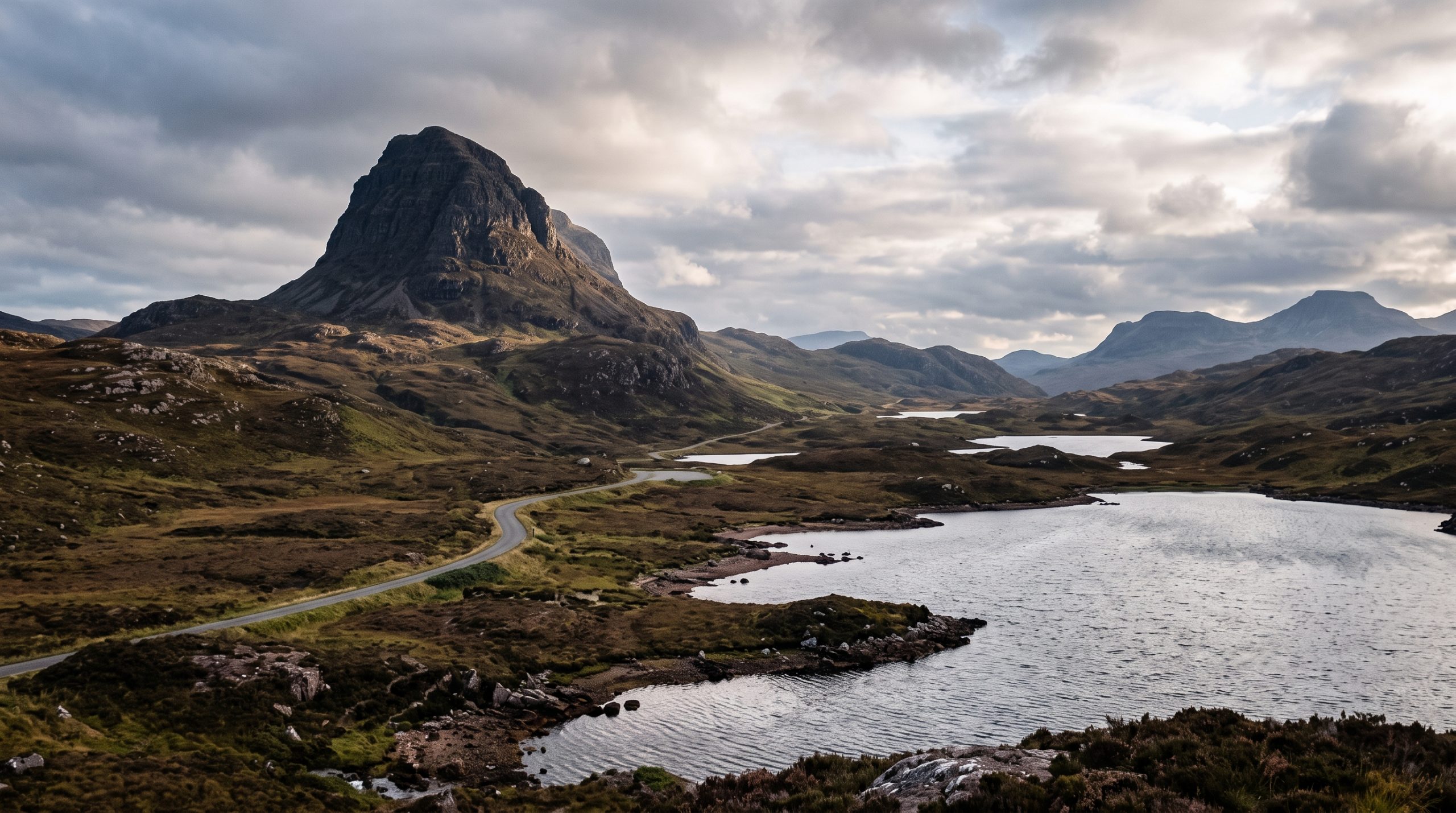
The public road out of Lochinver ends at a small car park with an honesty box in it. Past that post the tarmac turns into an estate track, and Suilven sits away to the east at the far end of a twenty-kilometre round trip that takes most walkers between seven and ten hours.
That box is the best short introduction to Assynt we can give you. The land beyond it is owned and managed by the Assynt Foundation, the parking is limited enough that people walk in from the village when it fills, and nobody is going to hand you a list of approved wedding venues, because Scotland does not run one. What you get instead is a district with one small harbour village at its heart, a coast road you cannot hurry, and mountains that stand alone instead of in ranges.
This page is about the practical shape of a ceremony out here. How far you actually walk. When the sun reaches which side of which hill. Who needs to know, and what we do when the wind comes in from the wrong quarter an hour before your vows.
Assynt in road miles and walking hours
Assynt is a district, not a single viewpoint. You can marry legally anywhere in it, outdoors, with an approved celebrant and two witnesses, provided each of you lodges a marriage notice at least twenty-nine days ahead. Ceremony ground ranges from a roadside lochshore to a twenty-kilometre hill day, and that choice sets your entire timeline.
Roadside, forty minutes, or the whole day on foot
Nearly every question couples send us about this corner of Scotland is really a question about distance. Assynt sorts itself into a few bands of effort, and the band you choose decides your footwear, your start time, and how much of the day is spent moving rather than standing still.
| Where you stand | From the car | Underfoot in wedding clothes | What it gives you |
|---|---|---|---|
| Loch Assynt shore, from the pull-ins along the A837 | Two or three minutes | Gravel, cropped heather, one short step to the water | Water, ruin and mountain skyline with no walk at all |
| The Glencanisp track, first one to three kilometres | Twenty to forty-five minutes | Tarmac, then a rough stone estate track, almost level | Suilven growing in front of you, Suileag bothy at about three kilometres |
| The northern shoulder of Stac Pollaidh | An hour to ninety minutes up | Steep stepped path, loose stone higher up, hands wanted free | The Inverpolly lochans and most of Assynt’s peaks in one turn of the head |
| Suilven’s summit ridge | Seven to ten hours, there and back | Mountain ground, one sustained steep pull onto the ridge | The ridge itself, and near-total solitude |
In wedding clothes the Glencanisp track is the kindest ground in Assynt. It was built for estate vehicles, it drains, and a long dress travels it without drama, though we usually carry the dress in a pack for the first stretch and change at the point where the view opens. The Stac Pollaidh path is a different proposition, and worth understanding properly before you fall in love with the photograph.
Stac Pollaidh: 570 metres from a roadside car park
Stac Pollaidh is the most accessible mountain shape in the northwest and it knows it. The path starts from a car park with toilets beside Loch Lurgainn, crosses the road, and climbs through a patch of woodland before it opens onto bare hillside. The round trip is only about four and a half kilometres, but it lifts you roughly 570 metres to a summit crest just under 600 metres, which is close to a kilometre of horizontal distance doing all of the work. Guidebook times run from two to four hours for walkers who are not carrying anything unusual.
The very top asks for hands on rock, so that is not where a ceremony belongs. The northern shoulder is, and it is the better view anyway: the lochan-punctured floor of Inverpolly laid out below, with Cul Mor and Suilven behind it. A couple in reasonable footwear reaches the shoulder in about an hour. Boots go up, shoes come out of the pack at the top, and the last ten minutes of the climb are the only part where the dress needs a hand.
There is not much standing room up there. Space for the two of you, a celebrant, two witnesses, and at a squeeze us. A photographer and a filmmaker who work in the same team divide that ground without needing to talk about it: one in close and low, one back along the path with a longer lens, then a swap, so neither of them turns up in the other’s frame and nobody walks through a moment. Wind is the bigger constraint. Vows on an open shoulder want a microphone under a collar with a cover on it, and when the gusts are running hard we hold the words in the hollow below the crest and climb for the frames afterwards.
One camera or two changes the shape of the hour rather than the place you stand: the Adventure covers a full day with a dedicated photographer or filmmaker from $4,900, the Expedition puts both on the hill together from $7,900, and our coverage page sets out what travels with each, including our own flights and beds.
Suilven, and the twenty-kilometre question
Suilven is the reason many couples find Assynt in the first place. It is also a full mountain day: about twenty kilometres from the Glencanisp car park and back, roughly a thousand metres of ascent, seven to ten hours for most people, and a season that runs from around April to October rather than all year.
Vows at hour six, with ten kilometres still to walk, is a real and wonderful way to get married, and we have built days around exactly that. It is not what most people picture when they say Suilven, though. Most of them want the mountain in the frame rather than underfoot, and the track from the honesty box delivers that inside forty-five minutes of easy walking, with Suileag bothy about three kilometres in as shelter if a squall crosses. If the car park is full, the walk out from Lochinver adds around two kilometres and half an hour, which is a genuinely pleasant start to a wedding day.
If the summit is the point, say so early. A ceremony up there wants two days rather than one, with the walk in on the first evening and the vows in morning light, and that is Odyssey territory: several days, several locations if you want them, built as a proposal rather than picked off a shelf.
Light at fifty-eight degrees north
Assynt sits at about fifty-eight degrees north, and that single fact governs your timeline more than any other on this page.
In mid-June the sun is above the horizon before half past four in the morning and still up after ten at night, and the hours in between never reach proper darkness. Late December gives you roughly six hours between sunrise and sunset, all of it low, which makes a noon ceremony look like an evening one everywhere else. Spring and autumn are the practical compromise: a golden stretch long enough to work through without a 4am alarm.
Direction matters more than duration here. The sea lies west of everything in Assynt and the mountains stand inland, which means that in June the sun rises behind the hills and the west-facing beaches sit in shade until mid-morning. Sunrise on the coast is the standard planning mistake in this district. Evening is the coastal hour, with the light coming in flat off the Minch, and the inland faces work in reverse: first light finds the eastern flanks, while Suilven’s western dome, Caisteal Liath, holds the glow until the very end of the day.
What that light does to the ground matters too. Assynt bedrock is ancient grey gneiss, scoured and rounded, with heather over the top of it, and low sun switches all of that texture on at once. Our published stories and films are the fastest way to read it before you choose a start time, because the gap between a midday frame here and a nine o’clock frame in June is not subtle.
Permission out here is mostly a conversation
Scotland does not license buildings for weddings the way England and Wales do. A religious or belief celebrant can conduct a legal marriage anywhere, indoors or out, and a registrar can attend a place agreed in advance. There is no approved-venue list to get onto and no location application to submit, so a small private ceremony on open hill ground in Assynt needs no permit from anybody. That is unusually simple, and most pages about eloping in Scotland hedge it.
The deadlines live in the paperwork instead. Each of you completes a marriage notice, form M10, and lodges it with the registrar for the district where the wedding will take place rather than where you live. It goes in no earlier than three months before the date and no later than twenty-nine days before it, with original birth certificates and, for non-UK nationals, a declaration of status. We plan backwards from that twenty-nine-day line with room to spare, and our planning fundamentals walk through the sequence in more detail.
Two witnesses sign the marriage schedule alongside you and your celebrant, so even the most private version of this day involves two other people on the hill. Deciding who they are is part of the planning, not an afterthought, and it is one of the first things we sort out with you.
The land itself is held locally, which is why the honesty box exists. We ask the estate before we do anything beyond turning up and walking in, and aerials run on the drone rules plus the landowner’s goodwill, so we confirm both while the timeline is still a draft and design the film around the window we are given.
What moves the plan: wind, midges and the summer road
Weather here arrives off the Atlantic and rearranges itself faster than any schedule can. Every timeline we build carries a second version, and in Assynt that second version has to be close by, because the coast road between Lochinver and Kylesku is single track with blind summits and it does not reward hurry. A plan B thirty minutes away is a plan B. One on the other side of the district is a lost evening.
Wind direction usually picks the coast for us on the day. An exposed west-facing beach in a hard northwesterly is somewhere to visit for ten minutes rather than stand still in, while a sheltered inlet a few miles round the headland stays calm enough to hear each other. The birch woodland at the foot of the Stac Pollaidh path can be thick with midges on a still, warm evening, which is why we time that stretch for a breeze or move it into the morning.
Crowds are worth being straight about. Assynt is emptier than almost anywhere in Britain and it is still busier than its reputation in July and August, with the pressure concentrated in small car parks and passing places along the North Coast 500 route. Stac Pollaidh takes the brunt of it, because it is short and it starts at the roadside. Arriving early is not enough there in high summer. What works is a six o’clock ceremony hour, or an evening one after the day walkers have gone down, or walking in on the Glencanisp track instead, where you will likely see nobody at all past the bothy. If you would rather compare Assynt against somewhere with easier logistics before you decide, our destination guides lay the options side by side.
Common questions
Do we need permission to say our vows on Stac Pollaidh or the Glencanisp track?
Not for the ceremony itself. Scotland’s access rights cover a small private gathering on open hill ground, and there is no permit or venue approval to apply for. Because we are working commercially, we speak to the estate in advance, and the Glencanisp car park has an honesty box for donations to the Assynt Foundation, which owns and manages that ground.
How late can we send the marriage notice for a wedding in Assynt?
Each of you must lodge a marriage notice, form M10, with the registrar for the district where the ceremony happens. The earliest it can go in is three months before your date and the latest is twenty-nine days before. Leaving it to the final week of that window is tight, so we build the paperwork into the plan months ahead of the walk.
Is there anywhere to change out of hiking boots?
There are toilets at the Stac Pollaidh car park beside Loch Lurgainn, and that is the extent of facilities at the trailheads. In practice couples dress at their accommodation in Lochinver, walk in boots, and change shoes at the top out of a pack. It is worth choosing a dress that packs, because it will spend an hour in one.
Can we get married on Suilven’s summit in one day?
Physically yes, and people do. It is about twenty kilometres round from the Glencanisp car park, roughly a thousand metres of ascent, and seven to ten hours of walking, in a season that runs from around April to October. Tell us if the summit is non-negotiable and we will shape it across two days instead, which is a better wedding and a better film.
What happens if the wind is too strong for the ridge?
We move down rather than cancel. The Glencanisp track, the lochshore pull-ins along the A837 and the sheltered woodland near Lochinver all sit within half an hour of each other, and every timeline we write names the alternative before the day begins, so the switch costs you a drive and not an hour of your ceremony.
What to send us when you write
Assynt suits couples who are happy to drive a long way and then walk, and who would rather have a mountain to themselves at six in the morning than a view they share with a coach party at noon. It suits patient people. If a pre-dawn start is not your idea of a good morning, June’s late light offers an eight o’clock evening ceremony with hours of usable sky behind it, and if you tell us what you actually want from the day we will say honestly which month and which side of the district fits it best.
Tell us your date, roughly how far you are willing to walk, and whether you want a photographer, a filmmaker or both. We reply within 24 hours with our brochure, then build a tailored proposal, and planning begins once the contract is signed and a 30% retainer is paid. All of it happens in writing, at whatever pace suits you, and we are currently booking 2027, 2028 and 2029. Tell Us Your Story.