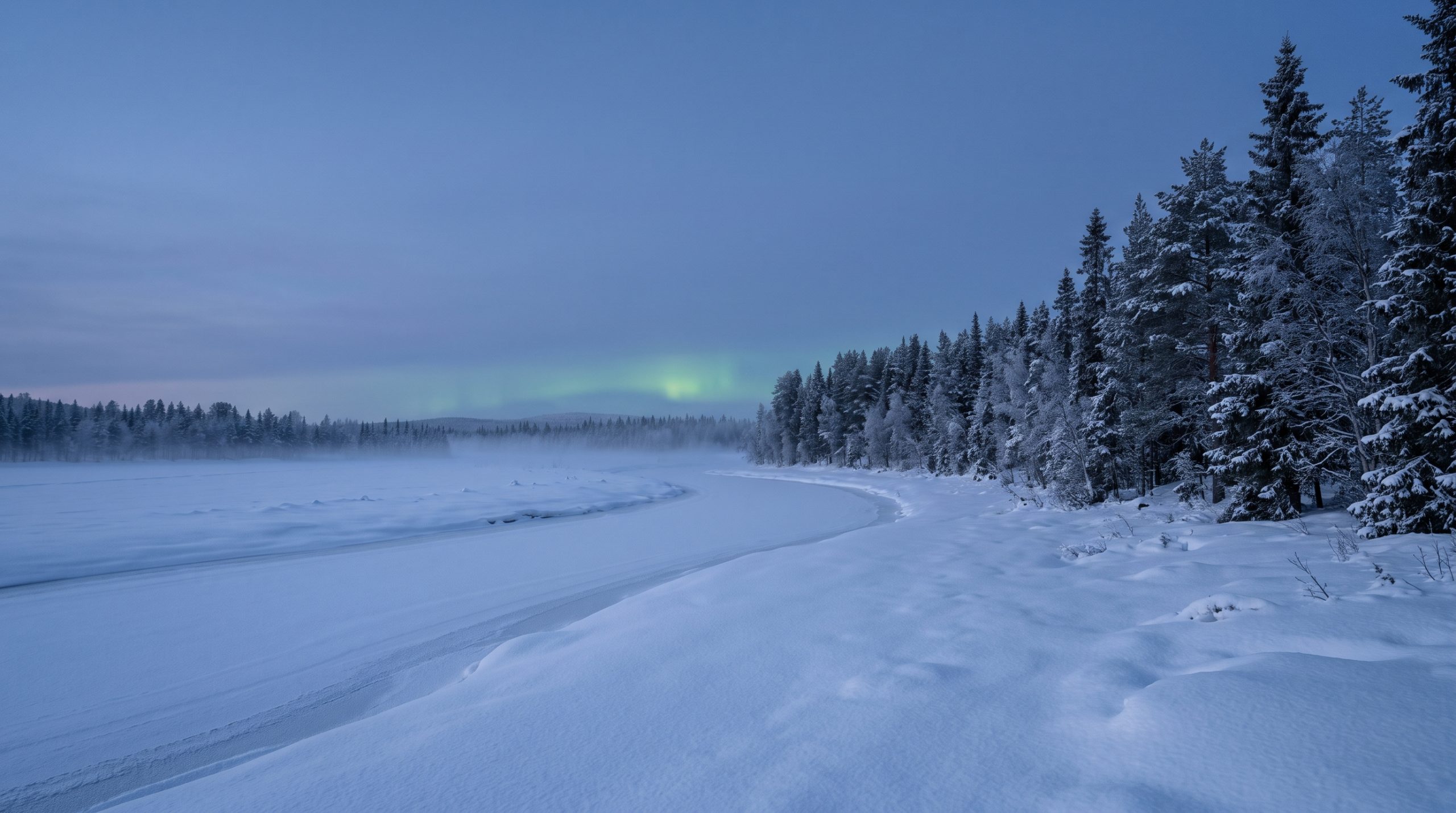
On 14 February in the fells above Kittilä, the sun clears the horizon around 08:45 and slips back under it around 16:25. At its highest point, near noon, it sits about nine degrees above the skyline. That single fact shapes every wedding film made up here. There is no golden hour to wait for, because the whole day arrives sideways.
The trade is that the useful part is short. On that same February day the sun is more than six degrees up for roughly four hours, from about 10:30 to 14:35, and everything either side of it is twilight running across snow. At the winter solstice the sun does not clear the horizon at Levi at all. What you get instead is civil twilight from about 09:35 to 15:00, five and a half hours of blue light that a camera reads beautifully and the human eye almost forgets to notice.
We plan around that arithmetic, and then we are the people standing in it with you. Photography, film and planning come from one team of eight, so whoever worked out where the light lands at 11:00 on your date is the same person on the ridge holding a camera. Finland also runs on paperwork with a clock on it: the examination of impediments to marriage takes at least seven days, and several weeks when neither of you is Finnish, so the legal side gets started long before anyone talks about locations.
Photography, film and planning, booked as one thing
We photograph, film and plan Arctic elopements across Finnish Lapland, from Rovaniemi on the Arctic Circle to the Kittilä fells, Saariselkä and Lake Inari. One team designs the day, researches the permits and runs both cameras. Coverage is a full day or several, team travel included, and where it starts is set out on our pricing page.
One February day, from 07:45 blue to the aurora watch
This is the shape of a full day in central Lapland in mid-February, which is the window most couples end up choosing once they see the numbers. The times move by a few minutes a week and by half an hour between Rovaniemi and Ivalo, so your timeline gets built from your own date rather than from this one.
07:45. Civil twilight opens. The snow stops being black and turns blue, and it stays that way for an hour. We are usually indoors just before this with rings, boots, the coat going on, then out into it while the forest still has no color at all.
08:45. Sunrise. Amber lands on the tops of the pines first and works its way down. For the next hour and a half the light comes in almost horizontally, which is why a walk between two stands of trees up here looks like something and the same walk at home does not.
10:30. The sun passes six degrees, and this is where we put the ceremony. Finnish law wants both of you present and two witnesses aged at least fifteen, which is a small enough group to stand on a frozen lakeshore without anyone sinking into a drift. Noon is the top of the arc at roughly nine degrees, so the flat overhead light that ruins midday everywhere else simply does not exist in a Lapland winter.
13:00. Warm-up cycle. A cabin, a thermos, sometimes a sauna, and twenty minutes of hands coming back to life. Cameras stay out in the cold or come inside bagged, never bare, and this is when the second pair of batteries goes into an inside pocket.
14:35. The sun drops back below six degrees and the second amber pass begins, longer and softer than the morning one. Snow takes pink, then violet. If there is one hour on a February day we protect above all others, it is this one.
16:25. Sunset, then blue again until about 17:27. Dark by half past six, which is early enough that dinner and an aurora watch are the same evening rather than a choice between them.
Two other months rearrange all of this. Around the June solstice the sun does not set at Levi or Ivalo, and it stays above six degrees until nearly 22:45, so a ceremony at half past ten at night reads as low gold rather than as night. Late March is the other sweet spot: twelve hours of sun on 20 March, snow still deep across the fells, and skies dark enough by half past eight that the aurora season has not finished with you yet.
Check Your Date and we will send back the actual sunrise, sunset and twilight times for it, with a first sketch of where the hours would sit.
Two cameras when the good light lasts four hours
Here is the specific reason we put a photographer and a filmmaker on the ground together in Lapland rather than asking one person to do both. On a February day the genuinely strong light is about four hours long. Every time a single operator stops to switch modes, reframe for motion and start again, that four hours gets shorter, and the sun is not coming back for a second attempt. Working as a pair, the same moment gets a still and a moving frame from two positions, and nobody is choosing which one to lose.
Cold makes the case sharper. At twenty-five below, a day runs on rotations: batteries live against a body, gear comes in bagged so it does not fog, gloves come off for a frame and go straight back on. With two of us, one is cycling equipment while the other keeps shooting, so the warm-up stops cost you nothing.
Then there is the aurora, which is where a solo operator has to make a real sacrifice. Stills of a good display want a tripod and a run of long exposures. Moving footage wants a locked camera, a different set of glass and time it is not going to give you back. When an active band comes over and lasts four minutes, a photographer alone films nothing and a filmmaker alone brings home no photograph. Two of us split the sky and you get both. The Expedition also carries proper audio for the vows, which matters more here than people expect: deep snow swallows sound, so a lavalier under a collar is the difference between hearing your own words and hearing wind.
Aerials fly under the European open-category rules, with a ceiling of 120 meters, Traficom registration for the operator and the airspace checked before every flight, plus whatever the protected area itself sets on top of that. We confirm the window first and then decide whether the film needs the frozen lake from above at all. If you want to see how this comes out on the screen rather than on paper, our published galleries and films are the honest version of the answer.
What travels north with us, and when the work lands
Everything below sits inside the coverage fee, in Lapland exactly as anywhere else we work.
- Destination and location design for your date, built from the light rather than from a list of viewpoints.
- A custom timeline made around real travel time on winter roads, with weather alternatives held in reserve.
- Permit research and logistics guidance, including which ground is state-owned and what that changes.
- Drone footage where it is legal, safe and appropriate.
- Professional audio for vows and other meaningful moments on the Expedition, where conditions allow.
- Team travel worldwide. Flights, accommodation and ordinary travel for the assigned team are included, with no long-haul surcharge and no European exception.
- Highlights delivered in 5 days, and the full gallery or film in 3 weeks.
Guest count does not move the fee. Six people instead of two changes access, permits, transport and the timeline, and we plan for that, but it does not change what you pay us.
Where Lapland coverage starts, and the euros outside it
Three shapes, and the difference between them is how many days you have and how many cameras are on them.
| Experience | Time on the ground | Who works your day | From |
|---|---|---|---|
| The Adventure | One full day | One dedicated photographer or one dedicated filmmaker | $4,900 |
| The Expedition | One full day | A dedicated photographer and filmmaker, working together | $7,900 |
| The Odyssey | Two to seven days | Photography and film, one or several destinations | Custom proposal |
Our flights and beds north are ours to sort out. What you pay locally, in euros, is worth knowing before you build a budget. A civil ceremony on the premises of the Digital and Population Data Services Agency is free of charge during office hours, weekdays between 09:00 and 16:15. Take the officiator out to a fell, a lakeshore or a snow chapel, or ask for a time after office hours, and a fee applies. Currently that is 250 euros for ceremonies officiated after office hours, with the officiator’s travel added on top.
The other local lines are accommodation, which in a glass cabin or an ice room in high season is the largest of them, and transport off the road network. Reindeer, dog teams, snowmobile transfers and a driver or guide are all priced per hour or per group, and any off-road driving on state land needs a permit before it happens. Filming inside a national park or another protected area can require an agreement with Metsähallitus, applied for through its registry office well in advance. We do that research and hand you the shape of it. The permit fees themselves, along with your celebrant, vendors and activities, are paid by you. Full detail of what we cover sits on the pricing page.
The aurora question, and who does well this far north
If the northern lights do not appear on your date
This is what couples ask us last, right before they write, and the honest answer is that nobody sells a guarantee on the sky. What we do instead is build a day that does not depend on it. According to the Finnish Meteorological Institute, three nights out of four are lit by aurora in northern Lapland around Kilpisjärvi and Utsjoki, as long as the sky is clear enough, and the season runs from late August into April. So the odds are genuinely in your favor, and they are still odds.
Practically, that means the ceremony and the portraits go in the light we can calculate to the minute, and the aurora becomes the night shift rather than the plan. It also means that if this is the frame you most want on your wall, more than one night is the way to get it, which is exactly what the multi-day route is for. We watch cloud as closely as we watch the geomagnetic forecast, because a clear gap forty minutes’ drive away is worth more than a strong reading over an overcast fell.
Couples who do well up here
Lapland rewards people who are comfortable being outside in twenty-minute stretches with a warm room to come back to, who will walk on uneven ground in proper boots and change at a cabin rather than in a suite, and who can hear at breakfast that we are driving ninety minutes the other way because that is where the sky is open. If the idea of a plan moving on the morning makes you tense, tell us and we will build a tighter version anchored to two locations and one short transfer.
And if what you actually want is warmth on your face and no darkness at all, say so early. That is a June conversation rather than a February one, and up here in June the sun never leaves the sky. Our destination guides go month by month if you are still weighing it. Either way, tell us the picture in your head and we will tell you which week of the year actually delivers it.
How a Lapland film enquiry becomes a held date
- You send the inquiry form with your rough dates and the shape you are imagining.
- We reply within 24 hours with our initial brochure.
- We put together a tailored proposal for your date, destination and coverage.
- You sign the contract.
- You pay a 30% retainer, and the date is yours.
- Planning begins, with the rest of the payment schedule set out in the proposal.
Our Lapland calendar is currently open across 2027, 2028 and 2029. Because there are eight of us, there is a colleague in reserve for every assignment, which is a large part of why a date two years out is a promise we can make at all.
Common questions
How much does a wedding film in Lapland cost with a photographer as well?
The one-day options are set out in the table above, and the difference between them is whether one specialist or two work your day. Multi-day coverage is quoted as a custom proposal. Team travel to Lapland is inside the fee in every case, so there is no Arctic surcharge to discover later.
Is December too dark to film an elopement in Lapland?
No, but it is a different film. Around the solstice the sun does not rise at Levi, and what you have is roughly five and a half hours of civil twilight, from about 09:35 to 15:00. That light is soft, blue and directional, and snow bounces plenty of it back up. What you do not get in December is a bright sunlit frame, so if that is the image in your head, aim for late February or March.
Can we legally marry in Finland as Americans?
Yes. You request an examination of impediments to marriage, which takes at least seven days and several weeks when neither of you is Finnish, and the certificate it produces is valid for four months. Both of you plus two witnesses aged fifteen or over need to be at the ceremony. We guide the sequence and the timing around your travel.
How cold does it actually get, and will your cameras keep working?
Cold enough to plan for. The Finnish Meteorological Institute logged minus 38.9 degrees Celsius at Tulppio in Savukoski on 8 January in a recent winter, though a normal February day is far milder than that. We work in warm-up rotations, keep spare batteries against the body and bag equipment before bringing it indoors, which is standard practice for us rather than an adaptation.
Do we need a permit to be photographed in a Finnish national park?
Everyone’s Right covers a great deal of ordinary movement and filming across Lapland’s open country. Protected areas, strict nature reserves and the region’s twelve wilderness areas each carry their own rules, and film production in them can require an agreement with Metsähallitus, submitted to its registry office in advance. Off-road driving always needs a permit. We research which of these your locations trigger.
Can you fly a drone over a frozen lake up there?
Usually, and always on the rules. European open-category flying tops out at 120 meters, the operator is registered with Traficom, and the airspace and any protected-area conditions get checked before each flight. We confirm the window during planning, so the aerials in your film are ones we already know we can make.
What is the best month for both deep snow and long light?
Late March. On 20 March there are about twelve hours between sunrise and sunset in central Lapland, the sun reaches roughly twenty-two degrees so it still has warmth in it, snow is at its deepest on the fells, and nights are dark by half past eight for the aurora. Ski slopes at Levi stay open into April and May, which tells you how long the snow holds.
How quickly do we see the photographs and the film?
Highlights reach you in 5 days, and the full gallery or film in 3 weeks. That timing is the same in Lapland as anywhere, including the weeks when we are traveling between assignments.
Picking your week in Lapland
Choose the month first and the location second, because up here the calendar decides what the film can look like. Tell us the week you are circling and what you want to feel like on it, and we will send back the light times, an honest read on that date and a proposal shaped around it. The planning stays in writing from the first message onward, at whatever hour suits you, with our first reply inside 24 hours. Tell Us Your Story and we will take it from there.