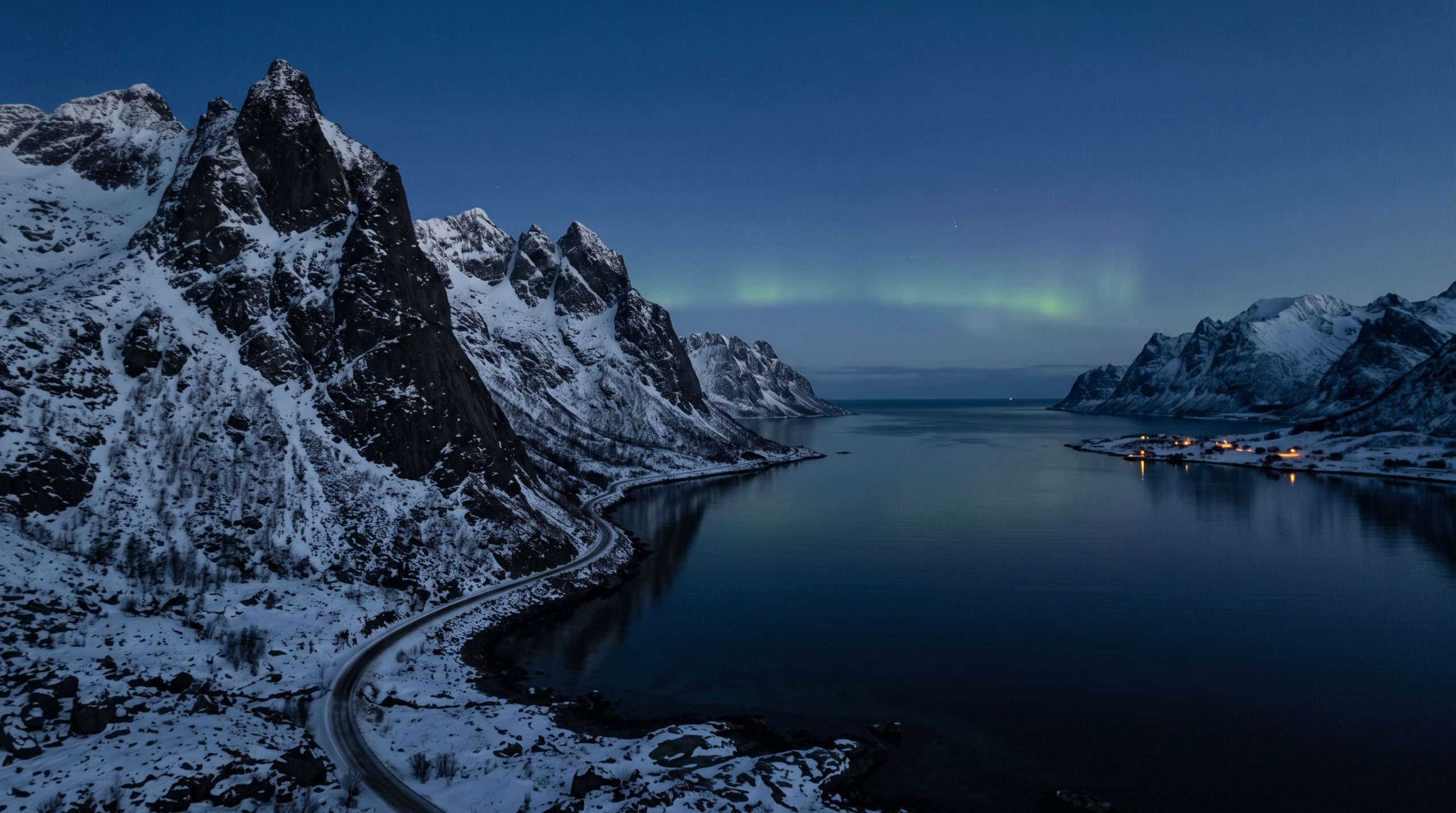
In Svolvær on the shortest days of the year, the sun never clears the horizon. It climbs to within a couple of degrees of it, holds there, and slides back down. What replaces sunrise is a long midday twilight, running roughly from half past nine in the morning to half past two in the afternoon, and it is not darkness. It is blue on the snow and rose on the water, and it moves the entire time.
Svolvær’s polar night runs from 7 December to 5 January. Then February arrives and the light returns at a rate that catches most visitors off guard: nine to ten minutes of extra daylight every day, better than an hour a week. By mid-February the sun is up around twenty past eight and down around ten past four, and for most of that stretch it sits low enough to light a face from the side.
This page is about what it costs to have a day like that filmed and photographed by the same team, and about how we build it. We work Lofoten, Senja and the fjords around Tromsø through every month of that cycle.
What the film costs and who shows up
Photography, film and planning come from one team of eight, not a photographer plus a videographer meeting for the first time on the morning. In Lofoten, Senja and Tromsø we cover one full day. A film with one dedicated filmmaker starts at $4,900, team travel to Norway included, and a photographer can work alongside that filmmaker.
Cloud, aurora and the light you can count on
Northern Norway does not have a good month and a bad month. It has completely different physics in each one, and choosing between them is the first real decision of the planning.
| When | What the sun does | What that gives the film |
|---|---|---|
| Late September into October | Tromsø sunrise near 6:15am, sunset near 7pm, fully dark by 8pm | A conventional working day plus the first aurora nights, with color still on the hillsides |
| December into early January | The sun stays below the horizon; midday twilight runs roughly 9:25am to 2:35pm in Svolvær | Five hours of blue and rose, and not one harsh frame in the whole day |
| February | Sunrise about 8:20am and sunset about 4:10pm mid-month, gaining nine to ten minutes a day | Deep snow, a sun that never climbs high, and the longest run of low light of the winter |
| March | By mid-month Tromsø runs 6:10am to 5:40pm | Long days, snow still on the peaks, aurora in play until the nights run out |
| Mid-May to late July | The sun does not set at all; over Lofoten it dips to under two degrees at about one in the morning | A night that behaves like a five-hour sunset, and no aurora whatsoever |
The question couples send us most often is what happens if the weather closes in. It is the right question, and the honest answer is that the thing which fails is a single fixed plan, not the destination. Lofoten is a chain of narrow islands with open ocean on one side and sheltered fjord on the other, and in a strong southwesterly the difference between those two shores is absolute. The Tromsø region does the same at larger scale, with the outer coast, the island fjords and the Lyngen Alps all within an afternoon of each other.
So we hold two or three alternatives inside a short drive of one another and choose on the morning, once we have seen the sky and read the wind direction rather than the temperature. We also refuse to build a film that only works if the aurora shows up. Aurora season runs from roughly late September to late March, and the long nights from November to February give it the most room to appear; when it does, we are already outside with tripods, and when it does not, nothing in the film was resting on it. Couples who want more than one night under a clear sky book The Odyssey, which spreads the work across two to seven days.
One more piece of candor. The famous ridge view above Reine deserves its reputation, and on a clear March day there is a steady line of people on the path up. For vows we would rather have a beach on the far side of the island to ourselves for an hour, and there are more of those than the guidebooks let on. Our destination guides go into where they sit and how long the drive is.
A February day in Lofoten, hour by hour
Mid-February, Vestvågøy, two people and two witnesses in a rorbu. The times below are real for that week, and they explain why one full day is genuinely enough in winter.
6:45am, still dark. We meet at the cabin. Coffee, batteries out of the warm bag, and a look at the wind reading for the outer coast rather than the one for the village, because those two numbers are rarely the same.
7:20am. The sky begins to lift. No sun for another hour, but there is already enough light on snow to work with, and it is the softest light anyone will get all day. We spend it on a west-facing beach where the horizon is open water.
8:20am, sunrise on paper. Lofoten’s mountains come out of the sea almost vertically, so a village sitting under a 600-meter ridge can wait another hour or two for direct sun even once the almanac says the sun is up. That is a planning fact rather than a problem. Open coast first, shadowed villages saved for the middle of the day.
9:30am, vows. The sun is a hand’s width above the sea and lighting faces from the side, which is the whole argument for an Arctic winter date. We pick the exact spot for shelter, not for the view alone, because a headland with thirty meters of rock on its windward side gives you vows you can actually hear on the film.
10:10am to 2:20pm. This is the only stretch of the day when the sun climbs above six degrees, and at its highest, just after midday, it reaches roughly nine. That is the angle Florida gets an hour before sunset. Nothing in the day needs protecting from it, so we use the block for the drive, a walk with no cameras up, food, dry socks and the second location.
2:20pm. The sun drops back under six degrees and the second run of low light starts, this time coming from the west and skimming across the water. The frame a couple ends up printing large usually arrives in this hour.
4:10pm, sunset. 5:15pm, the blue closes. From the first workable light to the last is under ten hours in February, which is exactly why a single day covers a winter elopement here without anyone hurrying. Compare that with June, where the same amount of usable light is spread over a full turn of the clock and two days start to make sense.
7pm onward. If the forecast holds, we go back out for the sky.
Send us the week you are circling and we will write back with what the light does across those specific days. Check Your Date
Two cameras inside a four-hour light window
Four hours. That is how long the February sun stays above six degrees over Lofoten, and almost every good idea a photographer has in that window is the same idea the filmmaker has, from the same angle, at the same minute.
Picture the alternative. A photographer booked from one country and a videographer booked from another meet in a car park at seven in the morning and spend the first hour learning how the other one works. The filmmaker needs the couple walking. The photographer needs them still and looking at each other. Both want to be between the couple and that low sun. At half past twelve, with ninety minutes of usable light left and a forty-minute drive to the next place, sorting that out becomes the most expensive item on the schedule.
Ours arrive on the same flight, working from one timeline they both helped write. Before anyone leaves the cabin it is already settled: the filmmaker takes the wide moving frame from the rise, the photographer stays three steps from the couple, and they trade at the turn in the path. Nobody stands around waiting for their turn with the light.
The cold changes the argument too. In a sea wind sitting either side of freezing, a camera operator working alone loses minutes to gloves, fogged filters and battery swaps, and in a four-hour window those minutes are the film. With two of us on the ground, one keeps rolling while the other resets. The Expedition adds professional audio for vows and other meaningful moments where conditions allow, and up here that is not a luxury line item. It is the difference between a ceremony you can hear and a ceremony you can only watch.
Aerials get planned rather than attempted. Norway’s drone rules sit with Luftfartstilsynet and follow the European framework: operator registration at flydrone.no, the operator number on the airframe, liability insurance, a 120-meter ceiling and visual line of sight at all times. Some places then add their own layer. Inside Lofotodden National Park the protection regulation prohibits drone flying, with permission possible from the park’s management authority on application, and the Norwegian Environment Agency notes that many protected areas are written the same way. Airport zones around Svolvær, Leknes and Tromsø need prior agreement. We settle where the aerial sequence lives before the timeline is built around it.
What the two crafts make of the same Arctic hour is worth seeing side by side, which is why our published films and galleries sit together. Watch how blue-hour footage grades against stills from the same twenty minutes, and how a drone pass over a snow beach reads next to a frame taken from three steps away.
What arrives with the team, and when it lands
Every experience carries the same planning spine, from a single-craft day to a multi-day Odyssey.
- Destination and location design for the month you are actually traveling in, not a generic list of viewpoints.
- A custom timeline built around real light and real driving time, the E10 and the ferry schedule included.
- Permit research and logistics guidance, so you know which municipality, landowner or park authority governs the ground you have chosen.
- Weather alternatives and backup planning, decided in advance rather than improvised at breakfast.
- Drone footage where it is legal, safe and appropriate.
- Professional audio for vows and meaningful moments on The Expedition, where conditions allow.
- Flights, accommodation and ordinary travel for the assigned team, worldwide, with no long-haul distinction.
Highlights reach you in 5 days, and the full gallery or film in 3 weeks. Guest count does not move the fee. Bringing four people or fourteen changes access, permits, transport and the timeline, all of which is our problem to solve, and none of which is a line on your invoice.
Where coverage starts, and the costs that stay in kroner
The Expedition is one full day with a dedicated photographer and a dedicated filmmaker working together, from $7,900. The single-craft day, one or the other, starts lower. The Odyssey runs two to seven days across one or several destinations and comes as a custom proposal built around what you want to do. All of it sits on the pricing page.
Team travel is inside that number. Flights, accommodation and ordinary travel for the assigned team are included worldwide, so Lofoten in February is not a surcharge on top of the coverage.
A shorter list stays yours, and most of it is quoted in kroner: accommodation, the celebrant, other vendors, activities, and any government, venue or landowner permit fee. Unusual transport is separate as well, meaning helicopters, private boats, 4×4 charters and mountain guides. Norway’s municipalities run civil ceremonies and the ceremony itself carries no charge; asking for an hour or a place outside the town hall’s normal routine is where a municipal fee can appear, and each municipality sets its own.
The small ones are worth knowing before you arrive. Haukland charges 20 NOK an hour to park, with the first twenty minutes free, paid at the meter or by app, and most Lofoten beaches and trailheads now charge something similar. A hundred kroner is around ten dollars at recent rates. For getting in, Widerøe flies Bodø to Svolvær and Leknes, and Hurtigruten leaves Bodø at 3pm daily for Stamsund and Svolvær.
From your first message to a signed date
- You send the inquiry form with your dates, or with the month you are circling.
- We reply within 24 hours with our initial brochure.
- We write back on which month and which stretch of coast fits what you have described.
- You get a tailored proposal for your day.
- The contract is signed and a 30% retainer paid, with the remaining schedule set out in that proposal.
- Planning begins: locations, timeline, permit research, alternatives for weather.
Our current Norway availability runs across 2027–2029, and Arctic dates around the February and March light tend to be settled earliest. If you are still at the stage of working out the shape of the thing, our guide to planning an elopement covers the fundamentals before any of this applies.
Common questions
Can we legally marry in Norway as Americans?
Yes. Non-residents apply to the Norwegian Tax Administration, Skatteetaten, for a marriage license known as a prøvingsattest, which confirms there is no legal obstacle to the marriage and is valid for four months. You hand it to whoever officiates, and two witnesses have to be present at the ceremony. Apply early, since documents from home take time to gather.
Is a wedding film even possible when the sun does not rise?
Yes, and December is one of our favorite months to film here. In Svolvær during the polar night the middle of the day still gives roughly five hours of twilight, from about 9:25am to 2:35pm, and that light is soft, directional and constantly shifting color. What you lose is a high sun, which nobody wants on camera anyway.
What happens if our date turns out cloudy or windy?
We plan for it rather than hope around it. Every Northern Norway day is built with alternatives inside a short drive, usually one exposed coast option and one sheltered fjord option, and we choose on the morning after reading the wind direction. Cloud also flattens contrast in a way that suits vows on a beach.
Can you fly a drone in Lofoten and around Tromsø?
In many places yes, on registration and inside the rules: operator registration with Luftfartstilsynet, a 120-meter ceiling and visual line of sight. Lofotodden National Park prohibits drones under its protection regulation, with permission possible on application to the park authority, and airport zones need prior agreement. We confirm the answer for your locations during planning.
Do we hire the photographer and the filmmaker separately?
No. Photography, film and planning come from one team of eight. On a two-craft day a dedicated photographer and a dedicated filmmaker work the same timeline they both wrote, and because there are eight of us there is always a second camera on the ground and a colleague in reserve.
How long until we see the film and the photographs?
Highlights land 5 days after the day itself, so you have something to send home almost immediately. The full gallery or the full film follows within 3 weeks. Nothing about that timeline changes because you eloped somewhere remote.
Do we pay for your flights and hotels in Norway?
No. Team travel is included worldwide, which covers flights, accommodation and ordinary travel for the assigned team. There is no European or long-haul distinction, and Northern Norway is treated exactly like anywhere else we work.
Is February better than September for us?
February gives snow, a low sun all day and aurora nights, with a short day that has to be planned tightly. Late September gives a full working day, autumn color on the mountainsides, easier roads and the first auroras. Tell us which of those two descriptions you were already picturing and we will tell you honestly which one your plans fit.
Which month suits which couple
Arctic winter is generous to people who dislike alarm clocks. In February the sun comes up after breakfast, and the best light of the day arrives at half past nine. Under the midnight sun the demand flips completely, because the strongest hour is around one in the morning and you have to be awake and outdoors for it. Both are good films. They ask for opposite things from you.
What every month here does ask is a tolerance for uneven ground, wind that arrives without warning and a plan that can change at seven in the morning. If you want a gentler shape, with short walks, a sheltered shore and the car never far away, tell us that in your first message. It is a genuinely different day and we build it deliberately, rather than trimming a harder one down.
The planning stays in writing from the first message onward, at whatever hour works in your time zone, so nothing about starting this has to be arranged around anyone’s working hours. Send us the dates or the month, tell us what you picture, and we will write back with the light, the ground and the shape of the day. Tell Us Your Story