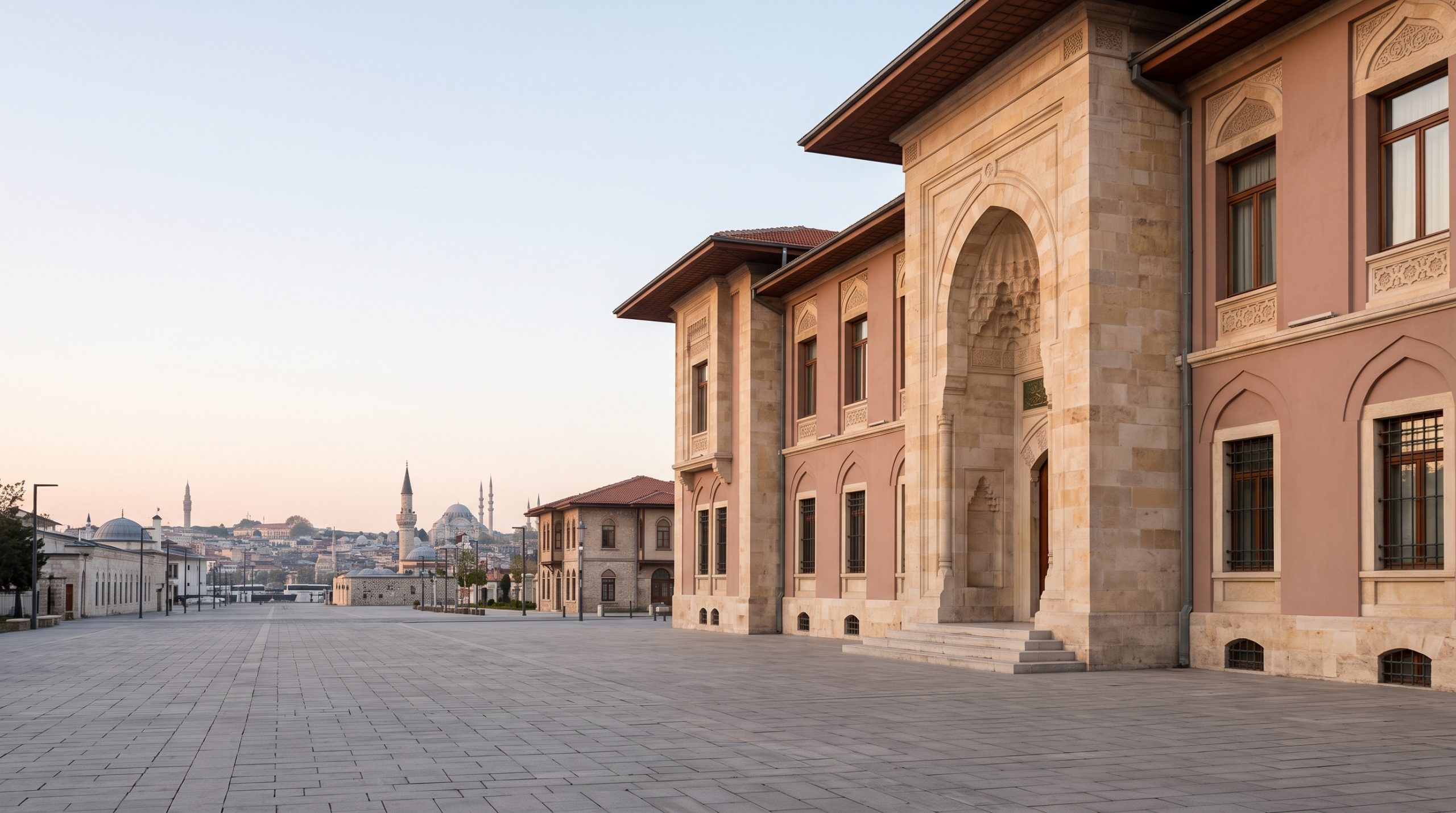
The document most American couples assume they can bring from home is the one they cannot. Türkiye wants a certificate saying you are free to marry, and for US citizens that certificate is signed inside the country, in front of a consular officer in Ankara or Istanbul, for a 50 dollar notarial fee paid online before you get there.
Everything after that is a relay between four counters: the consular section, a Turkish office that authenticates the consular signature, a sworn translator working with a notary, and the municipal marriage office, the Evlendirme Dairesi, that will actually perform the ceremony. Each counter wants the stamp from the one before it. All of them keep weekday hours.
We have built elopement days around that relay, and we have built just as many for couples who completed the legal marriage at home and kept the whole Cappadocian sunrise for themselves. Both are good days. What follows is what each route costs you in time, and which parts of it we carry.
Yes, it is legal, and the chain runs on Turkish soil
Two foreign nationals can marry in Türkiye before an authorized Turkish marriage officer. Only civil marriage has legal effect, so a symbolic ceremony alone does not marry you. Americans sign an affidavit of eligibility to marry at the embassy in Ankara or the consulate in Istanbul, then have it authenticated, translated and notarized before filing.
How much work the legal route actually takes
Nothing in the Turkish chain is exotic. The Marriage Regulation is explicit that a Turkish citizen and a foreigner, or two foreigners of different nationalities, may marry before an authorized Turkish marriage officer, and that where one party is foreign the municipal marriage offices and the district population directorates hold that authority. Two foreigners of the same nationality may also marry before their own state’s representation in Türkiye where their national law allows it, and the US consular instructions route Americans to a Turkish marriage bureau rather than to their own.
The difficulty is geographic and administrative. Your affidavit is signed in Ankara or Istanbul. Your Turkish authentication stamp comes from a government office, not from your hotel. Your sworn translation and notary work happens in Türkiye. Your health report comes from a clinic the marriage bureau itself designates. Then a bureau reviews the file and sets your date. Five errands, five offices, none of them at the trailhead in Cappadocia or on the headland at Kaş where you actually want to be standing at first light.
So the honest rating is fiddly rather than difficult. If you have a full working week in country and you are relaxed about spending three or four weekday mornings at counters in one city, the legal marriage in Türkiye is entirely doable and couples do it every month. If your trip is five days built around a balloon lifting off at dawn over Göreme, the shape that fits is a legal marriage at home and a ceremony here. Tell us which of those two you want, and if you are unsure, tell us the dates and the region and we will lay out what each version does to your mornings. Our guide to planning an elopement covers the fundamentals that sit underneath either choice.
Which documents come first
Order matters here more than in most countries, because three of these steps only accept a document that already carries the previous step’s stamp. Collect out of sequence and you pay for a translation twice.
- Birth certificate, apostilled at home. Order the long form, the one showing both parents’ names. Türkiye is a party to the Hague Apostille Convention, and the apostille is issued by the competent authority in the country that issued the document, never by an office in Türkiye. Marriage offices ask for the birth certificate whenever your certificate of no impediment does not itself show parents’ names together with place and date of birth.
- Divorce decree, apostilled, if either of you has been married before. The consular section wants to see the original or a certified copy when you sign your affidavit, and the marriage office wants it in the file. Where it applies, the certificate of no impediment should show the date the previous marriage ended.
- Affidavit of eligibility to marry, signed in Türkiye. Known locally as the bekârlık belgesi. The notarial fee is 50 dollars, paid through pay.gov in advance, because the embassy and the consulates no longer take cash or cards at the window. Bring your valid passport. Do not sign the affidavit before you are standing in front of the consular officer, because a pre-signed form is not notarizable.
- Turkish authentication of the consular signature. The Turkish side needs the consular officer’s signature verified before the document has any weight. Published guidance differs by consular district: the Ankara district instructions send the notarized affidavit to the Consular Department of the Ministry of Foreign Affairs, while the Istanbul district instructions send it to the legal office of the provincial sub-governor, the kaymakamlık. The office that governs is the marriage bureau performing your ceremony, so work from its list.
- Sworn translation into Turkish, notarized in Türkiye. The marriage office accepts the original document together with a notarized Turkish translation made in Türkiye. A certified translation bought at home is not a substitute. Your passport identity page is translated too, and the Istanbul instructions also ask for a notary-certified copy of the passport itself.
- Health report from a clinic the marriage bureau names. A pre-marriage health report is mandatory for each of you, and the bureau tells you which clinics it accepts. The report must carry the applicant’s photograph and the doctor’s stamp, and a report without both is refused.
- Photographs and proof of where you are staying. The Ankara district instructions ask for five photographs, two inches square, per person; the Istanbul district instructions ask for six. Two visiting Americans establish an address with a letter from their hotel, which also tells you which district’s office your file belongs to.
- The declaration at the counter, the Evlenme Beyannamesi. This one is completed at the marriage office along with the statistical form and the marriageability document. If you do not read Turkish, the office will expect a notarized translation of the declaration into your own language before you sign it.
The bureau then reviews the file and, once satisfied, gives you a date.
How the dates stack up
Work from the date and hour you want to be standing somewhere good, and go backwards.
| When | What has to be true |
|---|---|
| Three to four months out | Home documents ordered and apostilled, spellings checked letter by letter against both passports |
| Six to eight weeks out | Ceremony hour agreed with us against the light, the marriage office identified, travel booked into the right city first |
| Five weekdays before | Landed. Affidavit signed, Turkish authentication obtained, translation and notary done, health report issued |
| Two to three weekdays before | File submitted, declaration signed at the counter, date confirmed by the bureau |
| The morning itself | Two adult witnesses present, interpreter present if you need one, family booklet issued at the end |
There is one hard date rule worth building the whole plan around. Where a foreign document does not print its own expiry, marriage offices treat it as valid for six months from the date it was issued. That cuts both ways: ordering your certificate of no impediment and birth certificate a year ahead is worse than ordering them three months ahead, and a document collected in January for a September ceremony can quietly go stale in your folder.
The real minimum is short: with everything from home apostilled and in hand, the in-country errands can be compressed into three or four consecutive weekdays in one city, plus whatever review time the bureau needs. The comfortable minimum is the one we work to, which is a full working week in Türkiye before the ceremony date, with the home documents ordered around three months out. We would not build a Turkish civil marriage into a trip shorter than that, and we will say so plainly rather than let you discover it on a Friday afternoon.
The details that stop a file at the counter
This is where couples lose days, and almost none of it is about the law. It is about matching.
The single most common stoppage is a name. Istanbul’s Arnavutköy municipality states it about as directly as an office can: the personal details on the certificate of no impediment, the birth certificate, the passport and every other document must be identical, one to one, and a difference of a single letter or character means the transaction is not processed. Middle names that appear on one document and not another, a hyphenated surname rendered without its hyphen, an accented character flattened by a US records office. Check all of it the day the documents arrive, while you still have months to fix them, not the week you fly.
A few more that are cheap to get right and expensive to discover late:
- Honorary consulates do not count. The same municipality is explicit that documents obtained from honorary consulates are invalid. If the nearest office to you is honorary rather than a full consulate general, that is a travel plan, not a shortcut.
- Translation happens in Türkiye. Original plus a notarized Turkish translation made locally is the accepted pairing. Budget a translator day, not a translator hour.
- The declaration gets translated too. Not just your documents. The form the office prepares for you to sign is translated into your language and notarized when you do not read Turkish.
- Photograph and stamp on the health report. A report without the applicant’s photo and the doctor’s stamp is refused outright, and you will be sent back to the clinic.
- Copies, in the plural. The Ankara district instructions ask for three copies of both sides of the affidavit after the Turkish stamp, along with a copy of your passport bio pages. Bring more photographs than the list asks for as well.
- The ceremony is conducted in Turkish. If you do not understand it, the office may require an interpreter to be present, and your interpreter is not one of your two witnesses. Those are separate people with separate jobs.
- Everything in the chain is a weekday office. A Saturday ceremony is made possible by a file that moved Monday to Friday.
On money, the pattern is many small official fees rather than one large one. The international family booklet you leave the ceremony with is priced as an official document and reset each January, currently a little over 1,200 lira. Notary and sworn translation charges are set per document, and each municipality publishes its own ceremony tariff. Fees and deadlines quoted here were correct at the time of writing and are worth re-checking with the office that issues them.
The ceremony-only route
Most of the couples we fly out to meet in Türkiye are legally married before they land, and we want to be clear that this is not a lesser version of the day. It is the version that gives you back your mornings.
Practically, here is what changes. No consular errand, no authentication stamp, no translator, no clinic, no bureau calendar deciding your hour. You marry at your county or city office at home a few weeks earlier, with your two witnesses being whoever you like, and you fly with the marriage certificate in your bag. In Türkiye you then hold the ceremony you actually pictured: your own vows, read where you choose and when the light is right, with a celebrant if you want one, or with nobody but us.
Here is what does not change at all. The vows are yours. The rings still go on. The Evlendirme Dairesi has no say in where you stand, which means the ridge above Göreme at 5.40am, the terraces at Pamukkale, a boat off Kaş, or a headland on the Lycian coast at the end of the afternoon are all on the table. Drone footage runs wherever it is legal, safe and sensible, and site permissions inside protected areas are a separate track from any marriage file, which we research as part of planning. The finished work from days shaped this way sits in our published films and galleries, and the Turkish ones are mostly this route rather than the bureau route.
One legal note, stated plainly because it matters to planning. The Turkish Marriage Regulation is written for a bride and groom, in those words. Same-sex couples therefore complete the legal marriage at home and hold the ceremony in Türkiye, and nothing about how we plan, shoot or film that day is different. Our destination guides will give you a feel for the regions, and if you want to see how a ceremony-only day is built, Send Us a Message with your dates.
What stays with you, and what we build around it
We are photographers and filmmakers, not lawyers. Rules change and circumstances differ, so confirm the detail with the relevant registry office or your own consulate before you book flights. We do not file your paperwork and we do not stand between you and a Turkish notary.
What we do carry is everything around it. We hold your ceremony hour against the light rather than against convenience, which in Cappadocia usually means being in position before the balloons launch and on the coast means the last hour before the sun goes. We hold the date against a marriage office’s availability where the bureau route is the one you have chosen, we build the timeline around real travel time between Kayseri or Nevşehir and the valley floor, we research the location and site permissions, and we plan the weather alternative before you need it.
Witnesses are the one place our team shape shows up in the legal paperwork. A civil ceremony needs two adult witnesses, and couples flying out alone often arrive without them. On the Expedition, a photographer and a filmmaker are both on the ground for the full day, so there are two adults in the room who have done this before, and we confirm in advance what identification the office wants from anyone standing as a witness. What each experience includes, from planning through to team travel, is set out on our pricing page.
Common questions
Do we have to be in Turkey before the wedding to sort the paperwork?
Yes, for the American side of it. The affidavit of eligibility to marry is signed in person at the embassy in Ankara or the consulate general in Istanbul, and the Turkish authentication, sworn translation, notary and health report all happen in country afterwards. That is why we plan a full working week before the ceremony date.
How long is our certificate of no impediment valid in Turkey?
Where the document itself does not print an expiry date, marriage offices treat it as valid for six months from the date of issue. The same applies to a foreign birth certificate. Ordering these too early is a real risk, so we time the request against the ceremony date rather than against the booking date.
Does our birth certificate need an apostille for a Turkish marriage office?
Türkiye is a party to the Hague Apostille Convention, so a foreign public document is apostilled by the competent authority in the country that issued it. No office in Türkiye can apostille an American certificate. The consular affidavit is different: it takes a Turkish authentication of the consular signature instead.
Can the ceremony be held outdoors, or does it have to be at the marriage office?
Under the Turkish Civil Code the ceremony is held openly at the marriage office before the officer and two adult witnesses, but at the couple’s request it may be held in another place the marriage officer considers appropriate. That approval sits with the officer, so it is asked for early, in writing, through the bureau handling your file.
Who can be our witnesses if we are travelling to Turkey alone?
Two adults with capacity to understand what they are witnessing. There is no requirement that they be family or Turkish nationals. On an Expedition day both a photographer and a filmmaker are with you throughout, and we check with the office beforehand what identification it wants recorded for each witness.
Is a symbolic ceremony in Cappadocia legally binding?
No. Only a civil marriage performed by an authorized officer has legal effect in Türkiye, and a religious or symbolic ceremony on its own does not marry you. That is exactly why it is the flexible option: with the legal marriage completed at home, the ceremony here answers to nobody’s calendar but yours.
What document do we walk away with after a Turkish civil ceremony?
The marriage officer hands over the family booklet, the aile cüzdanı, as soon as the ceremony is finished. Foreign nationals married before Turkish authorities are also entitled, on request, to a multilingual marriage certificate. Ask for it at the counter when you file, because it saves translating the record again later.
Do we still need a health report if we are only visiting?
Yes. The pre-marriage health report is required of both parties whatever your nationality or length of stay, and it is issued by a clinic the marriage bureau designates rather than by your doctor at home. It must carry your photograph and the doctor’s stamp to be accepted.
Send us the date and the region, and we will map the rest
We keep every planning decision in writing, which suits paperwork planning well: you get a reply and our initial brochure within 24 hours, then a tailored proposal, then a contract and a 30% retainer, and planning starts. Highlights reach you five days after the day itself, the full gallery or film within three weeks. Our calendar currently covers 2027 through 2029. Tell us the region, the month and whether you want the bureau route or the ceremony-only route, and we will build the timeline backwards from there. Check Your Date.