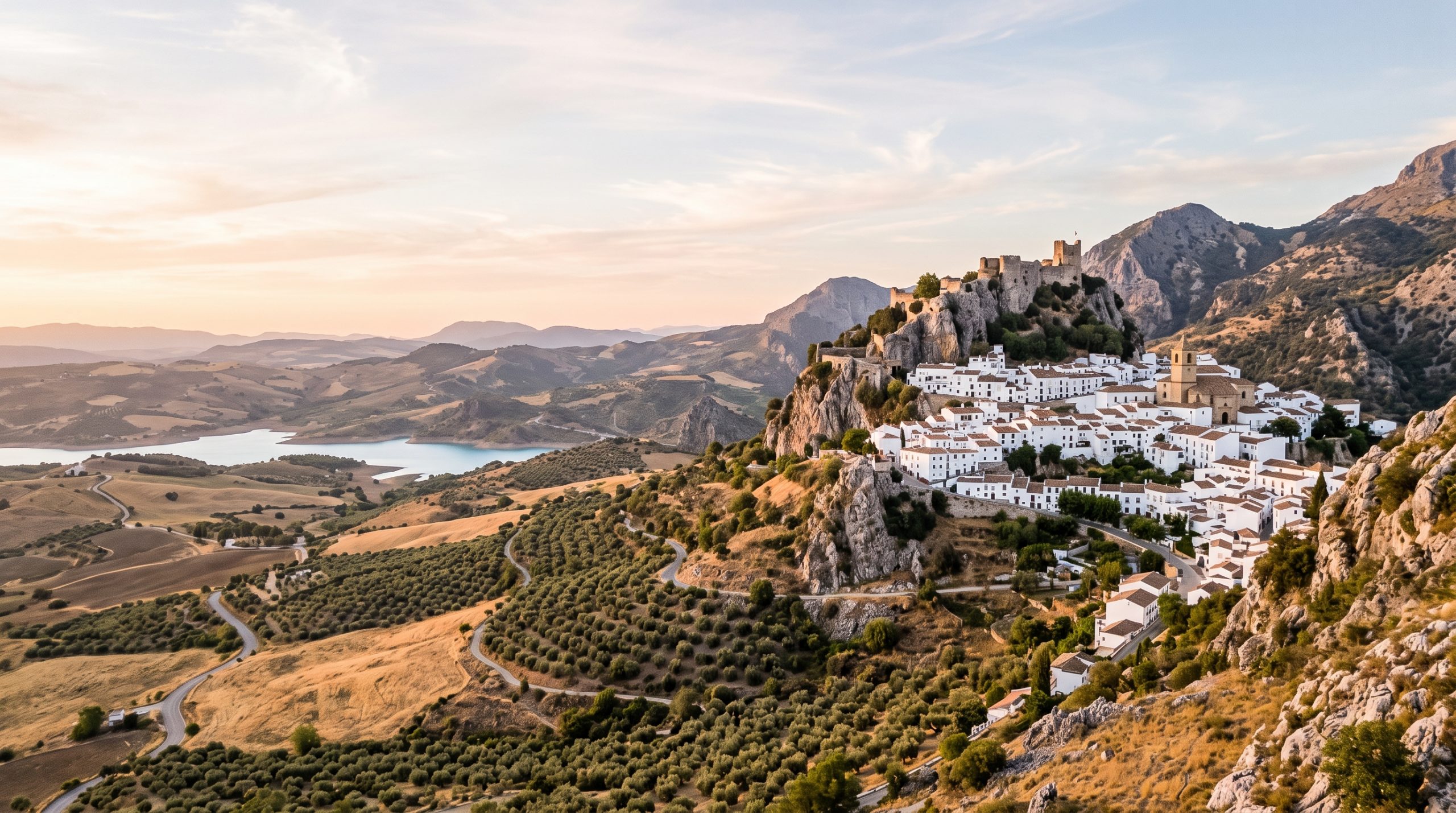
Spain keeps its clocks on Central European Time, and Andalusia sits almost due south of London. That administrative quirk is the most useful thing anyone can tell you before you plan an elopement here. In mid-July the sun does not set on Seville until 21:45, and there is still working light at 22:15. On the shortest days of December it does not clear the horizon until 08:34.
The light arrives late and leaves late, and for half the year the middle of it is no use to anybody. A late-September morning in the Ronda sierras begins to lift at 07:45, and the sun comes over the ridge at 08:11. By eleven the first coaches are up from the Costa del Sol and the Puente Nuevo has a line for the same six feet of railing. Between eleven and six you drive, eat and sleep, exactly like everyone who lives here.
We are Unmapped Stories: eight photographers and filmmakers who plan destination elopements and then shoot them ourselves. In Andalusia that means the timed half-hour palace slots at the Alhambra, the sand tracks into Cabo de Gata that shut behind a barrier when the parking fills, olive terraces above villages nobody stops in, and the Atlantic dunes west of Tarifa where the Levante wind decides which side of a ridge your vows can stand on.
Photo, film and planning from Granada to Cabo de Gata
One team covers all three. We photograph, film and plan elopements across Andalusia, from Granada and the high Sierra Nevada to the Cadiz sierras, the Atlantic coast and Almeria. Coverage starts at one full day with a dedicated photographer or filmmaker, and grows to both working together, or a route of several days. Team travel is included.
Two working blocks and a seven-hour gap
An Andalusian elopement day is not one continuous stretch of coverage with a lunch break in it. It is two long working blocks with a genuine hole in the middle, and once you accept that, the day gets better rather than worse. Here is a real late-September shape, based in the sierras between Ronda and Grazalema, where the villages sit twenty to forty minutes apart on switchback roads that are always slower than the map claims.
First block: 07:20 to 11:00
We meet at the door at 07:20 with coffee, in the dark, and in October you will want something over your shoulders for the first hour. The sky separates from the ridge line at about 07:45. We drive fifteen minutes to ground we chose months earlier and confirmed the previous evening, and the first frames happen in that flat blue half hour when the olive rows read grey-green and the villages below still have their street lights on. Sunrise lands at 08:11 and moves quickly at this latitude, so vows go at 08:20 with the sun still low and behind you rather than on top of you. From 08:40 to 09:40 the light is as good as Andalusia gets, and it is the hour we protect above everything else in the timeline. Then a second location while the streets are still empty, usually a village lane, and we are away from anywhere famous before the parking fills.
Second block: 18:00 to 21:30
Out again at 18:00, when the heat has come off the stone and the shadows have length. Sunset is at 20:14 in late September, and the twenty minutes after it are the ones worth driving for, because the limestone here holds colour after the sun has gone. Civil dusk runs to about 20:40, which is when a drone pass over a ridge stops working and a handheld frame with the last glow behind you starts to. Dinner is at 21:00, because that is when kitchens open in Spain, and by then we have been finished for a while.
Move that day into another month and the whole structure slides. Our destination guides go region by region, but the sun does the arguing:
| Window | Sunrise, Seville | Sunset, Seville | What the day gives you |
|---|---|---|---|
| Early March | 07:50 | 19:21 | Green sierras, full rivers, cool enough to walk all day |
| Late April | 07:37 | 21:08 | Wildflowers and long evenings; Seville beds are scarce around Semana Santa and the Feria |
| Mid June | 07:03 | 21:46 | A huge evening block and an afternoon you will not use |
| Late September | 08:14 | 20:17 | Warm sea, softer light, villages emptying out |
| Early November | 07:52 | 18:22 | Low sun all day, compact single-block days, olive harvest under way |
| Late December | 08:34 | 18:09 | The latest sunrise of the year and the gentlest start |
Everywhere famous here is busy by ten
The Mirador de San Nicolas is the view of the Alhambra you have already seen: red walls, Sierra Nevada behind, taken in the last half hour of sun. At that exact half hour it is also a wall three people deep with guitars going. We would rather say it straight than sell it to you. That is not a place to stand and say vows, and the photograph everybody loves is not improved by the eighty people who made it. At dawn the same view is backlit, cool and completely yours, which is a different picture and a much better hour to marry in. From San Miguel Alto, higher up the hill, the palace and the snow line and half the city fit in one frame with room to move.
The pattern repeats across the region. Setenil de las Bodegas under its rock shelf is extraordinary at 08:30 and a lunch street by noon. Private cars reach Genoveses and Monsul in Cabo de Gata on a daily quota in summer, the barrier drops when the parking is full, and a shuttle from San Jose takes over, so we work those bays early and leave before the first bus of the day. Inside the Alhambra, commercial photography and filming need prior authorization from the Patronato’s Public Visit and Commercialization Service, on top of a timed ticket that puts you into the Nasrid Palaces in a fixed half-hour slot you cannot move once you are there.
None of that is a reason to skip these places. It is a reason to plan them for the hour when they are actually good, and to keep somewhere else ready fifteen minutes down the road.
One team, two cameras, and light that goes hard by ten
Thirty minutes inside the Nasrid Palaces is not much time. A photographer working alone spends it on stills. A filmmaker working alone spends it on movement. Working as one team, we split the room before we ever walk in: one of us low in the corner for the arch and its reflection, the other holding a slow walk through the plasterwork while the light comes off it sideways. Nothing is negotiated in the doorway, because the plan was written weeks earlier by the same people carrying the cameras.
The same logic runs the coast. West of Tarifa the Levante can blow for days, and wind is the one thing that ruins audio and does nothing to a photograph. The Expedition adds professional audio for vows where conditions allow, which in practice means we put the ceremony in the lee of the dune or behind a rock spur, the filmmaker two steps in with a close mic, and the photographer out on the open side so the wide frame still has the whole Atlantic in it. Two people who met that morning would be making that choice at 19:40 with the wind rising. We make it in the proposal.
Then there is the middle of the Andalusian day, which from roughly 10:30 onward in summer is high, hard and contrasty. Stills can live off a single shade edge; film needs that light to hold steady for a minute or more. Picking ground where both work is a planning decision, not a morning improvisation. Aerials sit in the same category: they run under Spain’s AESA framework, and inside the Sierra Nevada, Cabo de Gata and Grazalema park boundaries they need an authorization and a stated window, so we confirm both before any sequence is built around them. One legal pass then serves the film and the stills, because it is one crew flying it.
Eight of us work these trips, which means there is always a second camera on the ground and a colleague in reserve. If you want to see how these sierras and this coast actually cut together, and how a backlit dawn in the Albaicin looks next to a 20:30 ridge in Grazalema, our published stories and films are the honest version of the answer.
Covered by us, paid locally
Every experience includes the planning, not just the shooting day:
- Destination and location design across the region, built from ground we have stood on
- A custom timeline written around real light and real Andalusian driving times
- Permit research and logistics guidance, including monument authorizations and park boundaries
- Weather alternatives and backup planning, which in the Cadiz sierras is not optional
- Drone footage where it is legal, safe and appropriate
- Professional audio for vows and meaningful moments on the Expedition, where conditions allow
- Team travel worldwide, flights and accommodation included, with no surcharge for this region
- Highlights delivered in 5 days, and the full gallery or film in 3 weeks
The Adventure covers one full day with a dedicated photographer or a dedicated filmmaker, from $4,900. The Expedition puts a photographer and a filmmaker on the same day, from $7,900. The Odyssey runs two to seven days, photography and film, across one destination or several, and is quoted as a custom proposal. We do not run half days. The full breakdown sits on the coverage and pricing page.
What you pay for locally in Andalusia: accommodation, your celebrant, monument and site tickets, any authorization fee a site charges, and transport. Alhambra general day admission is currently €22.27 a head, roughly 25 dollars with the euro trading a little above the dollar. A hire car handles most of the region, though the sand tracks in Cabo de Gata and a few cortijo drives want ground clearance, and anything unusual we would not drive ourselves is billed by its operator: a licensed boat off Cabo de Gata, a mountain guide above the ski station, a 4×4 into the Alpujarras. Guest numbers change access, permits and transport. They never change our fee.
If a week is already circled on your calendar, Check Your Date and tell us which corner of the region pulled you in first.
How an Andalusia enquiry becomes a held date
- Send the inquiry form with your rough dates and the part of Andalusia you are drawn to.
- We reply within 24 hours with an initial brochure and first thoughts on timing.
- We build a tailored proposal around your dates, your locations and the coverage you want.
- You sign the contract and pay a 30% retainer. The rest of the schedule is set out in the proposal.
- Planning begins: location design, the hour-by-hour timeline, permit research, weather alternatives.
- We travel, we shoot your day, and highlights reach you 5 days later.
The couples Andalusia rewards
This region is generous to people who will set an alarm. The hour from 08:40 to 09:40 in autumn does most of the work in a gallery, and you cannot buy it back at noon. It suits couples who are comfortable on uneven ground, because the good places here are karst limestone, sand track and olive terrace rather than lawn. It suits couples who can let a plan move on the morning, since the Cadiz sierras catch Atlantic weather and Grazalema is the wettest town in Spain, which is exactly why it is so green and why we always hold a second option.
If a 06:30 alarm is genuinely not happening, say so in your first message, because the fix is a month rather than a compromise. Early November gives you a 07:52 sunrise and a single unhurried block that ends by 18:50. Late December starts later still. If you want the reverse, June hands you an evening that runs to 22:00 and lets you sleep until nine. If you want green mountains and full rivers, March. If you want warm water, late September. Tell us what your ideal morning looks like and we will tell you honestly which weeks in Andalusia deliver it, and which ones will not. Our guide to planning an elopement covers the fundamentals that apply wherever you land.
Common questions
Can we legally get married in Andalusia if we are not Spanish residents?
A civil marriage in Spain is processed by the Registro Civil of the municipality where one of you is registered as a resident, with an empadronamiento certificate as proof of that. Couples travelling from the US therefore marry legally at home in almost every case, then hold a symbolic ceremony here with a celebrant. It changes nothing about how the day is planned or filmed.
Do we need permission to photograph and film inside the Alhambra?
Yes. Commercial photography and filming require prior authorization from the Patronato de la Alhambra y Generalife, handled by its Public Visit and Commercialization Service, and only requests compatible with the character of the monument are approved. You also need timed tickets, with a fixed half-hour entry slot for the Nasrid Palaces. We handle the research and the application timing; the ticket and any fee are yours.
Is July or August too hot for an elopement in Seville or Cordoba?
The Guadalquivir valley towns, Seville and Cordoba and Ecija among them, are the hottest ground in mainland Spain, and their afternoons in high summer are not photographable. The day still works, because sunrise is around 07:03 and light holds past 22:00. We build a dawn block and a long evening block and leave the middle alone, or move you to the coast or up into the Sierra Nevada.
Can you fly a drone in Cabo de Gata or the Sierra Nevada?
Aerials in Spain run under the AESA framework, and flights inside protected park boundaries need an authorization and a defined time window. We research both during planning and only build a sequence around a pass once it is confirmed. Where a permission is not available, the film is designed without it from the start rather than losing a shot on the day.
How many days do we need for Granada and the coast in one trip?
One full day works well if you stay inside a single comarca, such as Granada with the Albaicin and the sierra above it. Pairing Granada with the Almeria coast, or Ronda with the Atlantic dunes, really wants two or three days, because the driving is longer than it looks. That multi-day shape is what the Odyssey is built for.
When do we actually get the photos and the film?
Highlights arrive 5 days after your day. The full gallery, or the finished film, arrives within 3 weeks. Those windows do not change with the destination, and they do not change if we are working a multi-day route.
Does the price change if our parents and a few friends come?
No. Our fee is the same for two people as it is for twelve. What guests do change is access, permits, transport and the shape of the timeline, so tell us the number early and we will design the day around it.
Does it rain in the Andalusian mountains in winter?
The sierras of Cadiz and Malaga catch Atlantic fronts through the winter half of the year, and Grazalema records more rain than anywhere else in Spain. That is why the hills are green in March when the rest of the region is turning. Winter planning always carries a sheltered alternative and a village lane or interior we can work from if a front sits over the ridge.
Choosing your week in the south
Andalusia hands you an Atlantic coast and a Mediterranean one, the highest paved road in Europe above Granada, and a clock set nearly an hour and a half ahead of its own sun in winter. Which of those matters most to you decides your month more than anything else on this page. From the first reply onward, the whole process stays in writing: you send us your dates, we reply within 24 hours with the brochure, and the planning runs by email until we are standing in the dark with you at 07:20.
Tell us the morning you want and we will build the rest around it. Start Your Story.