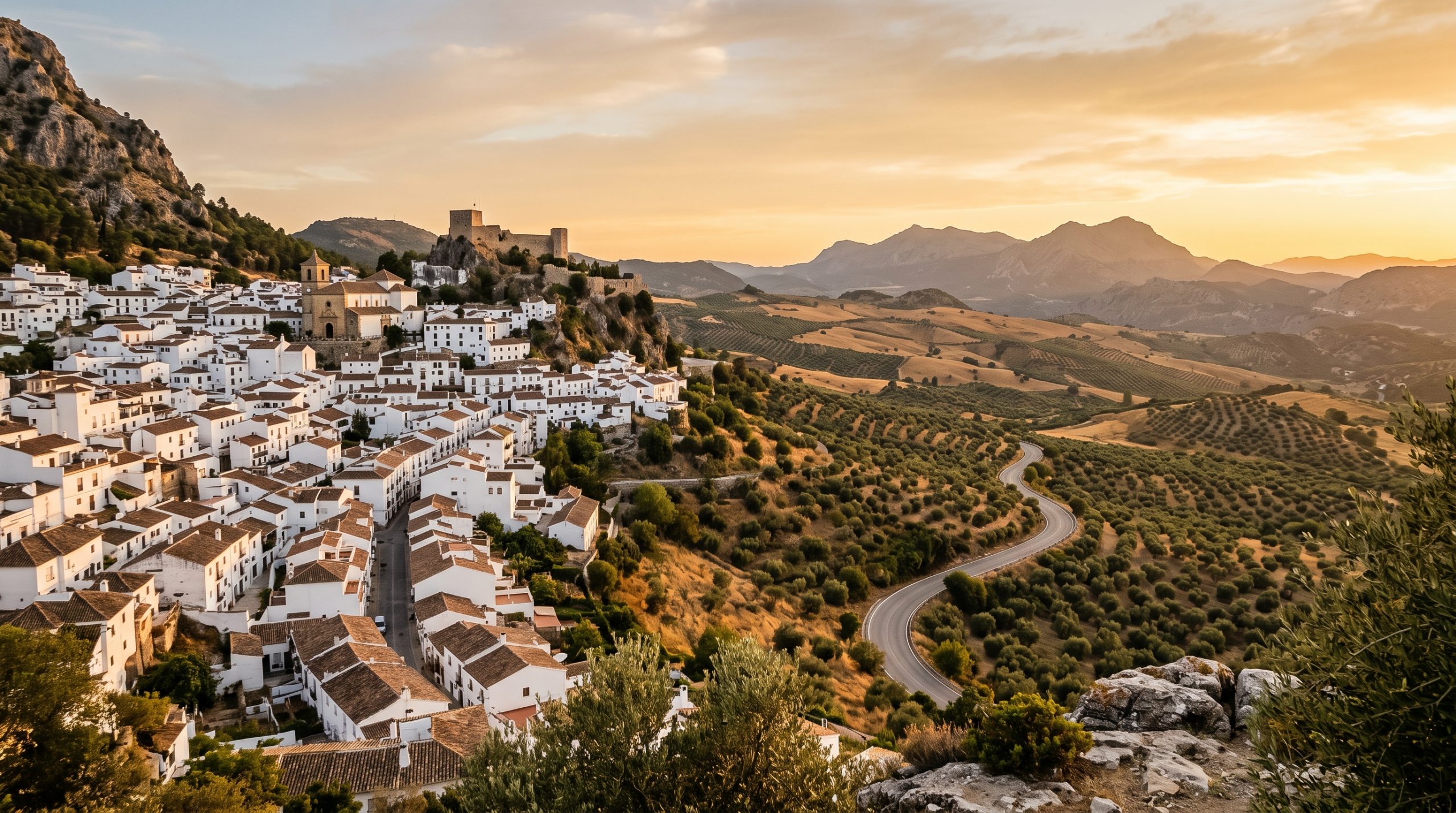
Andalusia sits at the western edge of Central European Time, and that one piece of geography shapes your day here more than any venue will. In mid-July the sun does not clear the Guadalquivir until around 7:15 in the morning, solar noon falls at 14:30, and the light does not leave Seville until nearly 9:45 at night. A day has two good ends and a long hollow middle, and every timeline we build in this region answers to that shape.
The second thing worth knowing early is that the most photographed view in Granada works at the wrong end of the day for a couple. From the Mirador de San Nicolás the Alhambra takes its warm light at sunset, which is exactly why people arrive an hour ahead and hold their patch of wall. At dawn the sun comes up behind the Sierra Nevada, the palace reads as a silhouette, and the white lanes of the Albaicín take the first light instead. Cooler, and much more private. We shoot the morning version.
What follows is how we plan an Andalusian elopement either way: one city done properly, or a route that links two or three provinces across several days. Photography, film and planning come from the same team, so the shape we propose is not a compromise between two suppliers’ schedules.
What we cover in Andalusia, and where a day starts
We are eight people, four photographers and four filmmakers, and we cover Andalusia as photography, film and planning from one team. One full day in Seville, Granada, Ronda or on the Cabo de Gata coast starts at $4,900. Multi-day routes linking two or three provinces are quoted as a proposal built around your dates.
One city or the A-92: how the two shapes differ
The A-92 is the spine of inland Andalusia, running Seville to Antequera to Granada and on to Almería. Seville to Granada is roughly two and a half hours of motorway. Seville to Ronda is a little over two hours on smaller roads, and Málaga airport puts you in Ronda in about an hour and a half. Those numbers are the whole decision, because they tell you what a driving day costs.
A one-city day gives you repositions of fifteen to thirty minutes and a great deal of time in front of a camera. A route gives you genuinely different country, and the drives happen on the mornings when nothing else is booked. What does not work is both at once. Nobody photographs Seville and Granada properly on the same day, because the drive lands squarely in the middle of it, and the middle of an Andalusian day is already the weakest light you will be given.
| Base | The day it gives you | What shapes the hours |
|---|---|---|
| Seville | Plaza de España close to empty at 7:30, Santa Cruz lanes, a rooftop at dusk | Monument opening hours and coach arrivals; professional photography inside the Real Alcázar needs written authorization from the monument, and there is a fee for it |
| Granada | Albaicín at first light, a Nasrid courtyard, then 2,500 m of mountain in the evening | The Nasrid Palaces admit visitors in 30-minute windows and the printed time is enforced |
| Ronda and the white villages | Gorge edge, old town, olive country and a cortijo garden | Small viewpoint platforms that fill by mid-morning; two hours from Seville |
| Cabo de Gata coast | Volcanic coves, dunes behind Mónsul, dry scrub and open sky | Summer vehicle access to Mónsul and Genoveses is regulated, with a shuttle from San José |
If you are still weighing regions rather than shapes of day, our destination guides go province by province. If you already know you want Granada, skip straight to the hours below, because in Granada the hours are the plan.
Sunrise at 7:15, dinner at ten: a Granada day hour by hour
This is a June day, the hardest version, because if the plan works in June it works in any month. Civil twilight in Granada begins around 6:25 and the sun is up by about 6:55.
We start in the Albaicín at 6:30, while the lanes still hold the night’s cool and the cisterns and carmen walls are empty. This is the hour the quarter belongs to a couple and two cameras rather than to walking groups. By 7:45 the light has gone hard and white, and that is the cue to stop, eat something, and change.
The morning’s fixed point is the Alhambra. The Nasrid Palaces admit visitors in half-hour windows, the time on the ticket is enforced at the checkpoint, and in the busy months those windows are gone weeks ahead. So the ticket comes first and the rest of the day is built outward from it. Inside, everything is handheld: tripods and flash need written authorization from the Patronato, and professional work needs that authorization arranged in advance rather than argued at the gate. We do that arranging as part of planning.
Between about one and five in the afternoon we do very little outdoors, and neither does Granada. Solar noon is 14:16 in June, the courtyards go flat, and the useful work is indoors or in deep shade: a carmen with a fountain, getting-ready frames, an hour of nothing at all. Couples who resist this part are always glad of it by nine that evening.
Ceremony at 18:30 in a private garden, when the walls have begun to warm again and the swifts are working the rooftops. Then the drive. The A-395 climbs from the city to Hoya de la Mora in about forty minutes, ending at roughly 2,500 m where the public road stops and only authorized vehicles continue. It is cold up there in July, patches of snow sit in the gullies into midsummer, and the wind comes off Veleta at 3,396 m. We bring layers for you and we tell you before the day, not on the roadside.
Sunset in Granada is about 21:38 in late June, later still from that ridge, and civil twilight holds until roughly 22:09, which gives a long blue window over the Vega de Granada. Dinner at 22:30 is entirely normal in this country. In mid-October the same day compresses politely: sunrise near 8:22, sunset at 19:38, everything an hour and a half later at the start and two hours earlier at the finish.
The heat and the ticket queue
These are the two things couples raise before anything else, and both are hour problems rather than reasons to look elsewhere. We do not fight the middle of a July day, we vacate it, which is why the timeline above holds two working blocks and a genuine gap. If you would rather not build a day around a 6:30 start at all, late September and October give you an 8:00 start, a 19:30 sunset and a far gentler afternoon.
The queue is a planning problem with a known answer. Timed monument entry is booked before anything else is confirmed, permission for anything beyond handheld work is requested in writing ahead of time, and the outdoor locations we choose for the first and last hours of the day are the ones that are not on a coach route. Tell us your month and we will tell you honestly which of Seville, Granada and Ronda behaves best in it. Check Your Date and we will come back with the shape of the day, not a brochure of options.
Two cameras inside a thirty-minute palace slot
Here is where one team stops being a talking point and starts being the reason the day works. You have half an hour inside the Nasrid Palaces, handheld, with other visitors moving through, courtyards blazing and adjoining halls three stops darker. A photographer and a filmmaker who met that morning will spend a good part of that half hour negotiating the same square meter of tile, and you will feel it, because you will be standing in the middle of the negotiation.
Our photographers and filmmakers arrive as a working pair rather than as two suppliers, and in a room like that they split without discussing it: the photographer takes the still from the arch while the filmmaker holds the wide, then the filmmaker moves in for the walking frame and the photographer steps back for the reflection in the pool. Nobody asks you to repeat anything twice for a second camera. Thirty minutes stays thirty minutes.
Andalusia also rewards a filmmaker in ways stills cannot reach. Water is everywhere in these gardens, and a courtyard fountain under a vow, swifts screaming over Seville rooftops at dusk, cicadas in the Cabo de Gata scrub, wind pushing up the gorge at Ronda: that is the soundtrack of the region, and it is half of what you will remember. The Expedition adds professional audio for vows and the moments that matter, where conditions allow.
Aerials are planned rather than assumed. Spain runs drone operations through AESA under Royal Decree 517/2024, which means operator registration, and separate authorization for heritage sites, national park land and urban airspace. So we confirm where a drone is legal and appropriate before we design a film around it, and in practice that puts the aerial work over open scrub, coastline and private estates rather than over a UNESCO courtyard. You can see how the pairing lands in our published galleries and films, where the same courtyards, gorges and high ground turn up in both the stills and the motion.
Because there are eight of us, there is always a second camera on the ground and a colleague in reserve. That is the quiet part of the promise, and it is the part that matters at 6am in a city you have never woken up in.
What the fee covers, and what Andalusia bills separately
Every experience, in every destination, includes the following.
- Destination and location design, and planning from the first message to the last frame
- A custom timeline built around light and real travel time, not around a template
- Permit research and logistics guidance, including monument authorizations and timed entry
- Weather alternatives and backup planning for every outdoor block of the day
- Drone footage where it is legal, safe and appropriate
- Team travel worldwide, flights and accommodation included, with no long-haul distinction
- Highlights delivered in 5 days, and the full gallery or film in 3 weeks
Coverage comes in three shapes. The Adventure is one full day with a dedicated photographer or a dedicated filmmaker. The Expedition is one full day with a dedicated photographer and filmmaker working together, from $7,900, and adds professional audio for vows where conditions allow. The Odyssey runs two to seven days across one or several destinations, photography and film, quoted as a custom proposal. The figures and what sits behind them are on the pricing page, and the fee does not move with your guest count. Guests change access, permits, transport and timeline, never the price.
Paid locally, in euros
Andalusia adds a short list of third-party costs, and it is short. Timed monument admission is per person and priced by each monument, so Alhambra and Real Alcázar tickets sit with you. Where a monument or town hall charges a fee for professional photography, that fee is yours and the paperwork is ours. Then the ordinary things: accommodation, your celebrant, food, and any unusual transport such as a 4×4 up a track, a private boat on the Almería coast, or the summer shuttle to the regulated beaches at Cabo de Gata.
How an Andalusia package moves from first message to plan
- Send the inquiry form with your dates, or your rough window, and the region you are circling.
- We reply within 24 hours with our initial brochure and a first read on whether your month suits the plan.
- We ask what kind of morning you actually want, and propose one city or a route accordingly.
- You get a tailored proposal: coverage, the team assigned, a sketch timeline and the permit list.
- Contract signed and a 30% retainer paid. Your date and your team are held.
- Planning begins in earnest, and the remaining payment schedule is set out in the proposal.
Our planning calendar for Andalusia currently covers 2027, 2028 and 2029, and if you are early in the process the planning fundamentals will save you a month of reading.
Couples who do well on Andalusian hours
This region suits couples who will take a 6:00 alarm in exchange for an empty Albaicín, who are steady on cobbles and sand and a rough mountain track, and who understand that 2,500 m is cold at nine in the evening even when the city below was warm at three. It suits people who like a plan that moves on the morning: the palace slot is fixed, and almost nothing else has to be.
It also suits couples who want their families there. The fee is the same for two people or twenty, and what changes is access, permits, transport and how the timeline breathes. Small groups do well in Ronda and in the villages; the tighter monuments reward a very small party.
If a pre-dawn start genuinely is not your idea of a good morning, say that in the first message. There is a version of this day that begins at four in the afternoon and finishes under a blue sky at ten, and there are months where the light is simply kinder to a later start. We would rather redesign the hours, or tell you plainly that October fits you better than July, than hand you a timeline you will resent at dawn.
Common questions
Can we legally get married in Andalusia if we live in the US?
Spanish civil marriage applications go to the Civil Registry or court where at least one of you resides, so almost every couple flying in from the States marries legally at home and holds the ceremony here with a celebrant. The ceremony is the real thing either way, and we build the day around it.
Can you photograph and film inside the Alhambra?
Yes, handheld. Tripods and flash require written authorization from the Patronato, professional work needs that authorization arranged in advance, and the Nasrid Palaces run on enforced half-hour entry windows. We book the slot first and design the day outward from it.
Can we do Seville and Granada in one day?
Honestly, no. They are about two and a half hours apart on the A-92, and that drive eats the middle of the day, which is the only part of an Andalusian day you can afford to lose. Two cities means two days, and that is what the multi-day proposal exists for.
Is October really a better bet than July?
Late September and October are the easiest to plan well: in mid-October Seville’s sun rises around 8:32 and sets at 19:48, so the day is civilized at both ends. May is beautiful and busy. July and August work, but only if you accept a 6:30 start and a genuinely empty afternoon.
Can we get a drone shot over the Alhambra or on the coast?
Not over the monument. Spain requires operator registration with AESA, and heritage sites, national park land and urban airspace need separate authorization, so we place aerials where they are permitted and appropriate: open scrub, coastline, private land. We confirm this before the film is planned, never on the day.
Can we reach Mónsul or Genoveses in August?
Yes, with timing. Vehicle access to those beaches is regulated each summer, currently from around 20 June to late September, with control through the middle of the day and a shuttle from San José. Our coastal blocks start well before control begins, which is also when the sand is empty.
How soon do we see photos and film?
Highlights land in 5 days, and the full gallery or film follows in 3 weeks. That timing is the same for one day in Seville and for a week across three provinces.
Do you charge extra for a second destination or extra guests?
Guests never change the fee. A second destination changes the structure rather than adding a surcharge, because multi-day coverage is quoted as its own proposal with travel between locations built into the timeline.
Choosing your month, and what happens next
The best Andalusian days we have made started with a couple telling us something small and specific: that they wanted the Albaicín before the shops opened, or that one of them had read about a cortijo outside Ronda, or that they simply could not face a crowd. Everything after that is our problem, from the palace slot to the layers at 2,500 m.
Every planning step stays in one written thread, at whatever hour suits you: the form, our reply and brochure within 24 hours, your proposal, then planning by email until the morning itself. Send us your dates, your region if you have one, and the hour of day you actually like being outdoors. Tell Us Your Story and we will come back with a day built on Andalusian light.