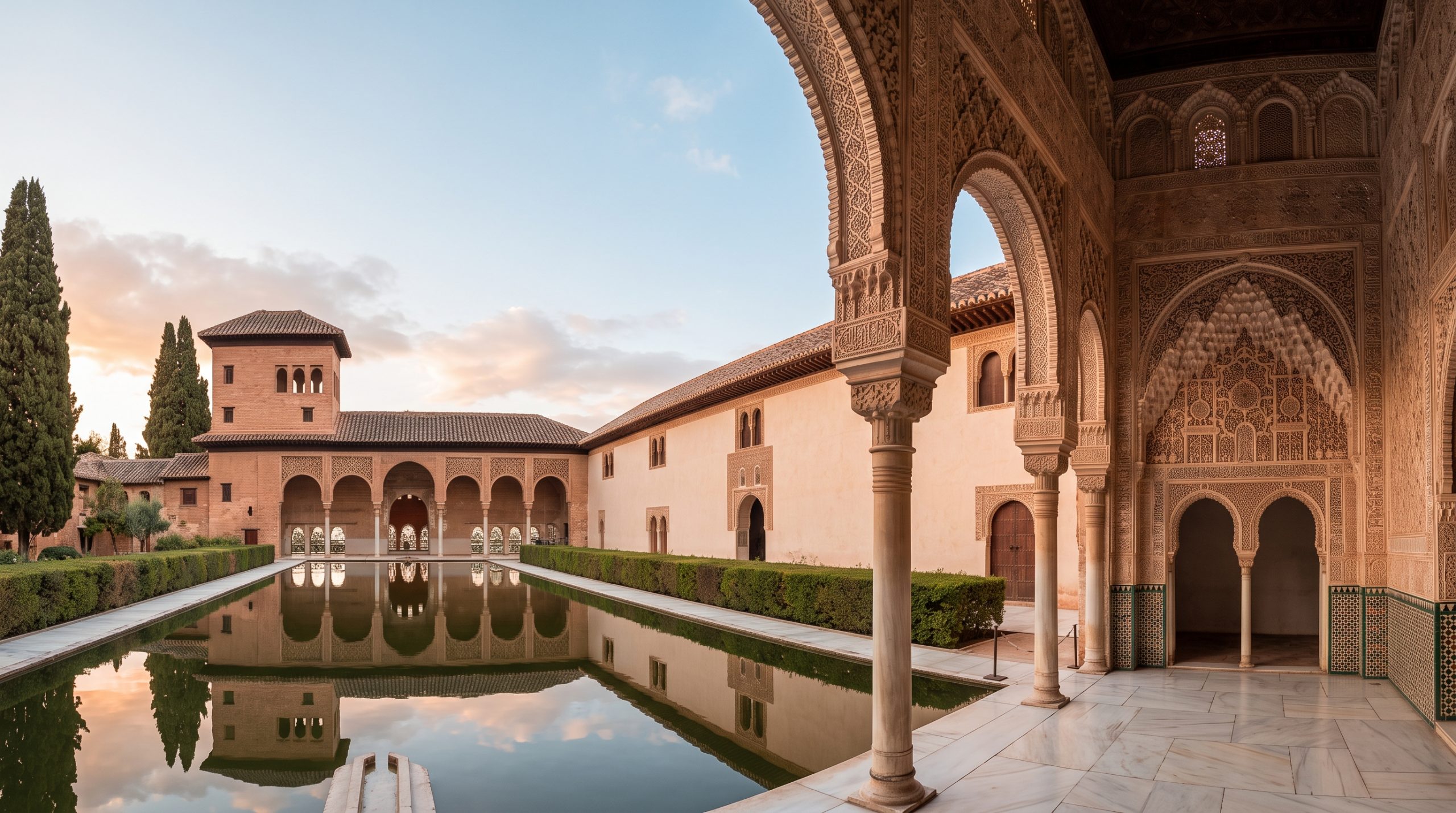
The Patio de los Leones at nine in the morning is quiet in a way it is not again all day. Ticket holders are still walking up through the woods from the Puerta de las Granadas, the marble is cold underfoot, and the twelve lions are pushing water into a courtyard that will be three deep in visitors by eleven. That hour, and the permission that gets you into it, is what this page is about.
The Alhambra is not a wedding venue. It is a World Heritage complex run by the Patronato de la Alhambra y Generalife, and it does allow wedding photography inside the walls, in a short list of named places, with authorization asked for and granted before the day. It also has exactly one building where a wedding is celebrated, and that building keeps a calendar of its own with twenty dates a year on it.
So what is actually allowed splits into two questions with two different offices behind them: what you may do with cameras, and what you may do with vows. The useful part is that both resolve into one workable day, and the shape of that day is predictable once you know the rules.
What the Patronato allows, in one paragraph
Wedding photography inside the Alhambra is allowed with prior authorization from the Patronato, and only in named spaces: the Patio de los Arrayanes, the Patio de los Leones, Lindaraja, the Partal and designated gardens. A legally celebrated wedding inside the complex happens in one place, the church of Santa Maria de la Alhambra, which holds twenty a year.
Four courtyards, a garden list, and the half hour that governs them
The Patronato permits wedding photography inside the monumental complex and also in the Andalusi monuments down in the city that it manages, and it does this by prior authorization. You ask, in writing, before the day, naming what you want. Inside the walls the permitted spaces are that short list and nothing beyond it: the Patio de los Arrayanes with its long reflecting pool, the Patio de los Leones, Lindaraja, the Partal, and designated gardens. None of it is negotiable on the morning, which is why we treat the list as the first line of the timeline rather than a detail to sort out on arrival.
The second constraint is the ticket itself. A general Alhambra ticket carries a named half-hour entry window for the Nasrid Palaces, and that window is the hardest edge in the day. You go in when it says, the route through the rooms runs one way, and you do not loop back for a second attempt at the Arrayanes pool because you liked the reflection. Everything else on the hill is elastic by comparison: the Partal terraces, the walk along the ramparts, the Generalife with its cypress hedges and water channels.
Then there is the crowd, and we would rather be straight about it than let you find out at 11:30. The Patio de los Leones in the middle of an April morning is shoulder to shoulder. The twelve lions are extraordinary and you will be photographing them past somebody’s elbow. The first palace slot after opening and the last hour before closing are genuinely different places: cooler in the marble courts, quieter under the arcades, and the light in the Arrayanes pool sits even rather than blowing out into white. If you want the Alhambra to feel like it belongs to you for twenty minutes, that is the trade, an early alarm or a late finish.
Film and photography behave differently in those rooms. Stills can live on one shaft of light through a lattice screen; a film needs movement, and the honest movement inside the Nasrid Palaces is you walking, slowly, with the building doing the rest. You can see how the two cut together in our published stories and films, which is a more useful guide to what these courtyards actually look like at 8:30 in the morning than any description we could write here.
Santa Maria de la Alhambra, and the twenty dates a year
The Patronato and the Archdiocese of Granada signed a regulating agreement that reopened this small church inside the walls to weddings after fifteen years without them, and it caps the number at twenty couples a year. Between 1 April and 15 October, ceremonies are held at 19:00, and only on Fridays and Saturdays. That is not a house preference you can negotiate around, it is the agreement, and the Patronato drew up its own rules for couples alongside it to protect the monument.
Access is written into those rules, because moving a wedding party through a monument that is still full of visitors needs a shape. The couple’s route into the grounds is by vehicle. Guests arrive on foot through the Puerta de la Justicia or the Puerta de los Carros, and public transport up the hill is advised over hunting for a space near the walls. Couples also commit to leaving the church and its surroundings exactly as they found them, which in practice rules out rice, confetti and petals, anything that somebody would have to sweep out of six-hundred-year-old paving.
For us the number that matters is 19:00. In the first half of October, a seven o’clock ceremony ends with the sun dropping behind the Vega and the walls turning the colour they were named for. The same hour in July is still bright and still hot, with the good light more than two hours away, which changes where we take you afterwards and how late the day runs. If a wedding inside the walls is what you want, the date is held through the church rather than the ticket office, and a date this specific is worth deciding a long way out.
Marrying legally in Spain, and the shape most visiting couples land on
Here is the difficulty rating, without the fog. A civil marriage in Spain is ordinary and straightforward for people who live there, and it is not realistically available to couples flying in for a week. The file that has to precede a civil wedding, the expediente matrimonial, is opened with the Registro Civil covering the place where one of you lives and is registered on the local padron. No residency, no file. That single rule is why weddings in Spain for visiting couples resolve into two routes instead of a dozen.
The first route is canonical. A Catholic wedding is open to non-residents, and it is the route that puts a legally effective ceremony inside the Alhambra walls at Santa Maria. The file starts in your own parish at home and travels through your own diocese to the Archdiocese of Granada; once the wedding has been celebrated it is entered in the Spanish civil register, and that entry is what gives it civil effect. It runs on church requirements and church time, which are not ours to speed up.
The second route is the one most couples we work with take, and we would not describe it as a compromise. You complete the legal marriage at home, in your own state, with your own witnesses, in the time it takes to park. Then you fly to Granada already married, and the ceremony on the hill is entirely yours: your words, your hour, no office queue, no interpreter, no translated file. Same-sex marriage has been legal in Spain since 2005 and the civil framework is the same for every couple; for visiting couples the deciding factor is residency, not who you are.
We can build the day around the paperwork, but we do not decide the law. Rules change and circumstances differ, so confirm the detail with the Registro Civil in Granada, with the parish, or with your own consulate before you book flights.
| What you are choosing | Wedding at Santa Maria de la Alhambra | Married at home, ceremony in Granada |
|---|---|---|
| Who holds the date | The church, through your own parish and diocese | You, against the light and the opening hours |
| Days and hours | 19:00, Fridays and Saturdays, 1 April to 15 October | Any hour the complex is open to visitors |
| How many a year | Twenty | No cap |
| Paperwork inside Spain | Canonical file, then entry in the civil register | None |
| Photography in the courtyards | Patronato authorization, named spaces only | Patronato authorization, named spaces only |
| How guests get in | Puerta de la Justicia or Puerta de los Carros, on foot | Named, timed tickets, the same as any visitor |
Start with your Alhambra photo window and work backwards
Guides to paperwork usually run forwards. Days on the Alhambra hill run backwards from the minute you say your vows, so that is how we build them.
- Fix the hour first. The ceremony time decides the ticket window, the walk, the light and the order of the courtyards, and every other choice bends around it.
- If the ceremony is the canonical one, open the file in your own parish at home. Your diocese forwards it to the Archdiocese of Granada, and the church holds the date.
- If the legal marriage is happening at home, complete it there before you fly. Nothing then has to be filed, translated or legalised in Spain.
- Request the Patronato’s authorization for the wedding photography, naming the day and the spaces you want to use.
- Buy named, timed tickets for everyone going inside, the two of us working included. Identification is checked against the name printed on the ticket.
- Confirm the access route: which gate the guests use, where a vehicle can reach, how long the uphill walk takes in the shoes you have chosen.
- If any official document does have to travel from the United States and be used in Spain, it needs an apostille from the state that issued it and then a translation by a traductor jurado, a translator sworn in Spain. Start both earlier than feels necessary.
The comfortable minimum for a church date at Santa Maria is a year, and that is what we would work to rather than anything tighter, because twenty dates a year spread across Fridays and Saturdays is a small pool and the good evenings in early October go first. A ceremony-only day with authorized photography in the courtyards is far more elastic, and there we plan in weeks rather than days for the authorization and the tickets, so the timeline is never sitting still waiting on an answer. Our planning fundamentals cover the decisions that come before any of this, the ones about shape and guest list and how much of the day you actually want photographed.
Deadlines and charges quoted here were correct at the time of writing and are worth re-checking with the office that issues them.
What catches couples out on the hill
- The half-hour palace window. It is printed on the ticket and it is the one thing up there that does not wait for anybody. We put a buffer in front of it and the slower, quieter frames after it.
- Named tickets. Every ticket carries a name and identification is checked, so a spare cannot be passed to a cousin who changed their mind at breakfast. Guest numbers get settled earlier here than at most destinations.
- The size of the site. From the ticket pavilion to the Nasrid Palaces is a fifteen to twenty minute walk on old paving, and the Generalife sits at the far end again. Two spots that look adjacent on the map can be a long uphill walk apart in a dress.
- Nothing that has to be swept up. Confetti, rice and petals are out inside the monument. That is a small thing to hear now and an awkward thing to discover with a bag of them in your hand.
- The drift in the light. In late June the light holds past nine in the evening; in December it is finished not long after six. The same 19:00 ceremony is a different photograph in October than it is in July, and the evening has to be built differently around it.
- The Mirador de San Nicolas at sunset. It hands you the postcard view of the walls with the Sierra Nevada behind them, and it hands it to you shoulder to shoulder with everyone else who read the same guide, buskers included. We either use it deliberately for ten minutes or not at all, and keep a quieter terrace further up the Albaicin for the part of the evening that is actually about the two of you.
None of that is hard once it is written down in the right order. It is simply specific, and a monument this old asks for specific. If you have a date in mind, or a week and no date yet, Check Your Date and tell us what you are picturing.
What we can hold on the Alhambra day, and what remains in your name
We plan the day around every constraint on this page: the authorization and the spaces it covers, the ticket window, the ceremony hour, the walking time between locations, and a weather alternative that is genuinely usable rather than theoretical. Permit research and logistics guidance are ours. The government, venue and landowner fees themselves are yours, along with accommodation, the celebrant, and anything with wheels or rotors that is not an ordinary taxi. We do not file paperwork and we do not sign anything on your behalf.
Because photography and film sit in one team here, that half hour inside the Nasrid Palaces never becomes a choice between them. A dedicated photographer and a dedicated filmmaker who planned the hour together walk in at the same minute, cover it from two positions, and nobody asks you to repeat a first look for the second camera. There are eight of us, so there is always a colleague in reserve.
Photography, film and planning are a single service with us, and the coverage levels are set out on our pricing page. Team travel is included worldwide, Granada among everywhere else. Highlights reach you within five days, and the full gallery or film within three weeks.
Common questions
Can you actually get married inside the Alhambra?
Yes, in one building. The church of Santa Maria de la Alhambra holds weddings under a regulating agreement between the Patronato and the Archdiocese of Granada, limited to twenty couples a year. Between 1 April and 15 October ceremonies are at 19:00 on Fridays and Saturdays. The date is held through the church, not through the monument’s ticketing.
Do we need a permit to photograph our wedding at the Alhambra?
Yes. Wedding photography inside the monumental complex, and in the Andalusi monuments in the city that the Patronato manages, requires prior authorization from the Patronato. The authorization is separate from admission: everyone who walks in still needs a ticket, including us.
Which parts of the Alhambra can we be photographed in?
The permitted spaces inside the complex are the Patio de los Arrayanes, the Patio de los Leones, Lindaraja, the Partal and designated gardens. That list is the plan. We build the rest of the day around Granada itself, the Albaicin lanes, the Sacromonte slopes and the viewpoints looking back at the walls.
Can Americans get legally married in Granada?
Not through the civil route in practice. The expediente matrimonial is opened with the Registro Civil where one of you lives and is registered locally, so it needs residency. The Catholic route is open to non-residents, and most couples we work with marry legally at home first and hold the ceremony in Granada.
Do our photographer and filmmaker need Alhambra tickets too?
Yes, and named ones. We buy ours as soon as the day is fixed, because tickets carry the holder’s name and identification is checked. It is one of the first things we do after a date is confirmed, alongside the authorization request.
Can we fly a drone over the Alhambra?
No. We do not plan aerial work over the monument or the city centre, where Spanish rules on built-up areas and gatherings of people make it the wrong tool. When a film wants altitude we build it into a second location outside the city, in the Sierra Nevada or the Alpujarras, on a permit and inside a time window.
Do we need witnesses in Spain?
A canonical wedding needs two witnesses, arranged with the parish through your own priest. If you complete the legal marriage at home, the witness rules are your own state’s and usually the simplest part of the whole thing. A ceremony on the hill with no legal effect needs nobody but the people you want there.
When is the light best in the Nasrid courtyards?
The first entry slot after opening and the last hour before closing, in that order. The courtyards are open to the sky and unforgiving at midday. Outside, late September and October give you a 19:00 ceremony finishing in low gold light, where the same hour in July is still full daylight.
Picking your hour on the Alhambra hill
If the Alhambra is the reason Granada is on your list, the decision that shapes everything is not the paperwork. It is the hour you choose to be standing in those courtyards, and whether you would rather have them at half past eight in the morning or in the last light of the evening. Tell us which of those two people you are and the rest of the day builds itself outward from there; our destination guides are a good place to see how other coastlines and mountains compare if you are still weighing Spain against somewhere else.
Everything between us happens in writing, whenever it suits you. You send the form, a reply and our first brochure come back within 24 hours, then a tailored proposal, and planning begins once the contract is signed and the 30% retainer is paid. Our current booking window runs through 2027, 2028 and 2029. Tell Us Your Story and tell us the month you are thinking about, and we will tell you honestly what the light and the calendar are doing in it.