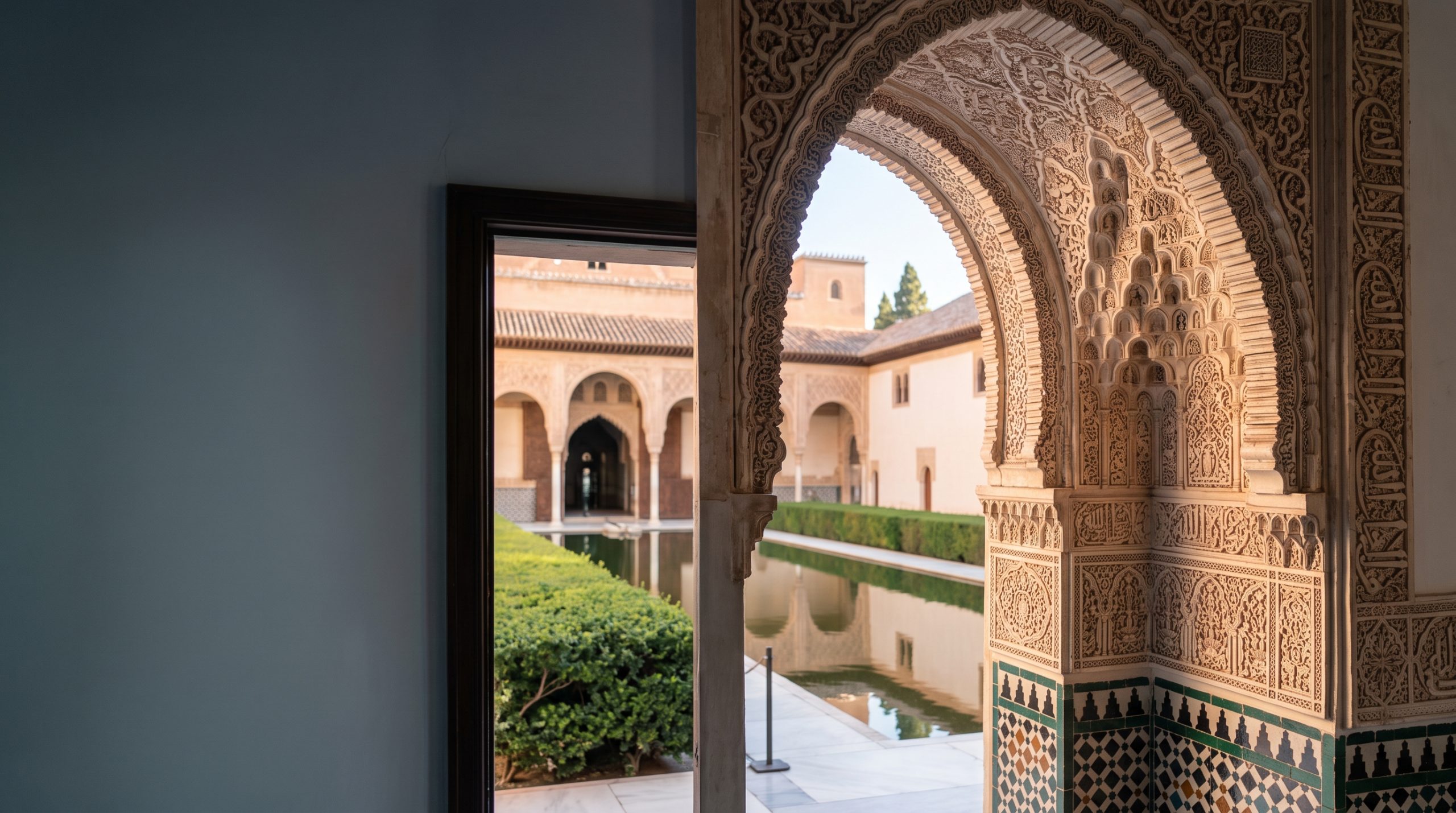
Five spaces. That is the entire list of places inside the Alhambra where wedding photography is permitted: the Patio de los Arrayanes, the Patio de los Leones, Lindaraja, the Partal, and the Jardines Bajos around the Generalife amphitheatre. Not the Alcazaba ramparts. Not the long water garden every postcard is taken in. Five, and only with an authorization the Patronato asks you to start at least fifteen days out, which is not confirmed until the fee has been paid.
That one rule reorganizes everything else. In most destinations we choose a place and the light follows. Here the monument hands you a shift and a set of rooms, and the vows, the walk and the last hour of the evening all arrange themselves around what is written on the authorization and the hour printed on your ticket.
So this page is about the parts that are hard to find: how the booking really works, what the hill is like to walk in wedding clothes, where a ceremony can actually take place, and why we treat the most famous viewpoint in Granada as a sunrise location.
The honest answer about ceremonies inside the walls
The Alhambra’s own rules provide for wedding photography, not for weddings. With prior authorization you can photograph in five named spaces during a morning or afternoon shift. The vows themselves happen elsewhere on the hill: an Albaicín terrace, a private garden, the Darro valley. The monument becomes the hour in the middle of the day.
Five spaces, two shifts, fifteen days
The Patronato de la Alhambra y Generalife, the body that runs the monument, allows wedding photography inside the monumental complex with prior authorization. The list of places is short and it is written down: Patio de los Arrayanes (the Court of the Myrtles), Patio de los Leones (the Court of the Lions), Lindaraja, the Partal, and the Jardines Bajos beside the Generalife amphitheatre.
The work happens in one of two shifts. Morning runs 08:30 to 14:00. Afternoon runs from 14:00 until closing, which is 20:00 in the summer season and 18:00 in winter. Inside your shift the Patronato assigns a specific hour for entering the Nasrid Palaces, and that hour is assigned at the applicant’s request, which makes it the most valuable line on the form. It is the one lever anybody has over the light in the Court of the Lions.
Applications have to be started at least fifteen days ahead. Fees follow the public price order in force, and the date is not actually held until the fee has been paid, which is worth knowing if you are pinning a whole trip to one morning. Filming and photography inside the monument require the Patronato’s authorization in their own right, and tripods and flash sit outside the ordinary visitor rules and need express permission, night visits included. That last detail shapes an interior hour more than most couples expect.
The research, the forms and the follow-up are ours. The permit fee itself, here as in every destination, is paid by you.
Getting up the hill in wedding clothes
The way in is not the way most couples picture it. The main entrance sits at the Generalife end of the hill, and the monument’s own guidance for wedding photography is to leave the car in the Alhambra car park and walk in through the Generalife pavilion, because the barrier further along, beside the Mimbre restaurant, admits public-service vehicles only. A taxi can therefore get you closer than a hire car can.
Then there is the ground. The Albaicín and the lanes along the Darro are paved with rounded river cobbles set on edge, polished by centuries of feet and steep in long stretches. A narrow heel finds nothing to stand on. Everybody we take up here walks in flats and changes at the top, and a long train gets carried rather than worn on the climb. The Cuesta del Rey Chico, the shaded path that rises from Paseo de los Tristes between the Alhambra walls and the Generalife, is a fine climb in the cool part of the morning and a poor idea at two in the afternoon in August.
Gates open at 08:30 and the ticket window from 08:00, so a morning shift means an early start with the lanes still empty. We want to be standing at the palace door before your printed hour, with the long walk from the entrance already behind us rather than ahead of us.
Vows on the hill, not in the palace
Spain’s civil registry route is built around residency, which is why the couples we bring to Granada almost always complete the legal marriage at home and hold a celebrant-led ceremony here. That is not a compromise. It means vows at first light on a private terrace, in whatever language you like, with nothing shortened to fit a registrar’s list. Our guide to how eloping actually works sets out the paperwork order.
Three kinds of place carry a ceremony well on this hill. A carmen, the Granada word for a walled house and garden, gives you privacy and the Alhambra sitting on the hill opposite; these are private property, so permission comes from an owner and the fee is theirs. The Silla del Moro, the restored watchtower above the Generalife, looks down on the whole complex with the Vega opening out behind it, and the Patronato lists it as a free-entry site, opened on a limited weekend schedule, reached on foot up the old road that starts behind the Generalife by the cemetery car park. We confirm those hours for your date before anything is built around it. Third is the Darro valley below Paseo de los Tristes, where you get water, plane trees and walls above you at an hour when nobody is on the bridge.
Guest count does not change our fee. It changes access, permissions and how long each move takes, which is why we ask about it in the first exchange.
San Nicolás at sunset, and why we go at first light instead
The Mirador de San Nicolás is a viewpoint where the light comes from behind you. Late in the day the sun drops over the Vega and lands full on the north walls, and the hill turns the colour the monument is named for. That is the reason for the crowd, and the crowd is the reason we rarely work there at that hour. People take their place along the parapet long before the light is any good, the square fills with tour groups and guitars, and arriving early is not, on its own, enough.
First light is a different location at the same address. The sun comes up behind the Alhambra, over the Sierra Nevada, so the towers stand dark against a lit sky with haze still sitting in the Darro valley underneath. You do not get red walls. You get depth, silence and an empty square, and in February you get snow on the range behind. That is the frame we plan for, and you can see how this kind of light behaves across our elopement stories and films.
If the red-wall version is the picture in your head, tell us. There are smaller terraces in the streets around the mirador where two of us and a couple can stand at that hour without negotiating for space, and we would rather put you on one of those than pretend the main viewpoint is quiet.
Two of us in the Court of the Lions
The court is an arcaded room built around a forest of slender columns, with a marked visitor route through it and people in it at every hour it is open. It is also, oddly, easy to work in as a pair. The galleries give a photographer somewhere to stand in shadow while the filmmaker takes the long axis from the opposite side, and the columns keep each of us out of the other’s frame. Because photography and film come from the same eight-person team rather than two vendors introducing themselves on the morning, that choreography is settled before we walk in. Sound is the honest limitation here: stone amplifies footsteps and conversation, so vows and anything that needs clean audio belong on the terrace or in the garden instead.
One full day with a dedicated photographer or a dedicated filmmaker is The Adventure, from $4,900, while The Expedition puts a photographer and a filmmaker on the ground together from $7,900, with team travel to Granada included either way and the rest set out on our pricing page.
We plan the Granada film to work entirely from the ground. If aerials matter to you somewhere on the trip, say so and we will tell you where they are realistic.
February and July are two different days on this hill
The closing hour moves with the season, and it takes the shape of the day with it. From 15 October to 31 March the complex opens 08:30 to 18:00, so the last good light happens outside the walls, in the Albaicín or on the Silla del Moro road. From 1 April to 14 October it stays open until 20:00, which puts the gardens and the Partal inside the part of the evening we actually want them in.
Night visits are their own proposition. Evening entry to the Nasrid Palaces currently runs Friday and Saturday, 20:00 to 21:30, in the winter season, and Tuesday to Saturday, 22:00 to 23:30, in summer, at 12.73 euros against 22.27 euros for the general daytime visit. Interiors after dark without a tripod means fast lenses and patience, so it earns its place for atmosphere rather than as coverage of anything that has to be captured.
Weather here tends to move a plan rather than cancel it. A wet morning sends us into covered galleries, the vaulted lanes above the Darro and a carmen’s loggia, all within a few minutes of each other, which is the practical gift of a city where everything worth photographing is stacked on two facing hills. Our destination guides go further into choosing months across Spain.
Common questions
Do we need permission to photograph inside the Alhambra if the ceremony is somewhere else?
Yes. Wedding photography inside the monument needs prior authorization from the Patronato, and it is limited to the Patio de los Arrayanes, Patio de los Leones, Lindaraja, the Partal and the Jardines Bajos. Applications start at least fifteen days ahead, the fee follows the public price order in force, and the date is not held until the fee is paid. We do the paperwork; the fee is yours.
Can we say our vows inside the Nasrid Palaces?
Not through the monument’s own permissions. The Alhambra’s framework covers wedding photography rather than ceremonies, and the interior is a timed public route while you are in it. Couples hold the ceremony elsewhere on the hill, usually a private carmen garden in the Albaicín or a terrace facing the monument, then use their assigned palace hour for portraits.
How far ahead do we need Alhambra tickets for our date?
Individuals can buy online up to 23:59 the day before a visit, but that is a deadline rather than a plan. The daily number of visitors is capped and good dates go early. Send us your date as soon as you have it, because the palace hour we can secure sets the shape of everything around it.
Can a car take us all the way up to the Alhambra?
Not your own. The guidance for wedding photography is to park in the Alhambra car park and walk in through the Generalife pavilion, and the barrier further in, by the Mimbre restaurant, admits public-service vehicles only, so a taxi reaches further than a hire car. Either way, plan on cobbles and a climb in shoes you can walk in.
Is the Mirador de San Nicolás worth it in a dress?
At sunset, honestly not: the parapet is claimed hours ahead and the square is busy with tour groups and buskers. At first light it is one of the best places in Spain to stand, with the Alhambra backlit over the Sierra Nevada and nobody else there. The way up through the Albaicín is steep and cobbled, so the shoes travel with us.
Is the night visit to the Nasrid Palaces worth adding to the day?
For atmosphere, often yes. Evening visits currently run Friday and Saturday 20:00 to 21:30 in the winter season and Tuesday to Saturday 22:00 to 23:30 in summer, and tripods and flash are not part of a standard visit, so we work with fast lenses and available light. It suits couples who want a quiet second act well after the ceremony.
Start with the date, then the rest of the day
We keep the planning in one written thread. Send the form and you will have a reply and our first brochure within 24 hours, then a proposal shaped around your date, your palace hour and the season you have chosen. A signed contract and a 30% retainer start the planning, highlights reach you five days after the day itself, and the full gallery or film three weeks later. We currently have Andalusia elopement dates available through 2027–2029, and the earlier a date reaches us, the more say we have in which hour the Alhambra hands back. Check Your Date.