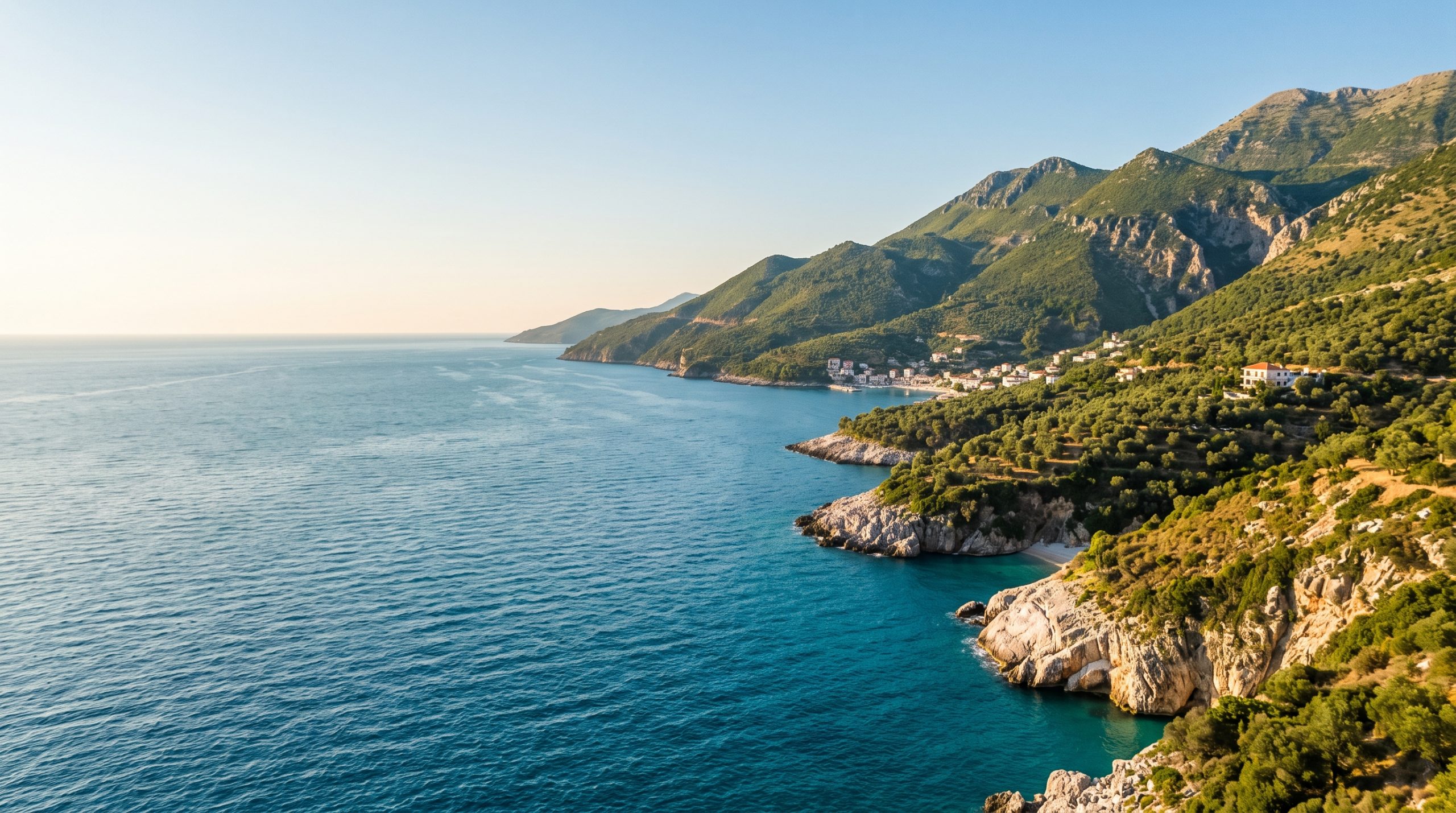
The sunrise time on your weather app is not the moment light reaches Himara. Mid-September gives 6:21 on paper, and that is honest enough out on the water, but Mount Çika stands 2,044 metres directly behind the beach and the Ceraunian ridge holds the sun off the shingle for the better part of an hour after that. The town wakes in cool blue shade while the Ionian a kilometre offshore is already bright.
That single fact reorganizes an entire day. On most coastlines you chase the first ten minutes of sun. Here the morning hands you a long, even, windless block of open shade with nobody else on the sand, and the sun arrives later as hard sculptural light on stone lanes and olive terraces. The coast pays you back in the evening, because everything from Dhërmi down to Qeparo faces west into open water, and the sun sets into sea with no land in the way.
We work this coastline from the Llogara Pass at 1,027 metres to the walls of Butrint in the south. This page is how a day with us actually runs here: the hours, the access, what a photographer and a filmmaker from the same team change on a path built for one person at a time, and where coverage starts.
Our work between Llogara and Butrint
We are an eight-person team of photographers and filmmakers who plan, shoot and film elopements along the Albanian Riviera, from Llogara and Dhërmi through Himara and Qeparo to Ksamil and Butrint. Photography, film and planning come from one team, team travel is included worldwide, and coverage starts with one full day.
Late sunrise, long evening: the shape of a Himara day
Two numbers set the frame. In mid-September the sun rises at about 6:21 and sets at about 6:51 in the evening, with roughly twenty-five minutes of usable colour after that. In late June it rises around 5:12 and sets at about 8:14, and there is light in the sky until almost a quarter to nine. Those are two completely different days, and pretending otherwise is how couples end up eating dinner at eleven at night in a dress they have been in since dawn.
A day in the second half of September
This is the version we build most often, because the sea is at its warmest, the beach businesses are still open, and the coast road has emptied out.
- 05:45 Out of the house in Himara. The coast road is yours. Nobody is awake except the fishermen and one bakery.
- 06:30 A small boat leaves the harbour for Gjipe or Filikuri. Twenty minutes across glass. The alternative is the walk down from the parking area above Gjipe, around half an hour on loose stone, which is a fine hike and a poor idea in the shoes you got married in.
- 06:45 The open-shade block. Cliffs behind you, no direct sun yet, the water flat and lit from above. This is the softest hour on the entire Riviera and almost nobody uses it.
- 07:40 The sun tops the ridge and everything changes character in about four minutes. Hard light, long shadows, spray going gold. We move to the waterline for it.
- 09:15 Ceremony. Usually in a cove or up in the old stone village above Qeparo, where the stairs hold the low light. The morning air is still, which matters for vows you want to hear again.
- 10:45 to 16:30 We stop, and we mean it. More on that below.
- 17:15 Back out. Either low along the water at Porto Palermo, where an Ottoman fort sits on its own peninsula fifteen minutes south of Himara, or up on the pass with the whole coast under you.
- 18:51 Sunset into open sea. Then the afterglow on west-facing rock, which is short and worth planning for rather than stumbling into.
- 19:30 A taverna, village lights, a handful of frames, and we are finished before you are tired of us.
The middle of that list is the part other pages leave out. Between about eleven and four the light here is vertical, flat and hot, the day boats have arrived in every photogenic cove, and in July and August the road bunches up around Dhërmi and Ksamil. There is no frame in it worth your energy. So we build in a real gap: lunch, a swim, sleep if you want it, and the filmmaker uses some of it to collect the village and the water while you are not in front of a camera.
June, when the day runs fifteen hours
A June sunrise at 5:12 means leaving a dark house at half past four, and a June sunset at 8:14 means the last frames land near nine. Nobody should be in the same clothes for that whole span. We either split it into two clear blocks with four hours off in the middle of it, or we spread the coast across two or three days, which is where the multi-day shape earns its keep. Decide how many days you want to be in the dress before you fall for a single beach, because on this coast the calendar sets the answer.
If you are based in the south instead, the day inverts again. Butrint opens at eight in the morning and the international ticket is currently around 1,000 lek, so a first-hour visit is genuinely quiet. Sunset from Ksamil goes down behind the hills of Corfu rather than into open water, which is a different picture altogether. Choose it on purpose or drive forty minutes north for the sea horizon.
Two cameras on a path built for one
Photography, film and planning come from one team here, and on this coast that is a logistical fact before it is a nice idea. The good ground on the Riviera is narrow. The canyon floor at Gjipe, the stairs in the upper village at Qeparo, the ledge track around Porto Palermo, the boat itself. Put a photographer you hired in January and a videographer you found in March on that boat and you have two people who have never worked together negotiating a metre of space while the light does what it wants.
Specifically, here is what our filmmaker changes about an Albanian Riviera day.
The ceremony hour gets set by sound. The Ionian is loud on shingle, and the afternoon breeze on this coast is real. Audio on vows wants the morning lull, so the filmmaker’s requirement sets the hour, and the photographer plans around it instead of arguing with it at 9am. That trade takes one sentence between two colleagues.
One boat, not two. A cove like Filikuri or Gjipe is reached by water. One team fits in one hull with a couple, a driver and the cases, and everyone lands at the same minute. Two separately booked vendors mean a second charter or a crowded one, and it comes out of your budget rather than ours.
Shade and hard light need different answers. In that pre-ridge hour, stills and motion want different exposures and different movement. We block the morning so both get what they need in sequence rather than competing for the same four minutes. Nobody says “one more” while you are standing in cold water.
One drone, one pilot, one clearance. Aerial work in Albania sits with the Civil Aviation Authority, so we confirm the permission and the window in advance and then build the sequence around it. We also plan a version of the film that stands up without a single aerial frame, because wind on this ridge is its own decision-maker.
You hear one voice. That is the quiet part. You are told where to walk once, by one person, and the two cameras sort themselves out.
With eight of us there is always a second camera on the ground and a colleague in reserve, in every destination we work. What the finished pair actually looks like matters more than any of this, so go and watch it: our published galleries and films show the same day told twice, in stills and in motion, by people who stood in the same cove.
Tell Us Your Story and we will come back with the hours, the coves and the honest version of your month.
Loungers, cranes and the case for late September
The objection we get about this coast is always the same, and it is fair. Couples have seen photographs of Ksamil in August with sunbeds edge to edge, and photographs of apartment blocks going up behind parts of the Saranda waterfront, and they want to know whether their film will look like a holiday brochure for somewhere else.
Here is the honest answer. In high summer, at midday, on the famous beaches, yes, it is busy and it is being built on. We do not photograph there at those hours. The answer is not a filter or a lens, it is three planning decisions made months ahead.
| Window | What the coast is doing | How we use it |
|---|---|---|
| Late May to mid-June | Green hillsides, cool water, businesses opening, road still quiet | Long days, mountain and coast in one day, early ceremony |
| July and August | Peak crowds and traffic, hot flat middays | Dawn and evening only, boat access to coves, long midday break |
| Second half of September | Warmest sea, thinning crowds, softer light | Our default recommendation for a one-day shape |
| October | 6:46 sunrise, 6:10 sunset, most sunbeds gone | Whole day inside civilised hours, stone villages at their best |
Then the stretches. Gjipe under its canyon, the Filikuri cove, the peninsula at Porto Palermo, the terraces below the Llogara Pass, the abandoned upper village at Qeparo, the lanes inside the castle walls above Himara. None of those are where the coaches stop, and several of them are only comfortable to reach with a plan and a boat, which is exactly what the planning half of our work is for.
What arrives with the team, and where coverage starts
Everything below is included in every experience, on this coast and everywhere else we work.
- Destination and location design for your specific dates, built from the light rather than from a list of beaches
- A custom timeline using real travel time on the coast road, not map estimates
- Permit research and logistics guidance, including park and municipal permissions and the Butrint question
- Weather alternatives and backup planning, which on a west-facing coast means a wind plan as well as a rain plan
- Drone footage where it is legal, safe and appropriate
- Team travel worldwide: flights, accommodation and ordinary travel for the assigned team, with no European or long-haul distinction
- Highlights in 5 days, and the full gallery or film in 3 weeks
The Expedition adds professional audio for vows and the moments that matter, where conditions allow. Guest count never changes the fee. Twelve people instead of two changes access, permits, transport and the timeline, and we plan for that, but the price is the price.
The Adventure is one full day with one dedicated photographer or one dedicated filmmaker, from $4,900. The Expedition is one full day with a dedicated photographer and filmmaker working together, from $7,900. The Odyssey runs from two to seven days across one or several destinations, photography and film, quoted as a custom proposal. There is no half-day version, and every figure lives on the pricing page rather than in a proposal you have to ask for twice.
What you pay locally, and not to us: accommodation, your celebrant, vendors and activities, plus government, venue or landowner permit fees where they apply. On this coast that list is short and mostly in lek. Butrint charges around 1,000 lek per international visitor. Beach parking areas take a small fee in cash at a kiosk, and so does the fort at Porto Palermo. A private boat from Himara into the coves is the one cost worth planning for properly, along with a 4×4 if you want the rougher tracks above the coast. Cash in lek is worth carrying, because card machines are not universal at park gates and boat jetties.
Six steps from your first email to the coast road
- You send the inquiry form with your dates, or the month you are circling.
- We reply within 24 hours with our initial brochure.
- We put together a tailored proposal for your dates and the shape of day you want.
- You sign the contract and pay a 30% retainer. The remaining payment dates are set out in the proposal.
- Planning begins: locations, permits, a timeline built on real light, and the alternatives for wind and weather.
- We travel to you, we shoot the day, highlights land in 5 days and everything else in 3 weeks.
Who gets the most from the Albanian Riviera
The Riviera rewards couples who are happy to be moving at 5:45 with coffee in a paper cup, who do not mind a boat ladder or a scramble down loose stone, and who can take a plan that changes at breakfast because the wind turned and the cove we wanted is now the wrong cove. Bare feet on hot rock. Salt in your hair for the rest of the day. If that sounds like your kind of morning, this coast will give you more than you asked for.
If a pre-dawn start is not your idea of a good beginning, say so in your first email, because there is a gentler shape and it is a legitimate choice. October compresses the whole day into human hours, with the sun up at 6:46 and down by 6:10. The stone villages inland, Qeparo and Vuno and the upper lanes at Himara, hold beautiful light long after the beaches have gone harsh, so a village-and-terraces day works while a beach day would not. And if you want the mountains as well as the water, the Llogara Pass sits an hour above the sea and behaves like a different country. Tell us what you actually want out of the day and we will either build it or tell you plainly which month and which stretch of coast fits it better. Our destination guides are a good place to compare this coast with the others we work.
Common questions
Do we have to get legally married in Albania, or can we sign at home?
Either works, and most couples we photograph here sign the legal paperwork at home and hold the ceremony on the coast. If you do want the legal marriage in Albania, it is registered with the Office of Civil Status, and American citizens need an Affidavit of Eligibility to Marry issued by the US Embassy in Tirana. A certified copy of your birth certificate has to have been issued within the previous three months, so that piece is worth starting early.
How do we actually get to Himara or Ksamil?
Two sensible routes. Fly to Corfu and take the fast ferry across to Saranda, which is a crossing of around 30 minutes with several licensed operators running it year-round, then drive up the coast. Or fly to Tirana and drive, which is four to five hours to Saranda on the inland road and longer if you take the coastal one, though the coastal one is the better afternoon of your life.
Do we need a visa for Albania?
US citizens do not need a visa to enter Albania and can generally stay up to a year without a residence permit, according to the US Embassy in Tirana. Your passport needs at least three months of remaining validity. That makes the paperwork side of an Albanian elopement lighter than most European alternatives.
Can you fly a drone on the Albanian Riviera?
Aerial work in Albania is governed by the Civil Aviation Authority, so we confirm permission and a flight window before we design any sequence around it, and we treat protected areas and airport zones as their own conversations. We always plan a film that works without aerials too, because the ridge wind gets a vote on the morning.
When is the coast quiet enough for a ceremony on the beach?
Before eight in the morning almost any month, and all day in the second half of September and October. In July and August we use dawn and evening and reach the smaller coves by boat, because the middle of a peak-season day belongs to the sunbeds and the day boats.
Can we photograph inside Butrint?
Butrint opens at eight and the international ticket is currently around 1,000 lek, so a first-hour visit is realistic and quiet. It is a national park and a UNESCO World Heritage site, so anything beyond a ticket and a hand-held camera means asking the park first, which is part of the permit research we do rather than something you chase.
What does an Albanian Riviera elopement cost with you?
Coverage starts with one full day and includes the team’s travel to Albania, and the full breakdown of the three experiences sits on the pricing page. The only Albanian costs that sit outside it are the local ones: accommodation, celebrant, park tickets, boats and any permit fees.
How soon do we see the photos and the film?
Highlights reach you 5 days after the day itself. The full gallery or film follows within 3 weeks. We currently have Albanian Riviera elopement dates available through 2027–2029, so there is usually room to pick your month rather than take what is left.
Send us the month you are thinking about
You do not need locations, a guest list or a firm date to write to us. A month and a rough idea of the kind of morning you want is plenty, and we will come back with the hours the light actually does here, two or three stretches of coast worth your day, and what it would take to get you into a cove at 6:45 with nobody else in it. Every planning step stays in one written thread, at your pace, starting with a reply and our brochure inside 24 hours.
We currently have Albanian Riviera elopement dates available through 2027–2029 on this coast now. Check Your Date and tell us what you are imagining.