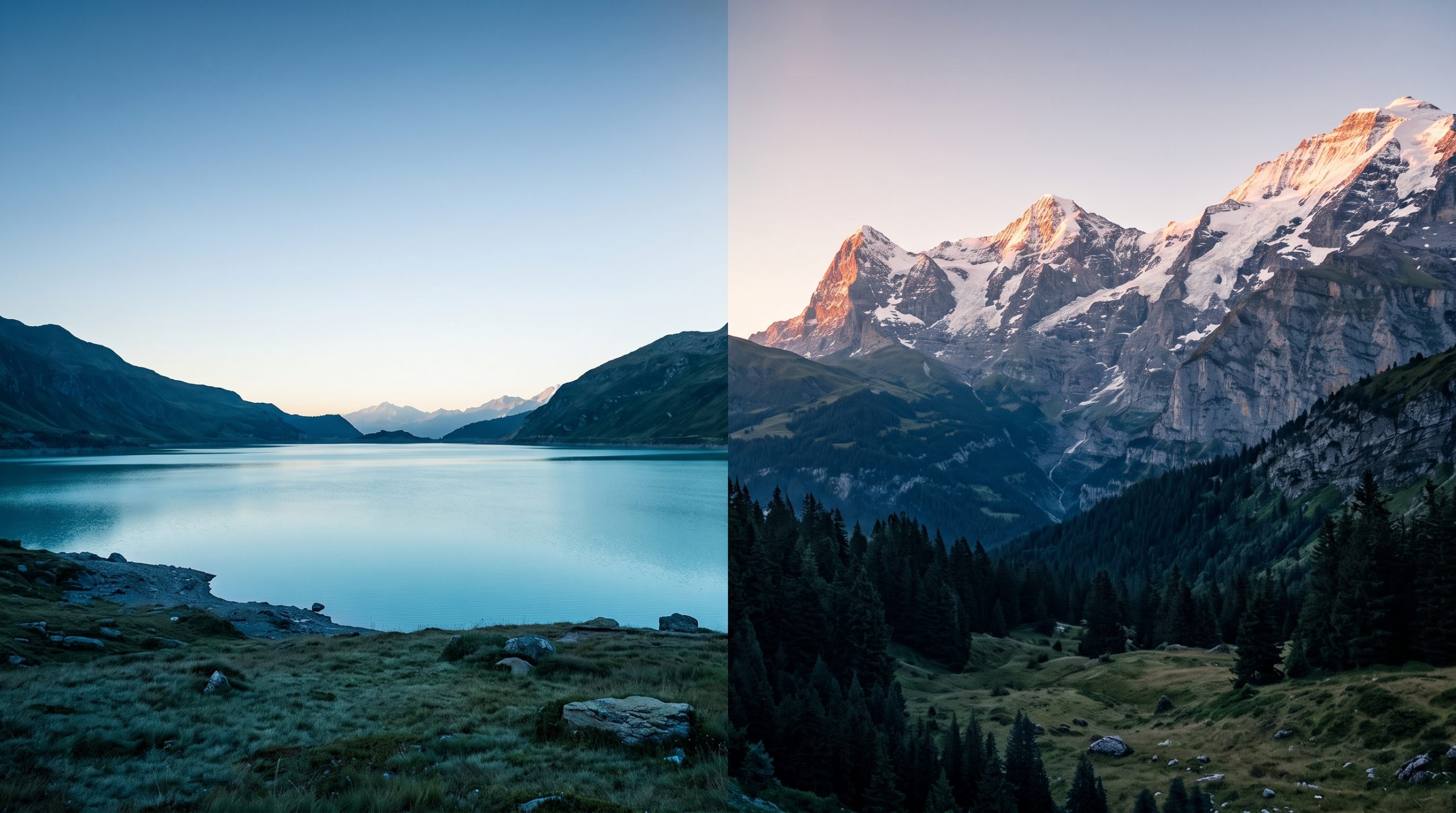
In mid-September, the sun clears the horizon at Zermatt at about 07:06. The first train of the day on the Gornergrat railway leaves the valley station at 07:00, and the ride up takes around 33 minutes. Do the arithmetic and you can see the problem: if you plan to travel up for sunrise, the best half hour is gone before you step onto the platform.
In mid-June it is worse on paper. Sunrise moves to roughly 05:35 and the first train still leaves at 07:00. That single gap shapes every good Swiss Alps timeline we have ever built, because light in a valley like this arrives from the top down. The high faces take the first color while the village at 1,608 metres (about 5,270 feet) sits in shade for another hour.
So here is a real day, hour by hour, with the transfer times that actually apply, the ones a route planner gets wrong, and the decisions we make on your behalf before you ever see a schedule.
Sunrise at 05:35, first train at 07:00
A Swiss Alps day runs downhill. Light hits the high ground long before the valley floor, and the first public train from Zermatt up to the Gornergrat leaves at 07:00 in the main season, so genuine sunrise coverage means sleeping on the mountain. Vows land mid-morning, midday is rest, and a second block runs to sunset.
Where the light lands first, and how long the valley waits
Every sunrise time you find online assumes a flat horizon. In the Matter valley there is no flat horizon in any direction, so the printed number tells you when the summits start to glow, not when the sun reaches your boots. On open ground above the treeline the difference is often twenty to forty minutes. Down among the timber lanes of the village it can be well over an hour.
That is useful rather than annoying. It means one morning gives you two completely different qualities of light in two places, and the walk or the ride between them is short.
| Month (mid-) | Sunrise, Zermatt | Sunset, Zermatt | What it does to the day |
|---|---|---|---|
| February | 07:35 | 17:55 | Short, cold, high contrast. One block, no midday break needed. |
| April | 06:45 | 20:15 | Snow still high, valley green. Two blocks with a long lunch. |
| June | 05:35 | 21:20 | Almost 16 hours of daylight. A 04:50 alarm and a real afternoon sleep. |
| September | 07:06 | 19:43 | The most humane version of this day. Low sun tracks longer. |
| October | 07:44 | 18:45 | Larches turn gold. Some valley trails close for the season. |
September is the month we push hardest, and not for the scenery. You get up at a reasonable hour, the sun stays low enough for long enough that the good light is not a fifteen minute panic, and the evening block finishes early enough to eat dinner like people on vacation. Our destination guides go deeper on how each month behaves.
Hour by hour: a mid-September day, top down
This version assumes you sleep on the mountain rather than in the village, which is the single biggest lever in the whole schedule. Times are the ones we would put in your timeline, not aspirations.
- 05:50 Coffee in a corridor at 2,222 metres, fully dark outside. We are on the terrace checking wind direction, because wind decides whether the vows happen on the open shelf or in the lee of the moraine forty minutes away.
- 06:20 Out the door in boots and coats. Blue hour up here is long and cold and photographs far better than most couples expect. You are wearing the dress under a down jacket and nobody minds.
- 07:06 Printed sunrise. The high faces take the first color. The village 600 metres below us is still grey, and there is nobody else on this path.
- 07:35 Direct sun reaches the ground we are standing on. The first train out of Zermatt is somewhere below, halfway up. We have had over an hour to ourselves.
- 08:05 The regular service has begun, every 24 minutes from 08:00, so we use it and ride further up the line toward the high lakes while everyone arriving is still buying coffee.
- 08:40 Reflection window. Still water, no breeze yet. This is a morning thing and it does not come back later in the day.
- 09:15 Vows on a sheltered shelf, coats off for ten minutes. On the Expedition your filmmaker has audio running, which matters more here than anywhere, because a moving-air day steals spoken vows if nobody has planned for it.
- 10:15 Breakfast on a terrace with warm hands around a cup. The photographer keeps working quietly through this. It is usually where the pictures you actually print come from.
- 11:00 to 14:30 The flat middle. High sun, busiest trains, hardest light. We ride down, you change, eat and sleep, and one of us scouts the evening ground while the other stays with you.
- 15:00 Village hour at 1,608 metres. No cars anywhere, electric taxis moving luggage, dark timber and geraniums. Completely different film from the morning.
- 17:00 Regular railway service winds down around now, with extra departures running outside those hours. If your last hour is high, we book the descent before the day begins rather than hoping.
- 18:40 Second climb, or a walk out along the valley. Long shadows, gold on the west-facing rock.
- 19:43 Sunset. The summits hold light for a while after the valley has gone blue, so we stay out past the point most people pack up.
- 20:15 Dinner. Boots off. Done.
In June the same day starts at 04:50 and runs to nearly 21:30, which is not one long day but two separate ones with a four hour hole in the middle. We plan that hole properly, with a room to lie down in, because couples who push through it are tired by the hour that matters most.
What the transfer estimate leaves out: Visp, Täsch and the last 40 minutes
Type Zermatt into a route planner and it will happily give you a driving time. It is fiction. Zermatt is car-free, so the drive ends at the Matterhorn Terminal in Täsch, where there are 2,100 covered parking spaces and a shuttle train that runs every 20 minutes from 05:55 to 21:55, hourly later in the evening, all year. The ride takes 12 minutes and the return ticket currently sits at around CHF 17.
| Leg | Plan on | What the planner leaves out |
|---|---|---|
| Zurich Airport to Zermatt by train | About 3 hours 30 minutes, one change at Visp | Long-haul luggage, platform changes, and a dress you do not want folded. Arrive a day early. |
| Visp to Zermatt | About 1 hour on the narrow-gauge line | Slower than the map implies. This is the scenic part and it cannot be rushed. |
| Driving to Täsch, then Zermatt | Parking plus 12 minute shuttle, every 20 minutes | Unloading, ticketing and the walk at the far end. Budget 40 minutes from car door to hotel door. |
| Zermatt up to the Gornergrat | Around 33 minutes, first train 07:00 | It looks like a short hop on a map. It is a mountain railway climbing to over 3,000 metres. |
| Zurich Airport to Lauterbrunnen | About 2 hours 40 minutes, change at Interlaken Ost | No direct train. The last leg is a small regional line with its own rhythm. |
Two things we would talk you out of. Flying into Zurich and travelling to Zermatt on the morning of your day is not worth doing, even though the timetable technically allows it. And scheduling anything meaningful in the twenty minutes on either side of a train arrival at an upper station is a false economy, because the platform empties across the exact ground you wanted. We build the ceremony hour into the gaps between departures on purpose.
The Lauterbrunnen valley plays by similar rules with different scenery. Staubbach Falls drops 297 metres straight off the cliff above the village, the highest free-falling waterfall in Switzerland, and the path to its base is a summer-only trail. An October plan in that valley works, it just uses different ground, and knowing that in advance is the difference between a good day and a scramble.
Sleeping at 2,222 metres, and what it buys you
The hotels on the Gornergrat line change the arithmetic completely. Stay at Riffelalp, 2,222 metres up, and you are already above the first train when the sun starts working. No 05:00 platform, no queue, no shared viewpoint. You walk out of a door into your own morning.
It costs you something in convenience. Everything you bring travels up by train, so we plan what comes with you and what stays in the valley. Dresses go up in a garment bag on a rack, not in a wheeled case. Give yourself a night up there before the day itself, so that the early start feels like a choice rather than a shock, and so a suitcase left in the wrong place is a small problem instead of the morning’s headline.
The paperwork hour, and why it rarely happens on a ridge
In Switzerland, marriage is exclusively a civil act, and only a ceremony before a civil registrar is legally recognized. Both of you appear in person during the preparation process, either before a registrar in Switzerland or at a Swiss consulate abroad. Documents submitted must be recent, and once your authorization is issued the marriage has to take place within three months of it. That is why most couples we work with handle the legal signature at home or in a register office, then hold the real ceremony at altitude with a celebrant and no clock. Our guide to planning an elopement walks through both routes.
Aerials, wind and two cameras on a 33-minute railway
Drone work in Switzerland runs under rules the Federal Office of Civil Aviation administers, aligned with the European framework since 2023. Most operators register and hold a competency certificate from an online test, drones fall into classes that set what you may fly and how close to people, the open-category ceiling is 120 metres above ground, and flights over gatherings of people are out. Zones around airfields and heliports carry their own restrictions, which matters in a valley where helicopters work daily. We confirm what is permitted for your specific ground and hour before a film is planned around aerials, and we build a version of the film that stands up without them.
The second thing altitude changes is redundancy. When the ride up is 33 minutes and the next train is 24 minutes behind it, going back for a spare body or a dead battery costs you the light, not five minutes. Two of us on the ground means two full sets of gear, and it means one person can walk ahead to the next spot and read the wind while the other stays with you. You can see how that plays out across our films and galleries, where the wide aerial and the close hand-held frame of the same moment exist because two people were working, not one person switching. The experiences and what each one covers are set out plainly, including team travel worldwide, and highlights reach you five days after the day itself.
If you already have a month in mind, or a hotel you have your eye on, tell us and we will build the light around it. Check Your Date.
Common questions
How early do we actually have to get up for sunrise light in the Swiss Alps?
In mid-September, moving by 06:20 for a 07:06 sunrise. In mid-June, moving by 04:50 for a 05:35 sunrise. Add twenty to forty minutes on top of the printed time before direct sun reaches you, which is why we walk out well before it and use the blue hour rather than waiting through it.
Do we have to sleep on the mountain to shoot sunrise?
To be up high in the first light, yes, because the first train from Zermatt leaves at 07:00 in the main season and the climb takes about 33 minutes. Staying at a mountain hotel such as Riffelalp at 2,222 metres puts you above that problem. Sleeping in the village is still a strong day, it just starts with second light instead of first.
Can we get legally married in Switzerland, or should we do the paperwork at home?
Both work. Swiss marriage is a civil act before a registrar, with both of you appearing in person during the preparation process and the ceremony falling within three months of your authorization. Many couples find it simpler to sign at home and keep the mountain ceremony free of any administration.
How long does it really take to get from Zurich Airport to Zermatt?
About three and a half hours by train with one change at Visp, then longer than you think for the last stretch on foot or by electric taxi. If you drive, you park at the Matterhorn Terminal in Täsch and take the 12 minute shuttle, which runs every 20 minutes from 05:55.
Can you fly a drone for our film in Zermatt?
Often yes, with a check first. Registration, a competency certificate, the 120 metre ceiling and the restrictions around airfields and heliports all apply, and protected areas have their own rules. We verify the specific location and hour before we plan aerials into your film.
What time is the last train down from the Gornergrat?
Regular service runs roughly 08:00 to 17:00, with additional departures scheduled outside those hours and the timetable shifting by season. If your final hour is at altitude, we confirm the descent before the day starts, so nobody is watching a clock during vows.
Is one day enough, or should we plan two?
One full day works well in a stable week, and it is what most couples book. Two or more days buy you a weather choice rather than a weather hope, and they let you use two valleys instead of one. That is what the Odyssey exists for, and we build it around the light and travel time rather than a fixed itinerary.
What do we wear at 3,000 metres in September?
Merino or silk next to the skin, a real down layer over the dress between locations, and shoes you can walk 400 metres of gravel in. For the ceremony hour the coats come off for ten minutes and go straight back on. Long veils are wonderful in moving air and impossible in strong wind, so we pick the shelf before we pick the hour.
Pick the month first, then the altitude
Once you know whether you want a 04:50 June morning or a 06:20 September one, everything else follows: which side of the valley you sleep on, which train you are above, where the vows sit relative to the 08:00 service. Send us the dates you are looking at and what kind of morning person you honestly are. We will answer in writing with the first shape of the day and a brochure within a day. Our calendar currently covers 2027 through 2029. Tell Us Your Story.