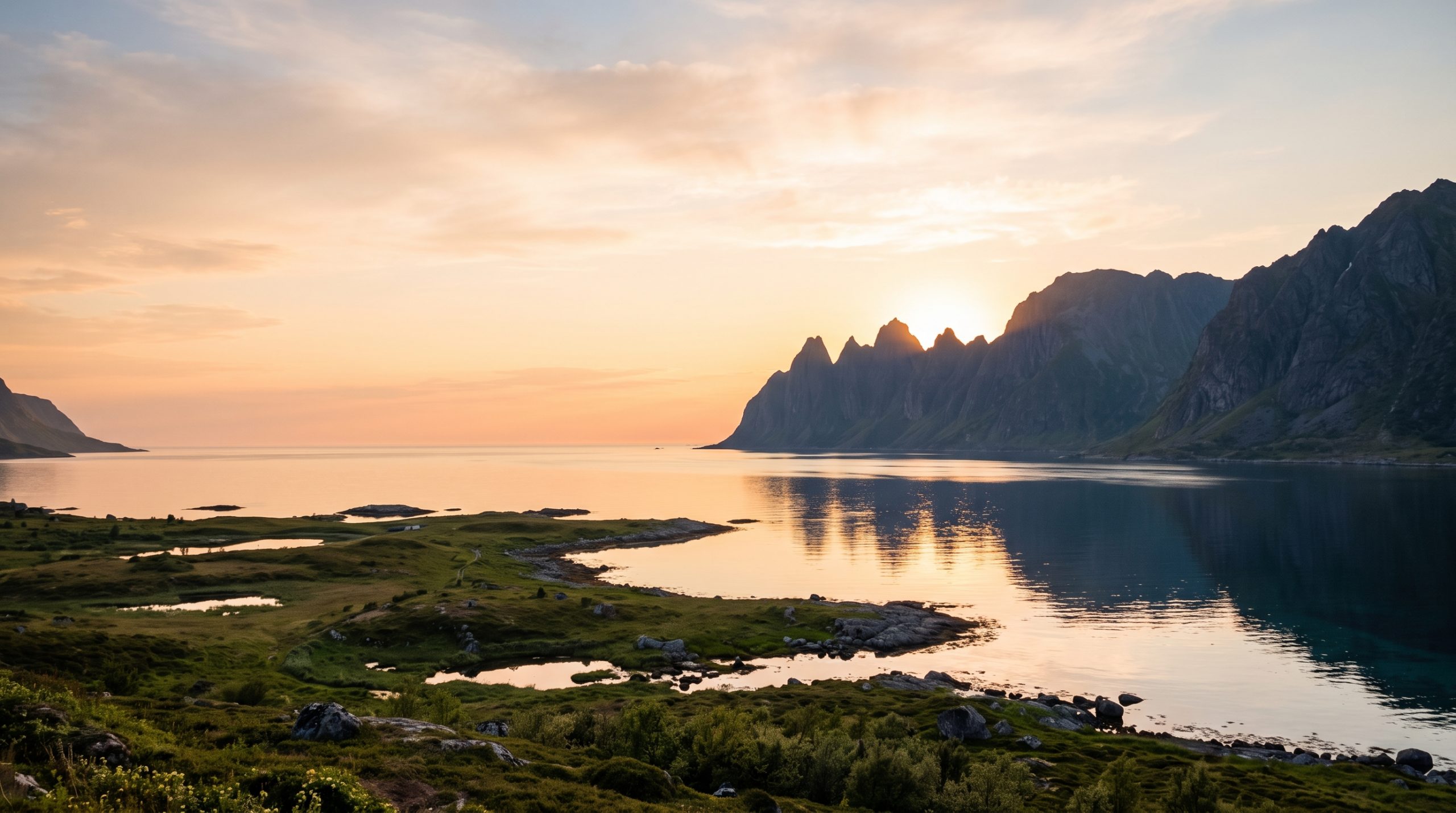
At one in the morning on the outer coast of Lofoten, the sun is in the north, about a hand’s width above the sea, and the color on the granite behind you is the same color a Californian sunset gives you for twenty minutes. Here it holds for hours. The lay-bys above Uttakleiv and Haukland that were nose to tail with camper vans at six in the evening have thinned out to two cars and a fisherman.
Couples arrive expecting the show at twelve, because that is what the phrase promises. The clock Norway runs on is not built on Lofoten’s longitude, though, and the sun keeps its own time. The lowest point of the night comes after one in the morning, so that is when we set the ceremony.
This is what we have learned planning ceremonies inside that window: when it opens and closes, which shorelines actually see the sun at 1am and which ones only see it on their mountains, and what we do on the nights the Norwegian Sea sends weather instead.
Why solar midnight here lands after 1am
Norway keeps summer time two hours ahead of UTC, and Lofoten lies west of the meridian that clock is built on. The sun therefore reaches its lowest point a few minutes after 1am, sitting due north above the sea. That hour, not midnight, is the one worth building a ceremony around.
Five phases of the season, 25 May to 18 July
Lofoten’s regional tourism board puts the archipelago’s midnight sun between 28 May and 14 July, with the exact dates shifting by a few days depending where you stand. Uttakleiv, facing open water on the northwest coast of Vestvågøy, holds it longest: 25 May to 18 July, fifty-five nights. Those dates are astronomy, so they do not move from year to year. Everything else in the table does.
| Window | The sun at 1am | Conditions | Crowds | Our verdict |
|---|---|---|---|---|
| 25 to 31 May | Clears the northern horizon on the outer coast only | Cold nights, snow still on the ridges, low ground just turning green | Emptiest of the season | Underrated |
| 1 to 14 June | Full disc, low and due north | Around 71 mm of rain across roughly 17 wet days for the month, the driest stretch Lofoten gets | Filling, not full | Our first choice |
| 15 to 27 June | Highest it ever sits at 1am, solstice on 21 June 2028 | Mild, long settled spells possible, midges on still evenings away from the wind | Peak begins | Best light, book earliest |
| 28 June to 14 July | Still up at 1am across the islands | About 15°C by day and 11°C at night, near 80 mm of rain over roughly 18 wet days | Busiest weeks on the E10 | Excellent, plan around traffic |
| 15 to 18 July | Uttakleiv and the far northwest keep it, elsewhere it dips | Softer air, settled spells common | Still high | Twilight version, still worth it |
Svolvær sits on the wrong side of the mountain
The most common disappointment in Lofoten has nothing to do with dates. It is a horizon problem. At 1am the sun is due north and only a few degrees up, so any ridge standing between you and the northern sea takes it away completely. Svolvær, the archipelago’s main town, sits south of high mountains that block it outright. Reine and Hamnøy, the two views that sell Lofoten to the world, face the wrong way for this hour.
We will say the unpopular part plainly: at 1am, Reine is a picture of light on rock. The peaks across the water glow, the reflection in the harbor is extraordinary, and you are standing in flat shade. If the point of your night is the sun physically touching you while you say your vows, you have to be on the outer coast.
Four stretches of shoreline hold it: Laukvik on the north side of Austvågøy, Hov out on Gimsøy, Eggum on the boulder coast, and Uttakleiv. Between them you have a working fishing village, an open green plain where Gimsøy flattens out to the water, a shore of surf-rounded stones the size of armchairs, and the beach every photographer in Europe already knows. They sit far enough apart that wind direction genuinely lets you choose between them, and close enough to Leknes that a night can use two of them. Our destination guides go deeper into how each one behaves at ground level.
Everything with an inland or southern aspect stays in the plan, just at a different hour. Reine at nine in the evening, with the sun still high in the northwest, is a completely different proposition from Reine at one.
What the light does between 10pm and 4am
The sun does not go down, so it goes sideways. At ten in the evening it is in the northwest, warm and side-on, throwing shadows the length of a bus across the sand. Over the next three hours it slides right and drops until, just after 1am, it hangs due north and as low as it will get. Then it starts climbing again through the northeast, and by four in the morning it is behind you and hardening.
The practical consequence is that Lofoten hands you three or four consecutive hours of the light most destinations give you for twenty-five minutes. Nobody has to run. A ceremony can take as long as it takes. We can walk fifteen minutes to a second spot in the middle of a night and arrive with the same quality of light we left. That is the single biggest reason a midnight sun night produces work that does not look rushed, and you can see how it comes out across our galleries and films.
It also changes how many people the night needs. In a short winter window, a photographer and a filmmaker are competing for one good position. Here they are not. A dedicated photographer and a dedicated filmmaker working the same 1am hour can split the ground, one close for vows and audio, one wide for the ridge line, and neither costs the other a frame. We are eight people, so there is always a second camera on the islands and a colleague in reserve. That pairing is our Expedition experience, from $7,900, and the full breakdown of what each experience covers is on our pricing page.
One caution about the low angle. With the sun on the horizon in the north, a westward beach like Unstad gets it raking straight along the water, which is beautiful and almost impossible to shoot into for long. We plan the direction you face as carefully as the place you stand.
The sleep problem, and how we solve it
A 1am ceremony means a nap, not an all-nighter. The shape that works: an early dinner, sleep from roughly seven until eleven, dress at midnight, and drive out with the roads empty. Breakfast happens somewhere near three in the morning, back at a rorbu with the curtains open because there is no point closing them. We build the timeline this way in planning and send it before you fly, so nobody is doing arithmetic on their wedding night.
The weeks when 1am stops being the ceremony hour we want
If the sun at 1am is the reason you are coming, the second half of July is the wrong booking. From 19 July onward the disc drops below the horizon everywhere in Lofoten, and it keeps dropping further every night after that. The hour still looks lovely, in a long blue and amber twilight, but it is not the same event. Move the date into the first two weeks of July and you keep everything you came for.
Late May is the one we defend most often. Couples avoid it because it sounds cold, and the ridges genuinely still hold snow. What they get instead is the emptiest week of the whole window, snow above and green below in the same frame, and light that behaves exactly the way it does in June. It has become a favorite of ours.
Then the case we see most: your date is fixed and it is nowhere near summer. October in Lofoten averages around 160 mm of rain across some 27 wet days, with daytime temperatures near 8°C, and that is a genuinely different craft. The answer is not to talk you out of it. It is a tighter geographic radius, a ceremony hour placed inside the short warm band rather than in the middle of the day, and a plan that treats a clearing squall as the thing you want rather than the thing you fear. Autumn Lofoten is dramatic in a way June never is. Tell us the date you actually have and we will tell you honestly what that month does, and which shorelines suit it.
Check Your Date and we will come back with what the sun is doing that night and where it will be visible from.
Cloud, wind and how the night gets rebuilt
July averages roughly 18 wet days. That number frightens people who have not been, and it should not. Lofoten weather is not a day-long gray lid, it is a sequence of squalls and clearings moving fast off the Norwegian Sea, and inside a four-hour warm window your odds of catching a clearing are good. We plan for the clearing.
The mechanism is simple and it is written before anyone lands. Every night has a primary location and two alternatives, and the alternatives are chosen by wind direction rather than by preference. A hard westerly makes the exposed outer beaches unworkable and simultaneously makes the Vestfjorden side of the islands calm, so we cross to the sheltered water and accept that the sun will be on the peaks opposite instead of on the horizon behind you. A northerly does the reverse. Fog sitting on the outer coast often means clear air two fjords inland.
The ceremony hour moves too. Because the warm light runs from late evening into early morning, we can shift a start time by ninety minutes on the day and lose nothing. That is a luxury a sunset ceremony at a lower latitude simply does not have. Aerial work sits inside the same logic: drone footage runs where it is legal, safe and appropriate, and we confirm the permissions and the window in advance so the film is planned around what we can actually fly.
What we do not do is promise weather. We give you probability and a plan, and on the nights the cloud stays low we shoot the low cloud, because a ceremony held in weather looks like something. The couples who are relaxed about this get the best of Lofoten.
Everything else is settled long before the night itself, paperwork included: the Norwegian marriage license is issued by the Tax Administration and is valid for four months, so the application window and your date have to line up, which is one of the things we track for you. Our guide to how eloping works covers the rest of the sequence.
Common questions
When exactly does the midnight sun start and end in Lofoten?
The archipelago’s window runs 28 May to 14 July, varying by a few days depending on where you stand. Uttakleiv on the northwest coast holds it longest, 25 May to 18 July, which is fifty-five consecutive nights. Those dates are set by astronomy, not by weather, so you can plan two or three years ahead with confidence.
Can we see the sun at 1am from Reine or Svolvær?
Not from either. Svolvær sits south of high mountains that block the northern horizon completely, and the classic Reine and Hamnøy views face away from where the sun sits at that hour. You get spectacular light on the peaks and none on yourselves. For the sun on your faces at 1am, the outer coast is the answer: Uttakleiv, Eggum, Hov or Laukvik.
Will it be dark enough for northern lights in June?
No. Inside the midnight sun window the sky never gets astronomically dark, so aurora and midnight sun cannot be combined on the same trip. They are two different elopements and we plan both. If the lights matter more to you than the 1am sun, say so in your first message and we will point you at the right months.
How cold is it at 1am in Lofoten in July?
July nights average around 11°C, against daytime highs near 15°C, and the wind off the water makes the exposed beaches feel colder than that figure suggests. It is a coat over the dress for the walk in, and a genuinely warm layer for anyone standing still as a witness. Nobody has ever regretted bringing gloves to Eggum.
Do we sleep before or after a midnight sun ceremony?
Before. Sleep from around seven in the evening to eleven, dress at midnight, and go back to bed at four or five in the morning. It works far better than staying up, and it means the two of you are awake and present for the hour that matters rather than running on fifteen hours of adrenaline.
What happens if our chosen night is a washout?
The plan already contains two alternatives sorted by wind direction, and the start time can move by up to ninety minutes because the light does not disappear at a fixed hour. Between those two levers, we very rarely lose the night. When the cloud does sit low all the way through, we shoot it as weather rather than as a problem.
How far ahead do people book a midnight sun date?
We are currently taking 2027, 2028 and 2029, and the fifty-five nights that hold the midnight sun are the part of the Lofoten calendar we get asked about most. Sending a date early costs nothing and tells you straight away whether that night is open.
Choose the night by the sun, not the calendar year
If you gave us the whole window and no other constraints, we would put you on the outer coast in the first two weeks of June, with a ceremony set for 1am, a nap in the plan and two alternative shorelines held in reserve. That is the version of this we would book for ourselves.
Send us the dates you are considering and what you actually want the night to feel like. All of our planning happens in writing, so you can read it, think about it and reply in your own time, and you will hear back from us within 24 hours with a brochure and an honest answer about the light on your date.