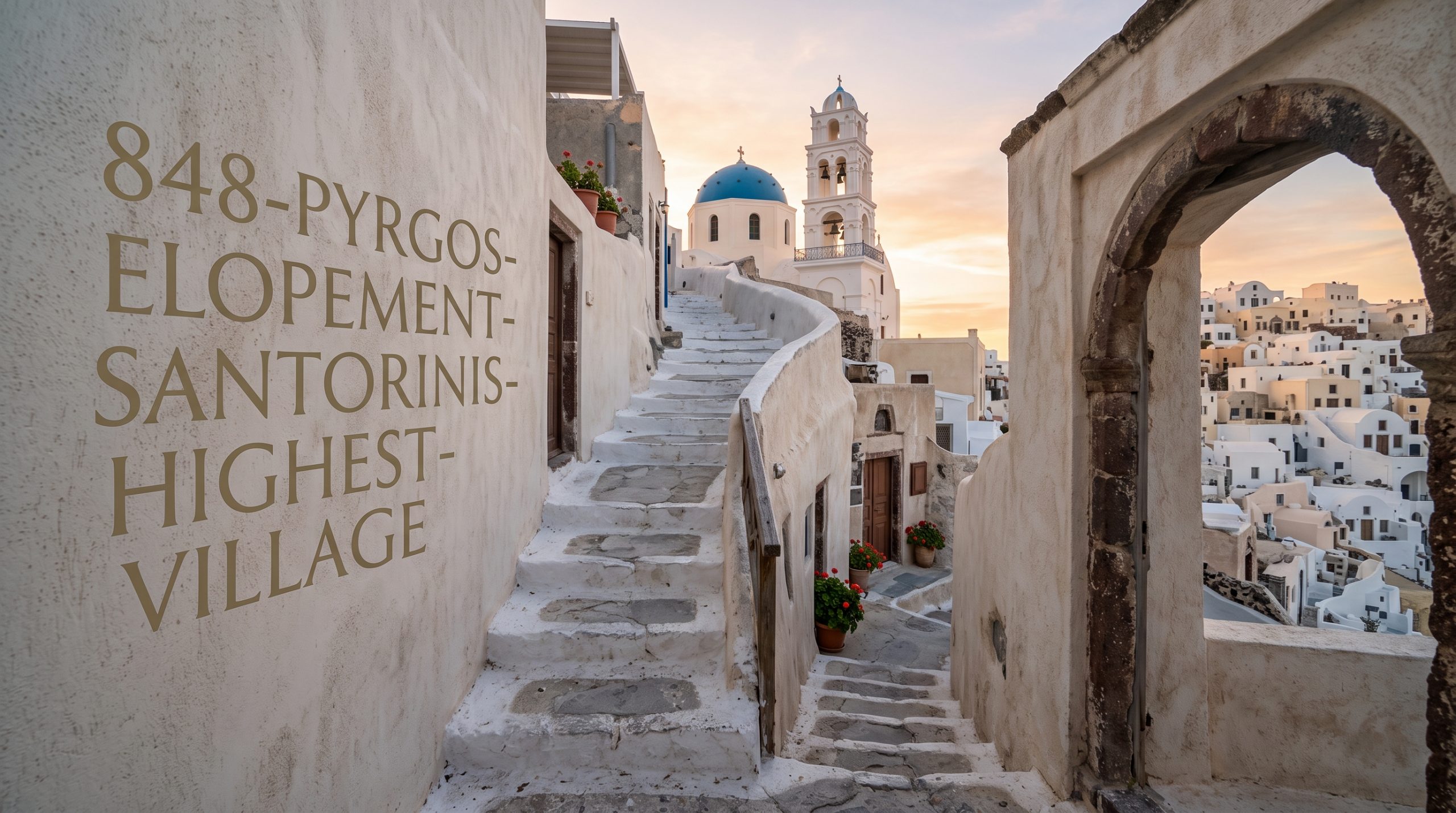
The road stops at the square in Pyrgos. Above it the village gives up on being drivable and turns into steps, vaulted passages and other people’s front doors, climbing until you come out on the walls of the Kasteli, the Venetian castle at the top, with the island laid out on every side: Fira to the north, the bay at Kamari to the east, the caldera rim west across the vineyards.
Most visitors never get past the square. Buses on the Fira to Perissa line come through roughly every half hour in high season, and some of them stop at the Pyrgos junction on the main road rather than in the village, which puts a ten-minute uphill walk between the bus door and the first lane. Plenty of people have a coffee near the stop and go back down.
That gap between the square and the top of the village is the whole argument for holding a ceremony here. Ten minutes by car from Fira. Built up the flank of Profitis Ilias, the island’s only mountain, whose summit stands 567 m above the sea. And a village that is still going about its own evening at eight o’clock, while the rim at Oia is standing three deep.
What marrying in Pyrgos actually involves
Pyrgos is a lived-in medieval village on the mountain side of Santorini, ten minutes by car from Fira. Ceremonies happen in its lanes, on rented terraces, or up beside the castle ruins at the top. The public lanes need no permission for a private ceremony. Interiors, courtyards and terraces need their owner to say yes.
The last ten minutes are steps, not road
From Fira it is about ten minutes by car. From the airport it is roughly six kilometres and a similar drive. From Athinios, where the ferries come in, it is close to five kilometres and under a quarter of an hour by taxi. All of which sounds easy, and is, right up to the point where the car stops.
Vehicles stay below the old village, around the square and the road that rings it. Everything above that is stepped or too narrow, which is exactly why the place still looks the way it does. The climb from the square to the Kasteli walls is short, a few minutes at most, but it is all up, on volcanic stone that generations of feet have polished, with the occasional shallow step that is not the same height as the one before it.
In wedding clothes this matters in specific, unromantic ways. A long hem collects whitewash dust off the walls wherever the lane narrows. Heels find the gaps between stones and stay there. Some of the passages run under the houses and are dark enough that you take your sunglasses off halfway through. So we plan the climb as part of the timeline instead of treating it as a transfer: walking shoes on the way up, good shoes carried, then five minutes at the top to change and get your breath back before anything is photographed. Couples who want the long version can walk the 2.5 km path from the main square up to the monastery on the summit, though that is a morning in trainers rather than a route in a dress.
The mountain that sets your morning light
Profitis Ilias sits southeast of the village, between Pyrgos and Kamari, and its summit at 567 m is the highest ground on Santorini. That single piece of geography governs the first half of any day you spend here.
Through the winter half of the year the sun comes up in the southeast, directly behind that ridge. The sky over Kamari is bright long before the lanes are, and when the sun does appear it is already climbing, so morning light in Pyrgos starts higher and harder than couples expect. In June it rises far enough north, out over the bay, to clear the mountain completely, and the east-facing walls above the square take direct light early. If you want a soft first hour in the shoulder months, the honest move is to give the morning to somewhere on the eastern coast and keep Pyrgos for the evening. Tell us which of those two mornings sounds like yours and we will build the day in that order.
Evenings here are simpler. The village faces west and northwest across the vineyards toward the caldera rim, so the last hour of sun comes in low and straight down the lanes on that side, printing the shape of every doorway, dome and chimney onto whitewash. Because Pyrgos is built in tiers up the hill, the highest walls keep that light for several minutes after the square has already gone blue, which is why we work downhill through the end of the day rather than standing still. You can see how the island’s white geometry behaves in that light in our published elopement stories and films.
Where the day-trippers actually stop
Pyrgos is quiet, and it is worth being precise about where the quiet is. The square holds the cafés and the bus stop, and it fills from mid-morning. Two or three lanes above it, past the last of the tables, the numbers fall off a cliff. The Kasteli at the top gets a trickle, mostly people who photograph the view and then leave rather than sit in it.
The summit is a different proposition. Profitis Ilias is a scheduled stop on island tours, because you can see both coastlines and the airport runway from up there, so vans come and go through the middle of the day and again for the evening view. In the village, arriving early is genuinely enough. On the mountain, early is the only thing that works, so we use the summit for first light or a wide establishing frame and keep the ceremony hour lower down where the walls do the work.
Whose doorway is that
A private ceremony in the public lanes of Pyrgos needs no permit. Nobody issues a licence to stand on a village step, and most pages hedge that into mush, so plainly: you can say your vows in the lanes with a small group and it is your decision alone. What comes attached is an obligation to be decent about it. These are homes. The lane you like is someone’s route to their own front door, and the passage under the arch is not a set. We keep the group compact, work a spot in minutes rather than an hour, and never put a tripod anywhere that blocks a passage.
Anything with a roof or a gate belongs to somebody, and is theirs to give. The village churches, among them the Holy Trinity church with its collection of ecclesiastical relics from the 16th to the 19th centuries, belong to the parish, so interiors are asked for well ahead and never assumed. Terraces belong to houses, hotels and tavernas. Renting a house inside the village solves three problems at once: somewhere to dress, a door to come back to, and a private edge to stand on when the light goes.
Legal marriage in Greece is registered through the local municipality, which for Santorini is the Municipality of Thira. Some couples take that route on the island; others complete the legal step at home and keep the village hour as the ceremony itself, with a celebrant they choose. Both work, and the difference in how the day is built is set out in our guide to planning an elopement. Permit research and logistics guidance are part of every experience we run; the permit fees themselves, and the celebrant, are paid by you directly.
Two cameras, one narrow lane
Photography and film here come from the same team of eight rather than two suppliers who meet on the morning, and in a village this tight that stops being a nicety. Above the square there is room for two people to pass and not much more, so a photographer and a filmmaker who have not planned the hour together will spend it standing in each other’s frames. Ours trade position instead: the filmmaker low on the steps shooting upward while the photographer works from a doorway above, then a swap on the next terrace, both of them already knowing which wall you will be standing against for the vows. Wind is the other reason it gets planned rather than improvised, because air moves across the open western terraces most of the year and the summit can be properly gusty, so the vows go where a wall breaks it and, on The Expedition, the audio is rigged to catch the words instead of the ridge. One full day with a dedicated photographer or filmmaker starts at $4,900, one full day with both working together at $7,900, and everything that sits inside those is on our pricing page.
What we move when the wind comes up
The Pyrgos plan always has a lower version, and holding one in reserve costs nothing. When the western side is exposed, the eastern lanes are sheltered, and the vineyards immediately below the village sit out of the wind almost entirely. Megalochori and Emporio are the next two villages along the same road, minutes away, and both are stone and shade rather than open edge. In cloud the summit view is not there at all, since at 567 m you are inside the cloud rather than looking down through it, so a low day stays low.
There is one kind of couple Pyrgos will not satisfy, and we would rather say so early than late. If the caldera drop has to be immediately behind you in the frame, this is the wrong hill, because Pyrgos looks across at the rim from inland rather than standing on its edge. Tell us that is the picture in your head and we will build the day from a rim village and use Pyrgos for the quiet hour instead. How we shape days across other destinations is in our destination elopement guides.
Common questions
Can we drive up to the Kasteli ruins in Pyrgos?
No. Cars stop at the square and on the road below the old village, and everything above that is steps and passages. The climb to the castle walls takes only a few minutes, but it is continuous and the stone is uneven and polished, so we build it into the timeline with walking shoes on and the good pair carried up.
Is there anywhere in Pyrgos to change out of walking shoes?
Not publicly, which is why we plan a base. A rented house or room inside the village gives you somewhere to dress, a door to return to between locations, and a private terrace for the last of the light. Without one, the change happens at the car by the square and we time the walk up around it.
Can we include the monastery on top of Profitis Ilias?
Partly. The monastery is a working community and closed to visitors, though the chapel of St Nektarios is open. The summit is reached by a narrow paved road climbing from Pyrgos, or on foot along the 2.5 km path from the main square. We plan it as a viewpoint at 567 m rather than as a ceremony site.
Will our vows be audible in the wind up there?
Where we place them, yes. The western terraces and the summit move air for most of the year, so vows are set behind a wall or in a lane that breaks the wind rather than on the most exposed edge. On The Expedition the filmmaker rigs audio for the vows, and we choose the spot for sound as much as for the view.
How busy is Pyrgos in August?
The square is busy from mid-morning, with buses on the Fira to Perissa line passing roughly every half hour in season and tour vans running to the summit through the day. Two lanes above the cafés it goes quiet and stays quiet. Early morning and the hour once the tables have filled and everyone is sitting are the two clean windows.
Do we have to be legally married before we come to Santorini?
No, and there are two workable routes. A legal ceremony is registered through the Municipality of Thira, or you complete the legal step at home and keep Pyrgos for the ceremony itself with a celebrant you choose. We research the requirements and sequence them into your timeline either way; the permit and celebrant fees are paid by you directly.
From the square to the castle, one evening
A Pyrgos day tends to run like this. Late afternoon in a house in the village, dressing while the heat comes off the walls. A slow climb through the lanes as the light slides down the western side. Vows on a terrace or beside the Kasteli, with a dozen people or with nobody at all. Then the walk back down through blue lanes to a table on the square. If a church bell goes while you are up there, it will be in the film, because that is the sound of this village at that hour.
Highlights reach you five days after the day itself, and the full gallery or film three weeks later. Our current Santorini availability runs across 2027–2029, and everything between your first message and the morning of the day happens in writing: send us your dates and what you want that evening to feel like, we reply with our brochure inside 24 hours, and a tailored proposal follows. Once the contract is signed and the 30% retainer paid, planning begins. Check Your Date.