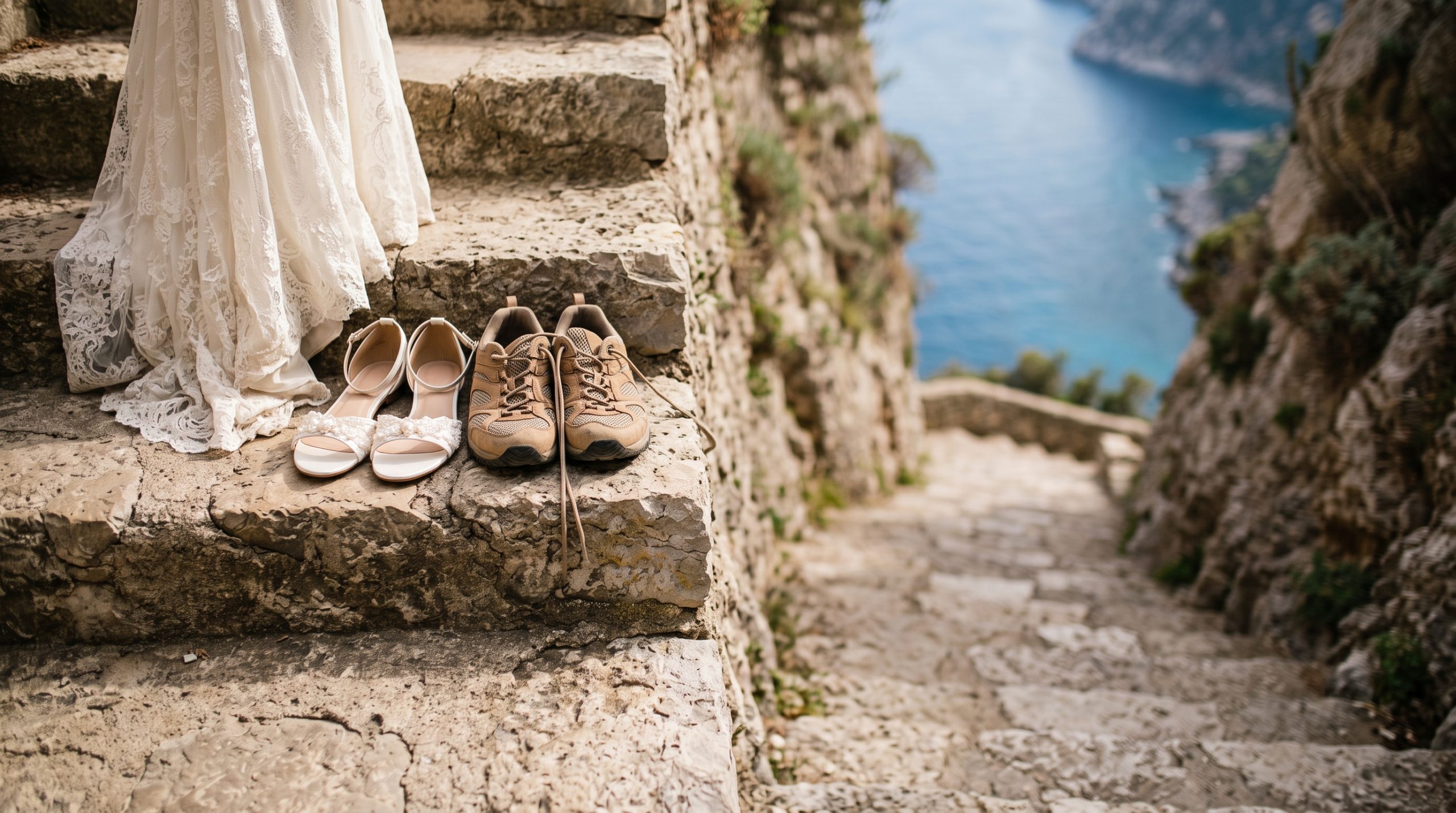
Corniglia’s Lardarina staircase is 382 steps in 33 flights of red brick, with benches built into the turns because the masons knew you would want them. As cliff staircases in Europe go, this is one of the kind ones. The risers are low, the flights are even, and it will still take a floor-length silk hem and turn it into a mop by the eighth flight.
Most of the staircases couples write to us about are less forgiving than that. The old path from Fira down to Santorini’s Old Port is 588 cobbled switchbacks. The stone descent from Nocelle into Positano runs to roughly 1,700 steps. Praia do Camilo in the Algarve is only around 200 timber treads, and it is the one people underestimate on the way back up.
Three hundred steps is where clothing stops being a question of taste and becomes a question of logistics. What the fabric does on stone, what the sole does on damp cobbles, and where in the day the climb sits are decisions made together, or they are made badly.
Two pairs of shoes, one hem you can carry
Walk the steps in a shoe with a rubber tread, and change into the pair you married in at the top or the bottom. Choose a heavier fabric, silk crepe or mikado or satin-back crepe, that hangs instead of sailing. Keep a hem you can gather in one hand, and let someone else carry the train.
What 300 steps costs you in vertical
A cut stone step rises somewhere near 17 centimetres. Three hundred of them is about 50 metres of climb, the height of a fifteen-storey building, and if the vows are at the bottom you are doing it twice. The count is the headline. The shape of the step is what decides your shoes.
Published counts for the same staircase rarely agree with each other, which tells you how little the number means on its own. A 382-step run of low, even brick is easier than 200 steps of uneven timber. Our destination guides deal with access and permits coastline by coastline. This page is about what you wear on them, so here are the four staircases we are asked about most, and what each is like underfoot.
| Staircase | Steps | Underfoot | How we plan it |
|---|---|---|---|
| Lardarina, Corniglia, Cinque Terre | 382 in 33 flights | Even red brick, polished smooth, benches on the turns | Uphill in trainers, one seated pause, shoes changed at the top |
| Fira to the Old Port, Santorini | 588 | Cobbled switchbacks, no two risers alike, open to the wind | Walk down, cable car back up |
| Nocelle down to Positano, Amalfi Coast | Around 1,700 | Old stone, worn noses, steep and sun-facing | Downhill only, and not in the vows shoes |
| Praia do Camilo, Lagos, Algarve | Around 200 | Timber treads, sand at the base, slick after rain or spray | Dry socks and a towel waiting at the bottom |
Fabric on stone: hems, trains, and what the wind gets hold of
Weight is the whole story. Silk crepe, mikado, satin-back crepe and heavy georgette hang down and stay down. Chiffon, organza and tulle are sails, and on an exposed flight they will be across your face at the moment you want both hands free. That is not an argument against them. It is an argument for knowing which fifteen minutes of the day they belong in.
Embellishment is the next thing to weigh before you fall for a dress destined for a cliff. Heavy beading loads the hem and catches on brick edges and iron handrails where a flight narrows. Horsehair hems abrade on stone. A pale raw silk hem on Ligurian brick dust, or on the ochre limestone above Lagos, will take on colour and keep it for the rest of the day, which is fine if you expect it and maddening if you do not.
Silhouette matters more than length. A fishtail cut close at the knee is made for a promenade, not for a 17-centimetre riser, and you will feel that by the third flight. A-line, slip and soft column shapes climb well. If the dress has a chapel or cathedral train, settle now who carries it and how: a wrist loop, a bustle, or one of us with clean hands. On 382 steps a long train is carried, never worn.
Underneath, plan for friction and heat rather than for the photographs. Fitted shorts or a smooth under-layer for the climb itself, and a light robe or an easy second dress if you are getting ready at the top and walking down before the ceremony. Pockets are worth asking a seamstress for, and they are badly underrated on a staircase where your hands are already full.
Soles, heels, and six surfaces you will really stand on
On the Cinque Terre coastal trails the national park asks walkers to use proper closed footwear instead of flip-flops and strappy sandals, and the same logic carries over to the village staircases, where a few million feet have buffed the brick to a shine. The working rule for wedding shoes on a cliff is simple. Rubber and tread while you are moving, anything you like once you are standing still.
Trainers under a wedding dress are the honest answer, and in a wide frame with the coast behind you nobody will ever know. A low white sneaker holds up in the close frames too. Whatever the pair, walk 5 kilometres in them at home first, because a cliff staircase is a poor place to break in a stiff new sole. Smooth leather soles are the quiet problem, and they usually belong to the partner in the suit: a brand-new pair skates on polished church marble and on sea-damp limestone. Any cobbler will add a thin rubber half-sole in a day, and that fixes it for good.
| Underfoot | Where you meet it | What works | What stays in the room |
|---|---|---|---|
| Even polished brick | Corniglia’s 33 flights | Block heel under 5 centimetres, rubber sole | Fine heel tips |
| Irregular cobbles | The 588 above Santorini’s Old Port | Trainers, or a flat with a lugged sole | Rope wedges, which soak and stay wet |
| Worn sea-facing stone | Positano and the Amalfi staircases | Closed toe, rubber tread | Anything with a smooth sole |
| Timber treads | The wooden run down to Praia do Camilo | Rubber sole, dry feet, a hand on the rail | Bare feet |
| Polished marble | Church and villa floors at either end | Rubber half-sole on dress shoes | New leather soles |
| Sand and rock | Beach landings at the bottom | Bare feet, briefly | Suede of any kind |
Where the published step count lies
Route planners mislead worse than the step counts do. A staircase covers almost no horizontal ground, so a walking app looks at 382 steps, draws a short line and prices it at a few minutes. In a dress, with a hem in one hand, we plan 25 minutes up the Lardarina and 20 minutes down, plus a genuine pause on one of those benches. On the cobbles above Santorini’s Old Port, where no two risers match, we plan 40 minutes down from Fira and the cable car for the return.
Down is the harder direction in wedding clothes, which surprises nearly everybody. Climbing, you can see the next step and the hem falls behind you. Descending, the fabric is in front of your feet and you are setting each one down by feel, on a tread you cannot see, usually with a view ahead that you would rather be looking at. Allow more time going down than coming up, and expect to want a hand.
Two climbs are technically possible and not worth doing in wedding clothes. The 1,700 steps from Positano up to Nocelle is a fine morning in trainers and a long, hot grind in silk. Walking back up the 588 to Fira in the middle of an August afternoon, when the cobbles have been storing heat since ten, is the same story told twice. Both are worth your time on the day before, in shorts, with a bottle of water.
The last twenty minutes before the vows
In the Cyclades the meltemi comes down from the north through the summer, roughly June into September, at its most insistent from the middle of July to the middle of August, when it can push into force 7 or 8. At the top of a caldera staircase that is not cathedral-veil weather, and planning as though it might be costs you the opening minutes of the ceremony.
So the veil is a decision, not a default. A short one, properly pinned, stays where you put it. A long one earns its place when it is used on purpose, with the wind behind it and a filmmaker set up for that frame. Or the exposed spot gets no veil and the long one comes out at a sheltered second location a quarter of an hour away.
The changeover is a real item on the timeline, not a gap between two items. Dry socks, a small towel for sandy feet, a soft brush for a hem that has taken on brick dust, and pins, because hair that survived the drive will not survive the climb. We allow five minutes and put it out of the wind, in a doorway or the lee of a chapel wall.
Who goes down the steps first
Two of us on the ground stops being a nicety on a staircase and turns into plain logistics. One stays with you for the whole descent, close enough to take a hem when a gust comes up the cliff face. The other is already at the bottom, framed up and waiting, because a filmmaker squeezing past you on a narrow flight to get ahead ruins the walk for everyone. Each carries their own bodies and lenses, so nothing has to be fetched back up 382 steps because it was in the wrong bag. There are eight of us, photographers and filmmakers on one team, which is why that pairing is planned in advance rather than arranged on the morning.
Stone staircases photograph better than they walk, which is the part worth holding on to while you are worrying about your shoes. Brick flights give a film its rhythm, and a wide frame from below turns two people into the one bright detail in a very large cliff. You can see how staircases and coast paths read in finished work in our elopement stories and films. Highlights reach you five days after the day itself, and the full gallery or film inside three weeks.
Photography, film, planning, permit research and our own travel sit inside one price in every destination, and the coverage options are set out on our pricing page. If you have a particular staircase in mind and want to know whether it works at the hour you want it, Send Us a Message with the location and the month.
Common questions
Can I wear heels on cliffside steps?
Standing still, yes. A block heel under 5 centimetres is steady on even brick like Corniglia’s flights. Walk the steps in something with a rubber tread and change at the top or the bottom, because a fine heel finds the gaps between cobbles on the 588 above Santorini’s Old Port every time.
Do we really need two pairs of shoes?
Yes, and it is the single change that makes the biggest difference. One pair with tread does the 382 steps or the descent from Nocelle. The other comes out of a bag for the vows and the portraits. We carry the bag, and the spare socks and hem brush that go with it.
What dress fabric survives 300 steps of stone?
Silk crepe, mikado, satin-back crepe and heavy georgette. They hang, they stay put in wind, and they shake out after a climb. Chiffon, organza and tulle behave like sails on an exposed flight, and a pale raw silk hem will lift brick dust in Corniglia and ochre limestone dust above Lagos.
Is it harder to walk down cliff steps or up?
Down, in a long dress, without question. Going up you can see the next tread and the hem trails behind you. Going down the fabric is in front of your feet and you place each one by feel. We plan 20 minutes down the Lardarina and 40 minutes down the 588 from Fira, slower than any app suggests.
Will a long veil work on the Santorini caldera in July?
The meltemi is at its strongest from mid-July to mid-August, reaching force 7 or 8, so a cathedral veil on the caldera rim is a frame you plan for deliberately rather than something you can rely on. A short pinned veil holds. The long one usually comes out at a sheltered spot fifteen minutes away.
What shoes should my partner wear on wet stone?
Not new dress shoes straight from the box. Smooth leather soles slide on polished marble and on sea-damp limestone, and a cobbler will add a thin rubber half-sole in a day. On the trails around the Cinque Terre villages the national park asks for proper closed footwear, which is sound guidance for the staircases too.
How much time should the steps take in our timeline?
We build 25 minutes up the Lardarina and 20 back down, 40 minutes for the descent from Fira to the Old Port, five minutes for the shoe change, and a buffer on top. Climbs go at the cool ends of the day, never at two in the afternoon on sun-facing stone.
The staircase you actually want to climb
Tell us the number you are happy with. If 382 steps of brick before breakfast sounds like a good morning, we will build the day around it and have someone waiting at the bottom. If it does not, say so plainly, and we will find you the clifftop that opens off a car park or the bay you reach by boat, on the same coast, in the same light. If the shape of the day is still open, our guide to planning an elopement sets out the order we work in.
All of it happens in writing, at whatever pace suits you: an inquiry, then a reply and a first brochure inside 24 hours, then a proposal built around your dates and your staircase. We are booking 2027, 2028 and 2029. Start Your Story and tell us where the steps are.