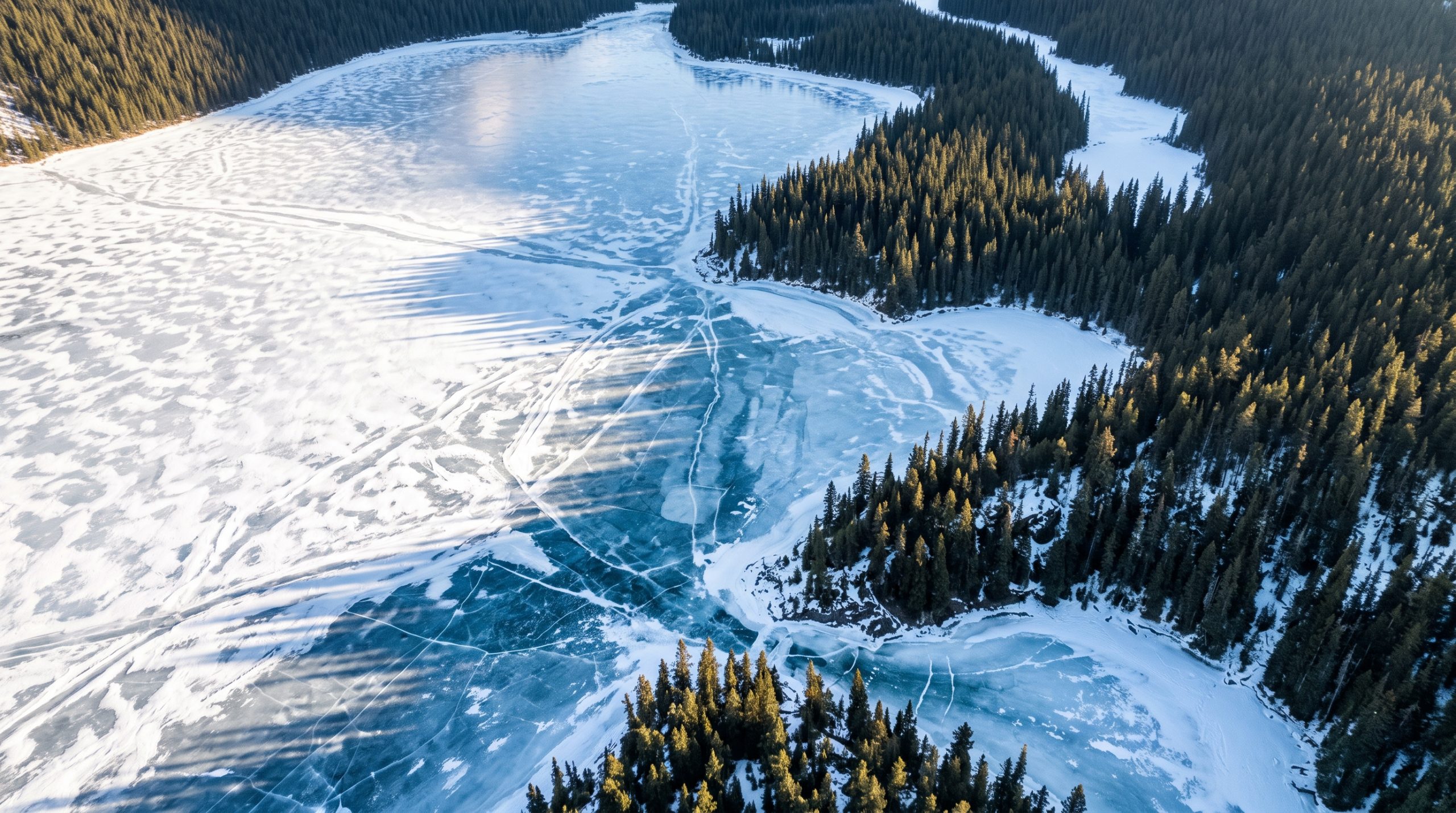
At the winter solstice, Banff runs on roughly seven hours and fifty-seven minutes of daylight, and the sun never lifts much more than fifteen degrees off the horizon. On paper that reads like a problem. In practice it means the low, sideways light that summer visitors wait until nine at night for is simply the light you get all day, from the moment it clears the ridgeline until it slides back behind Mount Rundle.
The ice is the other half of it. Lake Louise usually freezes solid around the middle of December, and the ice castle the Fairmont builds out on the surface needs sixteen to eighteen inches under it before anyone starts carving. That thickness is what changes the pictures. Walking out onto a frozen lake puts you inside a bowl of rock and glacier instead of standing on the shore looking across at it.
This is the winter calendar we plan from: which weeks hold ice, what the light does month by month, which roads are simply not open, and the two weeks we reach for first.
The two Banff winter weeks we would take first
The last two weeks of February. The lakes have carried ice since mid-December, February is the driest month in Banff, daylight passes ten hours by mid-month, and sunset sits close to six in the evening, so vows land in low warm light and nobody walks out in the dark. Late January is a close second.
Freeze-up to last powder: November through April
Elevation does most of the work here. The town sits at about 1,400 m in a valley at 51 degrees north, which is why a January afternoon can feel bright and hard at the same time. The table below is the version of this we send couples when they ask which month to pick, and it pairs with the seasonal notes in our destination elopement guides.
| Month | Conditions | Light | Crowds | Our verdict |
|---|---|---|---|---|
| November | Freeze-up. Valley snow thin early, building fast by the end of the month | About nine hours mid-month, sunset just before five | Quiet before the ski season fills | Late November only |
| December | Coldest daytime highs of the year, near -10°C (14°F). Lake Louise typically freezes solid mid-month | Shortest day of the year, about 7 hours 57 minutes, sunset near 4:40pm | Town full over the holidays, lakeshores are not | Real ice, thin light |
| January | Highs near -9°C (16°F), nights near -17°C (1°F), snow on around ten days | Eight hours rising to nine, sunset past 5:25pm by month end | The quietest weeks of the whole winter | Deep cold, cleanest ice |
| February | The driest month, around 33 mm of precipitation across eight snowy days, highs near -7°C (19°F) | Ten hours by mid-month, sunset just after six by the last week | Busy ski weeks, empty trailheads at first light | Our first pick |
| March | Heaviest monthly snowfall of the year, around 32 cm (13 in) | Almost twelve hours, and after the clocks change sunset runs past 7:45pm | Spring break peaks | Big snow, softening ground |
| April | Winter holds high, the valley floor turns. Skating on Lake Louise often runs to about mid-month | Close to fourteen hours | Quiet between ski season and summer | High ground only |
Read the crowd column carefully. Winter crowding in Banff happens in town, in the gondola line and on the ski hills, not on a frozen lakeshore at eight in the morning. That gap between where people are and where you want to be is the single biggest argument for a winter date.
When the ice arrives, and how far the dates move
Freeze-up is not a date on a calendar, it is a cold spell that either arrives in the first week of December or does not. Lake Louise usually turns solid mid-December and holds through the winter, which makes it the most dependable frozen lake in the park for a ceremony. By the time the ice is thick enough for the castle, sixteen to eighteen inches, it is comfortably thick enough for a wedding party standing still in one place for twenty minutes.
Clear black ice is a different matter. The glassy, cracked, look-straight-down ice that people save to a mood board exists for a handful of days between the freeze and the first real snowfall, and one overnight dump ends it until spring. We plan every winter day around snow-covered ice, which photographs as a clean white plain with the peaks doubling the scale, and we treat clear ice as a bonus if the cold arrives before the snow does. Nobody should book a February date expecting to shoot through the ice.
The frozen methane bubbles happen at Abraham Lake, which is outside the park boundary on the David Thompson Highway, and the good weeks generally sit somewhere between mid-January and late February. Those weeks shift by two or three weeks from one winter to the next, so we treat the bubbles as their own day rather than an add-on to a Banff afternoon, and we check how the lake is reading before we commit a timeline to it. If bubbles are the reason you are coming, tell us early and we shape the trip around a multi-day window instead of a single morning.
Early November and late March: what we would swap them for
Early November is the one stretch of winter we steer couples out of. The lakes have not committed, the valley floor often has just enough snow to look untidy rather than deep, and the high country already looks like February while the ground you actually stand on looks like a wet October. If you have flexibility, move to the last week of the month or straight to late February and you get an entirely different set of pictures for the same flights.
Late March is the subtler one. On paper it is the best month of winter: almost twelve hours of daylight, sunset past 7:45pm once the clocks change, and the heaviest snowfall of the year. On the ground, that snow is landing on top of ten weeks of freeze and thaw, so the valley floor around town goes grey and patchy in the afternoons while the high country stays flawless. Our answer in late March is elevation. We build the day up on snow that is still cold and clean and keep the valley for the drive.
If your date is already fixed in a month we would not have picked, say so in your first message and stop worrying about it. A fixed early-November date becomes a high-ground day with a different lake. A fixed March date becomes a morning start above the valley floor. The month sets the constraints, and the constraints are what we plan against. That is the whole logic behind how we build an elopement day.
A sun that never climbs above fifteen degrees
At the solstice the sun tops out around fifteen degrees above the horizon at this latitude. By late February it reaches roughly thirty. Both numbers are low, and low is the reason winter here is easier to photograph than July, when the sun climbs high enough at midday to flatten everything between eleven and four.
The almanac still lies to you a little, because Banff is a valley. Official sunrise in December is around a quarter to nine, but the peaks on the east side hold the sun off the valley floor for a while after that, so the first light you can actually work with lands later than the printed time and the first thing it touches is the rock high above you. We plan for that. On a solstice-week date, the practical working window on the valley floor runs from mid-morning to about half past three, and a ceremony belongs squarely in the middle of it. By the last week of February that window stretches to something closer to a normal day, with vows at five and warm light still on the peaks afterward.
The short day also changes how two people work. It gives you one pass at the ceremony hour and no chance to repeat it, which is exactly where a dedicated photographer and a dedicated filmmaker working side by side earns its place. Nobody puts a camera down to pick up a different one while the light drops off Rundle. You can see how a winter day resolves into stills and film in our published elopement stories, and the turnaround is the same in February as it is in July: highlights five days after the day, the full gallery or film inside three weeks.
Closed roads, licensed ground, and a licence with a clock on it
The big access fact first. Moraine Lake Road is closed to personal vehicles year-round, and the Parks Canada shuttles and licensed commercial operators run only from June to mid-October. In winter there is no driving to Moraine Lake at all, by anyone. Lake Louise, on the other hand, is open all year, both the community and the lakeshore, and the paid parking that governs summer visits applies during shuttle season rather than in February. Plan two hours for the drive in from Calgary in winter rather than the ninety minutes a summer map suggests.
Working in the park is licensed ground. A business licence is required for every company, guide and vendor operating in Banff National Park, and each contractor holds their own: Parks Canada issues them outside the townsite, the Town of Banff inside it. The town is clear that wedding photography within the townsite does not need a commercial film permit, and it asks for film applications about a month ahead of the shooting date. Worth knowing for anyone with bigger film ambitions: Banff, Kootenay and Yoho do not accept commercial film applications between June 1 and September 30, which means winter sits inside the open window rather than outside it. We carry the licences and do the permit research, and the government, venue and landowner permit fees themselves are paid by you. What a full day of winter coverage includes, team flights and accommodation among it, is set out on our pricing page.
Then the paperwork with a deadline attached. An Alberta marriage licence costs CAD 40 in government fees plus the registry agent’s own service charge, it has to be collected in person from a registry agent, it is only valid for a ceremony in Alberta, and it expires three months after it is issued. That last detail is the one that catches people. You cannot tidy it up eight months early, and registry offices keep weekday hours, so we build the errand into the day before rather than the morning of. Your officiant has to be authorized through Alberta Vital Statistics, which is a short list we work from rather than a search you need to run.
Check Your Date and tell us which weeks you can move, and we will tell you what the light and the ice are likely to be doing in them.
How the winter fallback is built before you fly
Every winter date gets a written plan with named alternatives, sorted by what the sky is doing rather than by preference. Flat grey overcast is not a lost day, it is a canyon day, and the frozen waterfalls in Johnston Canyon look better in soft light than in hard sun. Wind is the variable that actually moves us, because an exposed lakeshore in a strong westerly is a fifteen-minute location, not a two-hour one, so every open location has a treeline pairing within a short drive.
The ceremony hour is written as a movable object, not a fixture. Cold is managed the same way: vows are timed to the warmest part of a short day, the dress goes on over layers, and the long walking sections happen with coats on and cameras down. Heavy snowfall usually improves the frames and slows the roads, which is a timeline problem rather than a photography problem, and it is solved the night before by moving the start earlier and cutting one location instead of three.
What we will not do is sell you weather. A clear-summit February morning in the Rockies is a decent bet, not a promise, and the peaks spend a fair number of winter mornings wrapped in cloud. On those mornings the pictures move down into the trees, the falling snow does the work the mountain would have done, and we come back to the viewpoint the next morning if your trip has a second day in it. That is the strongest argument for giving a winter trip two days instead of one, and we will usually suggest a spare morning when we send a February proposal.
Common questions
How cold does it actually get for an outdoor ceremony in Banff in January?
January daytime highs sit near -9°C (16°F) with nights near -17°C (1°F), so a ceremony timed for the middle of the day is cold rather than punishing. We keep vows to a compact stretch in the warmest hours, put layers under the dress, and pair every exposed location with a sheltered one a few minutes away.
Can we actually get married out on the ice at Lake Louise?
The lake usually freezes solid in mid-December and the surface carries the Fairmont’s ice castle, which needs sixteen to eighteen inches of ice beneath it. Ceremony locations in the park run on a Parks Canada permit application, so we confirm the site and the paperwork before it goes into your timeline.
Is Moraine Lake possible for a winter elopement?
Not by vehicle. Moraine Lake Road is closed to personal vehicles year-round, and shuttles and licensed operators run only from June to mid-October. For a winter date we build around Lake Louise, the Bow Valley and higher ground, and save Moraine Lake for couples booking a summer or early-autumn day.
How many hours of daylight will we have for a December date?
About seven hours and fifty-seven minutes at the solstice, with sunrise near a quarter to nine and sunset near 4:40pm. Because the valley walls hold the sun back at both ends, we treat mid-morning to mid-afternoon as the working window and put the ceremony in the middle of it.
What happens if it snows hard on our wedding day?
We move earlier and simplify. Heavy snow makes better photographs and slower roads, so the fix is fewer locations, more time at each, and a start time reset the evening before. Your plan already names the alternatives, so nothing gets decided in a hurry over breakfast.
Do we need an Alberta marriage licence, and how long is it valid?
Yes. It costs CAD 40 in government fees plus the registry agent’s service charge, must be collected in person in Alberta, and is valid for three months from the date of issue for a ceremony held in Alberta. Your officiant must be authorized through Alberta Vital Statistics.
Pick your two weeks and we will build the day around the light
Send us the weeks you can move and what you want the day to feel like, and we will come back with the light times, the ice outlook and a shape for the day. The whole planning process stays written and easy to revisit, at whatever hour suits you: your inquiry gets a reply and our first brochure inside 24 hours, a tailored proposal follows, and a signed contract with a 30% retainer starts the planning. Our current availability runs across 2027, 2028 and 2029, and February goes first. Tell Us Your Story.