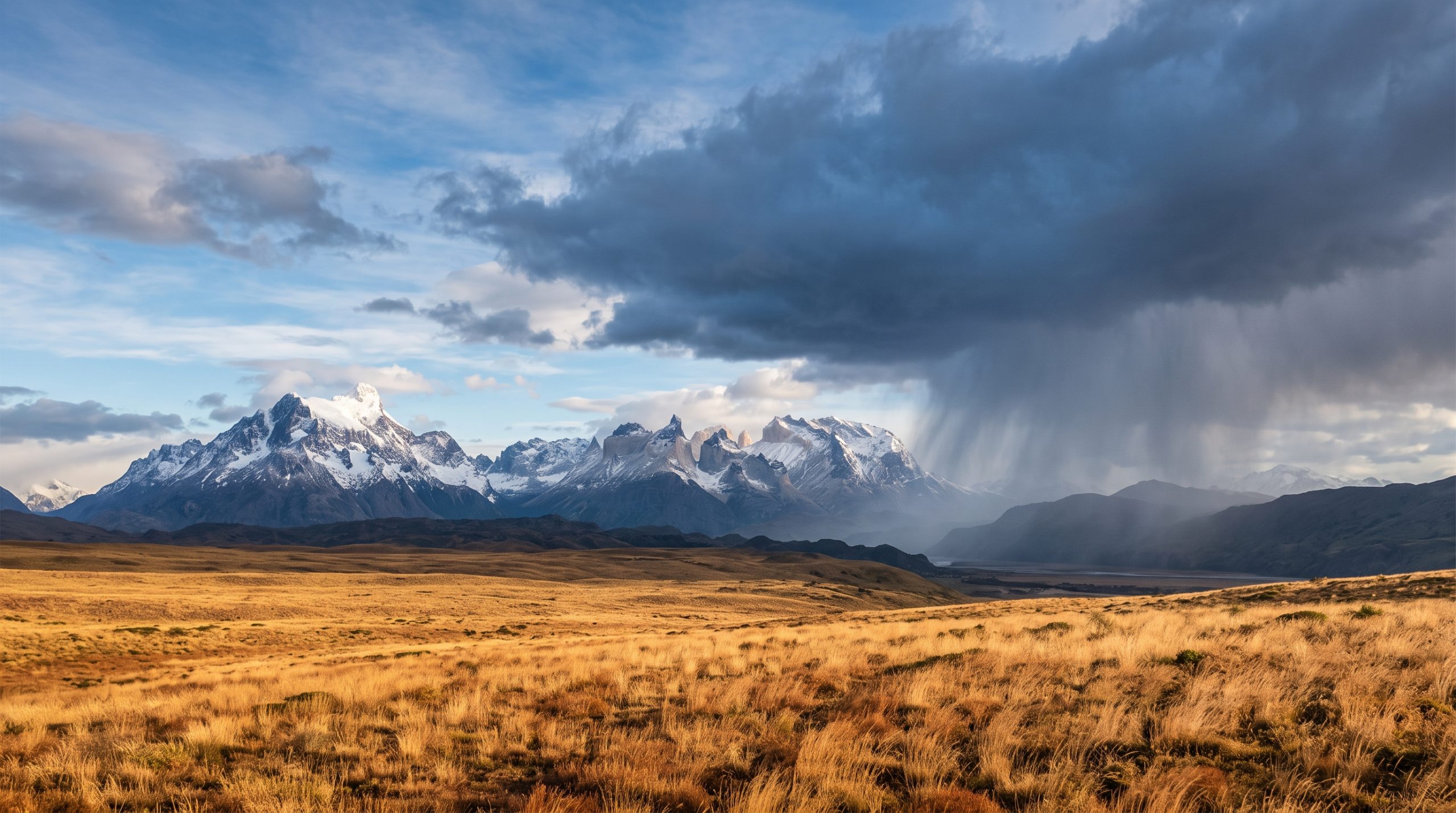
Stand on the shore of Lago Nordenskjold at seven in the morning in late March and the water is often glass. By eleven it can be running white, with spray lifting off the surface and the Cuernos gone behind cloud. By four the cloud has torn open and the granite is lit orange. Nothing went wrong. That is one ordinary day in Torres del Paine.
Couples write to us worried that this makes Patagonia a gamble. It does not. It makes it a place you plan differently: not around a forecast, but around wind direction, a ceremony hour that can move by two hours without anyone losing their nerve, and a short list of locations that each hold up in a different sky. Wind in the park runs from a steady breeze of about 20 km/h to gusts near 110 km/h, roughly 68 mph, and summer is the windiest part of the year. Wind is not the exception here. It is the medium you work in.
So this is the month by month version, with the temperatures, the daylight, the colour window, the seasons when the main trails run on guided access, and the plan we write before anyone gets on a plane. Numbers first. The atmosphere in Patagonia sells itself, but the numbers are what actually decide your timeline.
The Patagonia weather window we would take first
Late March into the first ten days of April. The lenga forests are turning, the summer wind has come off its peak, and the equinox splits the day into about twelve hours of light, so sunrise is reachable without a three in the morning start. Late September is our second choice.
Month by month: wind, light, crowds
Average daytime highs in the park sit near 11 C, about 52 F, in February and drop to roughly 2 C, about 36 F, in July, with nights running from 3 C down to minus 4 C. Rain is possible in every month of the year, which is why the verdict column below is about light and access rather than about staying dry.
| Month | Conditions | Light | Crowds | Our verdict |
|---|---|---|---|---|
| January | Warm and windy, the peak of the summer westerlies | Sunrise before six, light until close to ten | Highest of the year | Work the evening, not the afternoon |
| February | Warmest month, highs near 11 C | 14 hours 52 minutes on 8 February in Puerto Natales, full dark near midnight | Still peak | The month for a night sky frame |
| March | Wind easing, first colour in the last ten days | About twelve hours at the equinox | Falling away weekly | Our first pick from the 20th |
| April | Cool and changeable, snow on the high ground | Sunrise near eight, long low light | Quiet trails | Colour month, keep the timeline loose |
| May | Cold, early snow at low level | Under ten hours | Very quiet | Winter access rules begin |
| June | Cold and still, deep snow on the massif | 7 hours 51 minutes at the solstice | Empty | We would move your date |
| July | Coldest month, highs near 2 C, nights to minus 4 C | Short, low, raking all day | Empty | Only if you actively want snow |
| August | Snow holding, light returning fast | Back past nine hours | Empty | Beautiful and thinly serviced |
| September | Snow lingering, wind rebuilding | About twelve hours at the equinox | Still quiet | Strong second pick from mid month |
| October | Spring, unsettled, snow still on the peaks | About 13 hours at the start, close to 15 by the end | Building | Empty landscapes, real weather |
| November | Drier, highs reaching 16 C, gusts averaging around 60 km/h | Long evenings, late blue hour | Busy | Great light, book lee-side locations |
| December | Warming, windy, long dry spells between fronts | 16 hours 45 minutes at the solstice in Puerto Natales | Peak | Put the ceremony after eight in the evening |
Why one afternoon holds four seasons
The Southern Patagonian Ice Field sits immediately west of the park, and the westerlies cross it before they reach the granite. That is the whole mechanism. Air arrives cold and wet, the Paine massif forces it up, and the sky reorganises itself several times between breakfast and dinner.
It also means the park is not one weather system but several. Conditions genuinely differ between sectors because of elevation and the surrounding landforms, and the western side of the park picks up more scattered showers, since the ocean has a stronger hand there. The eastern approaches around Laguna Amarga and Lago Sarmiento often sit under a different sky entirely, half an hour of driving away.
We use that. If the forecast puts the front on the west, we start the day east and let the light come to us. If the cloud base is low on the towers, we work water level at Salto Grande or the Sarmiento shoreline, where a ceiling at 400 metres is an asset rather than a problem. The plan is never one location with a backup. It is three sets of locations sorted by what the wind is doing that morning.
Narrow windows worth planning around
The lenga and nire forests turn red and gold through March and April, and April is the month photographers travel here for. The peak is not a date. It moves by a week or two from year to year with how the autumn has run, so we plan colour work as a fortnight-wide range and confirm the exact days once the season shows its hand.
The other narrow window is daily rather than seasonal. The calmest air is usually in the first couple of hours after sunrise, before the ground warms and the westerlies get organised, which is why our first frames are so often at a lake edge and our exposed ridge work sits early too. And if you want stars, February is the month: on 8 February the sun sets at 21:30 in Puerto Natales and the sky does not go fully dark until just after midnight, so a night frame is a genuine 00:30 plan, not a poetic idea.
Why we would trade late June for late September
June and July are the two months we would ask you to move. The solstice gives Puerto Natales 7 hours 51 minutes between sunrise and sunset, park highs sit around 2 C with nights to minus 4 C, the O Circuit on the north side of the park is closed for the season, and the Base Torres trail runs on certified guide access through the winter months. None of that closes the park to you. It is simply a narrow day with fewer places to put it.
Late September buys back almost everything. The guide requirement on the Base Torres trail has lifted at the start of September in recent seasons, the equinox returns you to roughly twelve hours of light, snow is still sitting on the massif, and you will share the viewpoints with almost nobody. April does the same job from the other side of the year, with colour instead of snow.
If your date is already fixed in midwinter, we build a different shape and it works. The sun never climbs high in July, so the entire short day behaves like one long golden hour. We keep travel legs under an hour, base you in Puerto Natales, put the ceremony near midday when it is warmest, and use the low-level ground around Lago Sarmiento and Laguna Amarga where snow reads clean and access is simple. Tell us the date you are locked into and we will tell you honestly what that month gives you and what it does not.
What the light does between the solstices
At 51 degrees south the sun runs a low arc all year, and that single fact shapes every timeline we write. Even at midsummer noon the light is more raking than an American couple expects from a July afternoon at home, and the soft hours at either end of the day are long rather than fleeting.
In December the day is 16 hours 45 minutes long in Puerto Natales, and across the border in El Calafate the latest sunset of the year falls just after ten in the evening at the end of the month, with the earliest sunrise around 5:30 in the morning in mid December. That is a huge amount of usable light, but the middle of it is bright and contrasty. So we invert the normal wedding day: a slow morning, ceremony in the last third of the evening, portraits running until the colour goes out of the sky, dinner late.
Autumn does the opposite. In April the sun is low from the moment it clears the horizon, the warm window is wide, and a mid afternoon ceremony sits comfortably inside good light with hours to spare on either side. Winter compresses it further and gives you sidelight for the whole of a short day, which is the best light of the year if you are willing to work inside eight hours.
The difference is visible in the work rather than in a description of it. Our published elopement stories and films are the clearest way to see what a December evening looks like against an April afternoon, and which one you actually want your marriage to look like.
How we design around four seasons before you arrive
Every Patagonian timeline we build has the same architecture. Three location sets, each chosen for a wind direction and a cloud base. A ceremony hour with two hours of movement in it, agreed with you in advance so nobody has to make that decision under pressure on the morning. A running order that can be reversed if the front arrives early. Named alternatives within thirty minutes of each other, not vague reassurance.
Logistics get pinned before you fly. Park entry passes are sold through Chile’s national parks portal and are bought ahead of time, because there is no internet at the gate to fix it on arrival. The catamaran across Lago Pehoe between Pudeto and Paine Grande takes around half an hour and runs at the mercy of the same wind everyone else is watching, so we do not put a ceremony on the far side of a crossing unless the whole day is built to absorb losing it. Permit research, timeline design, weather alternatives and location design are part of every experience we run, and the shape of that work is set out on our experiences and pricing page.
Season also decides how many of us should be on the ground. In April a clear window on the towers can last twenty minutes, and a photographer and filmmaker working the same twenty minutes side by side is the only way you get both. In December, with light until ten, one person can work slowly and still bring back a full day. That is the practical reason we offer both shapes rather than one, and why we ask what month you are thinking about before we recommend either. If you are still deciding on region as well as month, our destination elopement guides and the how to elope planning walkthrough are the right places to start.
Dates are currently open across the 2027–2029 seasons. Send Us a Message with the month you have in mind and we will tell you what that month actually does here.
Common questions
What is the windiest month in Torres del Paine?
Summer is the windiest part of the year, so December through February carry the strongest and most persistent wind, with gusts reaching around 110 km/h. Winter is calmer but much darker. Late March and April are the practical compromise: the wind has come off its summer peak and there is still real daylight to work with.
Can we get married in Torres del Paine in June or July?
Yes, and it can be beautiful. Plan for 7 hours 51 minutes of daylight at the solstice, highs around 2 C, the O Circuit closed for the season and certified guide access on the Base Torres trail. We build midwinter days around low level ground, short drives and a midday ceremony, which is when the temperature and the light are both at their best.
When does the autumn colour peak in Patagonia?
The lenga and nire forests turn through March and April, with April the strongest month for colour. The peak shifts by a week or two each year, so we hold a range rather than a date and lock the specific days once the season declares itself. Booking the first half of April gives you the widest margin.
How late does the sun set in Patagonia in December?
Very late. Puerto Natales gets 16 hours 45 minutes of daylight at the December solstice, and in El Calafate the latest sunset of the year lands just after ten in the evening at the end of December. We routinely run summer ceremonies at eight or nine in the evening and still finish portraits in warm light.
What happens if the towers are in cloud on our date?
No month here offers a reliable clear summit, and any team that promises one is guessing. The honest way to raise your odds is more mornings rather than a better month, which is why multi day coverage suits Patagonia so well. On a single day we plan for the cloud to stay: lake level, forest, waterfall and glacier locations that look their best under a low ceiling.
Do we need to buy park entry before we arrive?
Yes. Passes for Torres del Paine are sold through Chile’s national parks booking portal and should be bought in advance, since there is no internet signal at the entrance to sort it out on the day. We handle that research and the permit questions that sit alongside it as part of planning, and you pay the official fees directly.
Choosing the month by flexibility, not averages
Patagonia rewards couples who are willing to be flexible by two hours rather than two days. Tell us the window you are considering, whether that is a fixed anniversary in July or a wide open March, and we will come back with what the light, the wind and the access actually look like in that stretch, and which fortnight inside it we would pick. From the first reply onward, the process stays in writing, so you can read our reply properly and at your own pace, and you will hear back from us within 24 hours with an initial brochure.
Check Your Date and we will start with the month.