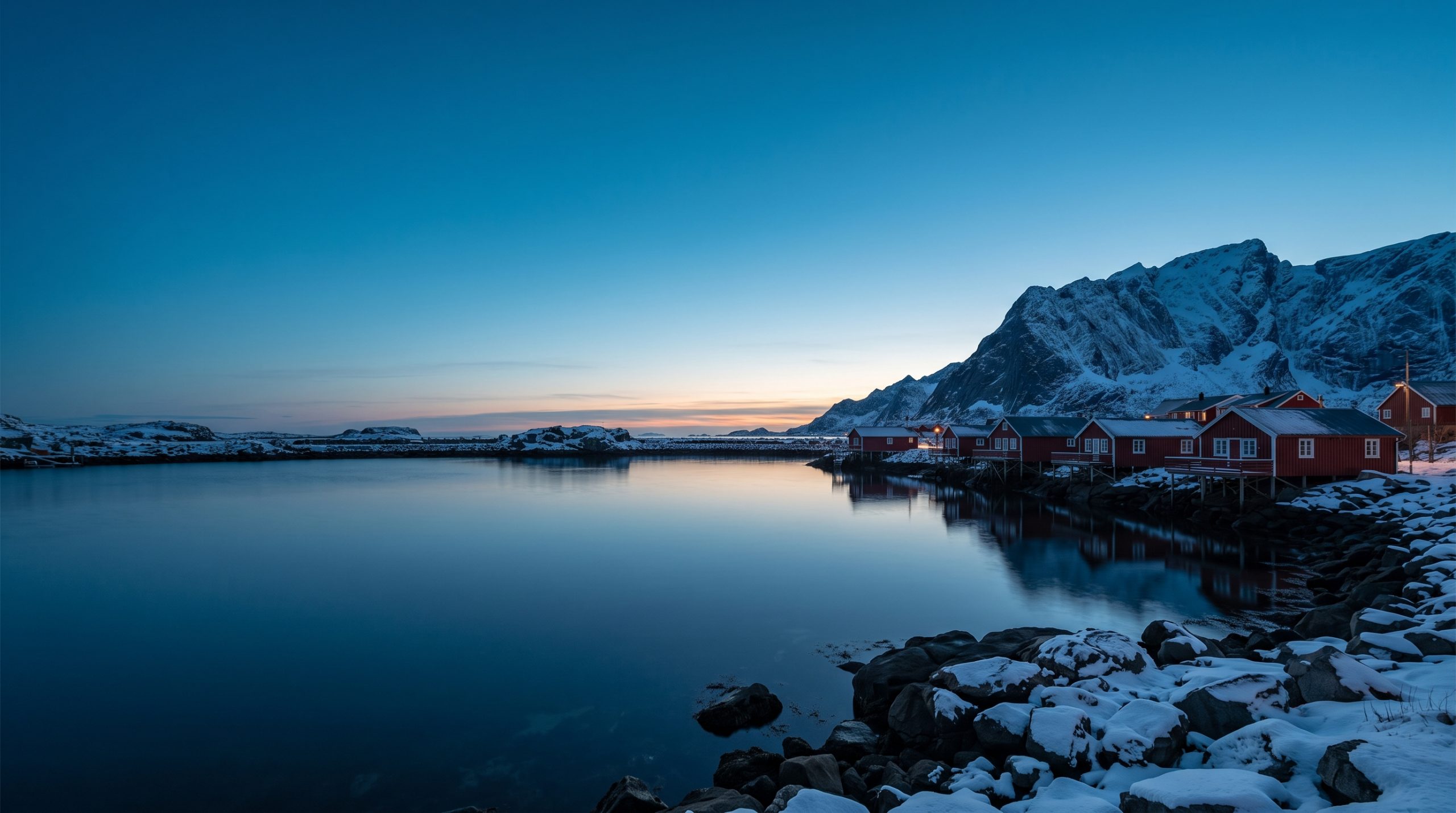
At midday on the winter solstice in Svolvær, the sun sits roughly a degree and a half below the horizon and never comes up. What happens instead is that the southern sky turns the color of a gas flame, holds it for hours, then hands it slowly back to navy. There is no sunrise to be late for. The twenty minutes of light that photographers sprint after everywhere else simply runs and runs.
That is the argument for eloping here in the last weeks of December, and it comes with a straight-faced catch. The same Atlantic air that keeps these islands mild for 68 degrees north also keeps them changeable. December at Leknes averages a daytime high near 38°F and 3.94 inches of precipitation, which means rain as readily as snow. We plan around that rather than hoping past it.
What follows is what each month here actually hands you, hour by hour and degree by degree, and how we shape a wedding day around it.
When the polar night runs, and how much light it gives you
In Svolvær the sun stays below the horizon from about December 7 until January 5, close to four weeks. It is not dark. At the solstice the sun climbs to within two degrees of the horizon, so civil twilight lasts roughly five hours, from about 09:25 to 14:35, with the strongest color near solar noon at midday.
Month by month, with the numbers behind the mood
Temperature and precipitation figures come from a decade of observations at Leknes, in the middle of the archipelago. Sun times are calculated for Svolvær on the fifteenth of each month, and shift by a few minutes across the islands.
| Month | Light | Leknes averages | Crowds | Our verdict |
|---|---|---|---|---|
| January | Sun up about three hours, 10:42 to 13:42; usable light 08:58 to 15:24 | High 35°F, low 26°F, 4.43 inches | Very quiet | Winter conditions turn reliable; low sun all day |
| February | 08:22 to 16:10; sun spends about 3.5 hours under six degrees | High 36°F, low 26°F, 4.99 inches | Quiet away from aurora tours | Our pick for snow with a real sunrise |
| March | 06:24 to 18:00, 11.6 hours; sun reaches 20 degrees | High 38°F, low 27°F, 5.28 inches; windiest at 22 mph | Rising | Wettest and windiest in the record; workable with a movable hour |
| April | 05:10 to 20:56 | High 42°F, low 31°F, 3.02 inches | Light | Aurora gone by mid-month, snow retreating uphill |
| May | 02:44 to 23:16; midnight sun from May 25 at Uttakleiv | High 50°F, low 38°F, 2.20 inches | Building | Green returns and evenings run past midnight |
| June | No sunset; at the solstice the sun never drops below 1.7 degrees | High 55°F, low 45°F, 1.59 inches | Busy | Strongest month for a multi-day plan |
| July | Midnight sun holds to roughly July 14 | High 61°F, low 50°F, 1.47 inches, the driest | Peak, and the Norwegian holiday month | Warmest and busiest; we work the 01:00 hours |
| August | 04:20 to 21:50; first aurora late in the month | High 60°F, low 48°F, 2.13 inches | Easing after mid-month | Warm water, darkness returning |
| September | 06:18 to 19:34, 13.3 hours | High 55°F, low 44°F, 3.64 inches | Quiet | The all-rounder: ridges open, aurora back |
| October | 08:08 to 17:26, 9.3 hours | High 46°F, low 37°F, 3.79 inches | Quiet | Color, weather fronts, long aurora nights |
| November | 09:18 to 14:12; sun peaks three degrees above the horizon | High 42°F, low 32°F, 4.90 inches | Empty | Darkness without dependable snow; see below |
| December | No sunrise from December 7; about five hours of blue | High 38°F, low 29°F, 3.94 inches | Quiet | The blue day, and our pick for this kind of light |
Four windows worth planning around, and how far they move
Two of these are fixed by the tilt of the planet and will not surprise you. Two are weather, and one of those gets sold to couples as though it were a schedule.
- Polar night, December 7 to January 5. Latitude sets it, so the dates hold from year to year within a day. Asked to name one week, we take December 15 to 21, when the twilight window is at its shortest and lowest and the villages are quiet ahead of Christmas.
- Midnight sun, May 28 to July 14 across Lofoten. Uttakleiv on the outer coast runs longer, May 25 to July 18. Also fixed.
- Aurora season, late August to mid-April. Eight months of the year the sky is dark enough. On an average night the aurora shows around 20:00 to 21:00 and fades a little after midnight, and the long nights of November and December do not automatically mean more of it. Cloud has the final word.
- Snow, unscheduled. Winter here averages close to freezing, and the storms that bring the heaviest precipitation arrive on mild western air, so rain is frequent at sea level while the peaks whiten. Colder spells come from the east and are drier and clearer. February and March hold ground cover best.
Our advice is to book your week for the light, which is arithmetic, and treat snow as a gift. If a white ceremony matters more than anything else, tell us early and we will weight the calendar toward late February and talk through the planning fundamentals that let a date flex by a few days.
When polar night becomes too restrictive, and the weeks we prefer
November is the one we argue about least. On the fifteenth the sun is up from 09:18 to 14:12 and peaks three degrees above the horizon, which is beautiful in principle, and the month averages 4.90 inches of precipitation with almost nothing settled underfoot. You get the darkness without the reflectivity that makes Arctic winter photograph the way you imagined. Move six weeks earlier to mid-September, where 13.3 hours of daylight, 3.64 inches and returning aurora nights give you both halves of the day. Or move six weeks later into January and get the snow you were picturing.
March is the harder conversation, because March looks ideal on paper: 11.6 hours of daylight, the sun climbing to 20 degrees, snow still on the peaks above Reine. In the Leknes record it is also the wettest month at 5.28 inches and the windiest, averaging 22 mph. We would nudge you to February, which gives 4.99 inches, a sun that spends three and a half hours under six degrees, and a proper sunrise at 08:22.
If March is already your week, for school holidays or family travel, it is a month we work often and we work it by using its length. Eleven hours of daylight means the ceremony hour can move by three hours on a morning’s notice, which a five-hour December window will not allow.
Which way the light falls, and why that redraws the map
This is the part most Lofoten planning misses. The sun does not just rise and set here, it swings around the compass through the year, and the location that works in May faces the wrong way in December.
During the polar night the glow sits due south, low over Vestfjorden. That puts the light in front of you on the fjord-facing shore: Hamnøy and Reine looking out from Moskenes, the islets at Henningsvær, the harbor at Svolvær. Mid-January is the clearest illustration of it, when the sun rises at 159 degrees and sets at 201 degrees, never leaving the southern quarter of the sky for the three hours it is up.
Then it unwinds fast. Sunset falls at 236 degrees in mid-February, 267 in mid-March, 300 in mid-April and 336 degrees by mid-May, which is nearly north-northwest. The famous west-facing beaches earn their reputation across that stretch, not in winter. It also explains a quirk worth knowing before you book a hotel: Svolvær sits south of high mountains that block the midnight sun, so the June nights get worked on the outer coast at Laukvika or Hov, 20 to 30 minutes away by car.
How all of this actually renders, the way polar-night blue reads almost violet against snow and how a summer night at 01:00 looks in motion, is easier to judge by eye than by description. Our published stories and films are grouped by place, so you can look at Arctic winter work and Arctic summer work side by side before choosing your month.
What is open, what is not, and how you get here
Access is seasonal in a way that changes the shape of a day rather than ruining it. The Reinebringen steps above Reine, the view on every Lofoten mood board, are not a winter route by the standing local advice, so December and January days are built at sea level, along the beaches and the fjord shore. The ridge lines are for June through September, and they are worth planning a summer date around.
Most couples fly to Bodø on a mainline carrier, then take the short Widerøe hop to Svolvær or Leknes. Winter driving on the single road spine through the islands is slower than a map suggests once you factor snow clearing and a low sun straight down the windshield, so our timelines budget real travel time between locations rather than optimistic time. Higher trails, huts and the interior hold their snow late; if you want a walk-in ceremony spot, we look at July and August. Our destination guides cover how those seasonal shapes differ from one Arctic region to the next.
How we build a blue-hour day before you arrive
Every day here goes out with named alternatives attached to wind direction, not a vague hope of clear skies. When the wind is out of the west and the outer coast is unworkable, we move to the sheltered fjord side, the lee of Reinefjorden or the inner channels at Henningsvær. When it turns easterly, the outer beaches at Uttakleiv, Eggum and Kvalvika go glassy and we go there instead. Both plans exist in writing before you land, with drive times attached.
In December the ceremony hour is the flexible piece. Five hours of twilight is enough to hold two slots, one either side of solar noon, and confirm the day before against the forecast. Aerials are treated as a bonus rather than a spine, because winter wind and cold decide whether a drone flies and no film should depend on a maybe. The aurora block, if it happens, sits separately in the evening.
A short window is also the honest case for two of us on the ground. In five hours of usable light you do not get to film the vows and then repeat them for stills, and one person cannot be at the wide angle and beside your hands at the same moment. The Adventure covers a full day with a dedicated photographer or a dedicated filmmaker from $4,900, while the Expedition puts both on the ground for the same day from $7,900, and the full detail sits on our pricing page. Team travel is included worldwide, so a Lofoten week costs the same in flights and logistics as anywhere else we work.
Tell us the week you are considering and what you want the light to be doing, and we will tell you what that week realistically offers, including the times we would rather see you here in a different month. Send Us a Message with your dates and we will come back with a shape for the day.
Common questions
Is it too dark to photograph an elopement during the polar night?
No. At the solstice there are about five hours, roughly 09:25 to 14:35 in Svolvær, when the sun sits close enough beneath the horizon to fill the sky with color. Both stills and film work well in it. What you lose is hard sunlight and contrast, and what you gain is even, soft light that lasts all day instead of twenty minutes.
What time would our ceremony be in late December?
Around 12:15. Solar noon in Svolvær falls near midday in December, and the deepest color sits within an hour either side of it, so vows go in the middle of the twilight window and portraits work outward from there toward 09:30 and 14:30.
Will we see the northern lights on a December wedding day?
Possible, never promised. The aurora is visible in Lofoten from late August to mid-April and typically appears between 20:00 and 21:00, fading after midnight. Cloud decides more often than solar activity does. We plan an evening block that we can cancel without losing anything, so the day stands on its own if the sky stays closed.
Is snow guaranteed in Lofoten in December or January?
No. Winter temperatures average close to freezing and the wettest weather arrives on mild western air, so sea-level rain is common while the peaks stay white. Colder, drier spells come from the east. If snow underfoot is your priority, late February is the stronger bet.
Can two Americans legally get married in Lofoten?
Yes. You do not need Norwegian citizenship or a residence permit, only a legal stay, plus a certificate of no impediment from the Norwegian Tax Administration, which is valid for four months and handed to your officiant. You need an authorized officiant and two witnesses physically present, and beyond that you can marry wherever you like. Municipalities keep the officiant lists and may charge for ceremonies held outside their own buildings or hours.
How cold does it actually get, and can we stand outside for vows?
January is the coldest month at Leknes, averaging around 31°F for the month with highs near 35°F. Wind matters more than the thermometer: it averages 19 mph in January, so we pick ceremony spots with something at your back, keep the vows to about fifteen minutes, and build warm-up stops into the timeline between locations.
Choosing the week by the length of blue hour
If you want the version of this place where the whole day is one long blue hour, you are looking at a four-week window each year, and we are currently booking 2027, 2028 and 2029 inside it. Highlights reach you five days after the day itself, with the full gallery or film three weeks later, which for a late-December date means it lands while the light is still fresh in your head.
Everything with us runs in writing, at whatever hour suits your time zone, and we reply to a first message within 24 hours with an initial brochure. From there it is a tailored proposal, a signed contract and a 30 percent retainer, and then the planning starts properly. Check Your Date and tell us which week you are circling.