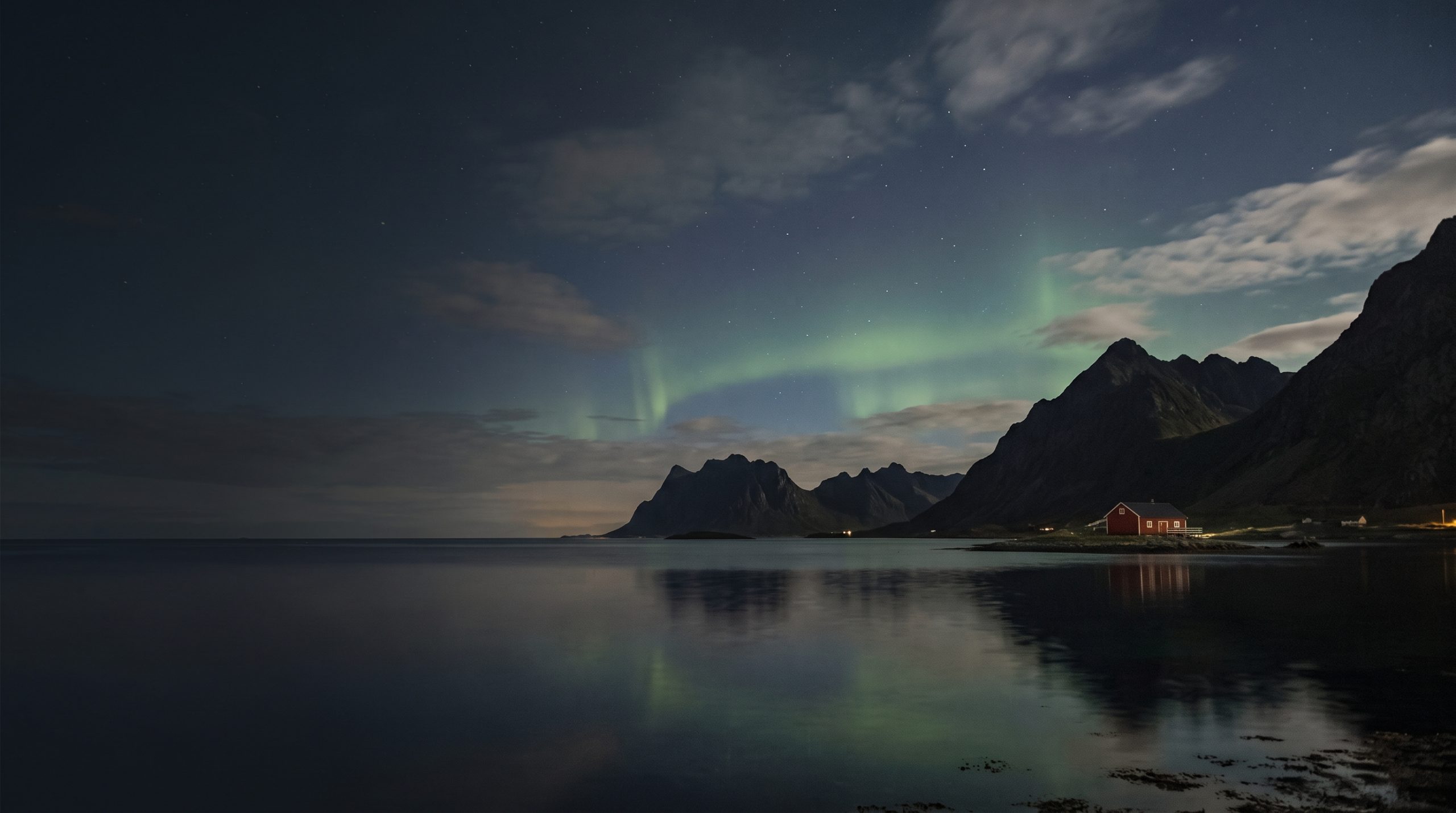
Here is the number that decides a Lofoten aurora calendar, and almost nobody publishes it. In Svolvær, the sky does not reach true darkness at all between roughly 30 March and 13 September. Between 15 April and 28 August it does not even reach nautical darkness. The sun sits too close to the horizon all night, and the northern lights are simply not on the menu, however busy the sun happens to be.
That one line cuts the year in half faster than any weather chart. What is left, mid-September through late March, is where the aurora is genuinely available, and inside that half-year the odds move week by week: how many hours of real dark you get, how much of the Norwegian Sea is throwing cloud over the islands, and how many nights you are willing to stand out in the cold.
We work these islands in winter and we would rather hand you the arithmetic than sell you a green sky. Below is what each month actually gives you, the month we would book, and what we do on the nights the sky says no.
Early March, and the reason is arithmetic
Book the first three weeks of March. Mid-March gives Svolvær around eleven and a half hours of daylight for the day itself, plus roughly five and a half hours of genuine darkness overnight, snow still sitting on the ridges, and the geomagnetic lift that arrives around the equinox. Late September is the runner-up.
Month by month: dark hours, daylight hours, verdict
Daylight and darkness figures below are for Svolvær on the 15th of each month. True dark means the sun more than eighteen degrees below the horizon, which is the point at which a faint aurora reads properly to a camera. Temperature and rainfall figures are the 1991 to 2020 normals for the town.
| Month | Daylight on the 15th | Hours of true dark | Ground and sky | Our verdict |
|---|---|---|---|---|
| January | 3 h, 10:40 to 13:42 | 12.5 | Snow most likely of any month; wettest month of the year at about 85 mm | Deepest dark, roughest weather |
| February | 7 h 50, 08:21 to 16:11 | 9.7 | Coldest month, averaging -0.3°C | Strong on every count |
| March | 11 h 35, 06:22 to 17:59 | 5.6 | Snow on the peaks, equinox activity | Our pick |
| April | 15 h 50, 05:08 to 20:55 | 0 | Snow retreating up the mountains | Aurora done, light excellent |
| May | 20 h 35, 02:41 to 23:15 | 0 | Green returns; midnight sun from the 25th | Long evenings, no night |
| June | 24 h | 0 | Driest month at around 35 mm | Best light, most people |
| July | 24 h until the 18th | 0 | Warmest month, averaging 13.6°C or 56°F | Peak season, zero aurora |
| August | 17 h 30, 04:20 to 21:52 | 0 until the very end | Nautical dark returns about the 28th | First faint displays late |
| September | 13 h 20, 06:19 to 19:35 | 2.1 | True dark returns about the 13th; autumn color on the heath | Best autumn window |
| October | 9 h 20, 08:07 to 17:28 | 8.3 | Ties January as the wettest month | Long nights, restless air |
| November | 4 h 55, 09:18 to 14:14 | 11.7 | Snow arrives, sun barely clears the ridgeline | Big dark, tiny day |
| December | No sunrise after the 7th | 13.3 | About five hours of usable twilight around midday | Blue hour all day |
Why one night is a gamble and three are a plan
Four things have to line up for you to stand under an aurora: activity on the sun, darkness, a clear sky, and a high enough latitude. Lofoten hands you the last one for free. The quiet-state auroral oval sits at roughly 67 to 68 degrees geomagnetic latitude, and these islands sit beneath it, which is why you do not need a headline geomagnetic storm here. Modest activity is enough. On a good night the display is often directly overhead rather than sitting politely on the northern horizon, which changes how we frame you entirely.
Darkness we can calculate to the minute. Solar activity is in decent shape: the maximum of the current solar cycle passed in October 2024, and the years after a maximum are historically generous rather than quiet, with the equinox months tending to produce the most active nights.
Cloud is the variable nobody can promise around, and it is the reason honest odds are quoted in nights rather than percentages. The Alaska Geophysical Institute puts it plainly: travel to the auroral zone, stay three to seven days, and under dark and clear conditions you will most likely see the aurora. One named night is a coin flip. Three nights inside the same week is a completely different proposition, which is why so many of our Lofoten couples build a multi-night Odyssey rather than a single dated day, keeping the ceremony fixed and the aurora night floating.
The other reason we work in pairs up here is that an aurora night gives you a narrow, unrepeatable window. A substorm can build and collapse inside forty minutes. In that window someone has to be shooting long exposures with you both holding still, and someone else has to be catching the sky as it moves, which is two jobs and two cameras at the same moment. It is the difference between coming home with a photograph of the aurora and coming home with the night itself.
The dates that barely move
Bloom dates wander by three weeks. These do not. They are astronomy, and they shift by a day at most from year to year.
- Midnight sun: Visit Lofoten gives the archipelago window as 28 May to 14 July, with Uttakleiv holding the sun from 25 May to 18 July. Svolvær runs to the same longer dates.
- Polar night: the sun stops rising over Svolvær around 7 December and comes back around 4 January.
- True dark returns: about 13 September. It is gone again by about 30 March.
- The wider aurora shoulder: nautical darkness runs from roughly 28 August to 15 April, which is the outer edge of any realistic northern lights planning.
Moon phase matters less than people expect and differently than they fear. A bright moon does wash out a weak display, but it also lights the snow on Reinebringen and the sea below it, so a moderate aurora over a moonlit landscape is often a better photograph than a strong one over a black hole. We look at the moon when we set the night, and we do not chase a new moon at the cost of everything else.
What the sun does at 68 degrees north
This is the part that changes your photographs more than any other seasonal factor, and it has almost nothing to do with the aurora.
On 15 January the sun’s highest point of the entire day is seven tenths of one degree above the horizon. Not seven degrees. Under one. It surfaces at 10:40, skims the southern horizon behind the Vestfjord, and drops at 13:42, and for every minute of those three hours it is inside golden hour. There is no harsh light in a Lofoten January. There is no midday at all in the sense you are used to. By 15 February the sun reaches nine degrees and you get closer to four hours of low, raking light. By mid-March it climbs to nearly twenty degrees, which is when the day starts behaving like a day again, with a proper morning and a proper evening and around two and a half hours of low sun split between them.
Turn it around and June does the same trick from the other side. The sun peaks at 45 degrees at the solstice and then spends more than five hours a night sitting within six degrees of the horizon, tracking north and grazing the water. Midnight on Kvalvika in late June is warm sidelight, and it lasts. That is why we run summer ceremonies at 22:00 and later, and why the walk out to Ryten at 01:00 is one of the best hours in our whole calendar. You can see how both extremes look on film in our published elopement stories, which is more useful than any description we can write here.
December is its own thing. No sunrise from the 7th, but roughly five hours of usable twilight either side of midday, and if there is snow on the ground it throws that pink light straight back up at you. Couples who come in December are not compromising. They are choosing a color palette you cannot get in any other month.
The two windows we would move you off, and where to instead
June and July, if the northern lights are the reason you picked Lofoten. There is no darkness. None. The sun does not set in Svolvær from 25 May to 18 July, and it is also the busiest stretch of the year across the north, with Northern Norway logging 2.37 million overnight stays over the June to August season in 2027. If aurora is the point, move to late September and you get around thirteen hours of daylight, autumn color on the hillsides, and true dark returning around the 13th. Move to early March and you get the snow as well.
Late April into mid-May is the other one. The dark is gone, the snow has left the low ground but the trails higher up are still soft, and the midnight sun has not started. It is the flattest stretch of the Lofoten year for a photographic day. Mid-March or the last week of May both sit close enough to it to solve the problem.
None of this is a rule. If your date is already fixed in July because of work or family, we will build you a midnight sun day instead of an aurora one, put the ceremony on a west-facing beach at 23:00 and use the four hours after it, and you will not spend that day wishing you had come in March. Tell us the date you are actually working with and we will tell you honestly what that month does well.
How storm risk and road access shape the aurora backup
Weather in Lofoten is not a hypothetical. October and January each average around 85 mm of precipitation in Svolvær, and a maritime Arctic system can rearrange a day in ninety minutes. So we do not plan a location. We plan a set of locations sorted by wind direction.
A hard southwesterly puts the outer beaches out of use, so the day moves inside the Reinefjord where the walls take the edge off, or east toward the sheltered water near Svolvær. A northerly flips it and the west coast opens up again. Everything sits on the E10, the single road that threads the whole archipelago, and Svolvær to Reine is only about 125 kilometers, near enough two hours in honest winter conditions. That road is kept open through the winter and the national road authority publishes live conditions, and we check it the night before every winter day we shoot, not the morning of.
Three more things we build in as standard. The ceremony hour is written to move, so if the good light lands at 11:00 instead of 13:00 we take it. The aurora night sits separately from the wedding day, on standby, so we can call it on the evening the forecast gives us a gap. And every winter day is planned with short approaches from the road rather than long hikes, so nothing depends on a trail being in good condition. If you want the longer walks, Kvalvika and Ryten are extraordinary and they belong to the snow-free months. The rest of the sequence, from paperwork to who stands where, is laid out in our guide to planning an elopement.
Common questions
Can you guarantee northern lights on our elopement night?
No, and anyone who does is guessing. What we can do is stack the odds: a date inside the dark half of the year, several nights held rather than one, a ceremony hour that can move, and locations chosen by wind direction on the night. Under dark, clear conditions in the auroral zone, three to seven nights makes a sighting likely.
How many nights should we stay in Lofoten to actually see the aurora?
Three at an absolute minimum, five if you can. The Alaska Geophysical Institute’s guidance for the auroral zone is three to seven days, and Lofoten’s maritime weather sits at the demanding end of that range. Most of our couples split the difference and hold three nights across a week.
Is September dark enough, or do we have to come in winter?
True darkness returns to Svolvær around 13 September, so the second half of the month works. You get about two hours of proper night on the 15th, thirteen hours of daylight for the day itself, and autumn color on the hills. It is the best compromise in the calendar.
We can only travel in June. Is a Lofoten elopement still worth it?
Yes, and it is a different film entirely. The sun does not set in Svolvær from 25 May to 18 July, so we run the ceremony late in the evening and work through the hours around midnight when the sun is low in the north and the beaches are almost empty. You will not see an aurora. You will get five hours of golden light in one night.
Does a full moon ruin northern lights photos?
It flattens a faint display, but it also lights the snow and the mountains, which usually improves the picture as a whole. We factor moon phase into which night we prioritize rather than treating it as a problem to avoid.
What happens if a storm hits on our wedding day in Lofoten?
We move, and it was already decided where. Alternatives are chosen by wind direction before anyone flies, the ceremony hour is written to shift, and the drive from Svolvær to Reine is only around two hours, so the whole archipelago stays available. Rough weather in Lofoten photographs magnificently, which helps.
How far ahead should we book a March date in Lofoten?
Our current availability runs across 2027, 2028 and 2029. Naming a March date early gives us the run-up we want for permit research and for building the timeline around the light. Booking starts with a signed contract and a 30 percent retainer, and planning begins straight after.
Choosing the week for darkness, cloud gaps and roads
If you want the northern lights, look at the first three weeks of March first and the second half of September second. If you want a sun that never sets, look at late June. If you want a whole day that behaves like a single long sunrise, look at the second week of January. Every one of those is a different film, and none of them is a lesser one. Our other destination elopement guides work the same way, built on the numbers rather than the adjectives.
Send us the dates you are considering, even if they are three of them and you have not chosen. The whole planning process stays written and easy to revisit, so you will have our reply and the brochure back within 24 hours, and a proposal shaped around your actual week after that. Start Your Story