The paperwork answer for Cappadocia does not begin in Cappadocia. For two American passports it begins at a desk in Ankara, where the Affidavit of Eligibility to Marry gets signed in front of a consular officer, blank until that moment, with the $50 notarial fee already paid online through pay.gov because the window no longer takes cash or a card.
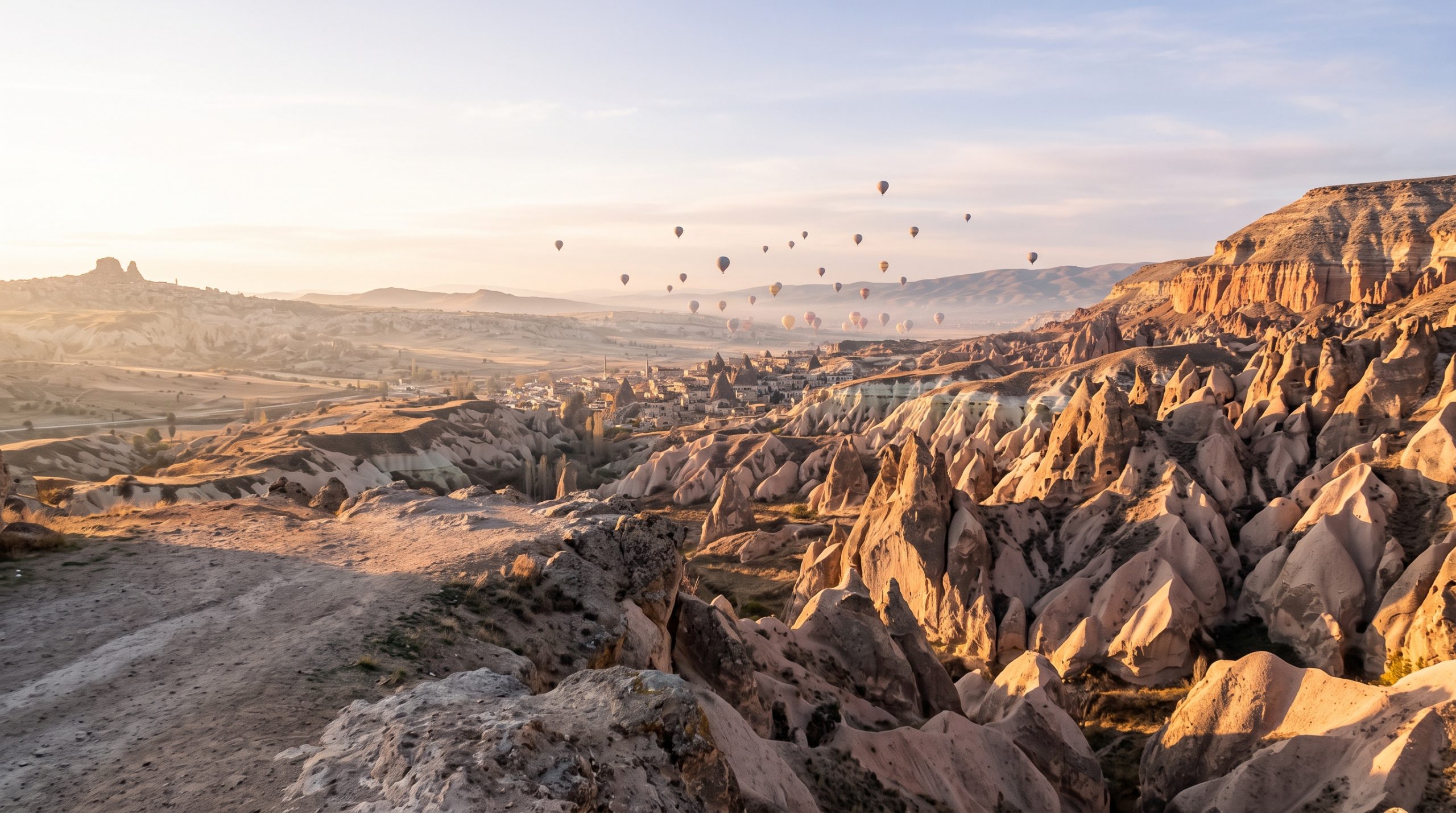
That one step is what sends most couples down the other road. They marry at home in a ten-minute civil ceremony, land at Kayseri or Nevşehir with the certificate already on record, and spend the morning on the thing the valleys do better than any office: the forty minutes when the first balloons come up and the light crosses the rock.
Both routes work. Below is the chain as the offices themselves describe it, what it takes in real days, and what changes on the morning if your marriage is already legal before you fly.
The honest answer for two Americans marrying in Nevşehir province
Yes, and there are two routes. Two visiting Americans can marry legally in Türkiye through a district marriage bureau, which means an affidavit signed in person at the US Embassy in Ankara, a Turkish ministry stamp, a local medical check and sworn translations. Most couples marry at home instead and keep Cappadocia for the ceremony.
Why the affidavit in Ankara decides your route
Rate the Türkiye route fiddly rather than hard. Nothing in it is discretionary or mysterious, and none of it depends on residency. What it does depend on is one consular act that can only happen in person, on Turkish soil, in a city that is not Cappadocia.
Marriage in Türkiye is civil. A religious ceremony on its own carries no legal effect, and the Nevşehir mufti’s office states plainly that where one partner is a foreign national the marriage goes through the municipal marriage officer instead. So your ceremony belongs to a belediye evlendirme dairesi, the marriage bureau of the district where you are staying, which around here means Nevşehir, Ürgüp or Avanos rather than the village whose name is on your hotel booking.
Before any of those offices looks at your file, each of you signs an Affidavit of Eligibility to Marry in front of a US consular officer. Nevşehir province sits on the Ankara list, so the Embassy in Ankara is the place to do it; the Consulate General in Istanbul executes the same document, and a notarized affidavit can be submitted at any marriage bureau in the country. Do not sign it in advance. You sign it there, you can collect it the same day, and the fee is paid online beforehand.
Then comes the step couples miss. Türkiye wants the consular officer’s signature authenticated. On the Ankara route that means the consular department of the Turkish Ministry of Foreign Affairs, through tasdik.mfa.gov.tr, and your bureau will want three copies of both sides of the affidavit once that stamp is on it, plus a copy of your passport bio pages. Couples who execute the affidavit in Istanbul have it certified at the provincial sub-governor’s legal office instead.
None of that is a reason to avoid the Turkish route. It is a reason to know which route you are on before you book flights, because the two produce completely different trips.
The Türkiye file, in the order you collect it
Collect in this order. Three items in the middle cannot exist until the one before them does.
- Vital records from home. Your birth certificate, and a divorce decree if you have been married before. Anything issued in the States travels the same way: an apostille from the state that issued it, then a sworn translation made in Türkiye and notarized there. The embassy and consulates do not provide apostille services.
- Photographs. Ankara consular guidance asks for five each, 2×2 inches, taken within the last six months. Some bureaus ask for six. Get them before you fly and carry spares.
- The Affidavit of Eligibility to Marry. Signed in person at the Embassy in Ankara or the Consulate General in Istanbul, with your passport and, if you have been married before, the original or a certified copy of the divorce decree in hand. The notarial fee is paid in advance online.
- Authentication of the consular signature. Turkish Ministry of Foreign Affairs on the Ankara route, the provincial sub-governor’s legal office on the Istanbul one. Three copies of both sides afterward.
- A notary-certified copy of your passport, plus a Turkish translation of the identity page, made by a sworn translator in Türkiye and notarized there.
- The medical report. One each, from a clinic the marriage bureau designates rather than one you choose, so ask the bureau for its addresses first. Blood type and a standard pre-marriage panel. The report must carry your photograph and the doctor’s stamp.
- Evlenme Beyannamesi, the marriage declaration. Picked up from the bureau itself, completed in two copies, with a notarized translation if you do not read Turkish.
- Proof of where you are staying. Where both partners hold US passports, embassy guidance points to a letter from your hotel.
The bureau then checks the file and offers you a date from its own calendar. That is the part no amount of preparation shortens.
Start with the ceremony and work backwards
Work back from the morning you want rather than forward from today.
- Ten to twelve months out. Fix the month and the ceremony hour, then the accommodation. In Cappadocia the hour is the decision everything else obeys.
- Three months out. Order vital records and send them for apostille. This is the one step that runs on somebody else’s mail room.
- Six weeks out. Photographs, notarized passport copies, and your chosen bureau’s own document list, in writing, kept.
- First days on the ground. Affidavit in Ankara, ministry stamp, sworn translations, medical reports, then the file goes in.
- Ceremony day. Late in the trip, never on the second morning.
The real minimum on the Turkish route is several working days in country with nothing at all going sideways: one for the affidavit, one for the ministry, one for translations and the medical reports, then whatever the bureau needs to check the file and whatever it has open. The comfortable minimum is two weeks, and two weeks is what we build to, with the ceremony at the back end and the office days early enough that a repeat visit to a counter costs you nothing but an afternoon. The general running order, stripped of Türkiye, sits in our guide to how to plan an elopement.
| What it takes | Legal marriage in Türkiye | Married at home, ceremony here |
|---|---|---|
| Consular affidavit | In person, Ankara or Istanbul | Not needed |
| Ministry authentication | Required after notarization | Not needed |
| Medical report | Both partners, clinic named by the bureau | Not needed |
| Sworn translation and notary | Several documents, all done in Türkiye | None |
| Witnesses | Two adults present at the ceremony | Nobody has to sign |
| Who sets the hour | The bureau’s calendar first, then the light | The light |
| Extra days in country | Plan on two weeks | None |
The small things that cost couples a day
Nothing here is dramatic. Each one is simply a day.
- An affidavit signed at your kitchen table is not an affidavit. It is signed in front of the consular officer, and not before.
- The notarial fee goes through pay.gov ahead of time. Cash and cards are not taken at the window.
- Walking out of the embassy is not the end of that document. Without the ministry stamp and three copies of both sides, the bureau’s file is incomplete.
- A medical report without your photograph or the doctor’s stamp gets handed back across the counter.
- Translations are made in Türkiye, by a sworn translator, and notarized there. One done at home is a gamble on the clerk in front of you.
- Take a Turkish speaker with you to the bureau and to the clinic. Embassy instructions say so outright, and it is the cheapest hour of the whole process.
- A ceremony outside the office, or outside office hours, has to be raised with the marriage officer when you file. The officer’s and the assistant’s travel is paid on the day, at the moment they leave.
- Ankara is a separate leg of the trip, several hours northwest of the valleys. Keep the office days and the ceremony day apart, with a night between them.
Fees and deadlines quoted here were correct at the time of writing and are worth re-checking with the office that issues them. Practice also varies between districts, so ask the bureau you will actually use for its own list and keep the reply.
Married in your county, then vows on a terrace above Göreme
Marrying at home first is the route we plan most often in Cappadocia, and it is not a lesser version of anything. It is a straight trade. You give up the Turkish marriage record, which you did not need, and you get the hour, which is the whole reason you chose this landscape.
Think about what that hour is worth here specifically. The balloons go up at first light and for roughly forty minutes the entire plateau is in motion, dozens of envelopes lifting off the valley floors while the sun works along the ridgelines. A marriage bureau opens when a municipal office opens. Standing on a terrace in Uçhisar with the burners audible below you is not something a registrar’s calendar produces. When the legal marriage is already done at home, the only clock left is the sun, and vows can sit at 5:40 in July or at last light on a Rose Valley rim in November.
What changes practically: no file, no medical reports, no ministry stamp, no sworn translations, no Ankara leg, no witnesses to find. Somebody you love reads the words. Nobody signs anything, and the certificate is already in a drawer at home.
What does not change at all is the set of permissions that belong to the place rather than to your marriage. Terraces, cave hotel roofs and valley-floor orchards are somebody’s property, so we ask, in writing, with a time window attached. Göreme National Park and the Rock Sites of Cappadocia has been on the UNESCO World Heritage list since 1985, and the ticketed sites inside it treat professional photography and filming as something to request rather than assume. Aerial work runs on Türkiye’s civil aviation rules plus site permission, so we confirm both before any part of the film leans on a drone. Balloon flights are released morning by morning on conditions, which is why we treat the balloons as a gift in the frame and never as the backbone of a timeline.
Honesty about the place, since it decides more than the paperwork does: the famous viewpoints above Göreme are shoulder to shoulder by twenty past six in summer, and flat by nine. Everything good we do here happens either side of that. If a 4am start is not your idea of a good morning, say so at the beginning, and we will either build a late-afternoon shape instead or tell you which month gives you the same light at a kinder hour. Our published films and galleries are the honest record of how this rock reads once the sun clears the ridge, and of what arrives in your hands afterward.
Tell us the hour you already have in your head and which route you are leaning toward, and we will tell you what each one costs you in days on the ground. Send Us a Message.
Where we fit into the legal process
We are photographers and filmmakers, not lawyers. Rules change and circumstances differ, so confirm the detail with the marriage bureau you intend to use, or with your own consulate, before you book flights. We do not file documents for you and we do not sign anything on your behalf.
What we do own: destination and location design, a timeline built around light and real travel time rather than optimism, permit research and logistics guidance, and a weather alternative for every part of the day that can have one. On the legal route we work the ceremony hour against what the bureau has available and hold the rest of the day around it, so the office keeps its slot and you still get the light you came for.
Because the photographer and the filmmaker come from the same team of eight rather than introducing themselves on the morning, that hour only has to be solved once. One brief, one timeline, two cameras whose positions were agreed the week before, and a colleague in reserve if something moves.
Government, venue and landowner permit fees are yours to pay; the research and the asking are ours. So are accommodation, your celebrant, and anything unusual with wheels or a burner attached: a private balloon basket, a 4×4 down to a valley floor, a guide. Team travel is included worldwide, flights and accommodation for the assigned team, in every destination, with no long-haul surcharge hiding anywhere.
Highlights reach you five days after the ceremony and the full gallery or film three weeks after, which matters more than it sounds when your families are waiting. Coverage runs from The Adventure, one full day with a dedicated photographer or filmmaker, at $4,900, through The Expedition at $7,900 with photographer and filmmaker working together, to the multi-day Odyssey, and the detail sits on our pricing page.
Common questions
Can two Americans legally get married in Cappadocia?
Yes. Marriage in Türkiye is civil, performed by the marriage bureau of the district where you are staying, which in Cappadocia means Nevşehir, Ürgüp or Avanos. A religious ceremony on its own has no legal effect. You will need the consular affidavit, the ministry stamp, medical reports, sworn translations and two witnesses.
Do we have to travel to Ankara before the ceremony?
For a marriage in Nevşehir province the Affidavit of Eligibility to Marry is notarized at the US Embassy in Ankara. The Consulate General in Istanbul executes the same document, and a notarized affidavit can be submitted at any marriage bureau in Türkiye. Either way it is a separate leg of the trip, not a morning errand from Göreme.
Is a Cappadocia ceremony legally binding if we married at home first?
No, and it does not need to be. Your marriage is already on record in your own county or state. The ceremony in the valleys carries no legal weight and no paperwork, which is exactly why the hour belongs to you rather than to an office calendar.
How long does the Turkish route take once we land?
Several working days at absolute minimum: one for the affidavit in Ankara, one for the ministry authentication, one for sworn translations and the medical reports, then the time the bureau needs to check your file and whatever date it has open. We plan two weeks in country and put the ceremony at the back end.
Can a registrar marry us in a valley or on a hotel terrace?
Marriage officers can perform ceremonies outside the office and outside office hours. You raise it with the officer at the time you file, not later, and you pay the travel costs of the officer and the assistant on the day, at the moment they leave the ceremony. Where they will travel to is the officer’s decision.
Who can be our two witnesses if we travel without family?
A Turkish civil ceremony is concluded in front of the registrar with two adults present as witnesses. Ask your bureau directly how it handles witnesses for visiting couples and get the answer in writing when you collect the document list. On the ceremony-only route the question disappears, because nothing is signed.
Do we need an apostille on our American documents?
Records issued in the States, such as a birth certificate or divorce decree, carry an apostille from the state that issued them, and the translation is then made in Türkiye by a sworn translator and notarized there. The US Embassy and consulates do not provide apostille services, so allow mail time.
Can we register our American marriage certificate in Türkiye?
You can, at the local vital statistics office, the nüfus dairesi, which will normally ask for an apostille of the US certificate. Nothing about a ceremony in Cappadocia requires it, and couples who marry at home and celebrate here usually skip the step entirely.
Picking your morning in Cappadocia
The valleys change more by hour than by month, but the months are not equal. Late spring puts green on the valley floors and keeps first light at a civilized hour. High summer brings the earliest starts and the fullest sky. November and December give low sun straight down the valleys, snow on the chimneys some mornings, and a real chance of a still, silent dawn with nothing flying at all, which is why we plan a morning that works whether the balloons are released or not. Our destination elopement guides go further into the month-by-month picture.
From there it is short. You write to us with your dates and the shape you want, we reply with an initial brochure within 24 hours, a tailored proposal follows, and planning begins once the contract is signed and a 30% retainer is paid. The whole planning process stays written and easy to revisit, which means you can read it twice, forward it to whoever is helping, and answer at whatever hour suits you. Dates are currently open across 2027–2029.
Send us the month you are circling and the route you are considering, whether that is the bureau in Nevşehir or a certificate already signed at home, and we will come back with a timeline built around the light. Check Your Date.