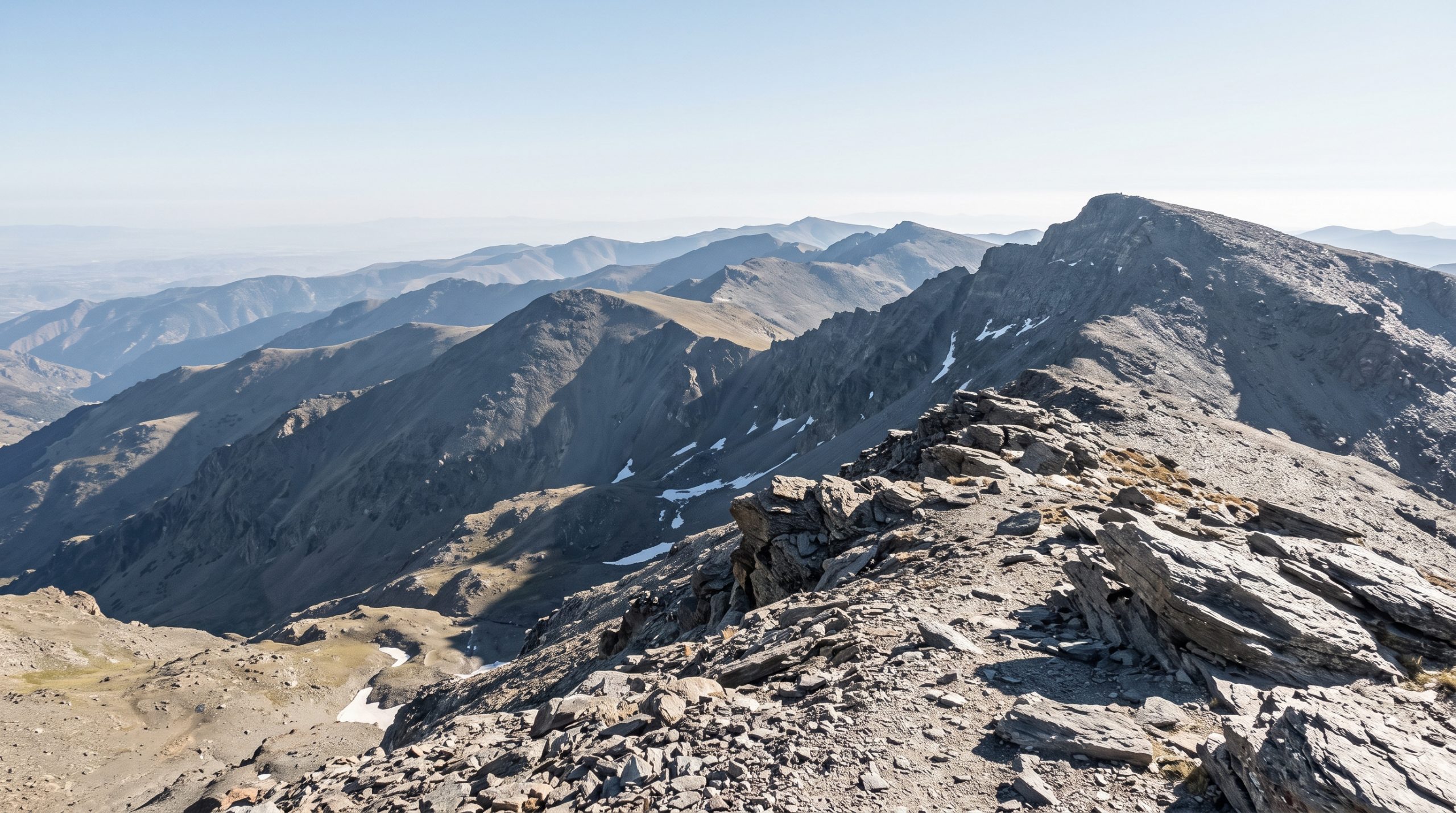
There is a barrier across the old road to Veleta at about 2,600 metres, a short way above the ski buildings at Pradollano. Cars stop there, and they have stopped there since 1999, when the road over the top was closed to general traffic. Almost everything that makes this range worth a long flight sits on the far side of that gate.
From the eastern edge of Granada, at around 750 metres, it is a 43 km climb of tarmac to the summit of Veleta at 3,396 metres. The last 13 km of it are closed to you. Mulhacén, at 3,479 metres the highest ground in mainland Spain and on the whole Iberian Peninsula, sits behind Veleta on a plateau that is reached from the other side of the massif entirely.
So the useful question is not whether the Sierra Nevada is beautiful. It is how two people in wedding clothes get above 3,000 metres at a sensible hour without the morning turning into an expedition nobody agreed to. There are two clean answers, one on each side of the range, and both of them run on a reserved seat.
Married at 3,479 metres: what is really possible
You can hold a ceremony on the high ground of the Sierra Nevada, including the summits of Veleta at 3,396 metres and Mulhacén at 3,479 metres. Cars stop at 2,600 metres, so the last stretch is walked or taken on the national park’s summer minibus. The legal paperwork is handled separately, off the mountain.
The barrier at 2,600 metres, and what it does to your morning
The north-side road runs out at Hoya de la Mora, 2,500 metres: a bowl of parking, the Albergue Universitario, an information point, and not much else, sitting under the Peñones de San Francisco. This is as high as an ordinary car gets in the Sierra Nevada, and it is where most plans quietly stop.
Above it, the old road carries on toward the summit as a service track used by park staff, cyclists and walkers. Through the summer months the national park runs a guided minibus up it, the Servicio de Interpretación de Altas Cumbres, from Hoya de la Mora to a viewpoint called Posiciones del Veleta at 3,100 metres, roughly 6 km of hairpins above the car park at km 39 of the old road. The park has operated the service since 2000. Seats are reserved in advance and there are not many of them, which is the single most important logistical fact on this page.
That reservation is the whole trick of a high ceremony here. A minibus lifts you 600 vertical metres of road you would otherwise be walking, and puts you out on a viewpoint above the Barranco del Guarnón with the north faces of the range directly in front of you and a long horizon of other sierras behind, from La Sagra in the north-east round to La Maroma over toward Málaga. More than 15 summits in this park clear 3,000 metres, and from there you can see a good number of them at once.
If you would rather walk instead, Veleta from Hoya de la Mora is about 10 km there and back, every metre of it above 2,500 metres. That is a real mountain day and a rewarding one, but it is a different animal from a ceremony day, and we would normally build it as a second morning rather than fold it into the first. Our planning fundamentals cover how those two-morning shapes get sequenced.
Veleta from the north, Mulhacén from Capileira
The two sides of the massif give you two different days, and the choice is usually made by which summit matters to you. Veleta is the one you can be standing on top of not long after stepping off a vehicle. Mulhacén, the actual roof of the peninsula, is a walk, and there is no version where it is not.
| Approach | Where a vehicle leaves you | Walk from there | What the day asks |
|---|---|---|---|
| North, by minibus | Posiciones del Veleta, 3,100 m, about 6 km above Hoya de la Mora | Under 300 m of climb to the 3,396 m summit of Veleta | The shortest route to standing on a three-thousander in wedding clothes |
| North, on foot | Hoya de la Mora, 2,500 m | About 10 km there and back to Veleta | A full high-mountain day, best built as its own morning |
| South, by minibus | Alto del Chorrillo, Mirador de Trevélez area, about 2,705 m, some 20 km of road above Capileira | Just over 10 km there and back to Mulhacén, around 760 m of ascent | Four to five hours on the hill for the summit of mainland Spain |
The south route starts in Capileira, down in the Alpujarras, and the park’s information point in that village handles its reservations. Drop-off points on this side are not always identical from season to season, so the walk gets measured from the point your booking actually names rather than from a map printed last year. That is a small thing and it changes the timeline by an hour when it moves.
What the last stretch feels like in wedding clothes
Here is the part almost nobody writes down. The reason a dress works on the Veleta side is that there is a road under your feet nearly the whole way. The old carretera is surfaced for most of its length and only unpaved near the very top, so from Posiciones del Veleta you are walking a broad, graded line with loose stone at the edges rather than picking through boulders. Heels are still a bad idea. Anything with a flat sole and a bit of grip is fine.
Above 2,500 metres there is no treeline and therefore no shade and no shelter, on either side of the range. Wind is the constant, not temperature. A long veil at 3,100 metres will be horizontal, which is either the frame you want or the thing that ruins the ceremony, and it is worth telling us which. Skirts get carried on the steeper minutes and dropped for the last thirty seconds. Boots come off at the top, not halfway.
On the Mulhacén side the ground is rougher and the distance is longer, so we plan that one with proper footwear the whole way and a change at the summit ridge. Four hours on a hill is four hours on a hill, whatever you are wearing.
Where the light lands, and how the place photographs
Aspect governs everything up here and it is the part most planning gets wrong. Hoya de la Mora, the old road and Posiciones del Veleta all sit on the northern flank, with the summit ridge above you and to the south. At first light the tops catch the sun while the ground you are standing on stays blue and cold for a while longer. Late in the day it reverses: the north-west stays open, the whole Vega de Granada spreads out below, and the last light runs along the range instead of across it.
Now the honest part. The minibus is a daytime service, so a ceremony that depends on it happens in the middle of the operating day, and midday at 3,100 metres is flat, hard light on grey stone under a pale sky. It is the least interesting hour on that mountain. If the summit is the thing you cannot compromise on, we take the ceremony hour where the bus puts it and build the character of the day out of scale, weather and distance instead. If the light is the thing you cannot compromise on, we hold the ceremony lower, on the Alpujarras side or in the meadows below Hoya de la Mora, and walk high afterwards on our own schedule. Tell us which of the two you actually care about more and the whole plan falls into place around it.
What this range gives a camera is scale and austerity rather than colour. Grey schist, snow lying in the shaded cirques long after the valleys have gone dry and gold, cloud pouring over the ridge from the south and evaporating on the north side. Two figures at 3,100 metres read as very small, which is the point. Our galleries and films will show you how we handle that kind of ground, and how a film cut on a wide, empty plateau differs from one cut in a valley.
Room to work matters more here than in most places. Posiciones del Veleta is a viewpoint on the edge of a gully, and the summit itself is small, so a photographer and a filmmaker who arrived separately would spend the ceremony dodging each other’s frames on a strip of old tarmac. Ours are on the same team, so one takes the drop side and one takes the road, positions are agreed before you start walking, and neither of them ever backs into the other’s shot. Wind is the other reason it helps: at that height it never fully stops, so audio for vows gets recorded from the sheltered flank while the wide frame comes from the exposed one, and the two people doing it are talking to each other rather than guessing.
One full day with a dedicated photographer or a dedicated filmmaker starts at $4,900, the two-person version with both working together starts at $7,900, and longer multi-day shapes are quoted on our coverage and pricing page.
Snow, wind, and the window the bus keeps
The high mountain minibus is a summer service and it finishes for the year when the first snows arrive. That single sentence sets the calendar for a summit ceremony more firmly than anything else, and it is why we would rather talk about which month you are flexible on than which date you have picked.
Outside that window the mountain is still very much open, it is just a different mountain. Pradollano is a working ski resort, so the road to Hoya de la Mora at 2,500 metres is maintained through the winter and you can stand in deep snow with the whole range above you a couple of hours after breakfast in Granada. What you do not do in February is plan a ceremony at 3,400 metres. We build cold-season days at and below the barrier, which photographs beautifully and asks far less of everyone.
For weather alternatives we look south rather than lower. Capileira and Trevélez in the Alpujarras sit in the valleys under Mulhacén, and the Poqueira valley below them holds together on days when the plateau is in cloud, which happens. Having a second location an hour away with a completely different character is worth more than a forecast. Our destination guides go further into how Andalusian days get paired up like this.
Aerials need their own line in the plan. Spanish rules require prior authorization from the body that manages a protected area before a drone flies over it, so on the Sierra Nevada we confirm permission and a time window first, then design the film around what we know we have. Where the answer is yes, the north faces from the air are the single best thing a camera can do here.
Common questions
Can we drive to the top of Veleta for the ceremony?
No. The old road continues to the summit but has been closed to general traffic beyond Hoya de la Mora since 1999, with a barrier at about 2,600 metres. Park staff, cyclists and walkers use it. For everyone else, the highest a vehicle goes is the park’s own minibus to Posiciones del Veleta at 3,100 metres.
Do we have to book the high mountain minibus in advance?
Yes. Seats on both routes are reserved ahead, the north route from the information point at Hoya de la Mora and the south route from the one in Capileira, and capacity is small. This is one of the first things we lock once a date is agreed, because the timeline for the entire day hangs off the departure you get.
Is a ceremony on Mulhacén legally binding in Spain?
Not by itself. Spain conducts legally binding civil marriages through its civil registries and town halls, which is a paperwork process at an address in a town rather than something that happens at 3,479 metres. Couples travelling in from abroad usually complete the legal side at home and keep the mountain ceremony symbolic, with their own words.
Where do we change out of hiking boots at 3,100 metres?
Wherever the wind is not. There are no facilities above Hoya de la Mora, so we plan for you to arrive already dressed and treat the last few minutes before the ceremony as the change: footwear swapped behind a rock, jackets off, layers stowed with us. It takes about five minutes when it is planned and twenty when it is not.
Will we feel the altitude if we have flown in from sea level?
Granada sits at roughly 750 metres and the viewpoint is at 3,100, so most people notice the thinner air on the walk to the summit and nowhere else. We build a night or two in Granada or the Alpujarras before the ceremony day, keep the walking pace slow and unhurried, and put generous margin either side of the ceremony hour so nothing is ever rushed uphill.
Does the high ground work in winter, or only in summer?
Both, differently. Summer is the window for a summit at 3,396 or 3,479 metres because that is when the minibus runs. Winter days are built at Hoya de la Mora and below, where the road stays open for the ski resort, and they trade altitude for snow depth and a much shorter walk.
If the roof of Spain is your kind of morning
The couples this place fits are the ones who like the idea that a mountain sets the terms. A reserved seat, a fixed departure, 600 metres of old road, and a summit that owes you nothing. If you would rather the day bent around you than the other way round, the Alpujarras valleys below Mulhacén give you the same range with none of the constraint, and we will say so plainly if that sounds more like you.
Either way, tell us what you want the morning to feel like and we will send back a shape for it, including which month on this massif actually delivers it. Photography, film and planning come from the same eight-person team, so nothing gets coordinated between strangers on the day. From the first reply onward, the whole process stays in writing, at whatever hour suits you: send the form, and you will have a reply and our brochure within 24 hours. We are currently taking Andalusia elopement bookings for 2027 through 2029, and planning begins once a proposal is signed and the 30% retainer is paid. Start Your Story.