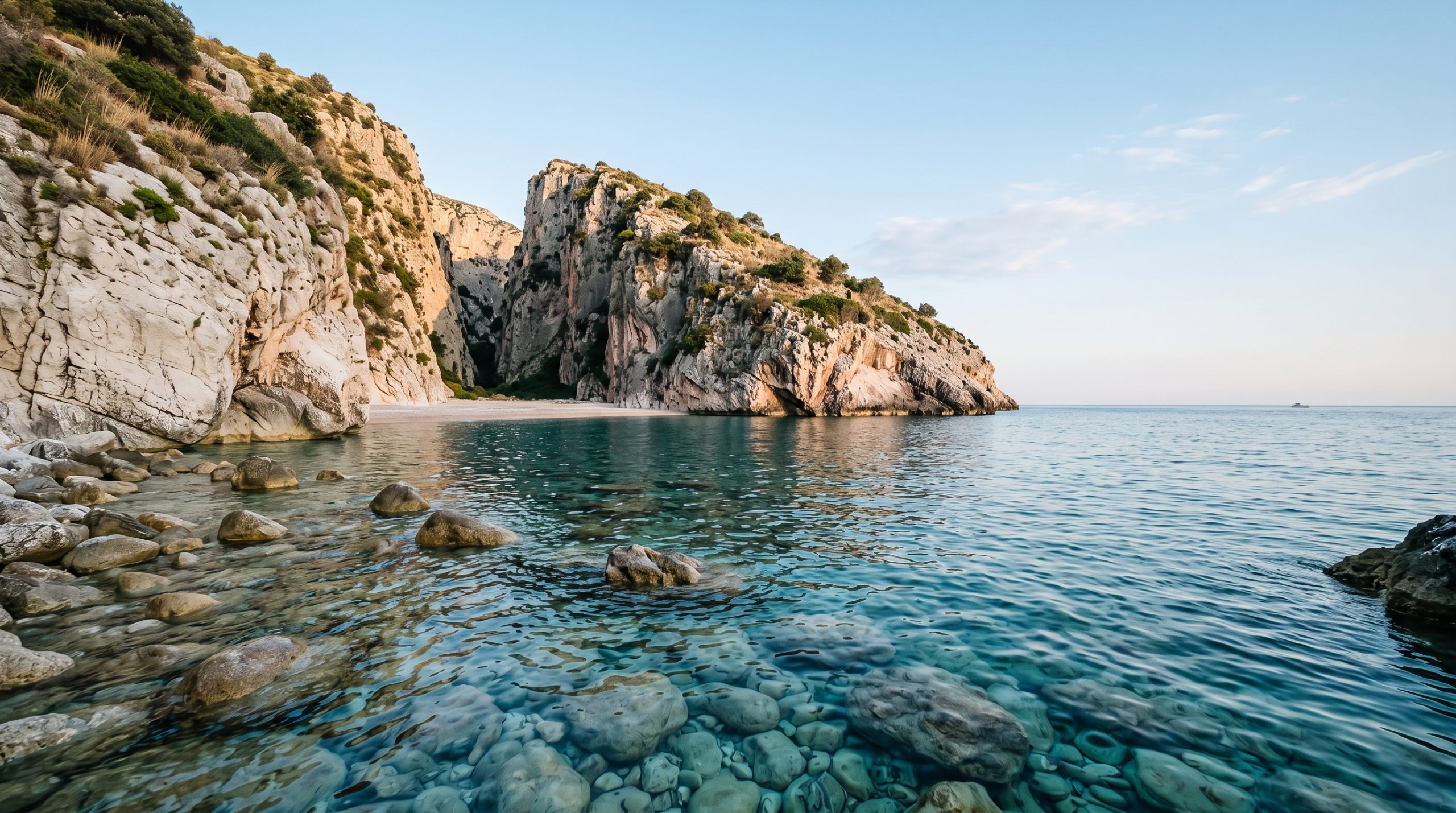
There is a sign at the top of the track with a red arrow painted on it, pointing at a gap in the scrub. That is the entire announcement Gjipe makes. Behind it a rocky path drops about a kilometer and a half to a cove of grey pebbles, maybe a hundred and fifty meters of them, with a limestone gorge opening at the back and the Ionian in front.
Nobody sells you this cove for the afternoon. There is no venue, no gate, no office that takes a booking. What exists instead is a walk, a parking yard that only takes cash, a fleet of day boats that arrive on a timetable you can set a watch by, and high ground behind the beach that decides when the sun turns up. Plan around those four things and Gjipe is one of the simplest places on the Albanian Riviera to marry.
We have walked that track with camera bags in August heat and in the cool blue before the sun clears the ridge. Here is what a day here asks of you, in the order it asks.
Gjipe in one paragraph
Gjipe is a public pebble cove at the mouth of a canyon between Dhermi and Himare, reached by a 1.5 km walk down or twenty minutes by boat from Himare. A ceremony there needs no venue booking. The legal registration happens in a municipal office, at least eleven days after you file.
The two kilometers of track, then the 1.5 on foot
The turn inland leaves the coast road between Dhermi and Himare, and both towns, where almost everyone stays, are twenty to twenty five minutes away by car. From there it is about two kilometers of narrow unpaved track to the parking area at the top of the canyon, with few places to pass anything coming the other way. A rental car manages it slowly, and more slowly with a dress bag on the back seat.
Parking is a privately run yard on the shoulder of the hill, a few hundred lek in cash, and there is no card machine near it. Lek run at roughly a hundred to the euro, so it is small change you simply have to be carrying.
Below the parking the track breaks up into loose rock and boulders, and only high clearance four wheel drives take it on. Everyone else walks: a kilometer and a half down, twenty to thirty minutes at a comfortable pace, closer to forty coming back up because it climbs and carries no shade. A squat concrete bunker beside the path marks the steeper middle section. Underfoot it is dust over loose stone, and the beach at the bottom is pebble, not sand.
In wedding clothes, here is the honest version. Walk down in trail shoes and something you do not mind covering in dust. A dress carried in a bag arrives clean; a dress worn down arrives grey at the hem, and you will spend the first ten minutes of your own ceremony brushing it. Heels have no purpose at Gjipe at any hour, and pebbles are unkind to bare feet, so bring something flat you are happy to have photographed. Walking out after sunset is easy with a headlamp each and tedious without one. We carry spares.
The other way in is by sea, about twenty minutes from the town beach at Himare, and the cove is a standard stop on the local boat trips, so a water taxi is easy to arrange in season. Private boats and four wheel drive charters are booked in your name and paid directly. We do the arranging, and we hold the walk in plan for the same day, because a landing onto pebbles depends on the sea.
Late sun, early shade: what the light actually does
The cove faces open water, which is the most useful fact about photographing here. The sun sets into the sea in front of the beach rather than behind a headland, and the last hour before it goes is when the limestone warms and the water shifts from turquoise toward bronze. In late June the sun is in the sea just after eight in the evening. By late August that is nearer half past seven, and by the third week of September around a quarter to seven. That drift moves an entire timeline, which is why your ceremony hour is written as a time and not as the word sunset.
Mornings work the other way, and most pages about Gjipe have this backwards. The ground climbs hard behind the beach, so although the sun is up by about ten past five in late June, it takes a while to reach the pebbles. First light lands on the water and along the top of the far wall while the beach sits in cool, even shade, and the limestone holds the night air in the gorge well into the morning even in July. If you pictured warm sunrise light on your faces here, the geography does not offer it. It offers a cold blue hour with nobody else in it, worth choosing deliberately rather than discovering at five in the morning.
The hour to avoid is the middle of the day, when light comes straight down, the pebbles glare and there is no shade on the beach at all. Early afternoon brings some relief as the cliff at the canyon mouth throws shade back across the top of the beach. If you want to see how a west facing cove behaves in that last hour before the sun goes, our published galleries and films are the plainest answer we can give.
The day-boat clock
Gjipe is on the itinerary of most boat trips out of Himare, which gives the cove a rhythm you can plan against. Before about ten in the morning it is close to empty. From mid morning until late afternoon there are boats anchored off the pebbles, rented sunbeds on the stones and a constant turnover of day trippers, and the cove takes a beating in August with campfire scars to prove it. Arriving early genuinely is enough here, because the traffic comes in on a timetable rather than trickling in all day, and it leaves the same way. By five or six the boats have run back to town and the beach belongs to the campers and to you.
Who you need to ask, and who you do not
A private ceremony on the pebbles needs nobody’s permission. The shoreline is public, there is no venue to hire, and nobody at the bottom of the track is in the business of selling a wedding. The only two operators involved are the parking yard and the summer camp on the beach, and if your ceremony sits on ground they use, the move is to speak to whoever runs it. We do that ahead of the date.
The legal part happens in a town rather than on a beach. In Albania a marriage is registered at the Office of Civil Status, and both of you must appear there at least eleven days before the date you want, with two witnesses at the registration who are not related to either of you. American couples also need an Affidavit of Eligibility to Marry in the Republic of Albania, issued by the US Embassy in Tirana, which carries the standard notarial fee of fifty dollars. Gjipe sits in Himare municipality, so the office that matters is twenty odd minutes from the trailhead.
That splits the day cleanly, and most couples prefer it: the paperwork signed in town, then the ceremony you actually wanted at the mouth of the canyon, with a celebrant and your own words. Our planning covers the location design, the timeline built around light and real travel time, and the permit research; for the groundwork, read how we plan an elopement. Aerial work in Albania runs through the Albanian Civil Aviation Authority, so we confirm clearance and a window before building any part of a film around a drone. Where an authority or a landowner charges a permit fee, that fee is yours and the paperwork behind it is ours.
Coverage for a single day comes in two shapes, one dedicated photographer or filmmaker from $4,900, or a photographer and filmmaker working together from $7,900, and both include the assigned team’s flights and accommodation wherever the day happens. Longer trips across several days are quoted on their own, and the detail sits on the pricing page.
Up the dry riverbed, where almost nobody walks
Most visitors stop at the water. The gorge behind the beach is the other half of this location, and it stays quiet at two in the afternoon in August when the pebbles do not. From the beach you walk inland along the streambed, dry through the summer, and the first five or six hundred meters are easy going on gravel and slabs, the walls closing in and the air cooling as you go. Then boulders arrive that need hands, and that is where we stop; getting past them is a scramble, not something for clothes you want to keep.
That stretch is where the light gets good. Sun bounces off the upper walls and fills the floor of the gorge with soft, directional light for a couple of hours either side of noon, which is precisely when the open beach is at its worst. Playing the two halves of Gjipe against each other is the craft of the place.
The gorge also settles a question couples ask about having a photographer and a filmmaker in a space this narrow. The floor is only a few meters wide in places, so there is no standing shoulder to shoulder. One of us works from further up the canyon on a long lens while the other stays close, and we trade ends rather than crowd a single sightline. Sound is the other reason we like it in there. The open beach picks up a breeze most afternoons and the gorge does not, so on an Expedition day, with professional audio running, vows spoken a few steps inside the walls come back clean enough to carry a film on your voices.
What moves the plan, and who this cove fits
Three things move a Gjipe day, and none are dramatic once they are planned for. Swell is the first: a landing onto pebbles wants a settled sea, so when the water is up we drive to the top and walk in, and the timeline holds. Heat is the second, since the track carries no shade in July and August, which pushes the shape of the day toward its ends. Season is the third. The camp and the drinks stand are summer operations, so outside the warm months nothing is open at the bottom of the walk and we bring water, shade and the changing arrangements in ourselves.
May, June and September are when this cove is at its kindest: warm water and far fewer boats than the first fortnight of August, on a track you can walk without suffering.
It suits couples who like the fact that their ceremony has a walk in it, and who would rather be up early than share the beach. Guests are welcome and our fee does not change with how many come, but the track has opinions. Every extra person is another liter of water and a few more minutes on the descent, and six guests in sandals is a different animal from two people in trail shoes. If a rocky descent is not the day you have in mind, this coast has coves twenty minutes away where the car park sits at the beach, and the stone villages on the slopes above are a different mood entirely; several appear in our destination guides. Tell us which version you want and we will either build it at Gjipe or say plainly which month, hour or stretch of coast fits it better.
Common questions
Can we drive all the way down to Gjipe beach?
Only in a high clearance four wheel drive. The last section below the parking is loose rock and boulders, so ordinary rental cars stop at the yard on top of the canyon. If walking down is not part of your plan, a four wheel drive transfer or a boat from Himare can be arranged in your name and the timeline built around it.
Is the walk down manageable in a wedding dress?
Manageable, but not advisable. It is a kilometer and a half of dust and loose stone with no shade. Carry the dress in a bag, walk down in trail shoes and change at the bottom. Twenty to thirty minutes down and up to forty back up is the realistic budget, and both walks go into the timeline rather than being wished away.
Does the boat from Himare still run if the sea is choppy?
Not reliably. The run takes about twenty minutes in settled conditions, and small boats landing onto an open pebble beach want calm water. Every Gjipe plan we write carries the drive and walk option for the same hours, so a windy morning changes how you arrive and nothing else about the day.
Is there anywhere at Gjipe to change, or a bathroom?
There is a small summer camp and bar with basic facilities and cold drinks while the season runs, and nothing at all outside it. No electricity, no wifi. When the camp is shut we set a changing spot among the boulders at the canyon mouth and carry water in for everyone.
Do we need a permit for a ceremony on Gjipe beach?
A private ceremony on the shoreline does not require one. There is no venue and no booking system at the cove. We speak in advance to the beach camp and the parking operator so nobody is surprised on the day, and where any authority or landowner does charge a fee, we research it and you pay it directly.
Will a ceremony at Gjipe be legally binding?
The ceremony at the cove is yours to write; the legal marriage is registered at the Office of Civil Status, where you both appear at least eleven days beforehand and bring two unrelated witnesses to the registration. American couples add an Affidavit of Eligibility to Marry issued by the US Embassy in Tirana. Most couples sign in Himare and marry, in the way that matters to them, on the pebbles.
Putting a Gjipe day in order
A good day here reads simply on paper: paperwork in town, a slow drive to the top, the walk down while the beach is still in shade, the gorge through the flat middle hours, and vows on the pebbles as the sun goes into the sea. Highlights reach you five days later, the full gallery or film three weeks after that. The full planning trail stays written and easy to revisit, which is how we work with couples across every time zone, and Our Albania calendar is currently open across 2027, 2028 and 2029. Send us your dates and the shape of day you are picturing, and you will have a reply and our brochure within a day. Tell Us Your Story.