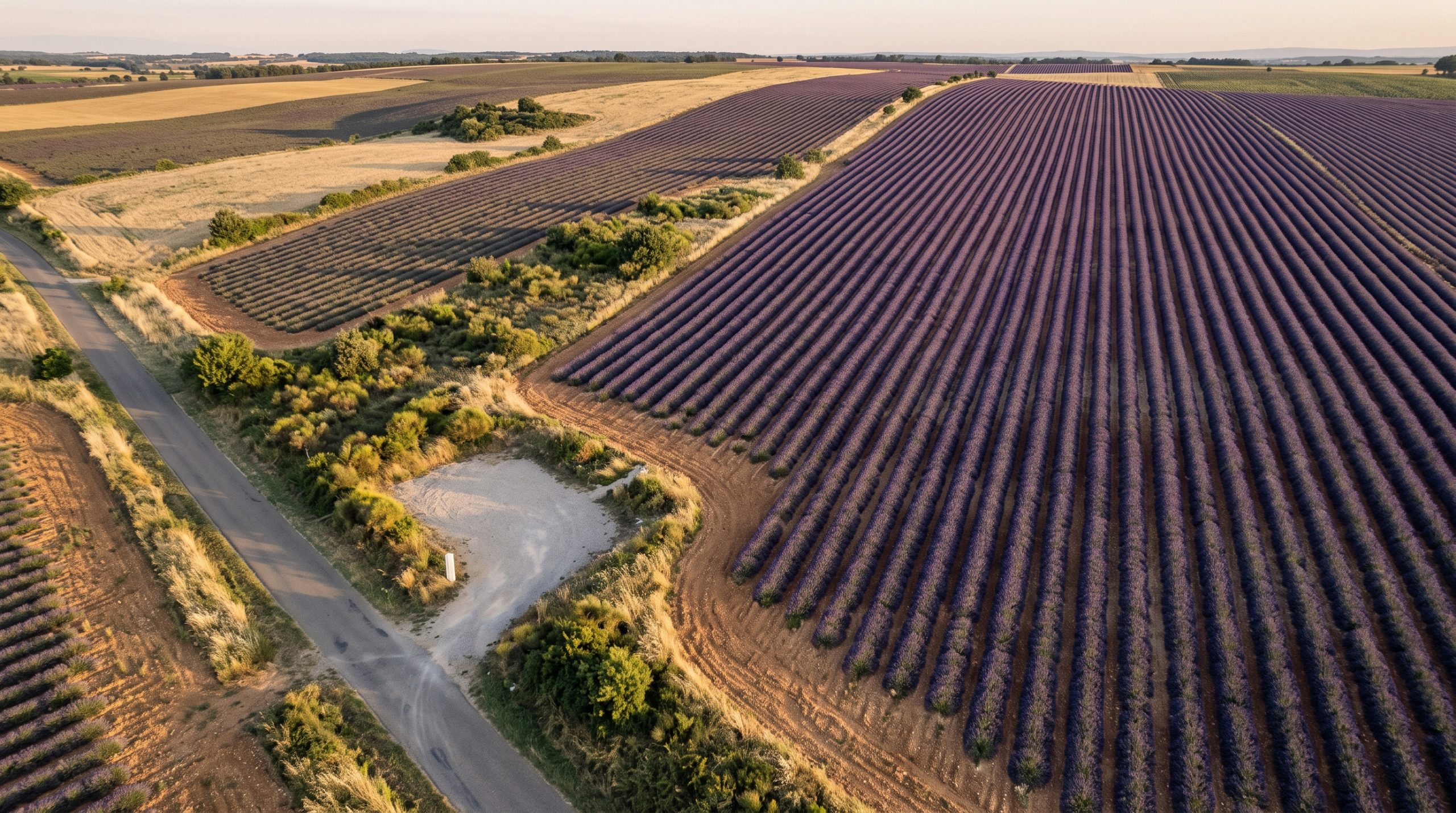
On the Plateau de Valensole, the field you saved from somebody else’s photograph belongs to a farmer, and it has a harvest date. Lavandin here is grown for oil rather than for the view, and cutting on the plateau generally starts in the second week of July. A field that stood hip-high and purple on Tuesday can be green stubble by Wednesday afternoon.
That one fact reorganizes a Valensole wedding day. It decides which week you fly, which road you drive at half past five in the morning, and whose gate you stop at first. It also explains why this plateau rewards couples who can hold two possible weeks rather than one fixed Saturday.
The plateau runs to roughly 800 square kilometers of working farmland between the Verdon and the Asse rivers, so “the lavender fields” is not an address. It is a road network with a village of about 3,100 people in the middle of it, and choosing the right field for the right hour matters far more than simply getting up early.
Fields, hour and parking in one paragraph
Come between mid-June and the second week of July, while the plateau is in flower and the cutting has not started. Work the fields along the D6 east of Valensole village and the road north toward Puimoisson. Park in the gravel pull-ins on the verge, which are free, and be standing there for a sunrise that lands just before six.
The grower’s harvest date, not your calendar, sets the week
Flowering on the plateau usually begins somewhere between the tenth and the twentieth of June, deepens through the last week of the month, and holds into early July. Then the tractors start. Harvest on Valensole generally gets going in the second week of July and is often well advanced by the middle of the month, which is earlier than most people expect and much earlier than the higher plateaus to the north.
The village celebrates its Fête de la Lavande on the third Sunday of July every year. It is a genuinely lovely day, with distillation demonstrations and a producers’ market, and it is also the single busiest day of the year in Valensole. In a hot summer, a good share of the fields closest to the village have already been cut by the time it happens. We would not build a ceremony hour on that Sunday, and we would not build one on the assumption that the third week of July is still purple.
What this means in practice is that we plan Valensole days with a target week and a fallback week, usually the last week of June and the first week of July, and we watch how the season is running before we lock the fine detail of the timeline. Dates are currently open across our 2027, 2028 and 2029 Provence seasons, so there is room to put a hold on the right stretch of the calendar rather than the convenient one.
The D6, the pull-ins, and what the ground does to a hem
The D6 is the spine of all of this. It runs through Valensole village, west toward Manosque and the A51, east toward Riez. Leave the village heading east and you pass wheat first, which throws a lot of visitors, and then after five to ten minutes of driving the lavender opens out on the left in long rolling lines with a small stone house sitting in the middle distance. That view is the reason most people came. It is also the reason there is a car in every pull-in by nine in the morning.
North out of the village, the Puimoisson road gives you higher, quieter ground and a different set of rows. West of the village on the Manosque side there is a well-known farm shop belonging to the Angelvin family, with unpaved parking opposite. Parking on the plateau is free and informal: compacted gravel bays and widened verges, a handful of cars each, no marked spaces and no machine.
Two small things we build into every plan here. We park on the same side of the road as the field we are working, so that nobody is walking a long dress across a road where every driver is looking sideways at the flowers. And we treat the plateau as a driving distance rather than a walking one: two fields in a morning is comfortable, four is a day spent in the car looking at a clock.
The walk itself is almost nothing, which is the luxury of this place. From the verge to your position in the rows is usually thirty seconds to two minutes. What matters is the surface. Lavandin is planted on ridges of dry, pale clay, and the strip between two rows is loose, stony and uneven, with clods baked hard since May. Heels turn over in it. Flat sandals or sneakers work, and most people carry the shoes they actually want to be photographed in and put them on at the edge of the row. A long hem collects dust and pollen and will smell of lavender for the rest of the trip, which we think is a fair trade, though it is worth knowing before you choose the dress.
Just before six, and again after nine
In the first days of July the sun comes up over Valensole at around 05:57 and goes down at about 21:22. By the end of the month that has shifted to roughly 06:24 and 21:00. Those two numbers are the whole shape of a day here.
The important thing about the plateau is that it has almost no relief. There is no ridge to wait for the sun to climb over, so light reaches the flowers at ground level within a minute or two of the actual sunrise. That is unusual and it is worth exploiting. Twenty minutes before the sun appears the whole sky over the Verdon side goes soft pink, the air is still cool, and the rows are quiet. A ceremony at a quarter past six is genuinely comfortable here, which is not true of many places where couples get up this early.
Near midsummer the sun rises well north of east and sets well north of west, and because every field is planted along the line its own ground takes, that geometry decides which fields work at which hour. Point a camera down a row toward a low sun and you get haze, glow and blown-out purple. Turn ninety degrees and shoot across the rows and you get the stripes, the depth and the real color. The same field will do one of those things at six in the morning and the other at nine at night, and a field that is dead at dawn can be the best thing on the plateau in the last half hour of light. This is the part we spend real time on before we ever suggest a location, and it is the part you can see in our published galleries and films, where the low-sun frames and the after-nine frames look like two different countries.
We will also be blunt about the middle of the day, because most pages are not. Between roughly ten in the morning and six in the evening the plateau goes flat and hazy, the purple reads gray, there is no shade to retreat into beyond the odd almond tree, and every row is loud with working bees. It is a fine time to eat, drive, visit a distillery or sit in the village. It is not the hour to exchange vows, and we build the day so that you are not trying to.
Nobody issues a permit for a lavender field
There is no ticket office and no park authority here. Every one of these fields is private property, part of a working farm growing a crop for the distillery, and the only person whose permission matters is the grower. That is a much simpler answer than most destinations give you, and it comes with real obligations: you do not cut flowers, you do not lie down in the plants, and you do not walk into rows you have not been invited into. Growers around Valensole have become far more welcoming of people who ask first, and a number of them now host visits on their own land. Asking properly is our job, and it is included in the planning work rather than charged as an extra.
The legal side of marrying is separate and it is worth being precise about, because a lot of pages are vague here. Under the French civil code a marriage is celebrated publicly at the mairie, by the registrar of a commune where one of you has a domicile or a residence established by at least one month of continuous habitation at the date the banns are published. Valensole’s mairie sits on Place Frédéric-Mistral in the village. For visiting couples, that residence condition is the sticking point, and the practical consequence is straightforward: the paperwork happens at home, and what you hold in the lavender is a ceremony you write yourselves, with a celebrant, in your own language, at whatever hour the light says. Our guide to planning an elopement walks through that sequence in order.
Aerials are the same kind of question, handled the same way. Drone footage runs on permission and a legal window, so we confirm both for the specific field before we plan any part of the film around them, and the plateau photographs beautifully from three meters as well as from thirty.
When a field is cut early, or the wind gets up
Open ground has no windbreak, so wind crosses the plateau without meeting anything, and an afternoon thunderstorm builds in full view for an hour before it arrives. Neither of those ends a day here, but both change its order, which is why the timeline we write has a spare hour in it rather than a tight chain.
If your field has already been cut, the plateau still has plenty to give: wheat going gold, almond orchards, and sunflower fields that come into their own in July as the lavender goes. If your dates fall later in the summer, the higher plateaus around Sault are harvested much later, generally in the middle of August, and Sault holds its own lavender festival on the fifteenth. And if you want a second landscape rather than a second field, Moustiers-Sainte-Marie is about 31 kilometers away, half an hour or so on the Riez roads, with the Verdon gorge and the water of Lac de Sainte-Croix behind it. Combining the plateau at first light with the gorge in the evening is one of the strongest two-location days in Provence, and it is the kind of shape we work out in our destination guides.
Tell us which of those matters most to you, a specific field or a specific week, and we will tell you honestly which one the other has to bend around.
Two of us on open ground with nothing to hide behind
This is a landscape with no walls, no trees and no corners, and that changes how a photographer and a filmmaker have to work. Sightlines run for a kilometer, so anyone standing in the wrong place is in the frame, and there is nowhere to duck out of it. What we use instead is the geometry of the field: the two of us work from opposite ends of a row, or from adjacent rows a few meters apart with the plants between us, trading positions on a signal rather than talking. Because we are one team who plan the day together rather than two suppliers meeting at the pull-in, that choreography is decided the evening before, standing in the actual field. The wind matters here too, since open ground means moving air across a microphone, so vows are recorded close in rather than from a distance. One full day with a dedicated photographer or filmmaker starts at $4,900, and a day with both working together starts at $7,900, with what each includes set out on our coverage and pricing page.
Common questions
Will the lavender still be standing in the last week of July?
On the Valensole plateau, often not. Cutting generally starts in the second week of July and moves quickly, so by late July many fields near the village are stubble. The higher ground around Sault is harvested much later, usually mid-August, and that is where a late-July or August date works better.
Do we need the farmer’s permission to stand in the rows?
Yes. Every field on the plateau is private property and a working crop grown for oil, so permission comes from the grower rather than from any council or park office. We identify who farms the field we want, ask in advance, and keep a second field agreed in case that one is cut early.
Can we get legally married in a Valensole lavender field?
No, and that is true of any field in France. A French civil marriage is celebrated publicly at the mairie, and the commune has to be one where one of you holds a domicile or a residence of at least one month’s continuous habitation when the banns are published. Visiting couples sign at home and hold their ceremony in the lavender.
Is there anywhere near the fields to change out of walking shoes?
Not at the fields. The pull-ins are gravel verges with no facilities of any kind. Because the drive from the village to the good rows is only five to ten minutes, we build the timeline so that you dress where you sleep and change shoes at the edge of the row, which is the only swap most people need.
How busy is the plateau at six in the morning?
Very quiet, and this is the one place where “arrive early” really is enough. The day-trip coaches and tour cars come up from the coast and the Luberon later in the morning, so a 6am ceremony hour is effectively private. The exception is the third Sunday of July, when the village festival fills every road on the plateau.
Sending us your dates
If Valensole is on your list, the useful first message is short: the years you are considering, how much room you have to move a date by a week or two, and if you want the plateau on its own or paired with the Verdon. From there we come back with a shape for the day, the fields that suit the hour you want, and what we need to ask the growers. We handle the planning in writing so nothing depends on matching time zones, so you can read, think and reply on your own time, and you will hear back from us within 24 hours. When you are ready, Check Your Date and tell us which week you are watching.