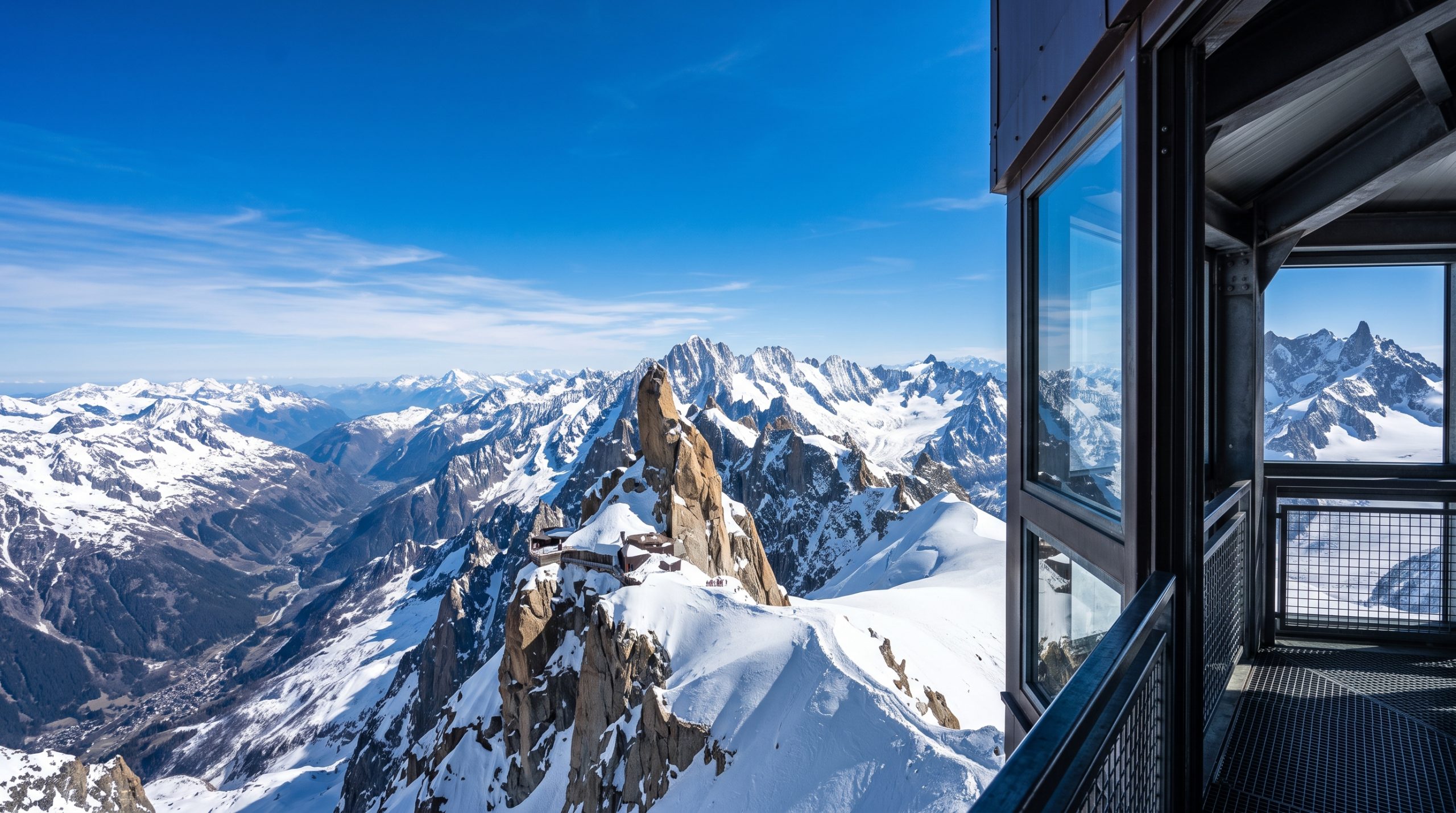
Stand in front of the church in Chamonix and watch the rock spire to the south. When the sun crosses its summit, it is midday. That is where the Aiguille du Midi got its name, long before anyone strung a cable to the top of it, and it is still the most useful thing anybody has ever said about this mountain and light.
The cable car changed the arithmetic. Chamonix sits at 1,035 metres. The summit terrace sits at 3,842 metres. The lift covers the difference in twenty minutes, which means you can finish coffee in a valley town and be standing 2,807 vertical metres higher, in snow, before the first coach has parked.
That speed is the whole opportunity and the whole problem. Nothing about your hands, your dress or your voice adapts in twenty minutes. Every plan we build for the Aiguille du Midi is shaped around that gap.
Twenty minutes, 2,807 vertical metres
You can hold a ceremony on the Aiguille du Midi’s public terraces at 3,842 metres, reached by cable car from central Chamonix in twenty minutes. The marriage itself is not legal in France without commune residency, so couples complete the paperwork at home and hold the ceremony that matters up here, usually on the first cabin of the day.
What the climb does to the first fifteen minutes
Air cools as it rises. With 2,807 metres between the street and the terrace, the top runs somewhere close to twenty degrees Celsius colder than the town you left, before the wind gets a say. There is snow on the walkways in August. There is ice on the handrails in July.
The air is also thinner, and everyone feels it in the same undramatic way: stairs take longer, sentences get shorter, and nobody wants to be hurried. So we do not hurry. The first fifteen minutes of a morning up here are deliberately empty in our timeline. You arrive, you walk out of the tunnel, you stand on the footbridge that links the north peak to the central one, and you look at the Vallée Blanche pouring away to the south-east. Nothing is scheduled. It works better than any plan.
Clothing follows from the temperature rather than from the pictures. A dress travels up in a bag and goes on inside. Boots come off at the last moment, and warm layers come back on between each part of the ceremony rather than after all of it. We carry the spare gloves. It is the least glamorous sentence in this article and the one couples thank us for most.
The 6.10 cabin, and the two hours after it
Close to half a million people visit the Aiguille du Midi in a year, and every single one of them arrives in the same box you do. That is the unusual thing about this summit. There is no back road and no early trailhead that lets you beat the crowd on foot. The cable car is the only door, which makes it a throttle rather than a floodgate.
That works in your favor if you use it. In high summer the first departure runs at around 6.10 am, service continues to roughly 6 pm, and the last round trip goes up at about 4.30 pm, with cabins leaving every fifteen or thirty minutes depending on how many people are waiting. The commune puts the average visit at two to three hours, and says plainly that it can double when the site is busy. Do the math on that. Everyone who rides up at 6.10 is still on the terraces at 8.30, and by then the eighth cabin has landed on top of them.
So the real window is the first two rotations. Not the first hour of daylight, the first two rotations of the lift. We plan the ceremony inside that, and we plan the quieter photography for the far side of the piton and for the enclosed gallery, where the flow of visitors thins out even at eleven in the morning.
An honest note on the famous glass box. Le Pas dans le Vide is included with the lift ticket, which means everyone on the terrace wants a turn, and by mid-morning it is a line of people photographing their own shoes. It is a genuinely strange piece of engineering and it is worth stepping into. It is not where your vows belong.
Who runs the terraces, and what France asks of the paperwork
The Aiguille du Midi is not a private venue and not a wild summit. Compagnie du Mont-Blanc operates the excursion site under a public service delegation from the commune of Chamonix-Mont-Blanc, which means it is a working visitor installation with staff and timetables, run on behalf of the town. Two people standing on a public terrace saying words to each other are visitors, the same as everybody else on the platform. Anything that needs floor space, staging or a reserved area is a different conversation, and it is a conversation with the operator rather than with the town. We do that research and hand you the answer with your proposal.
The legal side is cleaner than most planning blogs make it sound. In France only the civil ceremony performed at a mairie creates a marriage, and to be married at a French mairie one of you needs roughly thirty to forty days of continuous residence in that commune first. Almost nobody flying in for a week can do that. So the overwhelming majority of couples we work with in Chamonix sign the legal paperwork at home, quietly, in an office, weeks before they fly.
What happens at 3,842 metres is then entirely yours. No registrar, no statute read aloud in a language you do not speak, no schedule set by a booking slot in a town hall. If you are new to separating the legal act from the ceremony, our guide to how eloping actually works walks through the sequence.
Light on the mountain that tells the town when it is noon
At 3,842 metres you are above almost everything to the north and east of you, so the sun finds this terrace long before it finds the valley floor. On a clear morning you can stand in full light and look straight down at Chamonix still sitting in blue shadow. That single gap is the strongest visual argument for the first cabin, and it lasts only as long as the sun is low.
Then the mountain does exactly what its name promises. By the time the sun is over the summit, it is midday, the light is falling straight down, and the terraces are at their hardest and flattest. Faces go into shadow under brows. Mont Blanc, standing to the south, loses every ridge it had at seven in the morning. This is also the busiest hour. The two problems arrive together, and both of them solve the same way.
Early light up here behaves unlike anywhere at sea level. Everything underfoot is snow, so the whole summit works as a reflector, and the fill comes upward into faces rather than downward. Expose for the snow and let the bounce do the rest, and you get people lit from below as well as above, which is rare and which reads immediately in a frame. The terraces also face several directions around the central rock, so instead of waiting for the light to move we move, and the same twenty minutes gives us a side-lit ceremony and a backlit one. You can see how that reads in finished work across the films and galleries we have published. Highlights from your own day reach you in 5 days, the full gallery or film in 3 weeks.
Standing room: where two cameras actually fit
The terraces are narrow. They are steel walkways and small platforms bolted around a rock piton, joined by a footbridge and a lift, and there is no version of this summit where a photographer and a filmmaker can spread out into a semicircle. So they work in a line instead. One holds the wide frame down the walkway, the other takes the tight one from behind the shoulder, and they swap ends rather than crossing. Le Tube, the steel gallery that circles the piton at over 3,700 metres, gives 32 metres of enclosed arc where one of them can be completely out of the other’s frame and out of the wind. Wind is the real audio problem at this height, not noise, so vows are captured on a mic tucked under a collar rather than anything held in the open. Two people who already know each other’s habits sort all of this out in silence. Two strangers hired separately negotiate it in front of you.
That pairing is our Expedition, one full day with a dedicated photographer and filmmaker working together, from $7,900, and team travel to Chamonix is included in it. The single-camera Adventure day and the multi-day Odyssey are set out on the coverage and pricing page.
When the top is in cloud, and what 2,317 metres gives you instead
The Aiguille du Midi runs all year apart from its annual maintenance shutdown, which begins at the start of November and ends shortly before Christmas, and apart from days when the weather closes it. A summit at nearly four thousand metres makes its own cloud. Some mornings it is in it, and the terrace is a white room.
This is why we never build a Chamonix day with only one altitude in it. The same cable car has a mid-station, and the valley has other ceilings.
| Where | Altitude | How you get there | What it gives a ceremony |
|---|---|---|---|
| Chamonix valley floor | 1,035 m | On foot from town | Larch, river and meadow, with the whole massif standing over you. Warm hands. |
| Plan de l’Aiguille | 2,317 m | First stage of the same lift | Open ground you can actually walk on, summer hiking trails, far fewer people |
| Aiguille du Midi | 3,842 m | Both stages, then the summit lift | Snow, steel and Mont Blanc close enough to read every ridge |
Plan de l’Aiguille is the one most couples have never considered, and it is fifteen minutes below the summit on the same ticket. It has ground under your feet rather than grating, it is the start of the summer walking trails, and the crowd there is a fraction of the one above. In summer there is also the Panoramic Mont-Blanc gondola, which carries on from the top across the Glacier du Géant to Pointe Helbronner on the Italian side, for a couple who want the day to keep moving.
Beyond the terraces the ground becomes the start of the Trois Monts route toward Mont Blanc itself. That is roped and guided terrain that needs crampons, and a completely different kind of day, which some couples want and most do not. Tell us which one you are and we will build accordingly, or point you to the month and the altitude that suits it better. More valley-by-valley detail sits in our destination elopement guides.
Common questions
Do we need a permit for a ceremony on the Aiguille du Midi terraces?
The terraces are a public visitor site operated by Compagnie du Mont-Blanc under a public service delegation from the commune. Two people exchanging vows among other visitors are simply visitors. Anything that needs reserved floor space or staging goes through the operator, and we handle that research and the request as part of your planning.
Can we legally marry in France, or is the ceremony symbolic?
Only a civil ceremony at a mairie is a legal marriage in France, and it requires around thirty to forty days of continuous residence in that commune by one partner. Almost every couple who travels here signs the legal paperwork at home first and holds the real ceremony on the mountain.
Can you wear a wedding dress at 3,842 metres?
Yes, with a plan. The dress travels up in a bag and goes on inside, boots stay on until the last minute, and layers go back over the top between each part of the ceremony. Wind matters more than temperature for how fabric behaves, so we pick the terrace by wind direction on the morning.
How early can we get to the top in summer?
In high summer the first cabin leaves around 6.10 am, with departures every fifteen or thirty minutes after that, and the last round trip going up at about 4.30 pm. The first two rotations of the lift are the quietest ninety minutes of the day up there.
Is the cable car running in November?
Not for most of it. The Aiguille du Midi closes for annual maintenance at the start of November and reopens shortly before Christmas. If your date falls in that window we plan the day around Plan de l’Aiguille, the Mer de Glace side of the valley, or the valley floor itself, all of which photograph beautifully in late autumn light.
What happens if the summit is in cloud on our date?
We watch it from the day before and decide with you in the morning. The mid-station at 2,317 metres is often clear when the top is not, and the valley floor almost always is. Your alternative is chosen and timed before you fly, so a cloudy summit changes the location and not the day.
Can we bring our parents or our children up with us?
Guests are welcome on the lift, with one firm limit: children under 3 are not admitted to the Aiguille du Midi, and the visit is not recommended below the age of 5. Older guests should expect to move slowly at that altitude. Our fee does not change with guest count, though numbers do affect timing on the cabins.
Building the day around the first cabin
A good Aiguille du Midi morning looks like this. You are at the departure station in the dark, you are on the 6.10 cabin, and you are standing in sunlight at 3,842 metres while Chamonix is still gray below you. Vows happen inside the first rotation. Then you drop to Plan de l’Aiguille for an hour on real ground, and you are eating lunch in the valley by the time the queue downstairs is at its longest. A round trip currently runs to around 83 € per adult at the standard rate, and less when it is booked ahead.
Our Chamonix calendar is currently open across 2027, 2028 and 2029, and The planning stays in writing from the first message onward rather than on a schedule of meetings. Send us the date and the shape you have in mind, and you will have a reply and our brochure within 24 hours. Check Your Date and tell us what you want the morning to feel like.