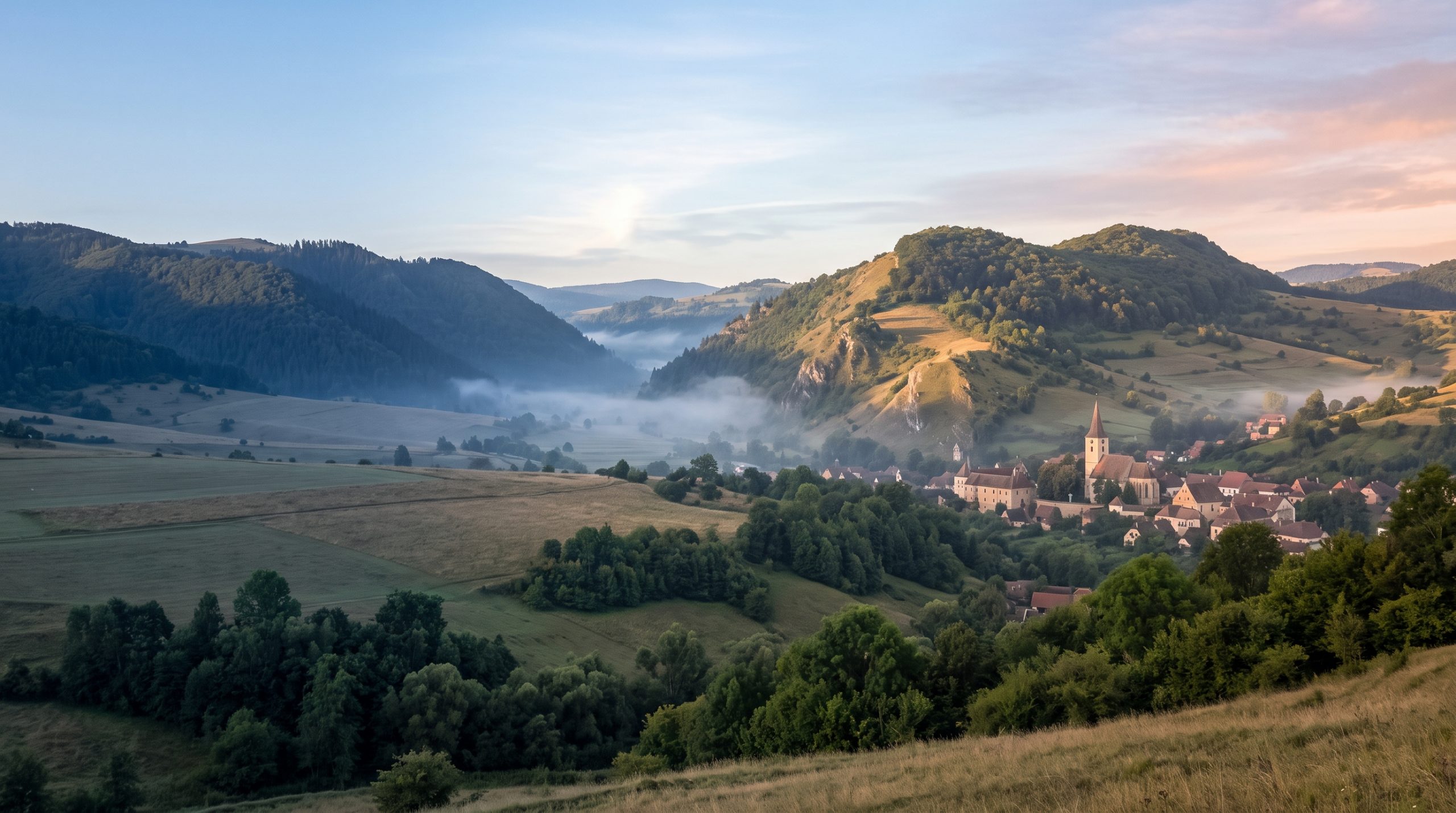
At 04:55 on a mid-June morning, the Făgăraș wall south of Sibiu is one flat silhouette and the hayfields underneath it are holding mist at knee height. Sunrise is still thirty-eight minutes away. This is the part of a Transylvanian day that nobody sees on a holiday, and it is why we ask couples to be in the car at 04:15.
A summer day here has two hard edges and a great deal of driving in between. Near Sibiu on the solstice the sun clears the horizon at 05:33 and sets at 21:17, with another hour of workable light wrapped around both. Fifteen hours and forty-four minutes of sun is generous. It is also why a badly built timeline fails in this country: not for want of light, but because the roads between the good places are slower than any route planner will admit.
What follows is how we build those hours, where the map lies to you, and the few things that have to be settled months before the morning itself.
Sixteen hours of light, and where they go
A June elopement day in Transylvania runs from a 04:15 departure to a finish around 21:55. Sunrise near Sibiu is 05:33 and sunset is 21:17. We put the mountains at first light, cross the country in the flat middle hours, use stone interiors while the sun is high, and hold the ceremony inside the last three hours.
The ten-day rule that decides where you sign
Romanian civil marriage runs through the local civil status office, and the paperwork keeps its own pace. The declaration is filed in person, documents issued by foreign authorities have to be translated into Romanian, and the marriage cannot be celebrated until a ten-day publication period has run, counted from the day the declaration goes in.
So most couples we take into the Făgăraș sign at home, in the week before or the week after, and treat the Transylvanian ceremony as the one that actually belongs to them. It takes a clock out of the day. Vows at 19:00 on a hay meadow with the whole range behind you is a different thing from an 11:00 appointment at a counter. If you do want the Romanian civil ceremony inside the trip, say so at the start and we will build a day around it, because it needs its own town and its own morning. Our walk-through of how eloping actually works covers the sign-at-home route in more detail.
04:15 to 22:00 in the Făgăraș foothills
This is a real mid-June shape, built around Cârțișoara on the northern approach to the Transfăgărășan, with the valley villages below it in the afternoon. Nothing in it is more than an hour from Sibiu. The clock moves with the month. The logic does not.
04:15 — out of the guesthouse, into an empty road
You are not dressed yet and neither are we. The drive from a village guesthouse out to the meadow takes twenty minutes at this hour and forty at nine in the morning, because at 04:15 the DN1 has no tractors, no flocks and no delivery vans on it. We spend the dark on transport so that we never spend light on it.
04:55 — civil dawn, and the light nobody books
Roughly forty minutes before sunrise the sky separates from the mountains and the meadows fill with cold blue. Mist sits in the low ground on most clear summer mornings. This is the window for the widest frames of the day, when the two of you are very small and the range is very large.
05:33 — sunrise, and the twenty minutes the ridge takes back
Printed sunrise is a horizon number. Down in a valley with high ground to the east, direct light lands twenty to forty minutes later than the app promises, and we plan on the later figure. When it does arrive it comes in sideways across the grass, and the first ten minutes of it are worth more than the next two hours.
07:30 to 12:30 — breakfast, the reset and the transfer
Back to the guesthouse. Real breakfast, a change of clothes, hair and makeup redone properly rather than at 03:30 in the dark. This is also when one of us drives ahead to the afternoon locations. By 12:30 you are moving again, unhurried, on roads that are now full of the traffic we avoided at dawn.
12:30 to 16:00 — the hours that belong to stone
Midday light on an open meadow is flat and unkind, and we would rather say so than pretend otherwise. The middle of the day goes behind walls instead: the Cistercian ruin at Cârța, ten minutes down the valley, a village church, a courtyard. Fortified church interiors keep museum hours and shut long before a June sunset, which makes them right for the hours you cannot use outside.
16:00 to 18:30 — the walk in
Ceremony ground worth reaching is rarely next to a parking space. We allow ninety minutes to two hours for the approach, which is usually twenty to thirty minutes of walking and a lot of stopping. Shoes for the track, shoes for the vows, and one of us carrying the second pair.
19:00 — vows, with two hours and a quarter still in the sky
We set the ceremony hour so that everything after it is downhill light. In mid-June, 19:00 leaves 137 minutes before the sun goes. Nobody is watching a clock, the audio is already running, and if the vows overrun by half an hour the day absorbs it without a single frame being lost.
19:45 to 21:17 — the long slide
At this latitude the last ninety minutes do not fall off a cliff the way they do further south. The colour comes down slowly through gold and then rose on the north faces of the range. This is the part of a Făgăraș day that convinces people, and it is easier to watch than to describe, which is what our galleries and films from days like this are for.
21:17 to 21:55 — after the sun
Sunset is not the end. Civil twilight holds until about 21:55 near Sibiu in mid-June, and the half hour after the sun drops is when the sky goes deep and the range turns to a paper cut-out. Then a short drive, and dinner somewhere that will still feed you at 22:30 because we asked in advance.
Where the Carpathian road eats the daylight
Romanian national roads are good surfaces that go straight through the middle of every village on the route, at 50 km/h, behind a truck. That is the whole explanation. A route planner averages you out at motorway speed and then hands you a number you cannot hit on a Friday afternoon. These are the figures we actually build a timeline on.
| Route | Distance | Route planner | Plan on |
|---|---|---|---|
| Bucharest Otopeni to Brașov, A3 then DN1 | 170 km | 2h20 | 2h30 to 3h+, worse on summer weekends |
| Cluj to Sibiu | 175 km | 2h40 | 3h |
| Sibiu to Brașov via Făgăraș town | 145 km | 2h15 | 2h30 to 3h |
| Sibiu to Bâlea Cascadă | 80 km | 1h15 | 1h30 |
| Bâlea Cascadă up to Bâlea Lac | 12 km of hairpins | 20 min | 30 to 40 min |
| Sibiu to Sighișoara | 90 km | 1h45 | 2h |
| Brașov to Bran | 30 km | 40 min | 1h in July and August |
Two things the map leaves out. The last kilometres into the Saxon villages are county roads that narrow, and behind a horse cart there is no overtaking and no point in wanting any. And a wet week turns unsurfaced village lanes into ground for a high car rather than the compact you booked, which is a decision made when the rental is chosen.
This is where eight of us stops being a line on a website. On a day with two hours of driving inside it we run two vehicles. While one of us stays with you through breakfast and the reset, the other is already at the afternoon ground, checking whether the hay has been cut, whether the lane took the rain, and where the sun really sits at 19:00 rather than where an app claims it will. The second car carries a second full set of bodies, lenses and batteries, which matters most on exactly the days when going back for something is a two hour round trip.
Why the Transfăgărășan cannot give you sunrise
The high crossing of the DN7C, from Piscu Negru at km 104 to Bâlea Cascadă at km 130.8, is closed through the winter and reopens for the summer, sometimes as late as June. CNAIR, which administers the road, allows traffic on it daily between 07:00 and 21:00, and can close it temporarily when the weather turns at altitude.
Read that against a 05:33 sunrise and a 21:17 sunset and the answer is plain: the barrier hours do not cover either end of the day. So we do not sell an alpine sunrise that cannot be driven to. First light goes to the foothills below Cârțișoara, where the whole range is the backdrop and the road is open at four in the morning, and the crossing itself goes in the middle of the day when the gate is up. Above 2,000 metres the midday light is hard and the place carries it anyway. The road authority’s standing advice on that stretch is not to stop for bears, so the mountain hour runs on proper pull-offs and short walk-ins.
The same day in October, and in December
Every hour above is a June hour. Shift the month and the shape compresses into a different day rather than a lesser one: October gives you a sane wake-up, low sun all afternoon and the beech forest turning on the Făgăraș slopes.
| Near Sibiu | Sunrise | Sunset | What it does to the day |
|---|---|---|---|
| Mid-May | 05:53 | 20:46 | Green foothills, snow still on the high ridges |
| Solstice, June | 05:33 | 21:17 | Longest day, earliest alarm, hay being cut |
| Mid-August | 06:29 | 20:26 | Warm nights, the easiest sunrise start of the summer |
| Mid-October | 07:38 | 18:40 | Colour on the slopes, eleven hours of daylight |
| Solstice, December | 08:01 | 16:41 | Under nine hours of light, one location, snow on the villages |
One date to watch: clocks go back on the last Sunday of October, so a sunset that was 18:40 becomes 17:40 overnight with the light quality otherwise unchanged. If you are still choosing between countries by month, that comparison is the useful one, and it is how our destination elopement guides are put together.
Aerials, tickets and the hour we cannot move
Two items in a Transylvanian timeline have lead times measured in weeks, so they are settled at planning, never on the day. Drone work sits under the Romanian Civil Aviation Authority, and where a flight falls inside a restricted area it needs the approval of whoever imposed that restriction plus approval from the Ministry of National Defence for the aerial filming itself. We establish which of those apply to your specific ground before a single aerial goes into the plan for the film.
The other is admission. Bran Castle sells through its own site, which warns that summer tickets often sell out well in advance, so if the castle is in your day it is booked when the timeline is locked, months out rather than the week before. Everything else in this article, from the permit research to the drive-time buffers and the reserve location we hold for weather, sits inside both of our single-day experiences; the only difference between them is whether a filmmaker works alongside the photographer, and the pricing page sets out both. Send us the month you are thinking about and we will tell you what the light does. Check Your Date.
Common questions
How early do we really have to wake up for a June sunrise in Transylvania?
In the car at 04:15, first light at 04:55, sunrise at 05:33 near Sibiu. You are back at the guesthouse for breakfast by 07:30 and the day has barely started. In mid-August the same sequence begins an hour later, which is why couples who hate alarms end up choosing late summer.
Can we drive up the Transfăgărășan for sunrise photos?
No, and it is better to know now. The high section between Piscu Negru and Bâlea Cascadă opens only for the summer season and traffic is allowed between 07:00 and 21:00, which sits inside the sunrise and sunset hours rather than around them. The mountain crossing goes in the middle of your day, and first light goes to the foothills.
Do we have to be legally married in Romania for the ceremony to feel real?
Most couples we work with sign at home and hold the ceremony here, because the Romanian civil route needs a declaration filed in person and a ten-day publication period before the marriage can be celebrated. The vows on the meadow are the same vows either way. Tell us which route you want and we will build the days around it.
Which airport should we fly into for a Făgăraș or Saxon village day?
Cluj is the largest airport in Transylvania, with the widest European network and connections through hubs including Vienna, Zurich and Istanbul, then about three hours down to Sibiu. Bucharest Otopeni carries most long-haul routings and sits 170 km from Brașov. Sibiu has its own international airport on a shorter list, and it is the tightest transfer to everything in this article.
Is one day enough in Transylvania, or should we plan two?
One day works, and the timeline above is that day. Two days let you separate the mountains from the Saxon villages instead of driving between them, and they give the weather somewhere to go. If you have three days, we would spend the third on the high crossing without a clock attached to it.
Can you fly a drone over the mountains and the fortified villages?
Often yes, and we confirm it per location rather than in general. The Romanian Civil Aviation Authority sets the framework, restricted areas need the approval of the body that imposed the restriction, and aerial filming inside one also needs Ministry of National Defence approval. We check your specific ground during planning so the film is designed around what is actually available.
What happens to the timeline if the morning is a wash-out?
We hold a second location for every block of the day, usually lower, more sheltered and closer to the base. Mist in the Făgăraș foothills often burns off between 08:00 and 10:00, so a grey 05:00 is not a lost day, and the stone interiors that were pencilled in for midday move forward while we wait it out.
Send us a month, we will send back the hours
Send a rough window, a base town if you have one, and the kind of morning you can honestly face. We will send back a timeline with real sunrise figures, real drive times and the alternates already in it. The planning stays in one written thread, at whatever pace suits you, and the first reply and brochure land by the next day. Dates are currently open across 2027, 2028 and 2029. Tell Us Your Story.