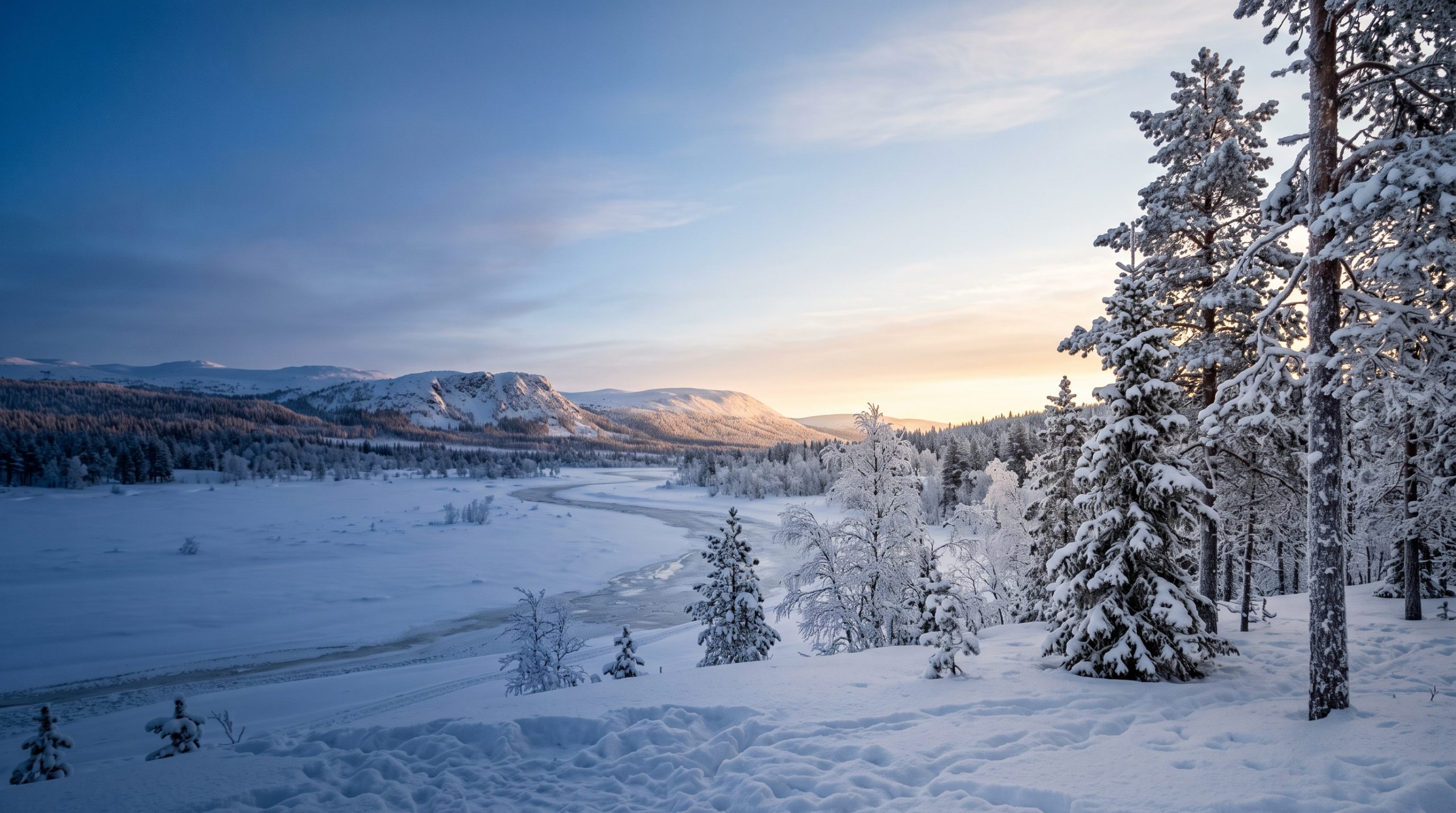
In the third week of February, on an open fell north of Kittilä, the sun clears the horizon around 8:20 in the morning and never climbs more than about eleven degrees above it. That one number decides everything else about the day. The low, raking light that photographers elsewhere wait all evening for is simply what Lapland looks like from breakfast until mid-afternoon.
So a Lapland timeline is not a shortened version of a summer one. It is a different shape. You get up in the dark, the strongest half hour of the day happens before the sun is technically up, the ceremony lands near midday because that is when the sun is highest and still low, and the sky goes dark early enough that an aurora window opens while you are both still in your coats.
What follows is a genuine hour-by-hour day built on Finnish Lapland’s real light, along with the airport transfers, the drive times worth planning on rather than the ones a route planner gives you, and the seven-day clock that starts running on your paperwork long before you board a flight. If you are still choosing between countries, our destination elopement guides are the place to begin.
Eight hours of low sun, and where the ceremony sits inside it
In late February around Levi, workable light starts near 7:20am, the sun itself is up from roughly 8:20 until just before 5pm, and blue hour holds until almost 6. We put portraits in the long dawn, the ceremony near midday when the sun is at its highest and still low, and keep the evening free for aurora.
A February Friday near Kittilä, hour by hour
This is the shape we build most often: one base, two locations, a ceremony that is not adjacent to any drive. Times are for the third week of February at the latitude of Levi and Ylläs. Move the whole grid an hour earlier for March, and compress it hard for late December.
| Time | Where you are | Why that hour |
|---|---|---|
| 06:45 | Cabin, lamps on, wool going on first | Outside is still full night. Dressing, rings, letters, and the quiet audio check before anyone says a vow out loud. |
| 07:20 | In the car, heading for the fell road | First usable light, a full hour before sunrise. Snow separates from sky long before the sun appears. |
| 07:50 | On the ridge, blue turning to pink | The strongest thirty minutes of the whole day, and it happens pre-sunrise. Coats stay on and nobody minds. |
| 08:20 | Sunrise | The sun arrives sideways and stays there. Raking light across open snow for the next two hours. |
| 09:15 | Aerials, if wind and permission allow | The one window where light and air are both reliably cooperating. |
| 10:15 | Back indoors, hot drinks, layers swapped | Hands and camera batteries both want twenty minutes in the warm. |
| 11:45 | Ceremony, two witnesses, officiator | The sun tops out just after noon and even then sits around eleven degrees up. Lapland has no harsh midday. |
| 12:45 | Whatever is actually yours | Sled, skis, sauna, a fire and a thermos in the trees. This is where the film finds its middle. |
| 14:15 | Second location, second block | The sun starts down and colour builds for two and a half hours rather than twenty minutes. |
| 16:50 | Sunset, then blue hour | Lantern light, cabin windows, snow going violet. We stay out until about 17:45. |
| 18:15 | Dinner, indoors, warm | Cameras down unless you want them there. |
| 19:30 | Aurora watch | Full darkness. If the sky opens, we are already dressed, set up and outside with you. |
Two things about that grid surprise almost everyone. The first is how much of the good work happens before sunrise and after sunset, which is why we ask for a start time that looks brutal on paper and turns out to be the easiest early morning of your life, because you are not competing with anyone for the ridge. The second is that nothing in the middle of the day needs to be sacrificed to bad light. You can see how that low sun behaves on snow in our published elopement stories and films, where the difference between a February fell and a summer one is mostly in what the snow does with the colour.
The ceremony hour is the one we protect hardest. It never sits within forty minutes of a transfer, and it never sits in the last hour of light, because a vow read in a hurry sounds like a vow read in a hurry and no amount of light fixes it.
The same day in the last week of December
Midwinter is a real option and it is a different animal. Rovaniemi’s shortest day runs 2 hours 33 minutes, the latest sunrise of the year falls on 23 December at 10:58am, and the sun’s high point sits less than a degree above the horizon, rolling along the treeline instead of rising. North of the city, around Kittilä and Levi, it does not clear the horizon at all for roughly three weeks. What you get instead is about six hours of blue and rose half-light, from mid-morning to mid-afternoon, and it is genuinely beautiful on snow.
The day then compresses: dressing at 8:30, out for 9:30, ceremony at noon, portraits until the light drains at three. The upside is that the sky is dark by five, so the aurora hour and the dinner hour can swap places without anyone staying up until one in the morning.
Kittilä, Rovaniemi or Ivalo: which airport puts you closest
Every route runs through Helsinki. Finnair flies Helsinki to Kittilä daily all year, with several flights a day in high season, and from November a set of direct winter services arrives from continental European hubs. Rovaniemi has the most connections and the longest onward drive to fell country.
| Arrival point | Base | Road distance | Plan on |
|---|---|---|---|
| Kittilä (KTT) | Levi | 17 km | 20 to 25 minutes |
| Kittilä (KTT) | Ylläs, Äkäslompolo | About 50 km | An hour |
| Rovaniemi (RVN) | Rovaniemi and the Ounasjoki valley | 10 km to town | 15 minutes |
| Rovaniemi (RVN) | Levi | 170 km | 2 hours 30 to 2 hours 45 in winter |
| Ivalo (IVL) | Saariselkä | 27 km | Half an hour |
| Kolari rail station | Levi | 85 km | 1 hour 30 |
Kolari is the northern end of the rail line and the reason the overnight train is worth considering: you sleep, you wake up in the snow, and you trade the flight for a road transfer at the far end. Ivalo is the quiet pick. It puts you half an hour from Saariselkä and the edge of Urho Kekkonen National Park, further north than Levi, with fewer arrivals sharing the same fells.
Road 79 after dark: the extra minutes we budget
Finnish roads are well maintained and beautifully empty, and that combination fools route planners into optimism. The 170 km from Rovaniemi to Levi on road 79 comes back as roughly two hours. In February, on packed snow, on studded tires, in the dark at both ends of the day, we plan two hours thirty to two hours forty-five, and we plan it with a stop.
The reason is not the surface. It is that a plowed road is the easiest walking in the forest, and Kittilä counts something like 30,000 reindeer against 6,000 people. They stand in the road. They do not hurry. Anyone who drives here regularly simply builds that into the average speed, which is why local advice tends to say two and a half hours for a distance that looks like two.
Two routes are technically fine and not worth doing. Flying into Rovaniemi to spend your ceremony day on the Levi fells means 340 km of driving inside a day that has six to eight hours of light in it, and the fells are not different enough from the forest an hour north of Rovaniemi to justify it. Booking a register office ceremony in Rovaniemi and a portrait block in Ylläs on the same date is the same mistake with paperwork attached.
The Kittilä airport transfer, by contrast, is exactly as short as it looks. The shuttle meets scheduled flights, and 17 km on a main road in winter really is twenty minutes. Levi to Ylläs is the one to watch: 50 km that eats a full hour, because the road bends around the fells rather than through them.
The seven-day clock on your paperwork
Marrying legally in Finland is admirably unfussy, and the one deadline that matters is invisible from outside. Before any ceremony, the Digital and Population Data Services Agency examines impediments to marriage. That examination takes at least seven days, and the certificate it produces is valid for four months. So it is a job for the month before you fly, not the week.
If neither of you is a Finnish citizen or resident in Finland, you also need a certificate from the authorities of your own country confirming that you are free to marry in Finland. Two witnesses aged fifteen or over have to be present, along with both of you. A civil ceremony held on the agency’s own premises during office hours is free of charge; one held anywhere else, or outside those hours, carries a fee agreed with the officiator, which is the route most couples on a fell take. The agency’s Rovaniemi office currently holds its ceremonies on Fridays, and that single detail decides the day of the week for a surprising number of Lapland elopements. Our guide to planning an elopement covers the sequence in more detail.
If you want aerials in the film
Finland runs under the European drone framework, administered by Traficom, which means operator registration, a remote pilot who holds the right certificate, and a zone check on the national drone map before anything leaves the ground. On state land, Metsähallitus is the authority for filming permission, and national park rules and nesting seasons can narrow the window further. All of that is ours to confirm, and we confirm it before we plan a sequence that depends on aerials rather than after.
What two vehicles and a second camera actually buy you
On a day with one hour of pre-sunrise light and a 50 km hop between locations, redundancy is not a luxury, it is the schedule. Photography, film and planning come from one team here, so the person shooting your film and the person shooting your stills arrive on the same flight and have worked the same fells together before. Where the day involves two locations, two vehicles mean one of us can leave early to check wind and snow conditions on the second spot while the other stays with you, and nobody’s timeline depends on a guess made yesterday.
It also means a second full set of bodies, lenses and batteries in a climate where batteries lose their enthusiasm fast. We carry spares warm, inside jackets, and rotate them. Team flights and accommodation are inside what you pay us, in Lapland as everywhere else, which is why we would rather add a scouting afternoon than shave one. Coverage, what is included, and how the full-day and multi-day experiences differ are set out on our pricing page.
Tell us your month and your base and we will send back the actual light times for your date, not a generic winter timeline. Check Your Date.
Common questions
How many days before the ceremony do we need to be in Finland?
None, legally. The examination of impediments to marriage takes at least seven days and is done by post and online before you travel, and the certificate stays valid for four months. We still ask for one spare day either side of your ceremony date, so weather has somewhere to move to.
Can Americans get legally married in Finnish Lapland?
Yes. The Digital and Population Data Services Agency examines impediments to marriage, and if neither of you is a Finnish citizen or resident you supply a certificate from your own authorities confirming you may marry in Finland. Two witnesses aged fifteen or over attend, and both of you must be present.
Is the last week of December too dark for photographs?
No, but it is short. Rovaniemi’s shortest day is 2 hours 33 minutes of sun and the sun barely rises above the treeline; north of there it stays below the horizon for about three weeks. You still get roughly six hours of blue and pink half-light, which photographs beautifully on snow.
Which airport should we fly into for a Levi elopement?
Kittilä, 17 km and about twenty minutes from Levi, with daily Finnair flights from Helsinki year round. Rovaniemi has more connections but sits 170 km away, a winter drive of two and a half hours or more. Ivalo suits Saariselkä, half an hour up the road.
What time do we actually have to be up?
In late February, dressing starts around 6:45 and you are on the fell by 7:50 for the pre-sunrise light. In late December you can sleep until 8:30 and still be the first people out. If early mornings are not your idea of a good start, tell us and we will weight the day towards the afternoon and blue hour instead.
Can you fly a drone over the fells for our film?
Usually, yes. It needs operator registration with Traficom, a certified remote pilot, a check of the national drone zone map, and on state land the relevant Metsähallitus permission. We confirm all of it in advance and design the aerial sequence around the window we are actually granted.
Do we need a car, or can you drive us?
Most couples rent a 4×4 or book a local transfer, and we travel in our own vehicle so we can scout ahead. On days with two locations that second vehicle is what keeps the timeline honest. Anything unusual, a snowmobile transfer or a private sleigh, is booked and paid separately.
How far ahead should we book a midwinter date?
Earlier than you would for most destinations. For the weeks either side of Christmas we like to be planning a year ahead, because cabins, officiators and sleigh operators around Levi and Saariselkä get committed a long way out. For the aurora months of February and March, six to nine months is usually comfortable. We are currently booking 2027, 2028 and 2029.
Tell us the week and we will build the light around it
Every Lapland date has its own arithmetic. A day in mid-March gives you nine hours of sun and a road that is still fully white, late December gives you six hours of half-light and a sky dark by five, and Rovaniemi’s longest day in June runs 23 hours 24 minutes and turns the whole timeline inside out. Send us the month you are thinking about and the base you like, and we will come back with the real sunrise, sunset and blue hour times for that date, a route that respects the reindeer, and an honest note on which week of that month fits you better.
We keep the whole planning thread in writing, at whatever hour suits your time zone. Fill in the inquiry form and you will have a reply and our first brochure within 24 hours. Start Your Story.