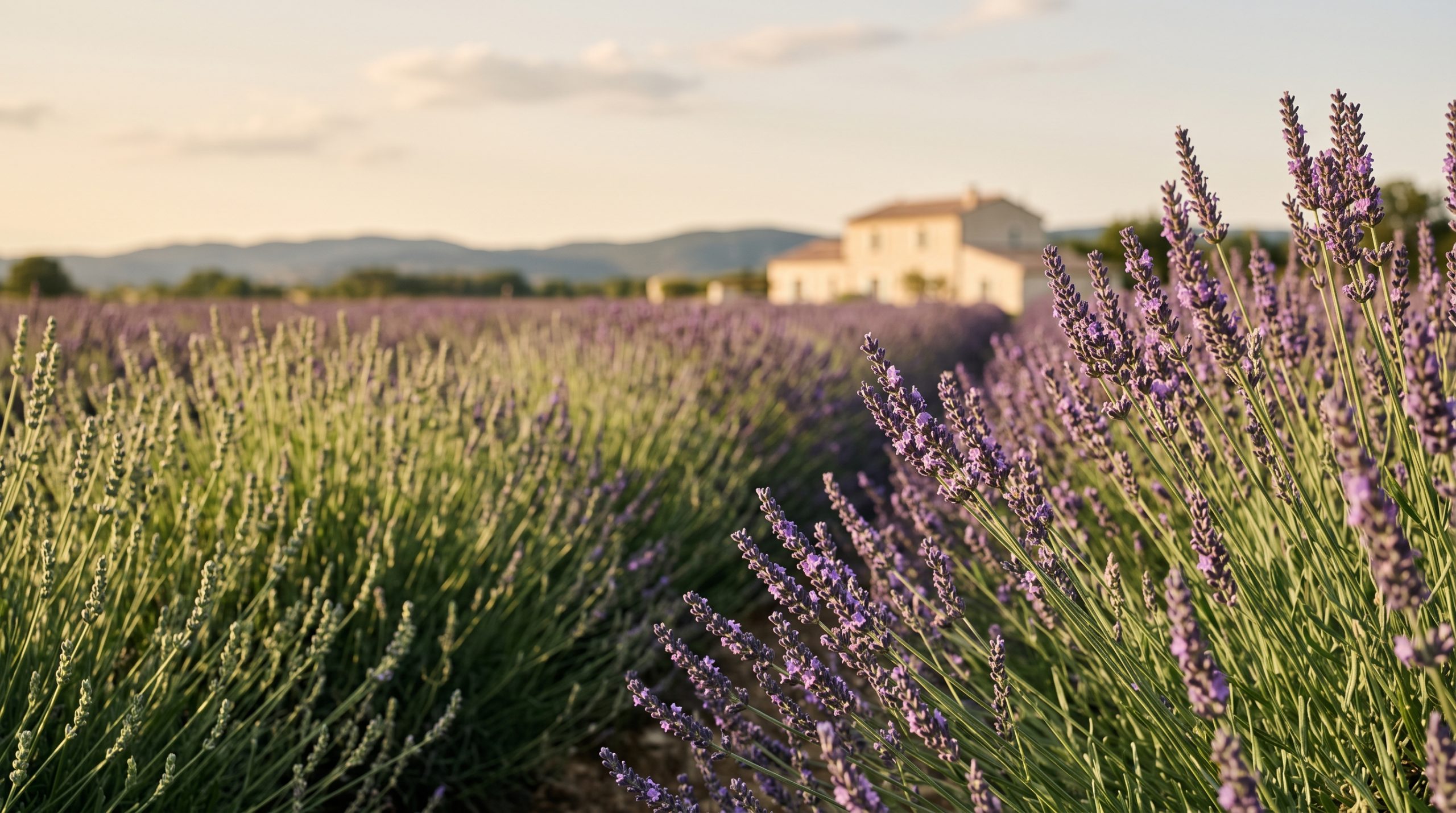
On July 5, 2027, the sun comes up over the Valensole plateau at 6:00 and does not go down until 21:21. That is fifteen hours of daylight, and only about three of them are any use to us. The rest belongs to a high summer sun and the heat shimmer that comes with it.
The thing most planning articles leave out is that lavender is a crop. The purple rows outside Valensole and Puimoisson are lavandin, planted in blocks, and they come down when the farmer decides the oil is at its peak, not when a wedding calendar says so. A field that is shoulder-high and humming with bees on a Tuesday morning can be flat green stubble by Thursday.
So the question is never really which month. It is which altitude, which week, and which hour.
The window we would book for a 2027 lavender ceremony
The first ten days of July, on the Valensole plateau. The lavandin is at full color, the cutting machines have not started, and the roadside pull-offs stay quiet until mid-morning. Sunrise falls around 6:00 and sunset near 21:20, so a ceremony can sit late in the evening with hours to spare.
Month by month on the plateau, from almond blossom to cut stubble
Sunrise and sunset below are for Valensole on the fifteenth of each month in 2027, local time. They are the one set of numbers in lavender planning that will not move.
| Month | Fields | Sunrise and sunset | Crowds | Our verdict |
|---|---|---|---|---|
| January | Bare gray rows, stone and sky | 08:07 to 17:24 | None | Graphic, cold, empty |
| February | First almond blossom late in the month | 07:36 to 18:06 | None | Underrated |
| March | Almond blossom on the plateau | 06:49 to 18:42 | Very light | Strong alternative to lavender |
| April | Green rows, orchards, wildflowers | 06:54 to 20:19 | Light until Easter | Good for villages, not for purple |
| May | Rows greening up, buds forming | 06:11 to 20:54 | Building | Beautiful, no color yet |
| June | Color from mid-month, Luberon first | 05:53 to 21:20 | Heavy from mid-month | Last week is excellent |
| July | Peak, then cutting from mid-month | 06:07 to 21:16 | Peak of the year | First ten days, our pick |
| August | Valensole cut, Sault still standing early on | 06:40 to 20:41 | Heavy in villages | Go high or go elsewhere |
| September | Stubble, vines turning, warm stone | 07:15 to 19:47 | Thinning fast | Our favorite month for everything but lavender |
| October | Olive and grape harvest, first real rain | 07:50 to 18:53 | Quiet | Golden and unhurried |
| November | Cut rows, bare vines, low sun all day | 07:30 to 17:11 | None | Intimate and cheap on daylight |
| December | Frost in the furrows on clear mornings | 08:03 to 16:59 | None | Nine hours of light, all of it soft |
Altitude decides your date: Luberon, Valensole, Pays de Sault
There are three lavender countries in Provence, and they run on a ladder. Every hundred meters of altitude pushes the bloom later, which means a couple with a fixed date is not choosing a month so much as choosing an elevation.
The Luberon sits lowest, roughly 350 to 700 meters, and colors up first. Late June into the first days of July is its moment, and the field in front of the Cistercian abbey at Sénanque is the most photographed rectangle of lavender in France. It is also one field in a narrow valley, four kilometers of hairpins from Gordes, and it is shared with coach parties from mid-morning onward. We shoot it early or we shoot the ochre villages instead and put the purple somewhere with room to move.
The Valensole plateau is the picture almost everyone has in their head: horizon-filling rows, stone farm buildings, sunflowers coming on as a second crop. It is about 65 kilometers from Aix-en-Provence and 100 kilometers from Marseille, so it is an easy first morning after a long flight. Color arrives around mid-June, holds through the turn of the month, and the cut begins in mid-July on the lower ground.
The Pays de Sault is the insurance policy. Sault and its neighboring villages sit between 700 and 900 meters on the flank of Mont Ventoux, which buys ten days to two weeks over Valensole, and the fine lavender grown up there is the crop the distilleries prize. Sault holds one of the largest lavender festivals in the world on August 15 every year, which in 2027 falls on a Sunday. Aurel and Ferrassières, a few minutes away, give you the same altitude with a fraction of the traffic.
Two dates get mistaken for bloom reports. The Valensole lavender festival is fixed to the third Sunday of July, July 18 in 2027, and by then a good part of the plateau can already be down. Sault’s August 15 festival is the opposite case: at that height the fields are usually still standing. Festivals celebrate the harvest. They do not promise it has waited for you.
Across years, the peak moves. A warm dry spring can pull the whole thing forward by a week to ten days, and a cool wet one pushes it back by about the same. That is why we plan a lavender date around a region rather than a single field, and why our destination elopement guides talk in windows rather than single days.
The two weeks we steer couples away from, and where we send them instead
Mid-July to the end of July on the Valensole plateau is the hardest sell we make. It is the week people book because it sounds like the height of lavender season, and it is the week the machines are working. Fields go over in a day, and the ones that survive have tractors parked at the end of the rows. If your date is locked in that stretch, we move you uphill: Sault, Aurel, Ferrassières, where the same date usually still buys full color and cooler afternoons.
The second half of August is the other one. Valensole is cut, the villages are at their busiest, and afternoons on the plateau sit in the low thirties Celsius, which is the high eighties in Fahrenheit, with thunderheads building over Ventoux by five o’clock. For a late-August date we build the day differently rather than chasing purple: the Verdon gorge and its water, vines coloring up, hill villages at first light, and a ceremony hour pulled back to the evening when the stone goes warm.
And if purple is non-negotiable and August is the only month you have, say so plainly in your first message. We will tell you which plateau still has standing fields that week and what the trade is, rather than letting you find out on the morning.
What the light does between 6:00 and 21:20 in July
Early July gives you two usable stretches and a long dead zone in between. Morning: the sun clears the horizon at 6:00 and is still under fifteen degrees of elevation until about 7:40, so there is roughly an hour and forty minutes of low raking light that turns a row of lavandin into a series of ridges. By eight it is climbing hard. At solar noon it stands near 69 degrees, almost overhead, and that is the hour purple photographs gray and the plateau turns into heat shimmer.
Evening is the more generous half. The sun drops under fifteen degrees around 19:45 and does not set until 21:21, which is an hour and a half of warm light with no rush in it, plus a long blue afterglow. That is why our Provence ceremonies usually sit between 19:00 and 20:00 in July. There is time for vows, for the walk out into the rows, and for a drink in the last of it.
Winter inverts the whole thing. In mid-January the sun never climbs above about 25 degrees, so the entire nine-hour day is soft and directional. Fewer hours, no bad ones.
The morning window is the reason we send a photographer and a filmmaker as one pair rather than one person trying to do both. Dawn on the plateau is not repeatable. You cannot walk a row at 6:20, stop, and walk it again for the camera at 6:35, because by then the shadow lengths have changed and the mist in the folds has burned off. Two people working the same hundred meters at once means the film and the photographs come from the same real moment. You can see how that reads in our published films and galleries, where the frames and the footage line up because they were made side by side.
If you already have a week in mind for 2027, send it over and we will tell you what the light and the bloom are likely to be doing: Check Your Date.
Roads, harvest traffic and what actually shuts
Provence is not a place with dramatic seasonal closures, but a few things catch planners out.
- The summit road up Mont Ventoux stays shut through winter and opens later in spring than most planners expect, so we build spring days on the plateaus and in the villages below it.
- The crest road above the Verdon gorge is a fair-weather route, and sections of the high loop can stay shut into spring. There is always a lower line along the lake.
- Harvest week brings machinery and trailers onto single-track plateau roads. We add travel time in mid-July rather than pretending a ten-kilometer hop still takes twelve minutes.
- Distilleries, farm shops and village restaurants thin out from November to March, and some close altogether. It changes where a small dinner can happen, so we book that side of the day early for winter dates.
- Roadside pull-offs on the plateau are small and informal. From roughly 9:30 in high season they are full, which is a timeline fact more than an access problem, and it is solved by being finished before then.
Aerials are their own piece of planning. Drone work in France runs on rules that vary by exact location, with protected sites and villages handled differently from open farmland, so we confirm what is permitted for your specific fields and hours before we design any part of the film around it.
The mistral plan, written before anyone lands
The mistral is the local character you should know about before you pick a date. It falls down the Rhône valley from the north and northwest, blows on something like a hundred days a year, and tends to arrive in runs of several days rather than single afternoons. It also scrubs the sky to a hard clean blue, so the clearest light of the year and the most difficult air often show up together.
What that means in practice is that our weather planning is about direction, not optimism. Every Provence timeline we build carries named alternatives sorted by where the wind is coming from: valley folds and terraced hollows that sit in the lee of a north wind, the walled lanes and courtyards of hill villages for veil-and-hair moments, the sheltered water of the Verdon when the plateau is being scoured. The ceremony hour is written so it can move two hours in either direction without anything else collapsing, and vow audio on our two-person coverage is planned for shelter rather than hoped for in the open.
Rain is the smaller worry. July is the driest stretch of the Provençal year and it is normal for a lavender week to pass without measurable rain. The wet months are the autumn ones, October in particular, when the total can run several times a July figure. August’s risk is different again: heat builds through the afternoon and releases as a thunderstorm over the high ground, which is predictable enough that we simply do not put anything that matters at four in the afternoon.
If you want the fundamentals of how a day gets built around constraints like these, our guide to planning an elopement covers the sequence.
Common questions
Will there still be lavender in bloom in Provence in mid-July 2027?
Somewhere, yes. On the Valensole plateau mid-July is when cutting starts, so fields there are a gamble by the third week. Between 700 and 900 meters around Sault, Aurel and Ferrassières, mid-July is reliably full bloom. Same date, different altitude, completely different photographs.
Is late June or early July better for the Valensole fields?
Early July, narrowly. Late June is often still filling in on the plateau, while the first ten days of July usually catch full color before the machines start. Late June is the better answer if the Luberon is where you want to be, because it runs a week or so ahead.
How early do we need to be in the fields?
In the field at sunrise, which is 6:00 in early July. That gives you until about 7:40 in low light and until roughly 9:30 before the pull-offs fill. It means leaving your accommodation in the dark, and it is the single decision that changes a Provence elopement most.
Our date is fixed in August. Can we still get purple fields?
In the first half of the month, often yes, at altitude. After the middle of August, plan on a different Provence instead of a compromised lavender day: the Verdon, coloring vines, hill villages, and an evening ceremony when the light drops. Tell us the date and we will tell you honestly which of the two you are looking at.
How much do the bloom dates move from year to year?
A week to ten days in either direction, decided by spring warmth and rain. That is why we hold two or three regions in a plan and confirm the specific fields close to the date rather than promising a single farm eleven months out.
Can we include the harvest itself in the film?
Cutting and distilling are among the best things in the Provençal year to film, all machinery and smell and purple dust, and they happen from mid-July at low altitude into August higher up. It needs the landowner’s agreement and a timeline built around their working day, which is exactly the kind of arrangement we handle in planning.
What happens on our day if the mistral is blowing?
We move, and we already know where. The alternatives are chosen by wind direction before anyone lands, the ceremony hour can shift by a couple of hours, and the sheltered locations are scouted as real options rather than backups on paper. Mistral days often produce the clearest light of the trip.
Booking a 2027 date on a moving bloom
We are currently taking elopement bookings for 2027 through 2029 now, and lavender weeks are the ones couples ask about earliest. The way it works is simple and it all happens in writing: you send us your dates and what you picture, we reply within 24 hours with a first brochure, and a tailored proposal follows. A signed contract and a 30% retainer start the planning. Photography, film and planning come from one team of eight, team travel to France is included, highlights land with you five days after the day and the full gallery or film three weeks after. What each level of coverage includes is set out on our pricing page.
Tell us the week you are holding, or the one you are still deciding between, and we will tell you which plateau it belongs on: Tell Us Your Story.