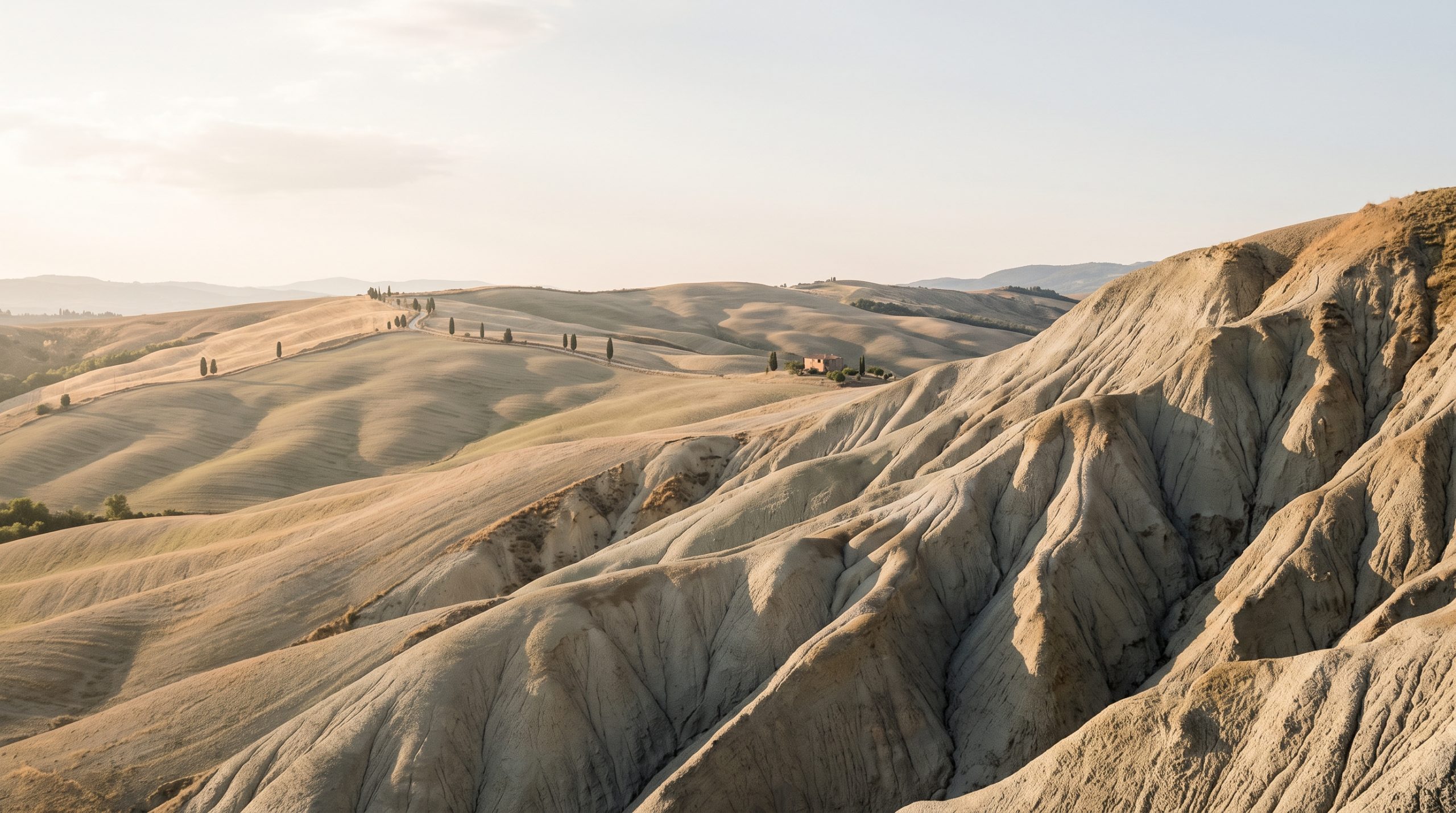
The Benedictines at Monte Oliveto Maggiore shut the abbey over the middle of the day and open it again in the afternoon, and a bell announces both. They have kept roughly those hours since the fourteenth century, and they happen to be exactly right about the ground outside. From late morning until mid-afternoon, the Crete Senesi is the palest, flattest, least interesting version of itself.
Then it isn’t. The hills here are marine clay left behind by a Pliocene sea, folded into ridges and eroded into bare grey-white domes the locals call biancane and the deep gullies called calanchi. The western and southern reaches of the comune of Asciano carry the name Deserto di Accona, the Accona desert, though no desert was ever here. It is farmland, worked for centuries and still worked now.
And it never looks the same twice in one year. Couples arrive with a picture in their heads of grey moonscape ridges, book a week in May, and find themselves standing in knee-high green wheat instead. Both versions are worth flying for. They are just not the same elopement, and the month decides which one you get.
Clay country, forty minutes east of Siena
The Crete Senesi is the eroded clay farmland southeast of Siena, about eighteen miles out on the SP438 and closer to forty minutes than thirty. It looks best in two windows: late April into early June, when green wheat turns gold, and mid-September into October, when plowing strips the hills back to raw clay.
Green, gold, then bare: what the ground does through the year
This is the one thing to settle before you pick a date, because the color of the ground is most of what a photograph of the Crete Senesi is made of. There are no waterfalls here, no cliffs, no forest. There is shape, and there is whatever the farmers have done to the surface in the past six weeks.
The rhythm is agricultural and it repeats. Wheat comes up green over grey clay in early spring. By June it has turned gold. It is cut in high summer, leaving pale stubble and beige stalks, and then in September the plows come through and turn everything back to bare clay, which is the look most people mean when they say the word desert. Broom flowers yellow on the banks in May. In late autumn and winter the hollows fill with fog and the ridges come out of it like islands.
| Window | The ground | What it means for the day |
|---|---|---|
| March to mid-April | Young green wheat over grey clay, bare trees | Cool mornings, workable light later into the morning, quiet roads |
| Late April to May | Deepest green, yellow broom on the verges, big skies | The gentlest month to walk a ridge in a dress; thunderheads build in the afternoon |
| June | Wheat turning gold, then gold everywhere | The sun is up before 5.45am, so a sunrise ceremony means leaving in the dark |
| July to August | Cut stubble, ochre and beige, hazy air | No shade anywhere on the ridges; the day has to live at its two ends |
| Mid-September to October | Freshly plowed clay, the true grey-brown desert look | Mist in the hollows at first light, sunset before 7.30pm, comfortable to walk |
| November to February | Bare clay, fog, stripped cypresses | Short days, softest light, almost nobody else out |
The lunar comparison you read everywhere holds for about six weeks a year, after the plowing and before the wheat greens up. If that specific bare, sculptural version is what you came for, say so early and we will build the date around the plowing rather than the other way round.
Bare clay at midday looks like nothing
We will be blunt about this because almost nobody else is. Clay is pale and it is smooth, so it has almost no texture of its own. Everything you love about the Crete Senesi in photographs is shadow: the crease of a calanco, a ridge line falling away, one cypress laying 40 feet of dark across a field. Take the shadows away and you have a beige hillside.
Nothing here is enclosed. There is no gorge wall to wait for the sun to clear, no tree canopy to filter it. Light lands on the whole valley at once, within a minute or two of the sun clearing the low eastern hills, and it leaves the same way in the evening across open sky rather than dropping behind a wall. That means two things. The good window opens and closes fast, roughly the first two hours and the last two hours. And the last twenty minutes of it are the strongest light of the day, because the sun goes out sideways over open country instead of being cut off.
In late June, first light is before 5.45am and the evening runs long, so we usually build the ceremony into the morning and leave the middle of the day for eating and sleeping. By late September the sun clears the hills after 7am and is gone before 7.30pm, which is a far more humane shape, and the hollows hold mist that burns off within the hour. If you want to see what pale ground and dark cypress actually do to a frame, and what the wind sounds like on a ridge in a film rather than in a description, our published elopement stories and films are the honest version. Highlights from your own day reach you within 5 days, the full gallery or film within 3 weeks.
The last half mile, in a dress
Off the SP438 the strade bianche begin: gravel and compacted clay, generally one car wide, with occasional pull-offs where somebody has flattened a verge. They are perfectly drivable in a normal rental car. What they do to clothes is another matter.
Dry, this is dust country. A car passing on a white road puts a pale film on a dark suit from thirty feet away, and a hem picks up a chalky line within a few hundred yards of walking. Wet, the clay is greasy and it builds. It collects on the sole of a shoe in heavy pads and it grips fabric that touches it. Cut stubble in July and August is stiff enough to catch tulle. None of this is a problem, it is just information: we plan the walking on gravel and grass verges rather than open field surfaces, keep the distances short, and put a second pair of shoes in the car so you arrive at the ridge in boots and stand in the field in something else.
There are no facilities out on the crests. No toilets, no water, no shade, and nowhere to change. So the day is built around one base, ideally a podere you have rented for the week. From a farmhouse out near Baccoleno you are about four miles from Asciano and close to fifty minutes from the middle of Siena, which sounds like nothing until you are doing it twice before breakfast.
Who owns the view, and who signs the register
Two separate questions live in here, and most pages about this area blur them together.
The land is somebody’s field
There is no national park here, no gate, no ranger, no ticket. What there is, is a working agricultural landscape divided into poderi: wheat, truffle ground, olives, grazing. The public white roads and their verges are open to anyone on foot. Standing wheat in May is a crop and somebody’s income, and walking into it is not ours to offer. The practical answer, and the one that makes the best days, is that the farm you are staying at usually says yes to its own land when it is asked properly and in advance, and that is exactly the kind of asking we do during planning. Permit research and landowner permission are part of what we handle. Where a government, venue or landowner fee applies, you pay the fee itself.
If you want the marriage legal in Italy
A civil marriage in Italy is celebrated by an officer of the state in a place the comune has formally authorized. A clay ridge is not one of those places, so couples split the day: the legal act inside a municipal room in a comune like Asciano, and the ceremony they actually care about out on the land, in whatever order suits the light. For US citizens, the paperwork runs through three documents. An Atto Notorio, the affidavit that nothing under US law prevents the marriage, obtained from an Italian consulate in the United States or in Italy. A sworn declaration, the nulla osta, made before a US consular officer in Italy. And the Declaration of Intention to Marry, made in person at the town hall where you will marry, with passports, apostilled and translated long-form birth certificates, and evidence that any earlier marriage has ended. You need two witnesses over 18 with photo ID, plus an interpreter if neither of you speaks Italian. Banns are normally waived or shortened when neither party is Italian or resident in Italy, which is why this works inside a trip rather than a residency. Afterwards you have the marriage certificate apostilled. Plenty of couples do the legal part at home instead and keep Italy entirely for the ceremony, and the timeline works either way. Our guide to planning an elopement covers the sequencing.
Tell us the month you are circling and the shape of morning you have in mind, and we will tell you what the ground will be doing then, and which comune and which base make the rest of it simple. Send Us a Message.
The abbey that closes at noon
Monte Oliveto Maggiore sits inside the comune of Asciano, reached along an avenue of cypresses and entered under a crenellated gate tower with a Madonna above it. Founded in 1313, red brick against grey clay, with a church from the early 1400s, a great library, and an inlaid choir with a cat worked into the woodwork by one of the monks. It is the only hard architecture in a landscape otherwise made of dirt and trees, and it changes the register of a film completely.
It is also a living monastic community, not a venue. Visiting runs on the abbey’s own hours, open in the morning, closed across the middle of the day, open again through the afternoon and later in summer, with Sunday mornings ending earlier. So we place it deliberately: the cypress avenue and the brick after a sunrise ceremony, or the afternoon leg on the way up to the hamlet of Chiusure on the ridge above. Quiet feet, and no tripods planted in a cloister.
Room to stand on a one-lane ridge
Sightlines here run for half a mile in every direction, which is a genuine problem for a photographer and a filmmaker who met that morning and have not worked out who stands where. There is no cover to hide in. We solve it with distance and with a plan made the day before: the filmmaker long on the road behind, the photographer close, then a swap, so neither of us ever appears in the other’s frame. Wind is the other one. An exposed crest is loud, so vows get recorded close and low, in the lee of a hedge or down in a hollow, rather than on the skyline where the microphone hears nothing but air. Eight of us work in this team, photographers and filmmakers together, which is why the two roles behave like one.
A full day with a dedicated photographer and filmmaker working together starts at $7,900, a single-artist day at $4,900, and the team’s flights and accommodation are inside that figure wherever we travel. The coverage and pricing page sets out the rest, including multi-day work across the Crete Senesi and the Val d’Orcia together.
Common questions
Can we legally get married out in the clay hills themselves?
Not the legal act. An Italian civil marriage has to be celebrated by a state officer in a place the comune has authorized, which in these small towns means a municipal room. The ceremony you write yourselves can happen anywhere you have permission to stand, which is the arrangement most couples here end up with.
How early do we actually have to get up in June?
First light is before 5.45am in late June, and the light is worth having for about two hours after that. From a podere near Asciano that means leaving in the dark, around 4.45am. If that is not your idea of a good morning, September gives you the same quality of light after 7am, and we would rather move your month than hand you a compromised hour.
What happens to a dress if it rains the day before?
Wet clay is greasy and it sticks in pads to anything that touches it. We move the whole day onto gravel white roads, the brick lanes in Asciano, and the paved approach to Monte Oliveto Maggiore, all of which stay clean, and we keep the field ground for the following morning if the sun is out.
Do we need permission to walk into a wheat field?
Yes, from the farm that owns it, and standing wheat in May and June is a crop worth real money. Public white roads and their verges are open. The simplest route is a podere you have rented, whose owner can say yes to their own land, and we arrange that in writing before you arrive.
Will there be other photographers at the Baccoleno viewpoint at sunrise?
On a clear morning in May, June or October, yes. That curve of cypresses is one of the most photographed views in Tuscany and the pull-off above it is small. Arriving early does not fix it, because everyone else has read the same advice. What fixes it is working ridges five minutes away that nobody has named, and coming back to the famous curve later in the morning when the tripods have gone.
Building a day out of two good hours
The shape that works here is simple and it is dictated by the light. Leave your podere in the dark, walk a crest you saw the evening before, and marry as the sun clears the eastern hills. Breakfast at the farm while the shadows shorten. The abbey mid-morning, inside its hours. Then a long, unhurried middle of the day, because there is nothing to gain from standing on bare clay at 1pm. Out again for the last two hours on different ground, with the plowed ridges going copper, and dinner somewhere in Asciano afterwards.
Every planning step stays in one written thread, from the first message to the final timeline, and we currently have Tuscan elopement dates open across 2027–2029. Send us the month you are considering and we will reply within 24 hours with a brochure and an honest read on what the fields will look like then. If a nearby valley suits your idea better, we will say that too, and we work there as well. Our destination elopement guides are a good place to compare before you write. Start Your Story.