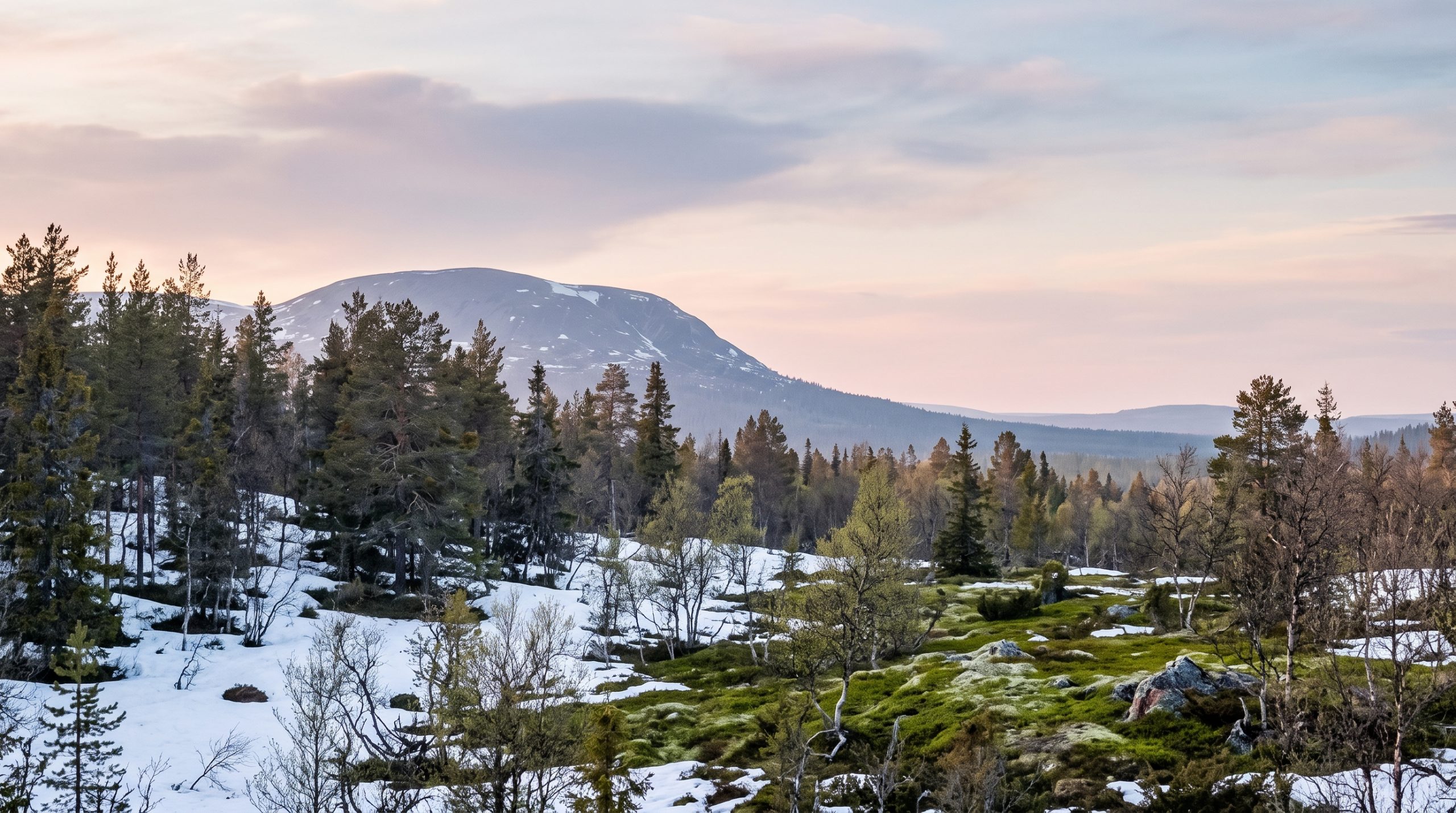
Lapland’s calendar is not really about temperature. It runs on two numbers: how many hours the sun sits above the horizon, and how many hours the sky goes properly black. On the shortest day in Rovaniemi the first number is a little over two hours. In late June the second is zero, and it stays at zero for weeks.
Everything else follows from those two figures. The hour of your ceremony comes out of the first. Whether the aurora is on the table at all comes out of the second. Snow depth is a third number, and it peaks later in the year than almost anyone guesses. We have waited on river ice at eleven in the morning for a sun that never climbed past one degree above the horizon, and we have filmed vows at half past midnight in June with warm light still coming in sideways across a fell.
So this is the month-by-month version, with the figures attached instead of the adjectives.
The month we would book, and why it is not December
March. Snow cover across Lapland reaches its deepest in mid-March, the Finnish Meteorological Institute names February and March as the strongest aurora months of the year, and by 15 March Rovaniemi gets eleven and a half hours of daylight with fully dark skies either side of it. December has the least light and the heaviest crowds.
Twelve months in Lapland, with the daylight figure attached
Daylight below is measured at Rovaniemi in the middle of each month, because that is where almost every couple lands. Move two hundred kilometers north to Inari or Utsjoki and the winter figures shrink, the summer figures stretch, and the aurora odds improve.
| Month | Daylight, mid-month | Ground and air | Who else is there | Our verdict |
|---|---|---|---|---|
| January | 4h 15m | Roughly minus 8C to minus 15C, snow settled | Empty once the first week passes | Book the second week |
| February | 8h 11m | Coldest nights of the year, hard snow | Far quieter than December | Cold, dark, excellent |
| March | 11h 37m | Deepest snow of the winter | Steady, never crushing | The month we would book |
| April | 15h 25m | Snow peaks, then melts fast | Busy over Easter | First ten days only |
| May | 19h 24m | Melt, brown ground, high rivers | Nearly nobody | Move the date to June |
| June | 24h, no sunset | Sunniest month of the year | Building week by week | Best of the summer |
| July | 21h 35m | Warmest, highs near 21C | Peak Finnish holiday month | Warm, and no dark sky |
| August | 17h 02m | Wettest month of the year | Thinning after mid-month | Aurora returns at the end |
| September | 13h 12m | Autumn color, first snow on the fells | Walkers on the fell trails | Our second choice overall |
| October | 9h 37m | First lasting snow usually settles | Very quiet | Underrated, dark early |
| November | 5h 45m | Snow likely, not yet certain | Quiet until the last week | Aurora yes, snow maybe |
| December | 2h 27m | Snow certain, deep cold | The busiest weeks of the year | January does this better |
The windows that are ten days wide
Four things in Lapland run on a window far tighter than a season, and they are worth choosing your week around rather than hoping to catch.
Autumn color, which Finns call ruska, peaks in northern Finland in the second week of September and holds about ten days according to Visit Finland, then rolls south at roughly 500 kilometers in two weeks. The dates move with the summer before them, so we plan a week and accept that the color may run a few days early or late.
Midnight sun at the Arctic Circle runs from about 6 June to about 6 July, so roughly one month with no sunset at all. Go north to Utsjoki and the sun stays up from the middle of May until late July.
The dark sky window is the one most couples have never considered. Between roughly 4 April and 7 September, the sky above Rovaniemi never reaches astronomical darkness at all. That is around 157 consecutive nights with no properly black sky, which is why an aurora cannot be part of a June plan no matter how strong the solar activity is. From the first week of September the window reopens and stays open into early April.
Snow depth has its own peak. The Finnish Meteorological Institute puts the thickest snow cover in mid-March, and in Lapland often as late as early April, with fast melting soon after. Rovaniemi itself never loses the sun completely, even at the solstice, when it clears the horizon by about a tenth of a degree. For a true polar night you go further north: in Utsjoki the sun stays below the horizon for around 54 days and comes back in the middle of January.
Three stretches we would nudge a date out of
None of these are bad weeks in Lapland. They simply give you less than the week next door, and if your date is already fixed inside one, we build the day differently rather than apologize for the calendar.
Late April into the end of May
This is the gap between the two versions of Lapland. Snow that peaked in early April goes quickly, rivers run high and brown, and the fells sit somewhere between white and green for six weeks. Nights no longer go dark, so the aurora is already closed. If you want snow, move to March. If you want summer, mid-June onward gives you a sunnier month and twenty-four-hour light. If May is your fixed month, we work water instead of snow: high rivers, rapids, meltwater on black rock, and evening light that now lasts until well after ten.
The week of Christmas
Rovaniemi airport takes up to 10,000 arrivals a day in December, and Santa Claus Village alone counts over 600,000 visitors a year. Nothing closes, but the quiet places stop being quiet and the cars, cabins and drivers go early. The light is also at its yearly minimum, about two and a quarter hours. Two weeks later the darkness is almost identical and the crowd has gone home, which is why we point December couples at the second week of January. If the date has to be Christmas week, we go early and go further out, using locations forty minutes from town that coaches do not reach.
The second half of July into August
August is the wettest month of the Rovaniemi year, July is its busiest domestic holiday month, and neither has a dark sky worth the name until August ends. Warm, green and pleasant, and lovely if you like a soft rainy forest, but not the Lapland most couples picture. September, two weeks later, gives you color, returning darkness and thirteen hours of daylight.
A sun that never climbs past one degree
This is the part that changes the photographs and the film more than temperature ever will.
At the December solstice in Rovaniemi, the sun rises around 11:08, sets around 13:23, and at its highest point stands one tenth of a degree above the horizon. There is no midday. The whole two hours behave like the twenty minutes other places call golden hour, the light arrives sideways, and the snow bounces it back up into faces. Mid-January is similar and a little longer: sun up at 10:20, down at 14:35, never higher than 2.4 degrees.
By mid-February the noon sun reaches nearly 11 degrees, with a real sunrise at 08:27, a real sunset at 16:38, and about three hours of low-angle light between them. Lapland then adds roughly seven minutes of daylight a day through February and early March, fast enough that a date two weeks later is a different film. By mid-March the noon sun is up at 21 degrees, so the middle of the day is bright and contrasty and best spent moving between locations while we hold the ends for the work that matters. In June it climbs to nearly 47 degrees at noon, then dips a fraction of a degree below the horizon around one in the morning, handing you about six hours of continuous low warm light. A ceremony at ten in the evening is normal. So is one at one.
What those hours actually produce is easiest to judge in our published elopement films and galleries, which beats reading any table, including ours.
This is also where having a photographer and a filmmaker on the ground together stops being a preference. In December the entire usable window is about two hours, and one person cannot cover a ceremony in stills and in motion inside it without compromising one of them. In June the opposite holds: six hours of low sun lets two people spread out, work slowly, and shoot the same moment from two distances.
Snow depth, office hours and what else the calendar decides
Access in Lapland is less about closed roads than about what the ground is doing. Frozen lakes, river ice and open fell terrain are at their most dependable from January to the first days of April, which is the same stretch the Finnish Meteorological Institute identifies as peak snow depth. After that the melt is quick, and a location that carried a ceremony on 2 April may not carry one on 25 April.
The legal side has a timing quirk that catches people. A civil ceremony held at a Finnish register office during office hours is free of charge, while an officiator traveling out to a location, or working outside office hours, means a fee plus travel costs. In December this collides with the light, because the office hours and the day’s only daylight are the same few hours. We plan around it by fixing the legal formality and the filmed ceremony as two separate moments, which is often what a couple wanted anyway. Our guide to planning an elopement covers how that split usually works, and our destination guides go deeper on individual regions.
One full day with a dedicated photographer or filmmaker starts at $4,900, while the same day with a dedicated photographer and filmmaker working together starts at $7,900, and both include the team’s flights and accommodation, the planning, the timeline and the permit research, with the detail set out on our coverage and pricing page. Permit fees, your celebrant and anything unusual on the transport side sit with you.
If you already have a month in mind, or a fixed week you cannot move, send us a message and we will tell you honestly what that week gives you and what it does not.
What we do when the forecast turns
In Lapland the variable is cloud, not wind. Cloud decides whether you get the low sun, whether the fells are visible from the valley, and whether the aurora is on the table on a night it is technically active. So the plan is written before anyone flies: a primary location, two alternatives chosen for a different cloud base rather than a different valley, and a ceremony hour that can move by two hours in either direction without anything unraveling.
In practice that means forest, frozen river and treeline when the fell tops are socked in, and fell tops when the valleys hold fog, which they often do on the coldest February mornings. Heavy snowfall is rarely a problem worth moving a day for. Falling snow at minus ten in a two hour light window is frequently the strongest frame of the day.
We will not sell you aurora odds we cannot keep. The Finnish Meteorological Institute puts it plainly: at Sodankylä in central Lapland, roughly every second night is an auroral night, with the strongest hours between 9pm and 1am. Cloud takes its share of those. On one fixed date, treat it as a coin toss that cloud can veto, and plan so that nothing depends on it. When it appears we are already outside and set up, because the film was built to hold that scene. When it does not, a night sky over snow photographs beautifully on its own.
Common questions
Is March warm enough to elope outdoors in Lapland?
March typically sits around minus 3C by day, about 27F, and closer to minus 10C overnight, which is milder than January and February. Outdoor ceremonies work well at those temperatures with the right layers underneath. We keep the ceremony itself compact, hold a warm indoor base within a short drive, and put the longer walking sections in the middle of the day when the sun is at its highest.
What are our real odds of northern lights on our elopement day?
Across the season, roughly every second night in central Lapland is an auroral night, and cloud reduces that further, so a single named date is genuinely uncertain. Three or more nights in the region raises your chances considerably, which is one reason multi-day coverage exists. We never build the ceremony around the aurora, only around the light we know will be there.
When does the snow actually disappear in Lapland?
Snow depth peaks in mid-March and, in Lapland, often as late as the first days of April, then melts quickly. Early April can be the best of both, with maximum depth and more than fifteen hours of daylight. By the end of April the ground is unreliable, and through May it is mostly bare. If snow matters to you, book on or before the first week of April.
Is Lapland worth eloping in during summer, without snow?
Yes, and it is a completely different place. From about 6 June to 6 July the sun does not set at the Arctic Circle, June is the sunniest month, and the low warm light runs for roughly six hours in the middle of the night. Rivers, lakes and open fell terrain replace ice. What you give up is any chance of an aurora, since the sky never darkens.
What time would a December ceremony have to happen?
Around the solstice the sun is up from about 11:08 to 13:23 in Rovaniemi, so a daylight ceremony happens late morning or at lunchtime, not at sunset, because those two things are the same event. We usually place the ceremony at about 11:30, keep travel to the morning dark, and use the long blue afternoon and evening for the rest of the film.
How far ahead are couples booking Lapland dates?
We are currently taking dates in 2027, 2028 and 2029. March and early April fill differently from October and November, so the useful thing is to tell us the month you are considering and let us confirm what we have, rather than working from a general rule about lead times.
Pick a week, then let us build the day around it
If we were choosing for ourselves, it would be the second week of March: deep snow, eleven and a half hours of daylight, dark skies at both ends, and none of December’s traffic. Second choice, the second week of September, for ten days of color and the return of a properly dark night. Third, the second week of January, for a sun that never leaves the horizon.
All of our planning happens in writing, at whatever hour suits you, and there is nothing to arrange before you write. Send us the month you are looking at and we will reply within 24 hours with our brochure and an honest read on that week, including the alternative weeks we would nudge you toward. Check Your Date.