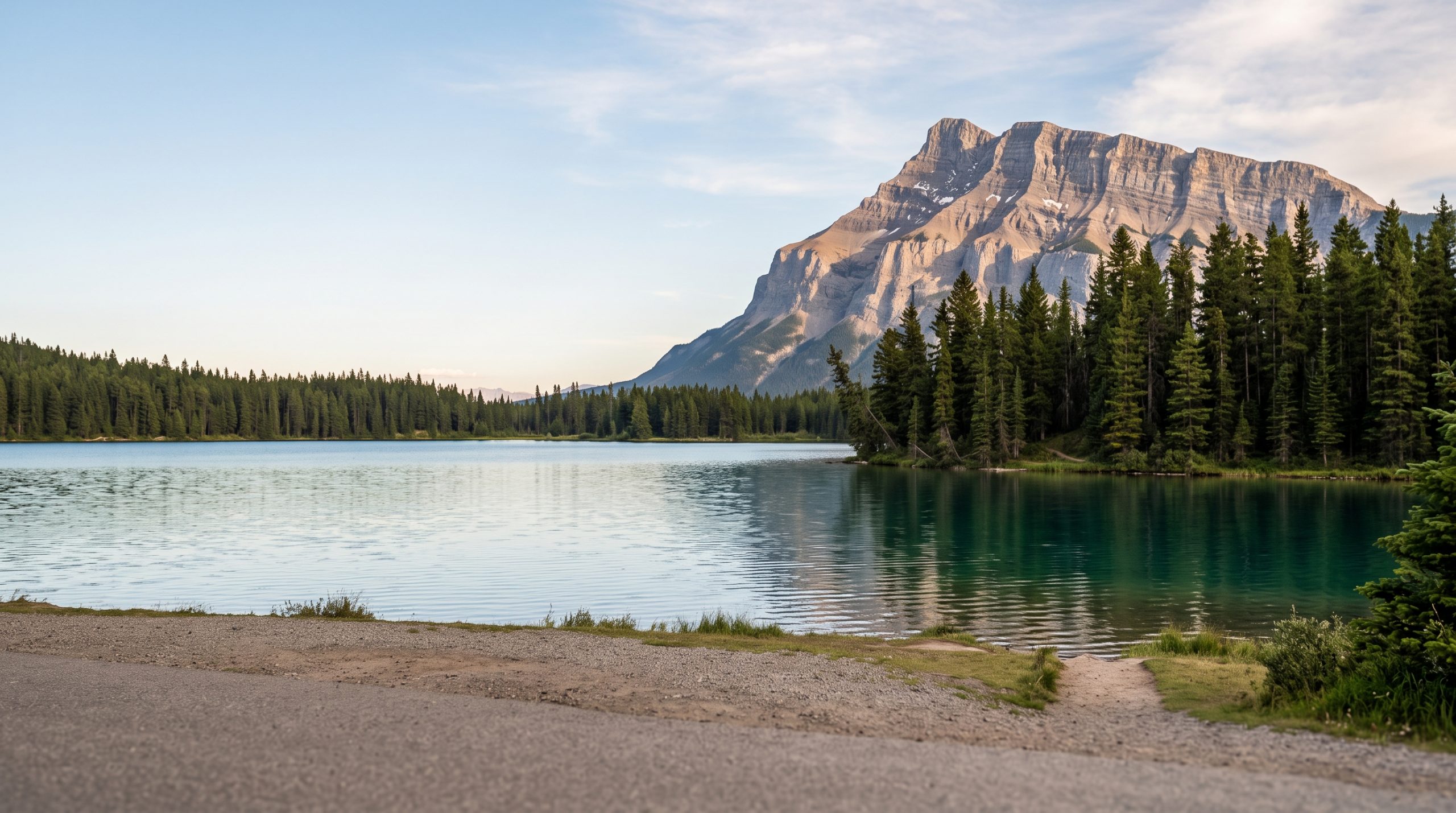
The Lake Minnewanka Scenic Drive is a 24 km loop out of Banff, and Two Jack Lake sits along it about 10 km from town, roughly fifteen minutes of driving. You park, you walk down a short slope, and you are standing on gravel with Mount Rundle filling the far shore. On a still morning the mountain is doubled in the water. That is the entire approach.
No trailhead. No elevation gain. Nothing that asks you to carry one pair of shoes and wear another for forty minutes before you can see anything. In a park where most of the famous ceremony spots involve a shuttle reservation, a gondola ticket or a climb, Two Jack is the one where the hard part is deciding what time to show up.
That ease is also the trade. Easy access means shared access, and by ten in the morning in July this shoreline is a picnic ground with paddleboards on the water. Everything below is about using the easy part properly and working around the rest.
The 15-minute version
Two Jack Lake is a Parks Canada day use area about 10 km east of Banff, a 15-minute drive with no hiking involved. Ceremonies are allowed with a Parks Canada wedding ceremony registration and a maximum of 20 people, vendors included. Mount Rundle takes the first light across the water, so plan for sunrise.
Ten kilometers from town, and nothing to climb
Coming from Calgary you leave Highway 1 at the Banff and Lake Minnewanka exit just past the park gates. Coming from a hotel on Banff Avenue you head out past the Norquay interchange and pick up the same road. Either way the sequence along the Scenic Drive is the same: Cascade Ponds first, then the turnoff for Johnson Lake, then Two Jack Main and Two Jack Lakeside campgrounds, then the Two Jack Day Use Area.
Parking sits a few steps above the water. The walk from a car door to the patch of shore where you would actually stand and say your vows takes under two minutes on packed dirt, and the two Parks Canada red chairs are right there at the picnic area. From that point a level shoreline path runs southeast to the Lakeside campground, 3.2 km out and back, almost no elevation change, water and mountain unobstructed the whole way. It is open and walkable from roughly May through October.
In wedding clothes, here is what that actually means. The shore is coarse gravel and small stones, so heels sink and tip, and they are worth bringing only for frames where you are holding them. The path is dry dirt for most of the summer, which means a long train picks up dust and pine needles rather than mud. Nobody arrives out of breath and nobody arrives sweating. You can step out of the car dressed, walk to the water, and still have clean hems an hour later, which is not true of most Banff locations worth photographing.
Rundle lights up before the shoreline does
Stand at the day use area and you are facing southwest, with the northeast wall of Mount Rundle filling the far side of the lake. That one fact decides your ceremony hour. The morning sun comes up behind you, over the ridgeline east of the lake, and it lands on Rundle’s summit long before it reaches the gravel under your feet.
For a while after sunrise the mountain burns and the shore stays in cool shade. That gap is the best of it: warm rock, cold foreground, and the water at its calmest of the whole day because the valley wind has not started yet. If you want the doubled mountain, that is the window, and it is not a long one.
Sunrise in Banff comes before 6 a.m. in late June and after 8 a.m. in December, which changes what booking this location asks of you. A June ceremony means a genuinely early alarm and an empty parking area. A late September ceremony means sunrise at a civilized hour, fall color along the shoreline, and cold hands. Both are good mornings. They are not the same morning.
Evening works differently and it is worth knowing before you commit to it. As the sun drops it swings around behind Rundle, so the mountain loses its light while the eastern side of the valley keeps it, and the warm side-light on Rundle happens an hour or two before sunset rather than at it. By then the water usually has a ripple across it. Evening at Two Jack is a strong hour for portraits and a weak one for reflections. Morning is the reverse.
If you want to see how that reads as finished work rather than as a description, our published galleries and films are the honest version of it: what a cold blue shoreline under a lit peak looks like in a photograph, and what a lake sounds like on film when the only thing moving is water.
You will not have this lake to yourselves
Two Jack is one of the most photographed lakes in the Rockies for exactly the reason you are reading this page. It is close to town and you can walk to it. From June through September, parking along the Minnewanka Loop is extremely limited and the day use lots fill early. Roam Transit runs a route along the loop through the summer, which is a genuine option for guests who would rather not add a second car to that lot.
Here, unlike some places in this park, arriving early is genuinely enough. The constraint is a small parking area, not a shuttle system or a timed reservation, so a five o’clock arrival in July puts you on an empty shoreline with the red chairs free and nobody on the water. By ten the same spot has swimmers, paddleboards and families at the picnic tables. Both of those are true of one morning.
Your Parks Canada registration does not close the site to other visitors, and no permit anywhere will. If a stranger walking past during your vows would ruin the moment, tell us that early and we will build the day differently: far enough down the shoreline path to be out of sight of the parking area, or an October weekday instead of a July Saturday, or a first ceremony hour somewhere quieter with Two Jack as the second stop.
Working a shore this narrow
The shape of this shore decides how the two of us work. It is a narrow strip of gravel between trees and water, which sounds restrictive and is actually ideal, because the good angles run along the beach instead of converging on one spot. Our filmmaker can work long from thirty paces down the shoreline while the photographer stays close, and neither ends up in the other’s frame. What this shore does not offer is shelter from wind coming across the water, so on the Expedition the audio recorder goes close to you rather than to the camera, and we pick the corner of the beach with trees at your back.
Twenty people, counted the honest way
A ceremony inside Banff National Park runs on a Parks Canada wedding ceremony registration. It is a form with conditions attached rather than a booking, and it does not reserve the ground for you. The conditions are short and firm. A maximum of 20 participants may attend. Tents and temporary shelters are not permitted. Music is limited to quiet options such as a guitar, flute or harp. Nothing live gets released, so doves and butterflies are out. Every person attending must hold a valid national park entry pass, sold by the day for around twelve dollars per adult or as an annual Discovery Pass, and the site has to be cleaned up thoroughly the moment you are done.
The number that surprises couples is the 20, because it counts everyone standing there rather than just the guest list. The two of you, an officiant, a photographer and a filmmaker puts you at five, which leaves fifteen. That is a workable group for this shore. Our fee does not move with guest count; what moves is parking, timing and how long a ceremony takes to assemble on a narrow beach. Above 20 people, Two Jack stops being the easy option and the conversation shifts to the ceremony sites the Town of Banff manages, which is a different kind of day and one we are glad to plan.
Aerials are the other thing to settle before you picture the film. Drone use is a restricted activity across Banff National Park, allowed only with written authorization from the park superintendent, and that authorization is issued for a narrow set of purposes that does not include weddings. So the film here is built entirely on the ground, which at Two Jack costs you less than you would expect, because the reflection does the job a drone would be doing somewhere else. For the wider sequence of a legal, well-planned park elopement, our elopement planning guide walks through the order things happen in.
Coverage here is a full day either way: The Adventure, from $4,900, puts one dedicated photographer or one dedicated filmmaker on the shoreline with you, The Expedition, from $7,900, puts both of them there working together, and everything included in each sits on our pricing page.
When the loop shuts and when the wind comes up
Two things move a Two Jack plan, and neither is dramatic once you know about it in advance.
The first is the road. The western section of the Minnewanka Loop, the stretch between the Lake Minnewanka parking area and Bankhead, closes to vehicles from November to May each year to leave wildlife room to move through the valley. Two Jack itself stays open the whole time. You approach from the eastern side of the loop instead, which adds nothing meaningful to the fifteen minutes from town, and the closed stretch gets partly groomed for cross-country skiing, which is a better use of it in February anyway. Couples plan around a closure that does not close the lake.
The second is wind. The reflection is a gift and not a guarantee, and no forecast promises glass on a mountain lake. Our planning writes the alternative into the timeline before you arrive rather than after. Lake Minnewanka is five minutes further along the same road, 21 km long and the largest lake in the park, and it holds up in a breeze because the scale absorbs it. Johnson Lake is small, wooded and sheltered. Cascade Ponds is back toward town with bridges, a stream and cottonwoods. The Bankhead ruins sit on the same loop for something with texture and no water at all. All of those are inside a ten-minute drive of where you parked, and that is precisely why we are comfortable letting Two Jack be plan A.
Some winters the lake freezes clear before the snow arrives and you can stand out on it. That is luck and timing, and we would rather tell you plainly what your week is likely to hold than sell you a picture of it. If you are still choosing a month, our destination guides compare how the Rockies seasons behave.
Common questions
Do we need a permit to get married at Two Jack Lake?
You need a Parks Canada wedding ceremony registration for any ceremony inside Banff National Park, and Two Jack Lake is inside it. The registration is a form with conditions rather than a reserved time slot, so it does not give you exclusive use of the shoreline. We do the research and manage the paperwork sequence as part of planning. Any government or landowner fees are yours to pay.
How many people can come to a Two Jack Lake ceremony?
Twenty participants, and that count includes your officiant and our team. With a photographer and a filmmaker there, fifteen guests can stand with the two of you. Groups larger than that move to a ceremony site managed by the Town of Banff rather than a national park day use area.
Is there anywhere to get changed at Two Jack Lake?
No. Two Jack is a picnic day use area rather than a venue, so plan to arrive dressed. Banff is fifteen minutes away, which is close enough that couples get ready in their hotel, drive out, and swap walking shoes for the real ones at the car. Bring a bag for the boots.
Can we fly a drone for our film at Two Jack Lake?
No. Drone use is a restricted activity throughout Banff National Park and requires written authorization from the park superintendent, which is not granted for weddings. Films here are shot from the ground, and still water gives back the sense of height that aerials provide elsewhere.
Can you reach Two Jack Lake in winter?
Yes. The western section of the Lake Minnewanka Loop closes to vehicles from November to May for wildlife passage, but Two Jack stays reachable from the eastern side of the loop all winter. The drive from Banff is still around fifteen minutes on a maintained road.
Will the lake be still enough for the reflection?
Most often in the first hour of daylight, and much less often after that. Wind builds through the day in the Bow Valley, so we set the ceremony early and treat the mirror as a bonus rather than the plan. If the water is moving, we walk the shoreline path or drive the five minutes to Lake Minnewanka.
The morning we would book for you
Leave your hotel about an hour before sunrise. Fifteen minutes of driving, an empty parking area, and enough time on the gravel to breathe before anything begins. Vows as the light works its way down Rundle. The shoreline path afterward for as long as you feel like walking, then back in Banff for breakfast before the first paddleboard goes in the water. The whole afternoon is still yours, for Minnewanka or a gondola or nothing at all.
The planning stays in writing from the first message onward, which means you can plan this from a different time zone without ever having to be awake at an appointed hour. Send us your dates and we reply with an initial brochure within 24 hours, then a proposal built around your specific hour at Two Jack. A signed contract and a 30% retainer begin the planning. Highlights reach you five days after the day itself, the full gallery or film within three weeks. Our Canadian Rockies calendar currently covers 2027, 2028 and 2029, and our travel to Banff is included in every experience.
Check Your Date and tell us the month you have in mind. We will tell you what the light does that week and what time you should be standing on that gravel.