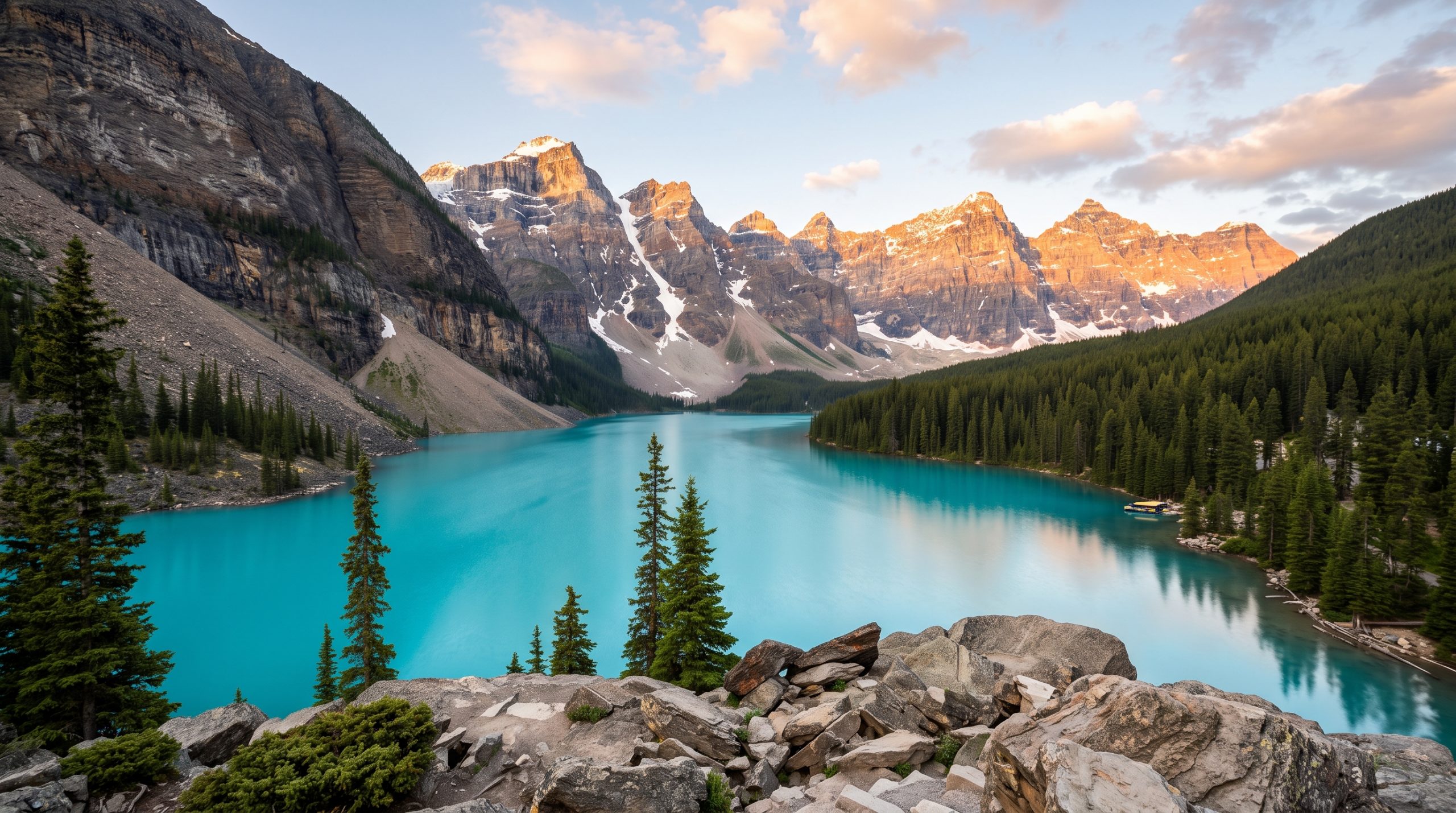
There is no longer any way to beat the crowd to Moraine Lake by getting up earlier. Couples used to set a 2:30 am alarm and drive the road in the dark to claim one of the last spots at the lakeshore. Since the summer of 2023 that road has been closed to personal vehicles, and a sunrise ceremony at the lake now rests entirely on a bus seat booked months ahead.
The access has one detail in it that almost nobody writes down. The Park and Ride for the daytime shuttles sits up Whitehorn Road at the Lake Louise Ski Resort, and that road is gated between 8 pm and 6 am from May to October to keep it quiet for wildlife. The pre-dawn departures therefore do not run from there at all. They leave from the Lake Louise lakeshore lot, which is where you and a garment bag will be standing at four in the morning with the Bow Valley still dark.
We work at Moraine Lake as one team, photography and film together, and a morning here is largely decided in April by whoever books the seats. Below is how the road access actually functions, what the light does once you are up there, and what the last few hundred steps to the water feel like in wedding clothes.
Getting up the road before sunrise: the three ways in
Moraine Lake Road has been closed to private vehicles since 2023, from June through mid-October. Before sunrise there are three ways up it: a pre-dawn Parks Canada departure from the Lake Louise lakeshore lot, a commercial operator holding a licence for the road, or a night at Moraine Lake Lodge. Roam’s buses from Banff arrive later in the morning.
The gate on Whitehorn Road decides where your morning starts
Parks Canada runs the public service from the Lake Louise Park and Ride, and reservations are the whole game. Seats for the coming summer open on a single morning in mid-April at 8 am mountain time, and roughly 40 percent of them are released then. The other 60 percent are held back and dropped at 8 am two days before each departure. That two-day release is genuinely useful if your date already shows as full, and it is why we set the ceremony date first and treat the bus as a booking exercise rather than the other way around.
The early departures are a separate product, sold as the Alpine Start. They currently leave in the 4 and 5 am hours, they board at the Lake Louise lakeshore lot rather than the Park and Ride, and they have to be reserved the day before. That lot charges a daily parking fee, worth knowing before you drive up in the dark with a car full of clothes.
Roam Transit is the other public option, and it works differently than most planning documents suggest. The Moraine Lake access comes as a reservable Super Pass, it must be used starting in Banff, and it cannot be used to reach the lake if you are beginning your day in Lake Louise. Bookings are round trip only, and they sell out for long stretches of the summer. Roam is also clear that a road closure does not trigger a refund outside their normal policy, which is fair enough and something we plan around.
Beyond that, the only vehicles allowed up are buses and commercial operators carrying the specific add-on licence for Moraine Lake Road. A rental car cannot go up, and neither can a hired driver without that licence, which catches out couples who assume a private transfer solves everything. The one place to sleep at the lake is Moraine Lake Lodge, and its guests get up there through arrangements the lodge makes.
First light lands on the Ten Peaks before it touches the water
This is the part most pages get wrong, and it is the part that decides your ceremony hour. The classic view looks southwest down the Valley of the Ten Peaks. The sun comes up behind that view, over the high ground on the Mount Temple side of the lake, so the first colour of the day arrives on the summits and on the ice below Mount Fay while the shoreline you are standing on is still in flat blue shade. The peaks can glow for the better part of an hour before direct sun spills onto the water.
That gap changes what a vow exchange looks like. In the early window we frame you small against a valley wall lit orange along the top, which is the strongest photograph the place gives anyone. Then, as the light drops down the slopes and reaches the water, the famous colour finally reads properly and we move in close for the vows. You can see how both halves of that morning resolve in our recent stories and films, where the lit peaks and the shaded water are doing two different jobs in the same sequence.
The clock moves a long way across the short season. Around the summer solstice the sun clears the horizon here at about 5:30 am, which makes the 5 am departure tight and the 4 am one comfortable. By the first of September sunrise has slipped to just before 7, and by the second week of October it is close to 8, so the earlier bus buys you an hour of standing in the cold rather than an hour of shooting. We match the departure to the date instead of always booking the earliest seat available.
From the bus stop to the water in wedding clothes
The walking is short and the surfaces are not kind. From where the bus lets you out, the Rockpile viewpoint is a few minutes of uneven rock steps and gravel switchbacks. It is brief, but it is genuinely uphill, and a long hem picks up dust and grit on the way. Boots up, shoes swapped at the top, and someone carrying the pack. The lakeshore path along the northeast side is the easier ground, flat and rooty, and it takes you well away from the viewpoint without any real effort. There is nowhere private to change once you are up there, so we build the timeline with that fixed: dressed before you board, and everything you need in one bag.
Two cameras on a rock dam with forty other tripods
Honest version: the Rockpile at sunrise in late July, and again through the larch weeks of late September, is a line of tripods shoulder to shoulder. Arriving early is no longer a strategy, because everyone on the 4 am bus had the same idea and there is no earlier bus to catch. What works is not being on the Rockpile for the ceremony at all. The lakeshore path and the open scree toward the far end of the lake give you room to say something to each other without an audience three feet away, and they look nothing like the postcard, which is rather the point.
Space is also why two of us matters here in a physical, unromantic way. On the narrow top of the Rockpile there is not enough width for a photographer and a filmmaker to work at once without each of them appearing in the other’s frame, so we split the ground: one takes the high line for the wide, the other stays low on the shore. Down on the flat lakeshore we swap and work close together. Wind funnels down the valley off the glacier most mornings, so audio goes on you rather than on a stand near the water, and vows get recorded properly instead of arriving as wind noise. Photography and film travel as one team on our coverage options, and the Expedition, from $7,900, puts a dedicated photographer and filmmaker on the same pre-dawn bus with professional audio for the vows.
Registration, park passes and the rule about drones
Weddings in Banff National Park go through Parks Canada’s own wedding ceremony registration for the Banff field unit, and the terms on that form are refreshingly blunt. The park is a public place, and exclusive rights to an area are not granted, so nothing gets roped off and nobody is asked to move along. Every participant must hold a valid national park entry pass, available at the park gates, at a Parks Canada visitor centre or online before you travel. Releasing live animals is out, and the site has to be left clean immediately afterwards. Which registration applies to two people and a celebrant, rather than a group of a dozen, is our work during planning, along with the submission.
There is a second layer that only affects us. Parks Canada requires a business licence for any company, guide or vendor operating in Banff, and each contractor needs their own. Parks Canada also does not accept applications for commercial film projects in Banff, Kootenay or Yoho between June 1 and September 30, which is worth knowing if anyone proposes a production-scale setup here in high summer. Our film work at the lake is deliberately quiet and small.
Aerials are simply not part of a Moraine Lake film. The use of drones is prohibited in Canada’s national parks, and that is not a permit we go looking for. We build height on foot instead, using the Rockpile and the rising ground along the shore, and long lenses to compress the Wenkchemna Peaks into something that feels as vertical on screen as it does in person.
The legal marriage is provincial, not federal. An Alberta marriage licence is issued while you wait at a registry agent, with both of you present in person and valid identification in hand. The government fee is 40 Canadian dollars, and the registry agent adds a service fee of their own. The licence is valid for three months and only for a ceremony held in Alberta, your officiant must be authorised through Alberta Vital Statistics, and you need two witnesses on the day. Our guide to planning an elopement covers how that sequencing usually falls for couples flying in.
Ice in the first week, and why the evening is the harder booking
Moraine Lake Road opens around the first of June and closes in the second week of October, weather allowing, and the lake does not read as turquoise on day one. Early June can still be ice, which is beautiful in a completely different register, all white plate and dark rock, but it is not the colour you came for. If the water is the reason you chose this place, the middle of the season is the safer booking.
Evenings are the real constraint, and the arithmetic is unforgiving. The last return bus currently leaves Moraine Lake at 7:30 pm. Around the solstice the sun does not set until roughly 10 pm, and even in the third week of September sunset falls close to 7:50 pm, so for almost the whole season the good evening light happens after the final departure. Only in the last days before the road closes does sunset drop early enough to work, and by then the road is days from closing. So we treat Moraine Lake as a sunrise location and put your evening somewhere you can genuinely drive to, most often Bow Lake up the Icefields Parkway or the Lake Louise shoreline twenty minutes back down the hill.
Weather moves things too. An early or late season storm can shut the road at short notice, so we hold a second plan on drivable ground with its own timeline rather than improvising at 4 am. If a 3:30 am alarm and a cold hour in the dark sounds like your idea of a good start, this valley will give you more than almost anywhere in the Rockies. If it does not, say so plainly when you write to us and we will either find you a mid-morning shape on the lakeshore path or point you at the destinations in our elopement guides where the best light of the day arrives at a humane hour.
Common questions
Can we drive to Moraine Lake for a sunrise ceremony if we hire a private driver?
Only if that operator holds the Parks Canada add-on licence for Moraine Lake Road. A rental car, a taxi or an unlicensed transfer will be turned around at the junction. The workable pre-dawn options are the Alpine Start departure from the Lake Louise lakeshore lot, a licensed commercial operator, or a night at Moraine Lake Lodge.
Where do we get dressed, and where do our things go while we are at the lake?
You board dressed. There is nowhere private to change at the lake and no left luggage, so the practical version is getting ready at your Lake Louise hotel, layering a warm coat over everything for the ride, and carrying one bag with shoes and rings in it. Whatever stays behind stays in your car at the lakeshore lot.
Do we need a permit from Parks Canada to exchange vows at Moraine Lake?
Banff handles ceremonies through a Parks Canada wedding ceremony registration rather than a site rental, and no area of the park can be held exclusively for you. Everyone present needs a valid park entry pass. We research the current requirement for your group size, prepare the paperwork and submit it as part of planning.
Can you fly a drone over the Valley of the Ten Peaks for our film?
No. Drones are prohibited in Canada’s national parks, Banff included, so a Moraine Lake film is built entirely from the ground. In practice that means the Rockpile for elevation, long lenses to stack the peaks, and the lakeshore for the close, quiet material.
What happens if the road closes on our date?
Early and late in the season it can happen, and Roam does not refund a booking for a road closure, so we never build a day that only works at Moraine Lake. Every Banff plan we write carries a drivable alternative with its own timeline, chosen for the same hour of light, and we decide the night before rather than at the trailhead.
Is the last bus late enough for a sunset ceremony at the lake?
For most of the season, no. With the final return currently at 7:30 pm and midsummer sunset near 10 pm, evening light at the lake is out of reach on the public system. Staying at the lodge changes that, and so does a licensed operator. Otherwise we take your evening to a lake you can drive to.
Building the morning around one bus
A Moraine Lake elopement is a normal, joyful day with one hard hinge in it: the seat reservation. We choose the date for the light and the season first, then work the booking windows in April and the two-day release, then build the rest of the day around when you come back down the hill. Our Canadian Rockies calendar currently covers 2027, 2028 and 2029, and we handle the planning in writing, at whatever pace works for you, so you can read, think and reply from whatever time zone you are in. Highlights reach you within 5 days of the morning itself, and the full gallery or film inside 3 weeks. Tell us the year and the week you have in mind, and whether the 4 am version of this appeals to you or not, and we will tell you honestly what that morning can look like. Start Your Story.