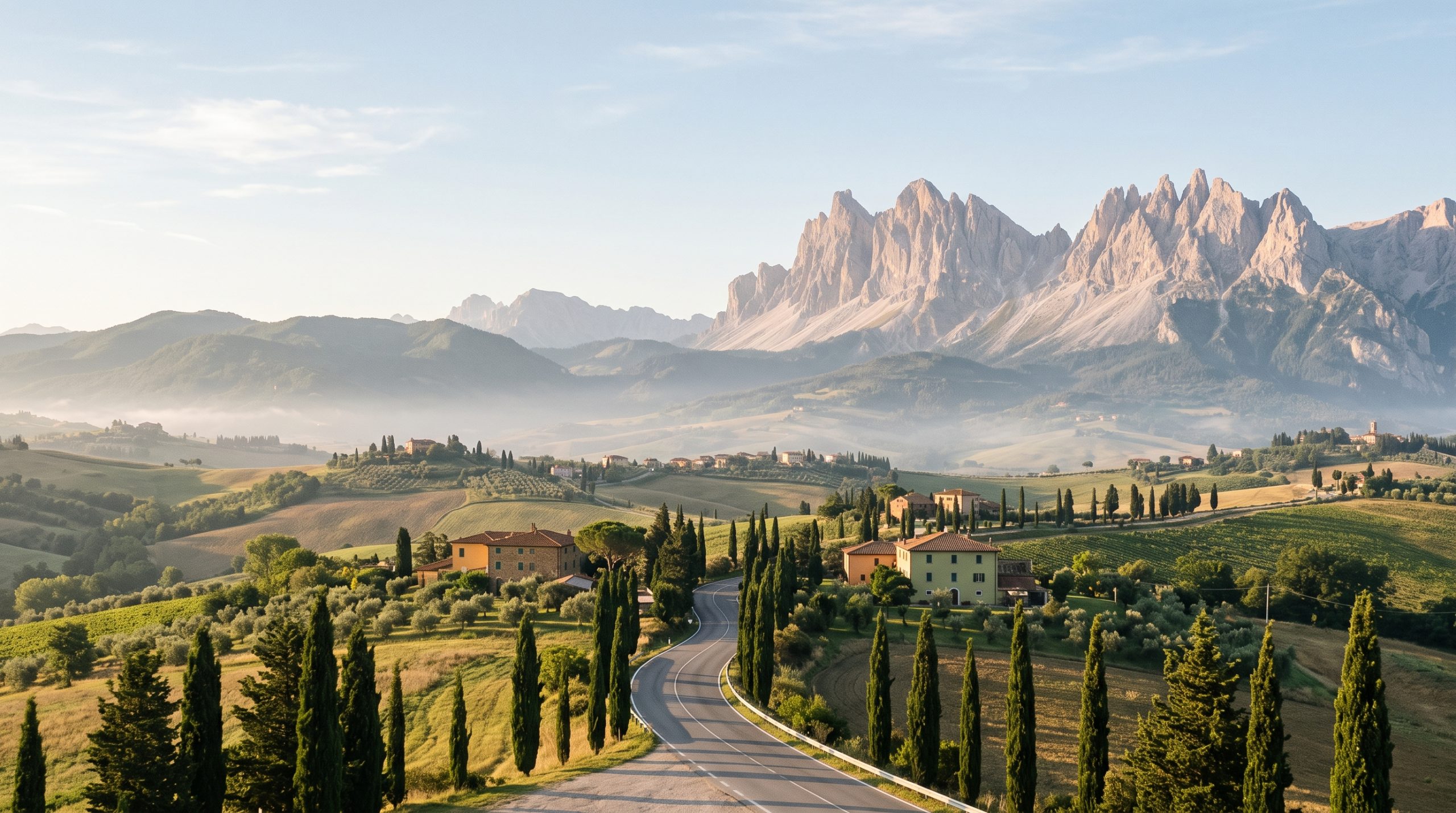
In late June the sun clears the horizon over Val d’Orcia at 5:34 and over Cortina d’Ampezzo at 5:18. Sixteen minutes apart on the clock, about 410 km apart on the ground. Almost everything that makes a Tuscany and Dolomites elopement work, or quietly fall apart, lives in the gap between those two numbers.
Couples ask us for this pairing more than any other Italian combination, and they are right to. A cypress ridge and a stone farmhouse at dawn, then limestone walls turning pink above a meadow two days later. It holds together. What breaks it is treating the move north as a morning rather than a day, and assuming a road that climbs to a 2,236 m pass behaves like the motorway out of Florence.
So this page is the operational half of the plan. Transfer numbers, which airports pair sensibly, the hours the mountain roads genuinely close, when the lifts stop running, and how a ceremony gets hung on all of it without the week reading like a bus timetable.
Florence in, Venice out, 410 km in between
Fly into Florence, spend the first half in Val d’Orcia, then move roughly 410 km north and finish in the Dolomites, flying home from Venice. Give the transfer a full day of its own. Six to eight nights is the honest minimum, and the mountain hours get built around road closures that start at nine in the morning.
Moving north: drive it, or ride the Frecciarossa and pick up a car
There are two sane ways to get from the Tuscan half to the mountain half, and they cost you different things. Driving the whole way keeps your luggage and your dress in one vehicle. Taking the high-speed train to Verona and collecting a car there buys back most of a morning, because the fast leg is genuinely fast: Florence to Verona Porta Nuova is 185 km, direct, from about 1 hour 32 minutes, with roughly eight direct departures a day.
| Leg | Distance | What the planners quote | What we schedule around |
|---|---|---|---|
| Florence to Cortina d’Ampezzo by car | About 410 km | Between 3h51 and 4h35, depending which planner you ask | A travel day of its own, arriving in daylight |
| Florence to Verona Porta Nuova by high-speed train | 185 km | From 1h32 direct, around eight direct departures a day | Morning train, car collected at the station, valleys by mid-afternoon |
| Venice Marco Polo to Cortina d’Ampezzo by car | About 160 km | Around 1h40 | Two hours from the terminal door is the figure we build on |
| Venice Marco Polo to Cortina d’Ampezzo by direct coach | Same road | About 2 hours, twice daily | Fixed departures, so we never place one next to a ceremony hour |
One small thing that catches almost every couple: Florence’s historic centre is a camera-enforced limited traffic zone, so a rental car parked outside your hotel the night before is not the free option it looks like. We collect the car on the way out of the city instead. If you are still deciding the overall shape of the week rather than the mechanics, our guide to planning an elopement from scratch is the better place to begin.
Where the route planner is optimistic
Here is the tell. Two mainstream route planners looking at the same Florence to Cortina drive return 3 hours 51 minutes and 4 hours 35 minutes. Forty-four minutes of disagreement on 410 km means the software is not confident either, and the reason is that this route is two completely different roads glued together. The motorway section behaves exactly as advertised. The last stretch, once you leave the autostrada and climb into the Boite valley, does not average anything like motorway speed, and it is the part with the views, so you will want to stop.
The same optimism shows up at the Venice end. A planner puts Marco Polo to Cortina at about 1 hour 41 minutes. The scheduled coach on that same road is timetabled at roughly 2 hours, and the coach drivers do this every day. When a professional operator’s timetable and a route planner disagree, we take the timetable.
Then there are the passes. Passo Giau sits at 2,236 m and links Cortina with Selva di Cadore, and it is the single most cinematic hour of driving in the region: hairpin after hairpin with Nuvolau, Averau, Pelmo and the Tofane stacked around you. It is also a high pass, which means snow can close it at short notice outside high summer. For any date from late autumn to early summer we plan the pass as a bonus rather than a fixture, with a valley location already chosen at the same distance from your base.
Two things we would talk you out of. The first is driving up from Tuscany and covering anything on the same day, in either direction. The second is a midday attempt on Tre Cime di Lavaredo in August, when the summit car park is full and the toll road closes behind it. Both are technically possible. Neither produces a morning worth remembering.
Two 5am starts that behave nothing alike
Clock times are close between the two regions. What the light does with them is not.
| Location | Late June sunrise and sunset | Late September sunrise and sunset |
|---|---|---|
| Val d’Orcia, near San Quirico | 5:34 and 20:56 | 6:58 and 19:15 |
| Cortina d’Ampezzo | 5:18 and 21:08 | 6:55 and 19:14 |
| Ortisei, Val Gardena | 5:20 and 21:10 | 6:57 and 19:16 |
In Val d’Orcia the hills are low and rounded, so the clock is close to honest. The sun lands on the cypress lines within a few minutes of the published time, and in late September a layer of mist usually sits in the hollows until the warmth burns it off, which is the single best reason to be standing somewhere at 6:40 in autumn rather than 6:40 in July.
Cortina is a bowl with 3,000 m walls around it. Sunrise at 5:18 is when the sun clears the horizon, not when it reaches the valley floor, and the difference on the ground can be well over an hour depending on which side of town you are standing. Ridges and high meadows are the opposite: Seceda, Alpe di Siusi and the passes catch it essentially on time. So the mountain morning is a decision about altitude, not just about hours. The evening runs the same logic in reverse, and the walls hold a pink flare that the Ladin locals call enrosadira long after the meadows have gone flat and blue. You can see how both halves cut together in our published elopement films and galleries.
Roads that shut at nine in the morning
The Dolomites are not a place you can wander into with a car at any hour. Several of the best-known locations sit inside protected landscapes with access rules enforced by a barrier or a checkpoint, and those rules dictate the timeline far more than the weather does.
| Location | The rule | When it applies | How we work with it |
|---|---|---|---|
| Alpe di Siusi, Sciliar-Catinaccio nature park | Access road closed to private cars from 9:00 to 17:00. Driving back down to the valley is allowed at any hour | Every day the cable car is operating | Through the checkpoint before 9:00, or up on the Siusi cable car and shuttled across the plateau |
| P2 Compatsch parking, Alpe di Siusi | Currently 30 euros a day, and an online reservation is now required in the summer season | Reservations open up to six days before arrival | We diarise the booking window, not the trip date, and hold a lift-based version of the morning |
| Lago di Braies | Valley road closed to private cars through the middle of the day in peak summer, in recent seasons roughly 9:30 to 16:00. Walking and cycling in is permitted at any time | Early July to mid-September | A pre-booked day-stay ticket with parking at the lake, or an arrival before the window starts |
| Tre Cime di Lavaredo toll road | Seasonal toll road from Misurina up to Rifugio Auronzo, around 30 euros for a car, online reservation required, and the road closes once the summit car park fills | Typically late May to late October, with the opening date set by how much snow is still lying | First light, before the queue forms. Toll tickets run for 12 hours, so one ticket covers a whole day’s plan |
| Val Gardena lifts | Summer running season only, with the last lifts closing at the beginning of November | Late autumn and the spring shoulder | Those dates get planned on ground you can reach on foot or by road |
Two of those deserve underlining. The Alpe di Siusi reservation window is short, so this is not something to book when you book flights; it is a diary note for the week of the trip. And the shoulder seasons flip the logic entirely. In the weeks when the Alpe di Siusi cable car is closed, roughly mid-April to mid-May and again from early November, the road up to Compatsch simply opens to traffic. A mid-May morning up there can be quieter than anything you will get in August, with more snow on the Sassolungo and nobody at the barrier. Our destination elopement guides compare the months region by region.
Aerials, nature parks and what we confirm first
Italy runs the European drone categories and then adds its own layer. Operators register through the D-Flight portal, camera drones are included even below 250 g, third-party liability insurance is required for every aircraft, and the ceiling in the open category is 120 m. ENAC is the authority, with an office in Bolzano for South Tyrol questions, and the D-Flight map shows which airspace is restricted. Because a lot of the ground you would want in a film sits inside a nature park, we confirm the zone and the permission before we design a sequence around aerials, and the film always has a version that works from the ground.
How we build a two-region timeline
The shape we keep coming back to is three blocks. Two or three nights in the south, with a Val d’Orcia morning and an evening in the same landscape. A transfer day with no coverage on it. Then three or four nights in the mountains, where the best hours are early and the access rules decide which valley you are standing in at 6am. Ceremony hours never sit next to a fixed departure, whether that is a coach, a timed lift or a barrier that drops at nine.
Because photo, film and planning come from one team rather than a photographer and a separately hired videographer meeting on the morning, a transfer week works differently for us. On the long days we usually run two vehicles: one of us goes ahead to read the light on the pass and check that the barrier is where we expect it to be, while the other stays with you and keeps the morning calm. There are eight of us, so there is always a second set of cameras on the ground and a colleague in reserve. Team travel to both regions is included, flights and accommodation, in every destination we work.
We handle the permit research and the logistics guidance, build the timeline around real travel time rather than map estimates, and hold a weather alternative for every location. Government, venue and landowner fees, accommodation, your celebrant and any unusual transport are paid by you directly. A two-region trip is an Odyssey by definition, since it runs across several days and more than one destination, and the experiences and coverage page sets out how ours compare before we write your proposal. Highlights reach you five days after the last frame, and the full gallery or film within three weeks.
We are currently booking 2027, 2028 and 2029. Send us the two regions, a rough month and how much of the week you want covered, and we will come back with a route.
Common questions
Can we really do Tuscany and the Dolomites in one elopement trip?
Yes, and it is one of the most rewarding combinations in Europe. The two regions sit roughly 410 km apart. Plan six to eight nights, keep one full day clear for the transfer, and treat the mountain half as the one with the tighter timing, because that is where the access rules live.
How long is the drive from Florence to the Dolomites?
Route planners quote between 3 hours 51 minutes and 4 hours 35 minutes for the 410 km from Florence to Cortina d’Ampezzo. The motorway section holds up. The final climb into the Boite valley does not average motorway speed, so we treat it as a full travel day rather than a long morning.
Is the train from Florence to Verona better than driving the whole way?
For most couples, yes. Florence to Verona Porta Nuova is 185 km, direct, from about 1 hour 32 minutes, with around eight direct departures a day. You collect a car in Verona and drive the mountain section fresh, which is the section where being alert actually matters.
Which airports work best for a Tuscany and Dolomites elopement?
Flying into Florence and out of Venice avoids doubling back, which is worth a day on a week-long trip. Venice Marco Polo to Cortina d’Ampezzo is about 160 km, quoted at around 1 hour 40 minutes by car, with a direct coach on the same road timetabled at roughly two hours, twice daily.
Do we need to book parking in the Dolomites in advance?
In several places, yes. The P2 Compatsch car park on Alpe di Siusi requires an online reservation in the summer season, currently 30 euros a day, and it can only be booked up to six days before arrival. The Tre Cime toll road also requires an online reservation, and closes when the summit car park is full.
When do the Dolomites mountain roads and cable cars open for the season?
The Tre Cime toll road typically runs from late May to late October, with the opening set by lying snow. Val Gardena’s lifts run through summer and the last ones close at the beginning of November. The Alpe di Siusi cable car pauses roughly mid-April to mid-May and again from early November, and during those weeks the road up to Compatsch opens to cars.
Can we have drone footage in our Dolomites elopement film?
Often, and we confirm it location by location first. Italy requires operator registration on the D-Flight portal, including for camera drones under 250 g, plus third-party liability insurance, with a 120 m ceiling in the open category. Nature park airspace is checked on the D-Flight map before we plan a sequence around it.
Sketching the route with us
The best version of this trip is not the one that fits the most locations into the week. It is the one where the transfer day is genuinely a day off, the mountain mornings start early enough to beat the barrier, and the Tuscan evening is long enough that nobody is watching a clock. Tell us the month you are thinking about and we will tell you honestly which half should get the extra night.
Everything runs in writing, at your own pace, from the first message onward. Send the inquiry form and you will have a reply and an initial brochure within 24 hours, then a tailored proposal for your route. A signed contract and a 30 percent retainer start the planning.