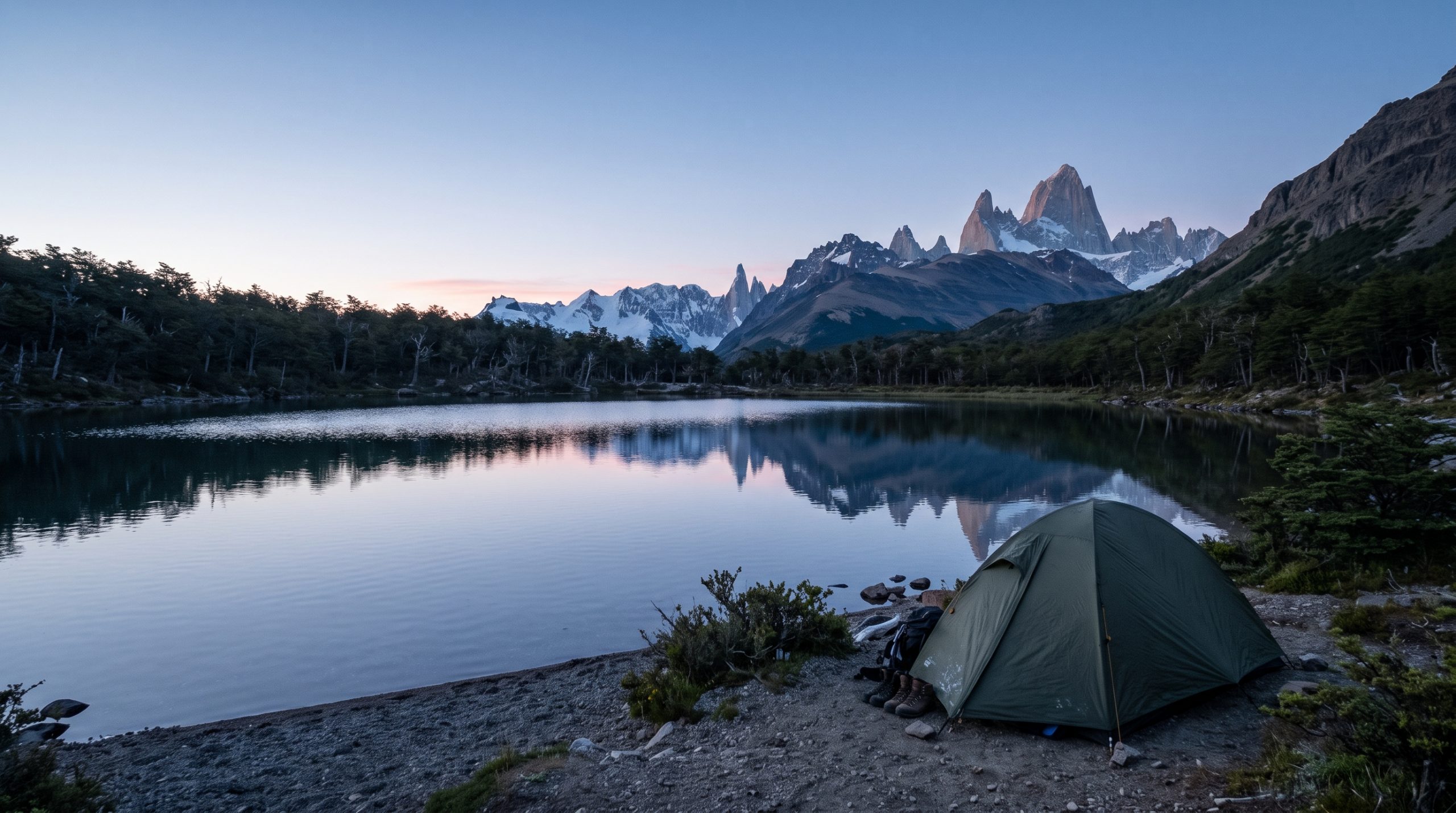
Until the middle of January 2027, Laguna Capri was the last of the three base camps in the north of Los Glaciares you could still use the old way: walk up from town, find a flat patch in the lenga forest, pitch a tent, pay nothing. Then the reservation system reached it. The site is now booked and paid by the night, looked after by the Asociación Amigos del Parque Nacional Los Glaciares Zona Norte, with staff on the ground and two working toilets that El Chaltén volunteers put back into service.
For couples that change is quietly excellent news. The flat ground you want on the one morning that matters is genuinely yours, on the date you chose, rather than something you race a trekking group for at four in the afternoon.
The lake sits four kilometres from the end of Avenida San Martín, on the near side of the water from Fitz Roy. You look west at the granite. That single piece of geography is the reason to sleep up there instead of leaving town in the dark, and it shapes every hour of the plan below.
What the night up there buys you
Camping at Laguna Capri puts you four kilometres inside Los Glaciares National Park, on the near shore of the lake, looking west at Fitz Roy. You wake already in position for the first colour on the granite, hours before the day hikers leave El Chaltén. The site is reserved in advance, with no fire and no power.
Four kilometres in, and the first one is the steepest
The trail starts at the north end of Avenida San Martín, where the town stops and the park begins. There is a parking area just before the trailhead and a large board with distances and walking times, and from there the path is marked by the kilometre, so you always know exactly how much is left.
The first kilometre is the steepest thing you will do all afternoon. It climbs to the Mirador Río de las Vueltas, a natural balcony over the valley, and that view down the braided river stays with you for most of the next hour. The second kilometre eases off along the western flank of the valley with the Cordón Los Cóndores in view, and by the two-kilometre marker you are into taller lenga forest. That forest matters more than it sounds. It is the first real shelter on the route when the wind is working, and on a rough afternoon you will be glad of it twice.
Nobody walks this in the dress. Every couple we have taken up there does the same thing: boots, layers and a pack, with the dress rolled in a dry bag and the jacket folded flat against the frame. Wedding clothes carried four kilometres arrive with the creases the walk gave them, and in this landscape that reads as truth rather than a problem. If you want a hem that has never touched a trail, Capri is the wrong lake, and Lago del Desierto, 37 kilometres north of town by road, puts you on a shoreline a short walk from where the car stops. Tell us which of those two things matters more to you and we will build the day accordingly.
A fit day hiker covers those four kilometres in well under two hours. We plan on more. With camping loads, a tripod and two people who keep turning round to look back down the valley, budgeting a full two hours to the lakeshore leaves room to pitch the tent, eat something hot and still have the entire evening in hand. Our team walks in with its own tent, food and kit, so nothing in your pack belongs to us.
The ticket, the reservation, and the short list of rules
Two separate things have to be arranged before you walk in, and neither one is complicated once you know which office owns it.
The first is park access. The north zone of Los Glaciares has charged for entry since October 2024, and access control is switched back on at the start of each high season, on 1 October, through three portals: Portal Los Cóndores at the Ceferino Fonzo visitor centre on Provincial Route 41 before town, the portal at the end of Avenida San Martín where the Fitz Roy trail begins, and the Río Eléctrico portal that serves Piedra del Fraile. Tickets are sold online. The tariff is set in pesos and revised as the season turns; the general rate for foreign visitors most recently sat at 45,000 pesos a day, with lower tiers for Argentine nationals and for residents of Santa Cruz province.
The second is the campground. Capri came into the reservation system on 14 January 2027 and is administered by the Asociación Amigos del Parque Nacional Los Glaciares Zona Norte, which also runs Poincenot and De Agostini deeper in the trail network. The stay is charged per adult per night, 15,000 pesos when the system opened, with children under twelve free.
After that, the list is short. The base camps have no services at all: no shop, no electricity, one latrine and one dry toilet, plus the dome that porters carried up the trail piece by piece for the campground crew. Open fires are prohibited throughout the park, so anything hot comes off your own stove. Drones are not permitted. Mountain-use registration exists, but it is aimed at climbing and at travel in remote country such as Laguna Toro and the Huemul circuit; the trunk trails, the Fitz Roy path among them, are marked, signposted and patrolled, and registration for those becomes mandatory in the winter months from May through September. Permit research and logistics are part of every booking we take, and they sit alongside the wider planning fundamentals we walk every couple through, so what reaches you is a list of what to carry and when to be where.
Evening at the lake, after the day hikers go home
Capri is a day walk for most people who come. Four kilometres in, lunch on the rocks, four kilometres back for a beer on San Martín. Which means the middle of the day up there is the weakest version of the place: high sun, the massif flattened and bleached, a dozen groups sharing the same handful of shoreline boulders. We would not put a ceremony hour into it, and we will say so if you ask us to.
By early evening the trail empties out. Around the December solstice there are more than sixteen hours between sunrise and sunset at this latitude, so the evening does not end so much as slowly give up, and the hours after the last day pack disappears down the hill are some of the best working light of the entire stay. Camp in the lengas, stove going, wind doing whatever the wind has decided to do. The quiet, unposed part of the film gets made here, and it exists only because you stayed.
First light, and where we stand for it
Fitz Roy faces you across the water from the west. The sun comes up behind your shoulder, which means the first colour of the day lands on the granite while the campground is still in shade and still cold. That order of events is the gift of Laguna Capri. It is also the catch: by the time the mountain looks the way you came for, you need to be standing where you decided to stand the previous evening, with the ring already out of the pack.
So we walk the shore before dinner and choose the ground then, in daylight, when everyone can see what they are agreeing to. Where the vows happen, where the two of you come from, which rocks are dry, where the tripod goes so that nobody has to move once the colour starts.
Timing follows the calendar hard. Near the solstice, sixteen hours of daylight puts sunrise before six and the alarm somewhere around four. In the last week of March the sun comes up just before eight and goes down around eight in the evening, which makes exactly the same ceremony a far more civilised proposition, and it is why we steer couples who like their sleep toward the shoulder of the season rather than the middle of it.
We tend to place vows on the back half of the colour rather than the front, then move to portraits as the light finally reaches the shoreline and the lake settles. Still water gives you the massif twice. A breeze takes the reflection away and hands you texture instead, and honestly the frames with a bit of chop in them are often the better ones. If you would rather see how this granite behaves on camera than take our word for it, our published films and galleries are the place to look.
Choosing the month, and the morning the mountain hides
The single decision that changes this plan most is not the gear list. It is which week you come, because daylight at 49 degrees south swings by eight hours across the year.
| Window | Daylight | What that means at Capri |
|---|---|---|
| Late December to January | About 16 hours 19 minutes at the solstice | Sunrise before six, an alarm around four, and the busiest trail of the year on the walk in |
| Late March | Roughly 12 hours, sun up near 7:50am | A ceremony at a sane hour, a quieter shoreline, and an evening that closes down by nine |
| May to September | About 8 hours 14 minutes at the June solstice | Registration for the trails is mandatory, first light is sociable, and the whole day is one short window |
Then there is the mountain’s own opinion. Fitz Roy keeps its summit in cloud a great deal of the time, and no amount of planning buys the peak. What planning does buy is a second version of the morning that is worth photographing on its own terms: the lenga forest, where scale comes from trees and mist instead of granite; the lake edge in flat light, which suits close work and vows far better than most people expect; and the Fitz Roy viewpoint at 743 metres, a few hundred metres off the junction, which we keep in the plan for the walk out in case the cloud lifts by nine. Weather alternatives are built into every booking before you arrive, and the same thinking runs through our other destination guides.
Two cameras on one shoreline, no drone above it
Start with what you cannot have. Drone use is not permitted in Los Glaciares, and Argentina’s civil aviation rules keep open-category flights out of national park airspace, so there is no aerial of this lake, from us or from anybody else. That is less of a loss than it sounds. The film that works here is at eye level: a tent zip at four in the morning, steam off a mug, a long lens across the water compressing the massif until it looks as big as it feels.
The usable ground on the Capri shore is narrow. Some low rocks, a short strip of stones, treeline immediately behind. Two people cannot both stand in the obvious spot, so one of ours works close while the other takes the higher line back toward the trail, and they trade positions every few minutes instead of competing for the one good angle. They can do that because they have worked together before and because they settled the geography the previous evening. Wind is the other argument for a pair: at dawn, on an open shoreline, somebody has to be shielding the mic while somebody else is watching the light.
One dedicated photographer or one dedicated filmmaker walking in with you is The Adventure, from $4,900; a photographer and a filmmaker working as a pair is The Expedition, from $7,900, and it is the one that adds professional audio for vows where conditions allow. What each covers is set out on our coverage and pricing page.
An overnight at Capri usually reads as one continuous stretch of coverage, from the afternoon walk-in through to the morning after. If you want two nights up there, or Capri plus a second location further down Route 40, we build it as The Odyssey instead, which runs from two to seven days on a custom proposal.
Common questions
Do we need to reserve the Laguna Capri campground, or can we just turn up with a tent?
Reserve it. Capri entered the reservation system on 14 January 2027 and is run by the Asociación Amigos del Parque Nacional Los Glaciares Zona Norte, with a fee per adult per night and children under twelve free. You also need a north-zone access ticket for the day you walk in, which is sold online. Both go into the timeline we build with you.
Is there anywhere to change into a dress at the campsite?
The tent. There is a latrine and a dry toilet at Capri and nothing else built, so the tent is the changing room and the dry bag is the wardrobe. We time the change as late as it can go, once the ceremony ground is set and the light is minutes away, because standing around in silk at five in the morning in Patagonia is nobody’s idea of a good start.
Can we fly a drone over the lake for our film?
Not here. Drones are prohibited in Los Glaciares, and Argentina’s aviation framework keeps open-category operations out of national park airspace. We build this film entirely from the ground, and we save aerials for the destinations where they are legal, safe and worth flying.
What happens if Fitz Roy is buried in cloud on our morning?
We photograph the morning we are given, using the forest, the water and the mist rather than the summit, and we keep the Fitz Roy viewpoint at 743 metres in the plan for the walk out in case it clears. If your dates allow two mornings up there, we choose the better one rather than gambling on a single dawn.
Can we have the dawn ceremony without camping at all?
Yes. It is four kilometres from the end of Avenida San Martín with the steepest ground in the first kilometre, so with headlamps and an unhurried start you can leave town well before sunrise and be in place for first light. You trade the evening, the stove and the sound of the wind in the lengas for a proper bed. Tell us which of those two nights you actually want and we will shape the day around it.
Building both halves into one plan
The night and the morning are one piece of work, and they need one plan: the access ticket, the reserved site, the two-hour walk with everything on your backs, the ground chosen at dusk, the alarm set to the season. Our Patagonia calendar is currently open across 2027, 2028 and 2029, and every planning step stays in one written thread, at whatever hour suits you. Send the form and you get a reply and our first brochure within 24 hours, then a proposal built around your dates, then a 30% retainer and the planning starts. Check Your Date and tell us which month you are looking at.