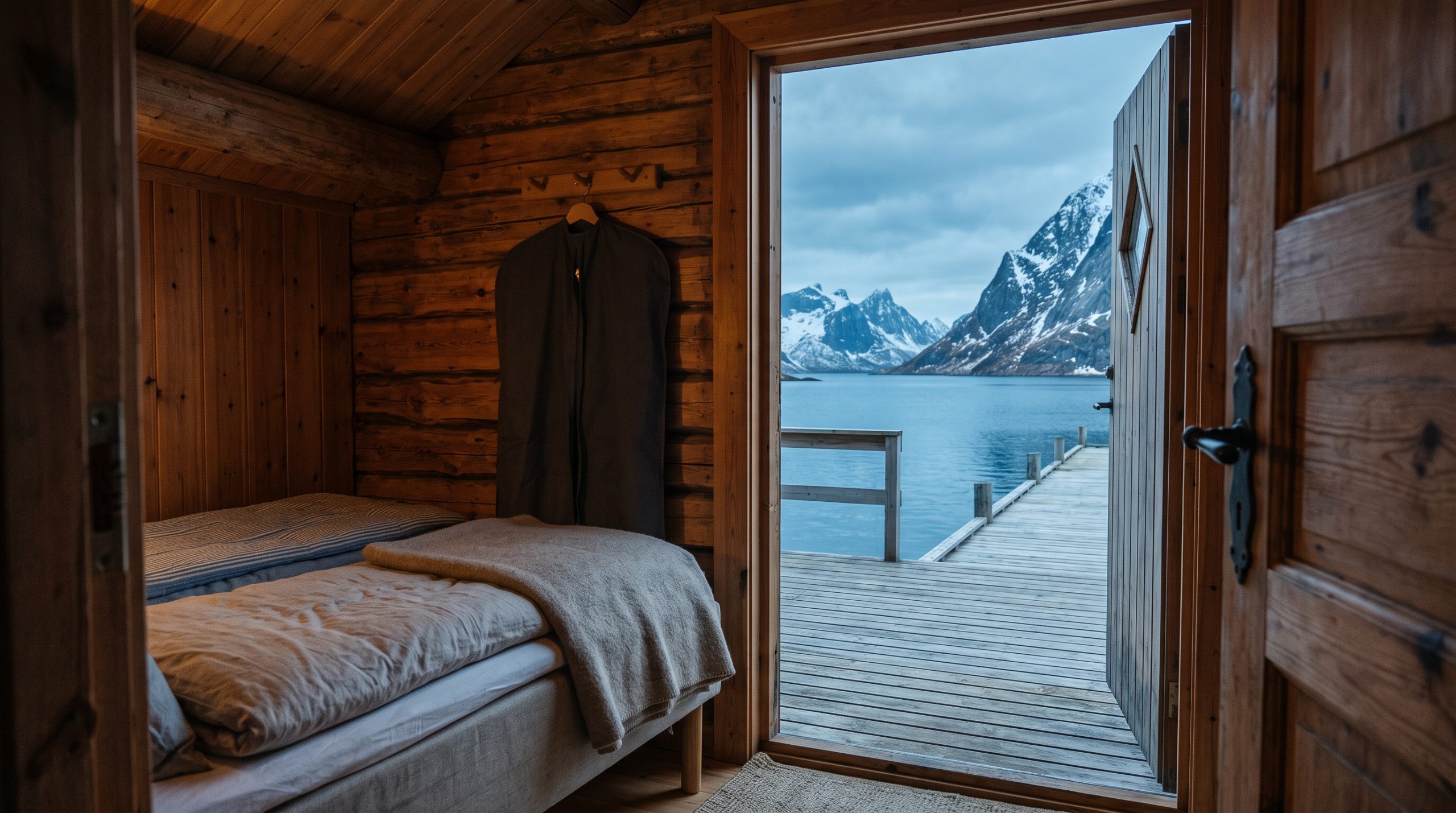
Most rorbu gangways we have worked on take two people abreast, and not much more. That one measurement shapes a Lofoten morning more than the mountain behind the cabin does. It decides where a long dress can be laid out, where a filmmaker can stand while a photographer works the doorway, and how many guests can watch you say your vows without half of them standing in the frame.
Couples write to us with the same two-part question. Can we get dressed in the cabin, walk out the door, and be married right there on the water. The honest answer is that those are two different permissions, held by two different people, and only one of them is the cabin owner.
One rorbu village in Lofoten publishes a wedding offer under its own name. Everywhere else, from the red cabins at Hamnøy to the boathouses of Henningsvær, hosting a wedding is a private arrangement with whoever owns the buildings. The legal side belongs to the municipality your cabin sits in, and there are four of those strung along the E10.
Two yeses, not one
Two separate permissions run in parallel. The cabin owner decides whether you can get ready, gather guests and hold a celebration on their property. The municipality your cabin sits in decides whether an officiant will say the legal words there. Nusfjord publishes a wedding offer of its own. Everywhere else, both yeses are arranged one at a time.
Nusfjord, the village set up to host all of it
Nusfjord Village and Resort takes wedding celebrations all year round, and it is the rare place in Lofoten where the accommodation, the dinner and the late evening all belong to the same operator. The village sleeps up to 62 people, with another 50 beds at Lofoten Cottages a five minute walk away. That is your guest list, decided by beds rather than by chairs.
Dinner is served in Restaurant Karoline, looking out over the water, and the evening moves on to Aurora Matbar or Trandamperiet. There is a wellness area, an art gallery in the old Salteriet building, a general store and a tavern, all inside a harbour you cross on foot in two minutes. The cabins have names instead of numbers: the House of Dahl, the Isolated Fisherman, the Upper Ice House.
What the website cannot tell you is what the ground is like in wedding clothes. Nusfjord sits in a tight bowl of rock around a small harbour, and you move between buildings on gravel, boardwalk and a few short steep pitches of tarmac. All walkable, none of it smooth. Flats between the cabins and the restaurant, heels for the last stretch, is the pattern that works. And the middle of a July day belongs to visitors on the same boardwalks you are, so we put the quiet parts of the day early and late and let the village keep its afternoon.
Guest numbers change none of our fee and all of our logistics. Twenty people means transport, timing, and somewhere for everyone to stand while you two are out on the pier. If you are still choosing between villages, our destination guides carry the groundwork for each region.
What to ask a cabin owner in Reine, Hamnøy or Henningsvær
Outside Nusfjord you are negotiating with a business that rents cabins to fishermen, hikers and photographers, and that may never have hosted a ceremony. Most owners are open to it. They need to know what you are actually asking for, which is rarely what a wedding enquiry sounds like.
- Is the gangway outside our cabin ours for an hour, or shared with the neighbouring cabins?
- Does the pier belong to the accommodation, or to the fish landing next door?
- May we move furniture in the main room, and put it back the same evening?
- How many people may stand on the property at once?
- Is there a second room, or a second cabin, so we can get ready separately?
- Where do guest cars go, and can they be parked out of sight of the water?
Two things the postcards leave out. The famous view of Hamnøy is photographed from the bridge above the village, looking down at the cabins, so standing on your own veranda you get the mountains and the water rather than the picture you saved to your phone. And the cabins at Sakrisøy are ochre yellow, not red, sitting so low that light coming through a window has bounced off the sea first. Both are good places to marry. Neither looks, from inside, like the image that made you search for it.
Send us the name of the cabin you are holding and we will put these questions to the owner in writing, in Norwegian where that helps, before anyone pays a deposit. If the answers come back thin, we will say so and suggest a village that fits the shape of day you described. Tell us which cabin you are looking at and we will start there.
Getting dressed in a room built for drying gear
A rorbu interior is painted wood, one or two small windows, a narrow stair to a sleeping loft, and door frames built for people in a hurry rather than people in a dress. There are hooks along the walls where working gear used to hang. What there almost never is, is a full length wardrobe.
So the practical questions get answered on arrival. Where does the dress hang overnight without creasing along the shoulder. Usually a beam hook or the top of a door frame, never the bathroom, because a rorbu shower fills the whole cabin with steam in about four minutes. Where is there a mirror taller than a face. Often nowhere, which is worth knowing in advance.
The light is the good news. One window in a small wooden room is a soft, directional source of exactly the kind we would build if we were allowed to build one, and if it faces the harbour the water throws light back up under the eyes for free. We turn the ceiling bulbs off so daylight is not fighting orange tungsten, open the gangway door as a second source, and shoot the loft stairs, because a narrow wooden stair with a train coming down it is one of the hardest frames in a village like this and one of the best. You can see how Lofoten cabins and coastline hold up in our galleries and films.
If you want to get ready apart, ask for two cabins, or one with a loft and a ground floor bedroom. In a room the size of most rorbuer, two people dressing at once means one of you is standing in the photograph the other wanted alone.
Whether the officiant comes to your dock
In Norway a marriage happens when both of you appear before an authorised officiant, declare that you wish to marry each other, and the officiant declares you married. Civil ceremonies are run by the municipality, and under the national regulation on municipal weddings each municipality decides for itself where and when it offers them. That is why the dock question is answered by a kommune office rather than by a cabin owner.
The four along the E10 chain are Flakstad, which covers Nusfjord and Ramberg, Moskenes, which covers Reine, Hamnøy and Sakrisøy, Vestvågøy, which covers Ballstad and Stamsund, and Vågan, which covers Svolvær, Kabelvåg and Henningsvær. The ceremony itself is free for people who are not resident in Norway but meet the conditions to marry here, which includes almost every couple who writes to us from the United States. Where a municipality agrees to marry you beyond its ordinary offer of time and place, it may charge its necessary extra costs, such as the officiant’s travel or heating a room, and it has to tell you that amount well before the date.
Vågan is the most documented of the four, and a useful picture of what a civil ceremony actually is. The ceremony room sits on the fourth floor of the town hall at Storgata 29 in Svolvær, guests are welcome, and two adult witnesses have to be present. In exceptional cases Vågan can provide one of them if that is arranged in advance. The ceremony runs in English if you ask beforehand. One hour is set aside, the civil formulary is read aloud, then you, your witnesses and the officiant sign the register and you leave with a temporary marriage certificate in hand. Rings can be exchanged in the room.
That last detail is why the strongest shape for a rorbu wedding is often two events in one day. Sign in town in the morning, certificate in your pocket by eleven, then drive out to the cabin and hold the vows that matter to you on the gangway with the water underneath, in your own words, at the hour the light is right. The legal part is done and the ceremony is yours. For a church route instead, the church in Vågan sends a priest to outdoor ceremonies at locations it has approved, and marries any day except Monday.
The four month clock on your paperwork
Skatteetaten, the Norwegian Tax Administration, is the office that checks whether you are free to marry and issues the certificate that proves it. It is valid for four months, and you hand it to your officiant on the day, so it has to be issued inside the four months before your date rather than a year ahead when you first start planning. Couples holding a certificate from another Nordic country still apply for the Norwegian one, and the original Nordic document goes by post rather than by email. We track this alongside the rest of the file, and our guide to planning an elopement sets out the sequence.
How light reaches a village at the foot of a mountain
Sunrise tables assume a flat horizon. In a rorbu village the horizon is the ridge behind the cabins, so direct light can arrive an hour or two after the printed time and leave long before sunset, and how much later depends on the direction the harbour opens. A harbour facing west holds the last light on the cabin walls. One facing east gets clean early sun on the water, then sits in its own shadow all afternoon. We check the aspect of your harbour before proposing a ceremony hour, because two villages twenty minutes apart on the E10 run on different clocks.
Lofoten sits far enough north that the summer sun never sets, and the hours after midnight are the best working light of the year. Empty boardwalks, low warm light, nobody asking to get past you on the pier. In spring and autumn the sun travels low and slowly, giving long soft afternoons and an early mountain shadow. In the weeks around midwinter it does not clear the ridge at all, and you get hours of even blue light, glowing cabin windows, lantern light on wet wood. Three different films, and not one of them a compromise.
If you have a fixed idea of a ceremony at six in the evening, tell us the village and we will tell you honestly whether six works there in your month, or whether nine at night is the hour that place was built for.
Two cameras on a gangway two people wide
Photography and film here come from one team of eight rather than two vendors meeting on the morning, and on a pier this narrow that matters physically. The photographer and filmmaker split the cabin before you come out of it, one inside on the window, one outside on the gangway, swapping on a signal rather than a whisper. Neither backs into the other’s frame, because they agreed who owns which side of the door while you were still putting your shoes on. Wind off the water is the real problem for sound in a harbour, so where audio is included we rig it before the vows, on the sheltered side of the cabin wall.
A full day with one dedicated photographer or one dedicated filmmaker starts at $4,900, and a day with both of them working together starts at $7,900, with the longer multi day option and everything included set out on our pricing page. Highlights reach you five days after the wedding. The full gallery or film follows within three weeks.
Common questions
Can we legally marry on the rorbu veranda, or only inside a town hall?
It depends on the municipality, not on the cabin. Each Lofoten kommune decides where and when it offers civil ceremonies, and some will travel while others hold ceremonies only in their own room. Where a municipality goes beyond its usual offer of time and place it may charge its necessary extra costs, and it must tell you the amount in advance.
Does the ceremony cost anything if we are American and not resident in Norway?
The municipal civil ceremony is free for people who are not resident in Norway but meet the conditions to marry here. Charges only appear when you ask for something outside the standard offer, such as an officiant travelling out to a cabin or a room being opened outside normal hours.
How far ahead do we apply for the Norwegian paperwork?
The certificate from Skatteetaten is valid for four months and you present it to your officiant on the day, so the application belongs to the final months of planning rather than the first. Everything before that is gathering documents from home, which is the part that takes the time.
Who signs as our witnesses if we come to Lofoten without guests?
Two adults must be present and sign the register. Vågan states that in exceptional cases it can provide one witness if this is arranged in advance, and other municipalities take their own view, so it is a question we settle in writing long before you fly rather than on the morning.
Is there anywhere in a rorbu to change out of hiking boots?
Yes, and it is one of the real arguments for basing a day in a cabin. You come off the trail, up the gangway and through your own door, boots off in the entrance, dry socks, kettle on. It is also why we put the hike before the ceremony rather than after it.
Holding the cabin and the officiant on the same date
The cabin is the easier of the two to secure, and the one couples book first. The officiant is worth confirming before you pay anyone, because it decides whether the words happen at the water or in town, and therefore what hour the whole day is built around. That research is part of the planning, alongside the timeline, the light, the weather alternative and the walk that gets you to the pier without arriving out of breath.
Our current Lofoten availability runs across 2027–2029. Send us the village, the month and the shape of day in your head, and you will have a reply and our brochure within 24 hours, then a proposal built for that harbour. A signed contract and a 30 percent retainer start the planning. From the first reply onward, the whole process stays in writing, in whatever time zone you are in. Start Your Story.