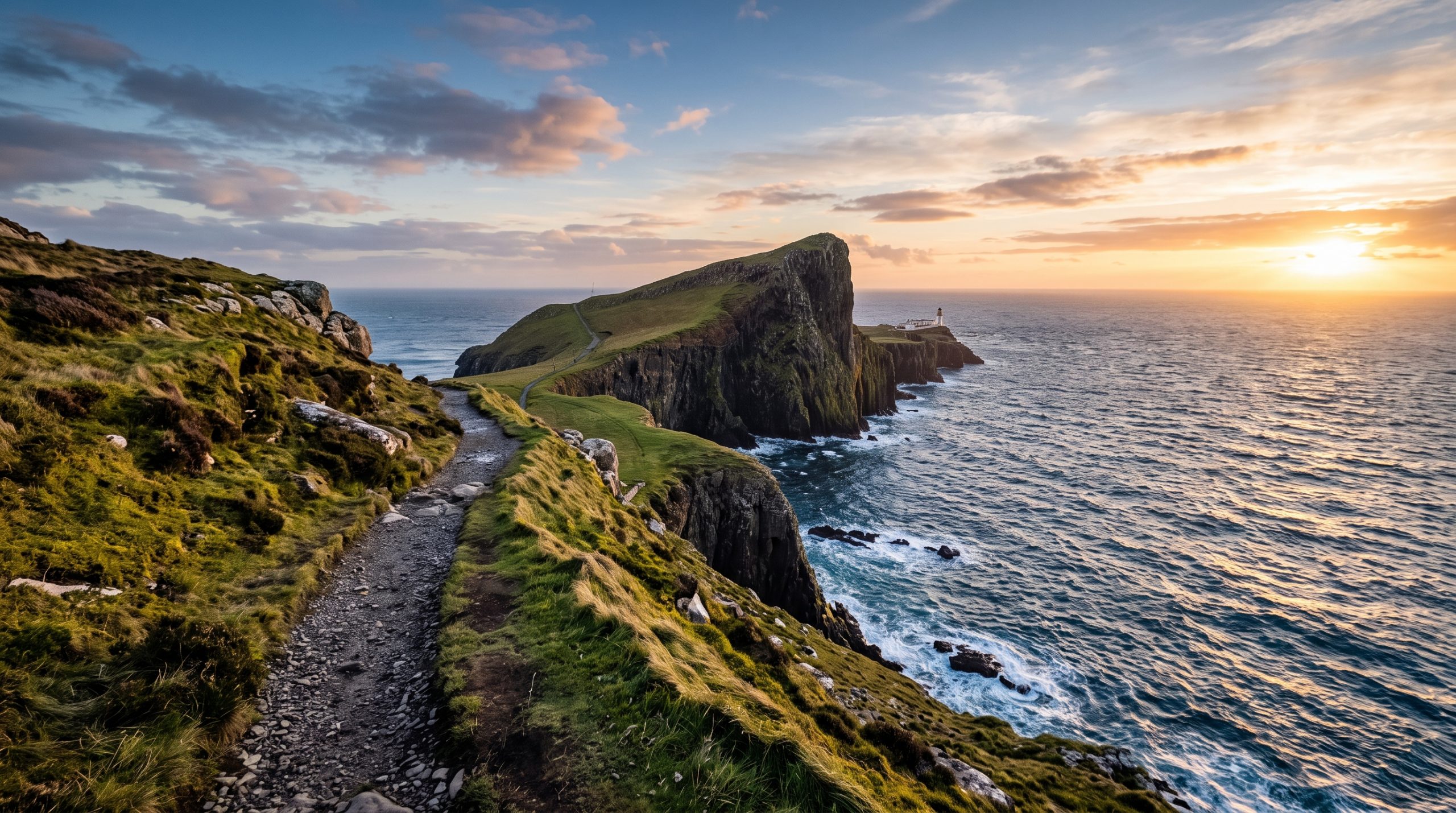
Supplies for the Neist Point lighthouse used to arrive by aerial cableway, slung down from the top of the cliff because there was no other sensible way to get a load of paraffin to the far end of Skye. The cableway has gone. The line it followed is still the way down, concrete underfoot, handrail on the steep pitch, and it is the reason a wedding dress at Neist Point is a logistics question before it is a styling one.
The light has been running since 1 November 1909. Nineteen metres of white masonry designed by David Alan Stevenson, one white flash every five seconds, a range of sixteen nautical miles out into the Minch, and nobody has lived in the keepers’ cottages beside it since the station was automated in 1990. This is the westernmost point of Skye. The horizon in front of it is open water all the way to the Outer Hebrides, and there is nothing at all between you and the weather.
Couples write to ask whether they can actually be married out there. They can, and the paperwork is simpler than most people expect. The harder questions are which month puts the sun where they want it, and what happens when several dozen other people have the same idea about sunset.
Yes, and the notice goes to Portree
You can legally marry on Neist Point. Scotland has no approved-venue list, so the spot itself is agreed between you and your celebrant. Both of you submit an M10 marriage notice to the Portree registration office at least 29 clear days ahead, currently £45 each, plus £10 to enter the marriage in the register.
Three sets of people can perform a legally binding marriage in Scotland: a registrar, a religious minister, or a belief celebrant such as a humanist. A civil marriage takes place either in a registration office or at any place agreed between the registration authority and the couple, which is why the Highland Council office on Park Road in Portree matters to you even though it is a long way east of the point. A religious or belief celebrant can marry you outdoors without that agreement, which is the route most couples take out here.
Your notice form is valid for three months and must be lodged no later than 29 clear days before the date. Most registration districts would rather see it around ten weeks out, and for a couple posting documents from the United States that is the sane target rather than the legal minimum. The registrar issues a marriage schedule; it is signed at the ceremony by you, your celebrant and your two witnesses, who need to be sixteen or over, and it goes back to the office afterwards. If you are new to any of this, our guide to how an elopement is actually put together covers the sequence in more detail.
One thing worth knowing before you picture the ceremony: the tower is an operational aid to navigation run by the Northern Lighthouse Board and monitored remotely from Edinburgh, and the former keepers’ cottages next to it passed into private hands after automation. So the ceremony happens on the open ground of the headland, outside the compound wall, not in the lighthouse yard. That is not a restriction anyone notices on the day. The ground outside the wall is the better ground anyway.
The Waterstein road, and a car park with nothing on it
You come in on the B884 through Glendale, then turn onto the single-track road signposted Waterstein and bear left at the first junction. The road passes a viewpoint over Loch Mor, bends south, crosses a cattle grid and simply stops at a small free car park at the end of the tarmac. There is no other approach. Every vehicle heading for the point is on that one strand of single track, using the same passing places, in both directions.
Route planners consistently underestimate this drive, because they do not model reversing eighty metres to a passing place for a camper van. We build the transfer with a buffer rather than a best case, and we tend to suggest couples base themselves around Dunvegan or Glendale rather than Portree, so the single-track section sits at the end of a short drive instead of a long one.
The car park is free and unstaffed, and there are no toilets, no cafe and no shelter of any kind at it. That single fact shapes more of the day than the cliffs do. You arrive dressed, or you change in the car, and boots come off at the bottom rather than the top. Bring water. The number of people you bring changes the parking, the timeline and the walking pace, not what the day costs.
Twenty minutes down, and rather longer back up in a dress
The full return walk from the car park to the lighthouse and back is around 1.75 miles, or 3 km, and walkers logging it typically finish the loop in about an hour including a look around. Roughly twenty minutes each way if you are moving. The first section is the steep one: a concrete path with steps and a handrail dropping off the shoulder, after which the ground flattens into grass along the spine of the headland and out to the tower.
In wedding clothes, the descent is the easy half. Gravity is on your side, the handrail is genuinely useful, and a long hem gets carried rather than worn. The climb back is the work, and it comes at the end of the evening when you are cold, happy and no longer in a hurry. Nobody has ever regretted having walking boots in the car for the return.
Two practical things we build in every time. The grass on the spine holds water for days after rain, so hems get dirty and there is no point pretending otherwise; we plan the order of the day so the dress meets the wet grass after the pictures that need it clean, not before. And because there is nowhere at the car park to change, we set the shoe swap at the bottom of the steps where there is flat ground to stand on, rather than halfway down a concrete slope in the wind.
Where the sun actually goes down here, month by month
This is the part almost every page about Neist Point gets wrong, and it is the part that decides your ceremony hour. From the shoulder above the car park you are looking roughly west-southwest at the lighthouse. The sun does not set in one fixed place all year; at this latitude it swings across a huge arc, and where it lands relative to the tower changes the photograph completely.
| When | Where the sun sets, seen from the clifftop | What that gives you |
|---|---|---|
| Late May to mid July | Far to the north of the tower, well out over open water | The lighthouse is side-lit rather than backlit, and the sky stays pale for hours afterwards. Sunset itself is past ten at night. |
| Late July to early September | Swinging back toward due west, still to the right of the tower | Warm light straight onto the west faces of the cliffs, with the sea lit rather than the couple silhouetted |
| Late September to mid October | Close to due west, just off the tower’s shoulder | Sun and lighthouse together in one wide frame without either one burning out |
| Late October into November, and again in February | Down the line of the headland, behind the lighthouse | The alignment everybody thinks Neist Point does all summer. These are the weeks it genuinely happens. |
| December and January | South of the tower, and low from mid-morning onward | Raking light for most of the short day, with everything finished by late afternoon |
Two more things follow from the geography. Morning light arrives from behind you, over the land, which means the west-facing cliffs stay in flat shade until the middle of the day; a sunrise ceremony here is about empty ground and soft grey sea, not about golden light on rock. And because the horizon is water rather than mountain, the sun runs all the way down to the sea line. Inland Skye loses the sun behind a ridge forty minutes before the official time. Neist Point does not, so the last hour is longer here than almost anywhere else on the island.
The flip side is the walk out. The path back up faces away from the afterglow, so it goes properly dark on that slope while the sky over the Minch is still bright. We carry headtorches for everyone, always, and we build fifteen minutes of slack into the return so nobody is rushing a concrete step in good shoes.
The clifftop at the famous hour
Neist Point is the end of one of the busiest walks on Skye, and the busiest hour of that walk is the hour you want. Arriving early does not fix this, because everyone else is also arriving early for the same sunset. By the time the light is good, the shoulder above the car park has people on it and the verges along the Waterstein road have cars on them.
What does work is knowing which ground empties. Most visitors stop at the clifftop viewpoint for the postcard and never commit to the descent, and of those who do go down, plenty turn round at the lighthouse rather than continue past it. The far ground beyond the compound thins out noticeably, and it is the ground the ceremony wants anyway. Dawn is the other answer, and it is a real one: the same headland with nobody on it, quieter sea, and a car park you can turn round in.
If total solitude at sunset is the thing you care about most, Neist Point in July is not where you will find it, and we would rather say that now than on the day. There is a version of this with a mid-week October ceremony, or a dawn start, or a different headland entirely, and Dunvegan and the coral beaches sit close enough to work into the same day. Tell us which of those matters more to you and we will build the day around it, or say honestly which month fits it better. Our destination guides cover the wider west coast if you are still narrowing things down.
Wind off the Minch, and two of us on a narrow ridge
The spine of the headland is not wide. Below the steep section it opens into grass, but at the neck there is essentially one line of ground to stand on, and a photographer and a filmmaker have to solve that before the ceremony starts rather than during it. In practice one drops below the ridge line and shoots upward against the sky while the other holds the high ground, or takes the far side of the tower where the land falls away. Because we work as one team rather than two suppliers meeting on the morning, that gets agreed in the planning, not negotiated in whispers behind your celebrant.
Wind is the other half of it. A westerly comes in off the Minch with nothing on the headland to slow it down, and it will eat spoken vows for breakfast. So vows get placed on the leeward side of the ridge, angled out of the direct blast, and on the Expedition the audio is recorded properly rather than left to a camera microphone standing twenty feet away in a gale. Aerials run on permission and a weather window, and we confirm both before any part of the film is planned around them.
What this place gives a photograph is scale. A nineteen-metre tower reads as a detail here because the cliff behind it is so much bigger, and two people on that spine become very small very quickly. That is either exactly what you want or the opposite of it, and it is worth looking at our published galleries and films from headlands like this one before you decide. Highlights come back to you within 5 days, and the full gallery or film within 3 weeks.
Common questions
Is there anywhere at Neist Point to change into a wedding dress?
No. There are no toilets, no cafe and no buildings open to visitors at the car park or on the headland. Couples get dressed at their accommodation and travel out ready, or change in the car. We build the timeline around that, including where the shoe swap happens.
How close can we park to the lighthouse?
The public road ends at the small free car park above the point, and from there it is on foot. Around twenty minutes down, a little longer coming back up, on a concrete path with steps and a handrail on the steep section.
Do we need permission from the lighthouse owners to have a ceremony?
Not for the open ground. The tower is an operational Northern Lighthouse Board station and the former keepers’ cottages are privately owned, so the ceremony sits outside the compound wall on the headland itself. Scotland has no approved-premises scheme, so there is no venue to licence.
Will other people be standing behind us during the vows in summer?
At sunset in high season, some will be on the clifftop above. Down on the far ground past the lighthouse it thins out a lot, and at dawn the headland is usually yours. We place the ceremony accordingly rather than hoping.
How dark does the path get on the walk back up?
Darker than the sky suggests, because the slope faces away from the afterglow while the Minch is still glowing. It is a made path with a handrail on the steep pitch, we carry headtorches for everyone, and we allow extra time for the climb rather than hurrying it.
Can our parents watch if they would rather not do the descent?
Yes. The clifftop shoulder above the car park looks straight down onto the headland and the lighthouse, so anyone staying up top still sees the ceremony from above. It is a two-minute walk from the car.
Holding a west-facing evening
A day here has a simple shape. Dress in Glendale or Dunvegan, drive the single track with time in hand, walk down while the sun is still high enough to be useful, marry on the spine of the headland in the last hour, then climb back up in the dark with the light still flashing every five seconds behind you. Everything else is detail, and the detail is ours: the timeline, the permit research, the weather alternative fifteen minutes inland for the evening the westerly wins.
We are eight people, photographers and filmmakers in one team, currently taking bookings for 2027, 2028 and 2029. A full day at Neist Point with one dedicated photographer or one dedicated filmmaker starts at $4,900, and the day with a dedicated photographer and filmmaker working together starts at $7,900, with the longer multi-destination option set out on the pricing page. Team travel is included wherever the day happens.
we keep all of it in one written thread, which suits a five-hour time difference: send us the date and a sentence about the kind of morning or evening you want, and a reply with our brochure comes back within 24 hours. Check Your Date.