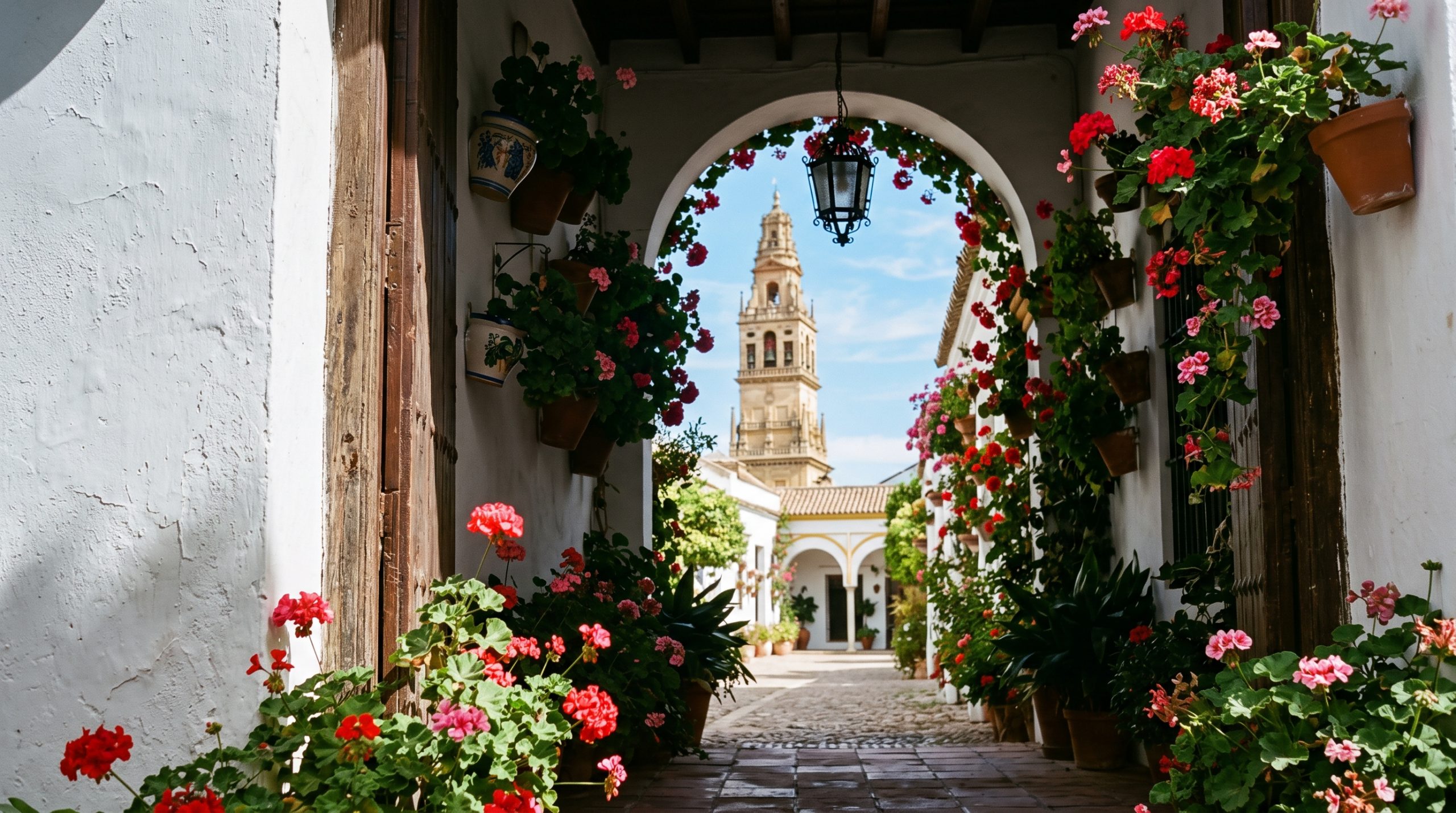
The patio gates in San Basilio shut at two in the afternoon, sixteen minutes before the sun reaches its highest point over Córdoba. Spain keeps central European time while sitting a long way west of it, so solar noon here in the middle of May falls at 2:16pm. The courtyards close on the hardest light of the day and open again at six, by which time there is no direct sun left in them at all.
That collision shapes a Córdoba day more than any choice of location does. Handled well, it gives you an empty Roman bridge before eight, a long lunch indoors while the city bakes, and three hours in a courtyard of geraniums lit entirely by whitewash. Handled badly, it puts you in line during the only hours that matter.
Here is what we have learned putting days together in this city: the Mezquita, the two weeks in May when the patios are open, and everything the timetable does to both.
The honest answer on marrying at the Mezquita
The Mezquita-Catedral is a working Catholic cathedral, not a venue for hire, and Spain routes legal marriage through the Registro Civil on residence paperwork. Almost every couple who writes to us signs at home and holds the ceremony itself outdoors in Córdoba, within sight of the bell tower. That combination is straightforward, and it is what we plan around.
Two weeks in May when the courtyards are unlocked
The Fiesta de los Patios has run as a competition since 1921. UNESCO added it to the Representative List of the Intangible Cultural Heritage of Humanity in December 2012, and Spain had already named it a Fiesta de Interés Turístico Nacional back in 1980. For 2028 the city has set the dates at 4 to 17 May. The dates move a little each year and the council publishes them in advance, but they always sit in the first half of the month.
Entry to the competing patios is free. The owners open their own homes, sweep the tiles, water several hundred pots twice a day and let strangers walk in. The daily hours right across the two weeks in 2028 are 11am to 2pm and 6pm to 10pm, and those are the only times the gates are open. Outside them you are looking at a closed door in a quiet street.
The competition splits into four categories: old architecture, modern architecture, singular patios and convent patios. That matters more than it sounds. An old architecture patio in San Basilio is a tight lime-washed well with a stone basin and pots climbing the walls to the eaves. A convent patio is a different animal entirely, larger, older, calmer, with cloister arcades instead of balconies. Alcázar Viejo and San Basilio hold the densest concentration of entries and the longest lines with them.
Those lines are the honest part. Arriving early does not solve a patio in the way it solves a mountain viewpoint, because nothing opens before eleven and everyone arrives at eleven. What works is choosing entries away from the two headline streets, going in at the start of the evening opening rather than the middle, and accepting that the famous prizewinner with forty people at the door is a place to visit as a couple rather than a place to hold a ceremony.
A patio is a light well, not a garden
This is the part almost every planning page gets wrong. A Córdoba patio is a shaft of open sky in the middle of a house, and it behaves like one. Direct sun only reaches the floor when the sun clears the rooflines, which in May means roughly noon until four in the afternoon. The morning opening ends in the middle of that stretch. The evening opening never touches it: at six o’clock a two-story wall throws a shadow more than ten meters long, which is wider than most of these courtyards are across.
So from six until dark you are working in pure reflected light, bounced off lime-washed plaster, and it is some of the kindest light in Andalusia. No hard edges, no squinting, color coming up off the tiles and the geraniums. The sun does not set until around 9:20pm in mid-May, which gives the evening opening more than three usable hours and a final stretch after 8pm when the sky itself goes warm and the whole courtyard warms with it. If you want to see how that reads in finished work, our galleries and films are the fastest way to understand what reflected light does to a small enclosed space.
Room to stand is the real constraint. Some of these courtyards are barely six meters across, with a well head in the middle and pots on every vertical surface, and a photographer and a filmmaker who have not worked together will simply be in each other’s frames all evening. Ours have. They agree the geometry at the door, one takes the arcade side and one takes the stair, and they swap. Sound is the other thing: hard plaster and glazed tile bounce a voice around a patio like a bathroom, and there is usually water running somewhere. Vows get recorded close, on a body mic, never from across the courtyard.
First light on the bridge, and the wall that stays cold until ten
The sun comes up at about 7:15am in mid-May, out of the east-northeast, straight up the line of the Guadalquivir. The Roman Bridge is closed to traffic, so at that hour it is joggers and one or two people with cameras, and by half past seven the low light is crossing the deck sideways and throwing the parapet shadows all the way over it. The Albolafia waterwheel sits just below the north bank. The Torre de la Calahorra anchors the south end, and the walk from that end back toward the Puerta del Puente is the single most photographed line in the city, which is exactly why it belongs at 7:30am and not at 7:30pm.
Now the part worth knowing. The Mezquita’s long river frontage faces south. The sun does not swing round onto it until roughly half past nine in the morning, and it slides off again a little before seven in the evening, two and a half hours before sunset. The golden-hour picture that couples arrive imagining, warm light raking across that famous wall from the bridge, does not happen in May. What does happen is better and nobody plans for it: at dawn the frontage is a cool gray silhouette against a lit sky, and at the end of the day the last warm light lands on the west faces instead, on the bell tower and on the Alcázar walls, while the river side falls quiet and blue.
The Alcázar de los Reyes Cristianos sits about 360 meters from the bridge and opens at 8:15am from Tuesday to Friday through the winter and spring season. That is an hour after sunrise in May. Long shadows, clipped hedges, water channels the length of the garden and almost nobody in them.
What the Cabildo allows inside
The monument is run by the Cabildo Catedral, and the rules are published and enforced. No tripods or stands anywhere inside. No photographing or filming a liturgy in progress. Hats off at the door, no large bags or backpacks, and the marked route only. The general daytime ticket now stands at 15 euros, with reduced rates for over-65s, students and children, and free entry for anyone born or resident in the diocese of Córdoba. There is also a free access period on Monday to Saturday mornings for individual visitors, which starts at 8:30 and is cleared by 9:30, in strict silence.
The bell tower is ticketed separately and climbed in timed groups, with a stop at the first bell chamber 35 meters up and the top chamber at 45 meters, and a cap of a few hundred people a day. With more than two million visitors a year passing through the hypostyle hall, the interior is a place we take you to see, handheld and quietly, rather than a place we plan a ceremony around.
Cobbles, ramps and the last stretch in a dress
The old town around the monument is closed to cars. The nearest a vehicle gets to the west door is the taxi rank on Calle Torrijos, right alongside the monument wall, and from there everything is on foot. Bus lines 3 and 6 run to the Alcázar end.
What that means in wedding clothes is specific. The Roman Bridge is the easy part: the deck is flat, wide and evenly paved, and heels are genuinely fine on it, which is not something we say about many of the places we work. The Judería is the opposite. Those lanes are narrow, rounded underfoot and pitched for drainage, and a long train picks up every bit of grit on them. We route the walking so the difficult surfaces happen in flats, and the arrival happens in whatever you actually want to be photographed in.
Patio doorways are their own puzzle. Many open off a zaguán, a covered entry passage with a step at each end and a wrought iron gate halfway, and a wide skirt goes through it sideways with someone lifting. Inside, the floor is glazed tile and often wet, because the pots get watered twice a day in the heat. Flat soles, and someone whose job it is to carry the hem. That is the level of detail our destination guides get into, and it is the difference between a plan on paper and a plan that survives contact with a real street.
The rest of the year, and why October is quiet
From 15 June to 15 September the Alcázar closes at 2:15pm, which tells you everything about a Córdoba summer afternoon. In those months a day here is genuinely two days: everything before ten in the morning, a long gap, then everything after eight in the evening. It works, and it works well, but it is a shape you should choose on purpose rather than discover on arrival.
Mid-October is the quiet answer. The sun rises around 8:30am and sets around 7:45pm, so both ends of the light fall at civilized hours and the whole day compresses into something you can actually walk. The patios are not open as a festival then, so we build instead around Medina Azahara, the tenth century palace city 8 kilometers out of town, where entry is 1.50 euros for visitors from outside the EU and a shuttle bus every twenty minutes covers the last 2 kilometers from the reception center, since that is the only authorized way in. Terraces, horseshoe arches and long views back over the valley, with a fraction of the footfall.
If those two weeks in May are the only dates you can travel and you want the patios, tell us early and we will build the day around the two openings. If your dates are movable, tell us that instead and we will tell you honestly which month gives you more of Córdoba for the same trip.
Common questions
Can we get legally married inside the Mezquita-Catedral?
Not as visiting foreign nationals arranging it around a trip. It is a working Catholic cathedral rather than a venue that takes bookings, and legal marriage in Spain runs through the Registro Civil on residence documents. Couples flying in from the US sign at home and hold the ceremony they actually remember outdoors in Córdoba. Our guide to how elopements work covers the paperwork order in plain terms.
Do the patios cost anything to go into during the festival?
No. Every patio entered in the competition opens free of charge during the published hours, which in 2028 are 11am to 2pm and 6pm to 10pm. The cost is time rather than money, because the prizewinning courtyards in San Basilio can have a line at the door for most of the evening opening.
Can we take a tripod into the Mezquita?
No. Tripods and stands are prohibited throughout the monument, and photographing or filming a liturgy in progress is not permitted either. Everything inside is shot handheld and available light, which suits the building anyway. Large bags and backpacks are also turned away at the entrance, so plan what you carry.
What time does the light actually work in Córdoba in May?
Sunrise is around 7:15am and sunset around 9:20pm, with solar noon at 2:16pm. The usable blocks are 7:15 to about 9:30 in the morning, and 6pm until dark. The middle of the day is overhead and unforgiving, which is why the patio evening opening at 6pm is the hour we build most Córdoba days toward.
How close can a car get to the Mezquita with a dress in it?
The taxi rank on Calle Torrijos runs along the monument wall, and that is the closest vehicle access on that side. From there it is a flat walk of a minute or two to the monument’s west gate and the courtyard of orange trees. Everything deeper into the Judería is pedestrian and uneven, so we plan the arrival point rather than leaving it to the driver.
Is Medina Azahara realistic for a ceremony?
Yes, with the transport built in. The site is 8 kilometers from the city, the archaeological area is 2 kilometers beyond the reception center, and the shuttle running every twenty minutes is the only authorized way to cover that stretch. Entry is 1.50 euros for non-EU visitors. It needs a proper permission conversation with the site first, which is part of what we handle.
How we build a Córdoba day around the gates
A typical shape: on the bridge by 7:15am with the city still asleep, into the Alcázar gardens when they open at 8:15, breakfast, the Mezquita interior mid-morning, then out of the sun entirely for the middle of the day. Ceremony in the late afternoon somewhere shaded and private, and into the patios the moment they open at six, finishing in the lanes after 9pm when the walls hold the last of the heat and the streets belong to residents again.
One full day with a dedicated photographer starts at $4,900, and a full day with a dedicated photographer and filmmaker working side by side starts at $7,900, with team travel to Córdoba included and everything else set out on our coverage and pricing page. Highlights reach you within five days, and the full gallery or film within three weeks. Our current Andalusia availability runs across 2027–2029, and We keep every planning decision in writing, so you can read it, think about it and answer when it suits you.
Send us your dates and what you want the day to feel like, and we will come back inside 24 hours with the honest version of what May in Córdoba can give you. Tell Us Your Story.