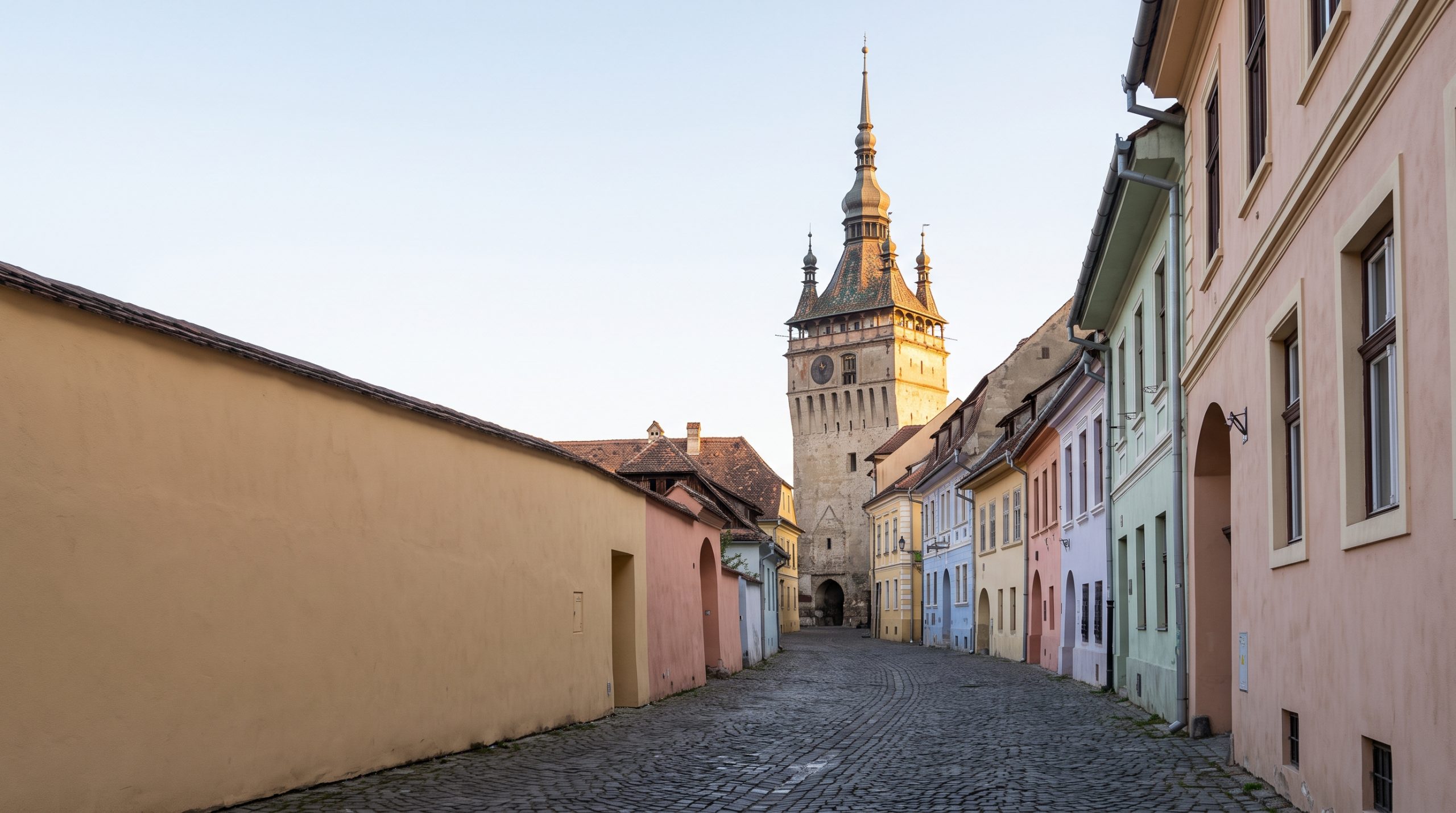
At six in the morning in December, a small painted figure steps out on the face of Sighisoara’s Clock Tower to mark the day shift. The sun will not clear the hills for another two hours. The lanes below are still blue, the cobbles hold last night’s rain, and the loudest thing in the citadel is somebody’s front door closing behind them.
That is the part most pages about this place leave out. The Historic Centre of Sighisoara went onto the UNESCO World Heritage list in 1999 as an inhabited medieval citadel: a small fortified Saxon town, begun in the 12th century, that never emptied out into an exhibit. School bags, cats, wheelie bins, delivery vans. You do not book this place. You get married inside it, quietly, at an hour you picked for a reason.
Which makes it one of the more precise days we plan. Two legal clocks, one steep hill, cobble between you and every location, and, in summer, two short windows when the sun actually reaches the ground.
Married inside the walls: what the law asks
Yes, you can marry here, all year. Romanian civil marriage is a registrar’s act: you file a declaration at the civil status office and wait ten days, with a medical certificate and a certificate of legal capacity from your embassy. Many couples we work with sign at home instead and hold the ceremony that matters in the citadel.
Ten days for the registrar, fourteen for the doctor
Romania runs marriages through the civil status office, and the timings are the part that surprises American couples. Filing the declaration starts a ten-day wait before the registrar can conclude the marriage. The medical certificate you both need is valid for fourteen days, so it has to be issued in a narrow window before you file, not organised months ahead. If neither of you speaks Romanian, the law puts an authorized interpreter in the room. And a religious or celebrant-led ceremony carries no legal weight here on its own, which cuts both ways.
Both ways, because it also means the ceremony you hold in the citadel is entirely yours to design. Nothing about it has to satisfy a registrar. Most couples we take to Sighisoara complete the legal marriage at home in a courthouse morning, then stand in these lanes with vows they wrote and one person they chose to hear them. If you want the Romanian civil marriage too, it happens indoors, on office hours, at a counter, and we shape the rest of the day around the slot you are given. The municipality sits inside the walls at Piața Muzeului 7, with public counters Monday to Thursday from 08:00 to 16:30 and Friday until 14:00, and those are the same hours that answer any question about using a square. Our guide to how an elopement day gets built covers the sequencing.
Light at 46 degrees north, and where it actually lands
Sighisoara sits at 46.2 degrees north on a mound with steep slopes, above the Târnava valley, with the Lower Town at its foot. That geometry decides your timeline more than anything else on this page.
Late June: the sun arrives around 05:29, well round to the northeast, and leaves around 21:15 in the northwest. By 08:15 it is more than 25 degrees up, and it stays that high until 18:30. In a walled town of narrow lanes and tall Saxon houses, a high sun means the lane floors sit in hard shade while the roofs and the top of the 64-meter Clock Tower catch everything. Nothing is wrong with that light. It simply is not the light people have in their heads when they picture this town, and the frames in their heads were made in the first hour and the last two.
Mid-September is the kinder version of the same place. Sunrise near 07:00 at almost due east, sunset near 19:30 almost due west, which turns any lane running east to west into a corridor with the sun sitting at the end of it. You get that twice in one day, and you do not have to be awake at five for the first of them.
December is the one nobody books and probably should. The sun does not rise until about 08:00, never climbs past roughly 20 degrees, and is gone by 16:37. There is no harsh hour in the whole eight and a half hours of daylight, only low raking light on plaster and snow-dust on the tiles, in a citadel at its emptiest. The trade is cold, and short days, which is a fair trade if the sound of it appeals.
Rain improves this place, which is not true of most destinations we work in. Wet cobble doubles every lit window in the lane, the roof tiles go deep, and the ochre and green of the houses lift. We would take a wet October morning here over a bright noon in June. How the lanes hold that kind of weather is easier to see than to describe, so it is worth looking through our galleries and films before you decide what month you want.
A citadel that wakes up around you
Sighisoara is a day-trip town. Cars and coaches come up the hill through the middle of the day, the citadel gets walked in an hour or two, and by evening it hands itself back to the people who live here. That pattern is worth planning to rather than resenting.
The unflattering truth about the main square: at three in the afternoon in July it is a busy, flat-lit rectangle with parked cars, café umbrellas and a queue of people photographing the same tower. We do not put vows there at that hour. Arriving early genuinely does work in Sighisoara, more than it does at the famous trailhead viewpoints, because there is no sunrise crowd here at all. At 05:45 in June, or 07:30 in December, the citadel is effectively yours, and the only people you meet are residents walking dogs who have seen stranger things than a wedding dress on the cobbles.
What early cannot fix is the middle of the day, so we stop trying. The ceremony and everything that depends on emptiness goes to the ends of the day. The busy hours get the things that want life around them: breakfast at a table inside the walls, the walk down into the Lower Town, an hour out among the Saxon villages in the hills. Our destination guides show how those middle hours get used elsewhere too.
Cobbles, a hill and the shoes you chose
The citadel stands on a mound with steep slopes, which is exactly why it was built up here and exactly what your ankles will notice. The surface is old cobble: uneven, rounded, shiny after rain and unforgiving to a narrow heel. A long hem collects grit on the way up, and a dark tide line if the stones are wet.
So bring shoes you can spend a morning of cobble in, carry the good ones, and stay inside the walls overnight if you can, so the distance from your door to your ceremony is measured in minutes and not in a drive. We route the day to cross the fewest slopes in the clothes that mind them most.
Five places inside the walls, and the hour each one wants
The citadel is small enough to walk end to end, which is its quiet advantage: four or five genuinely different backdrops in one morning, and never once getting into a car. What changes between them is the hour.
| Where | The hour we would use | What it asks of you |
|---|---|---|
| Piața Cetății, the citadel square | The first hour after sunrise, or the last before it goes | Sharing a lived-in square with the people who live on it |
| Piața Muzeului, under the Clock Tower | Before 07:00 in summer, almost any hour in December | Standing back far enough to hold all 64 meters of tower |
| The covered wooden staircase | Any hour, it makes its own light | Steps, in whatever you are wearing |
| The walls and towers above the Lower Town | The last 40 minutes before sunset | A steady pace on uneven stone |
| The lane corner at Casa cu Cerb | Mid-morning, in the shade the houses throw | Working around a café’s breakfast trade |
Casa cu Cerb is worth knowing by name. Its core dates from the 13th century with work added in the 14th, 16th, 17th and 18th; the name comes from the stag’s head on the corner of the building; it was restored in 2001 by the Messerschmitt Foundation of Munich and now holds a guesthouse, a café-restaurant and a Romanian-German cultural centre. One address where you can sleep, eat, dress and step straight into the frame.
Two cameras in a lane this narrow
Lane width is the whole argument for how we staff this town. Where two people can pass and not much more, a photographer and a filmmaker who met that morning spend the day stepping out of each other’s shots, and one of them ends up over the other’s shoulder for an hour. Ours have worked together for years, so they divide the geometry instead: one takes the lane, one takes the stair or the doorway opposite, and they trade places without a word about it. On the Expedition the filmmaker also carries dedicated audio for the vows, which matters in a walled town, where wind moves over the roofs and footfall carries two streets. We set the vows a few minutes clear of the hour so the tower’s timekeeping stays behind your voices rather than on top of them.
Aerials over a World Heritage centre run on permission and a time window, so we confirm both during planning and only build the film around a drone once they exist. Whichever shape suits you, one photographer working the day or a photographer and filmmaker working it together, team travel to Romania is inside the fee, and the coverage options are set out on the pricing page. Highlights reach you five days after the day itself, and the full gallery or film inside three weeks.
Common questions
Can we hold our ceremony in the citadel square without renting a venue?
The squares and lanes are public space in a town where people live, and a ceremony of two people and a witness or two reads as visitors standing still. Anything with a footprint changes the question: chairs, an arch, amplified sound, a vehicle inside the walls. Those go to the municipality at Piața Muzeului 7, and that research and the guidance around it is part of what we do for you.
Do we have to be legally married in Romania to elope in Sighisoara?
No. A religious or celebrant-led ceremony has no legal effect in Romania on its own, so what you hold in the citadel is separate from the paperwork, and plenty of couples arrive having signed at home. If you do want the Romanian civil marriage as well, plan the trip around the ten-day wait and the fourteen-day validity of the medical certificate.
How early do we have to be up to have the citadel to ourselves?
In late June, sunrise lands around 05:29, so we would have you in position by 05:10 and out of the empty lanes before seven. In mid-September the same quiet belongs to about 06:45. In December you can sleep: the sun does not appear until roughly 08:00, and the town stays quiet well past it.
Will the Clock Tower be sounding over our vows?
The tower keeps time for the whole citadel, and its two painted figures change over at 06:00 and again at 18:00. We treat that as a marker to plan to, setting vows a few minutes either side of the hour, and on the Expedition recording them on dedicated audio so the tower sits behind your voices in the film rather than across them.
Is it worth climbing the Clock Tower on the elopement day itself?
It is 110 steps up six museum levels on narrow wooden stairs, and the view from the top is the best summary of the citadel you will get anywhere. It is also not a thing to do in a long dress with twenty minutes of light left. We usually put the climb on the day before, in normal clothes, and keep the day itself at street level.
The last hour on the wall above the Lower Town
A day here tends to end where it can see the whole town: up on the wall, Lower Town roofs going orange underneath, the sun leaving in the northwest, the two of you finally still after a morning of stairs. Between the 05:30 start and that, there is breakfast, a change of clothes, a ceremony in an empty square, and a long unhurried wander through a town going about its Tuesday.
Sighisoara suits couples who want a town rather than a wilderness, and who will trade one early alarm for lanes with nobody in them. If a 05:10 start in June is not your idea of a good morning, tell us, and we will move you to September, where the same emptiness arrives at a civilised hour, or to December, where there is no harsh light to dodge at all. We currently have Romania elopement dates available through 2027–2029, everything is handled in writing at whatever hour suits your time zone, and you will have a reply and our first brochure within 24 hours of writing to us. Then a tailored proposal, a contract, a 30% retainer, and the planning begins. Start Your Story.