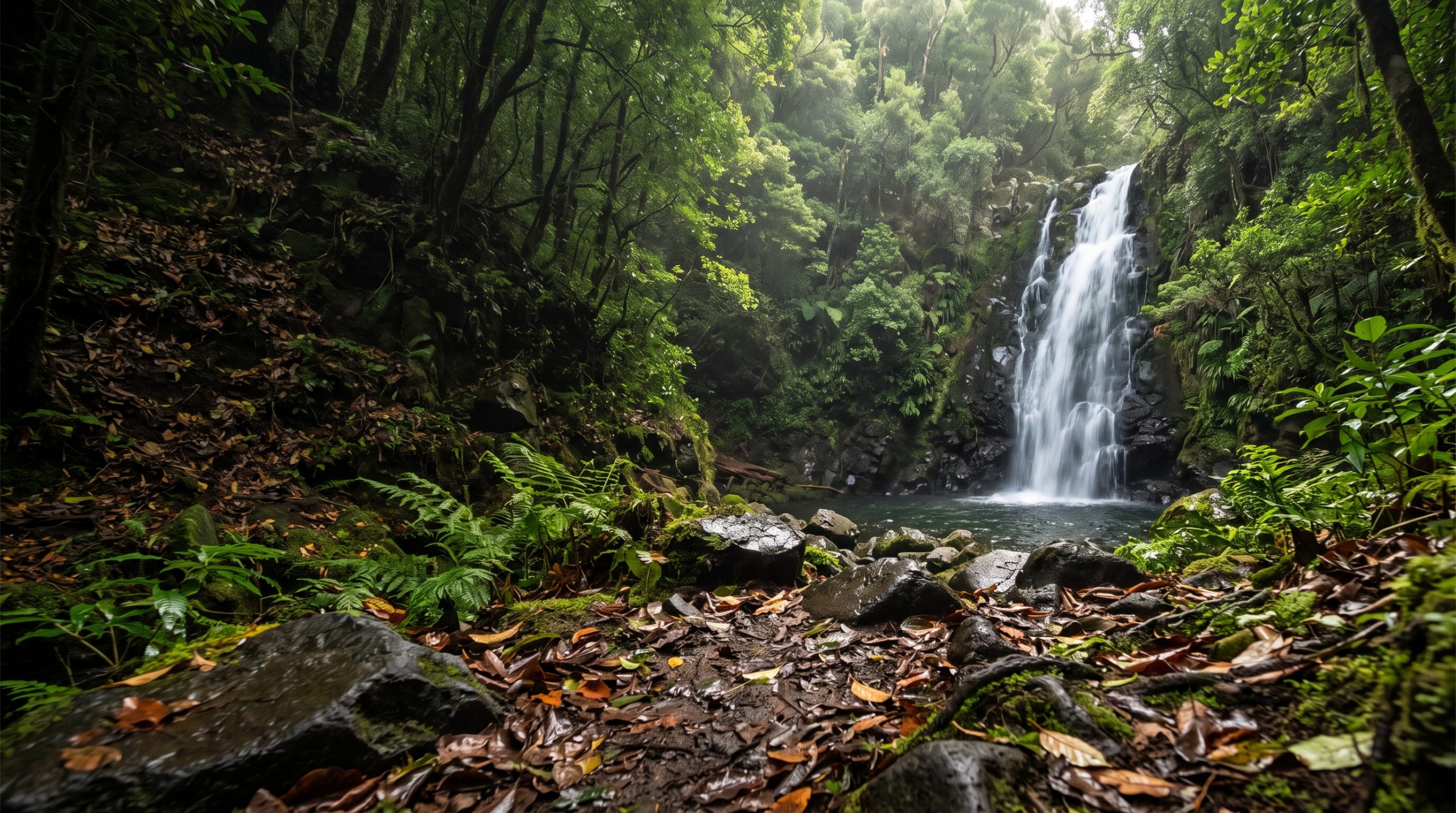
The public road into Faial da Terra ends at a bus stop. Everything past it happens on foot: a lane between houses, then a dirt road along the left bank of the stream, then stretches of old paving stone that go glassy when they are damp. None of it is hard walking. It is simply that no car reaches the ceremony, and that single fact reorganizes the whole day.
The orchards on both banks belong to small family farms, and the official route notes ask walkers not to pick the fruit as they pass. That line tells you what kind of valley this is. Not a park with a gate, but a worked slope at the southeast end of São Miguel, in the municipality of Povoação, with a marked trail threading through the middle of people’s land.
Salto do Prego itself sits in a bowl of wet rock and canopy where direct sun barely lands. That is the point of the place rather than a problem with it, but it does mean the hour most couples reserve for a ceremony is the wrong hour here. We build the day the other way round.
What it takes to hold a ceremony at the falls
Salto do Prego sits on PRC09 SMI, an official marked trail in Faial da Terra that is open year round and free to walk, so a small private ceremony at the waterfall needs no ticket and no reservation. The walk in from the village takes under an hour. Legal registration runs on its own track, through the Portuguese civil registry.
Why the light here runs backwards
Most locations have a best hour. This one has a best hour for the open ground above the valley and a flat, barely changing light everywhere else, and knowing which is which is most of the planning.
The path climbs between rock walls furred with moss and fern, with Australian cheesewood and acacia closing overhead. Those two species dominate the trail, and they hold their canopy year round, so the walk is roofed for long stretches. At the falls the sky narrows to a slot. Light arrives as one soft source from directly above, spray puts a fine haze in the air, and eight in the morning looks far more like one in the afternoon than it would anywhere on the coast.
Bright sunshine is not an upgrade here. When it does reach the basin it blows the white water out against black wet basalt and drags hard leaf shadows across faces. Overcast is the better forecast, which is a strange thing to write about a ceremony location and completely true about this one.
So the plan inverts. The falls get the empty hour rather than the pretty hour, because the light there is generous all day and solitude is the thing in short supply. The last warm light goes to open ground higher up, where the trees give way. If you want to see what that actually produces, cool greens and a lot of texture in wet stone, our galleries and films are the honest version of it, shot in places like this rather than described.
The last kilometre, in a dress
The lane through Faial da Terra narrows as it goes inland, keeps the stream on your right, and finishes near the bus stop where the trail begins. There is no formal car park. What exists is a handful of considerate roadside spaces between people’s houses, which is another reason we would rather arrive at first light than at eleven with everyone else.
From there the route goes up asphalt to a fork, straight on to the dirt road, and stays on the left bank. The vegetation thickens. Wooden footbridges cross the water more than once, there is a bridge over the stream to reach the falls side, and above it a fork where you turn right for Salto do Prego. The full official loop is 4.5 km and takes about two hours at a moderate pace, with roughly 200 metres of climbing spread across it. The longer variant that adds Salto do Cagarrão runs nearer 8 km and around three hours.
In wedding clothes, the numbers matter less than the surfaces. A long train collects leaf litter inside the first hundred metres, and the paving-stone sections are where you want a free hand rather than a fistful of hem. So we walk in dressed for work and carry your clothes in a bag, one of us on the strap. Nothing is built at the falls: no shelter, no bench. The change happens on the trail, on a flat, screened piece of ground we pick out on the way up, and it takes a few minutes with a coat held as a wall.
Two more things nobody mentions. The last few metres in front of the water are wet permanently, from spray rather than weather, so anything that must stay dry stays back with the bags. And boots go back on for the walk out, which is why we leave generous time at the end rather than hurrying anyone out of the basin.
Sanguinho, and the hour after the trail empties
The loop comes back through Sanguinho, a village the families left in the 1950s and 1960s as life moved down toward the coast and the school. Most of its houses have since been restored as rural accommodation under an ecotourism project, and the place takes its name from Frangula azorica, the endemic shrub the islanders call sanguinho.
For a ceremony day, Sanguinho is the counterweight to the falls. It is open. Stone lanes and terraces, with room to stand back far enough that two people look small against the slope, and the warm end of the day actually lands on it. Couples who take one of the restored houses change the logistics completely, because getting ready and walking to the waterfall become the same footpath instead of two drives and a car park in between.
Who works the land you walk through
The trail is public and signed and asks nothing of you. The ground on either side is somebody’s smallholding, which is why the ceremony belongs in the basin and on the path, and why we bring nothing that needs anchoring into soil and leave the orchards entirely alone.
That also sets a practical ceiling. A footpath with single-file bridges and no vehicle access limits what can be carried in, and the limit is usually lower than couples expect. Our fee does not change with guest numbers, but numbers change access, permits, transport and the timeline: twelve people on a wooden bridge is a different morning from two.
The legal side is paperwork, not landscape. Portugal registers marriages through the civil registry, and that process runs separately from anything that happens in the valley. Permit research and logistics guidance are part of every experience we run, so we work out what your specific plan needs and tell you what to lodge and where. Government, venue and landowner permit fees themselves are paid by you. If you are at the stage of working out the order of all this, our guide to planning an elopement covers the fundamentals, and the destination guides go deeper on the islands.
Two cameras in a space the size of a small room
The basin is a pool, some fallen rock, and a few metres of usable standing ground facing the water. Two people cannot both own the front of it, so one takes the close ground while the other moves: back down the path for the long frame through the trees, or up the side route toward the higher part of the stream, which the official route notes as an option from the falls. Sound is the other constraint, because falling water swallows a vow spoken three metres away, so audio has to be planned and close. That is what the Expedition’s professional audio is for where conditions allow. Photography and film here are one team of eight rather than two strangers meeting at a trailhead, which is the only reason that choreography works in a space this tight.
When the stream is up and the plan moves
A wet morning is this valley at its best. More water in the drop, greens at full saturation, not a hard shadow anywhere. What rain changes is footing, not beauty, so the usual answer is to keep the location and change the order, walking in earlier and moving the clothes change closer to the falls.
When the stream is genuinely high, the alternatives are close by. PR11 SMI, the Ribeira do Faial da Terra route, connects to the path near the waterfall, and the coast at Faial da Terra is minutes back down the lane. Salto do Cagarrão, the steeper extension above the falls, is a fine-weather option and we treat it as one rather than promising it. Weather alternatives and backup planning are built before you fly, so the timeline you carry has a first plan and a second plan on the same page.
Common questions
Can we drive anywhere near Salto do Prego?
No. The road through Faial da Terra ends near the bus stop where the trail starts, and the waterfall is reachable only on foot. There is no formal car park at the trailhead, so the arrival, the roadside space and the walk in all get planned as one piece of the timeline.
Is there anywhere to change out of hiking boots?
Nothing is built at the falls, so the change happens on the trail. We choose a flat, screened spot on the way up, carry your clothes in a bag and hold a coat as a wall. Boots go back on before the walk out, because the paving stones deserve them.
How busy is the trail during a ceremony?
PRC09 SMI is one of the most walked routes on São Miguel, and by late morning the basin gets a steady flow of hikers. First light genuinely works here, because Faial da Terra sits in a far corner of the island and day trips arrive late rather than early. Loop direction matters too.
Does the waterfall photograph better after rain?
Usually. There is more water in the drop and the greens go deep, with no hard shadow through the canopy. The trade is grip, since the paving stones and wooden bridges hold water for a long time afterwards, so we start earlier and give the walk more room in the timeline.
Is a drone worth bringing to the falls?
Not inside the ravine. The canopy closes over the path and the basin is a slot in the trees. Aerials earn their place over the valley mouth and the terraces near Sanguinho, where they are legal and appropriate, while the film at the waterfall is made close in and on the ground.
Can our parents make the walk to the waterfall?
Often, yes. The full loop is 4.5 km with roughly 200 metres of climbing, but the out-and-back to the falls is shorter and gentler, and much of it is dirt road rather than steps. We build the timeline around the slowest walker and put the rests where the paving begins.
If this sounds like your kind of morning
Salto do Prego suits couples who like the idea of walking to their own ceremony and who would rather stand in a loud, dripping basin at seven in the morning than anywhere with a view of a car park. If what you actually want is the warm, wide, open version of São Miguel, tell us, and we will build the day around the terraces and the coast instead, or tell you honestly which month gives you both.
One full day with a dedicated photographer or filmmaker starts at $4,900 and the two working together starts at $7,900, with everything else set out on our coverage and pricing page. If you want the valley plus more of the island across several days, the Odyssey is written as a custom proposal. Highlights reach you five days after the day itself and the full gallery or film three weeks later. Our Azores calendar is currently open across 2027, 2028 and 2029, and everything between us happens in writing, at whatever hour suits you: send the form and you will have a reply and our initial brochure inside 24 hours, then a tailored proposal, then a contract and a 30% retainer, and planning begins. Start Your Story.