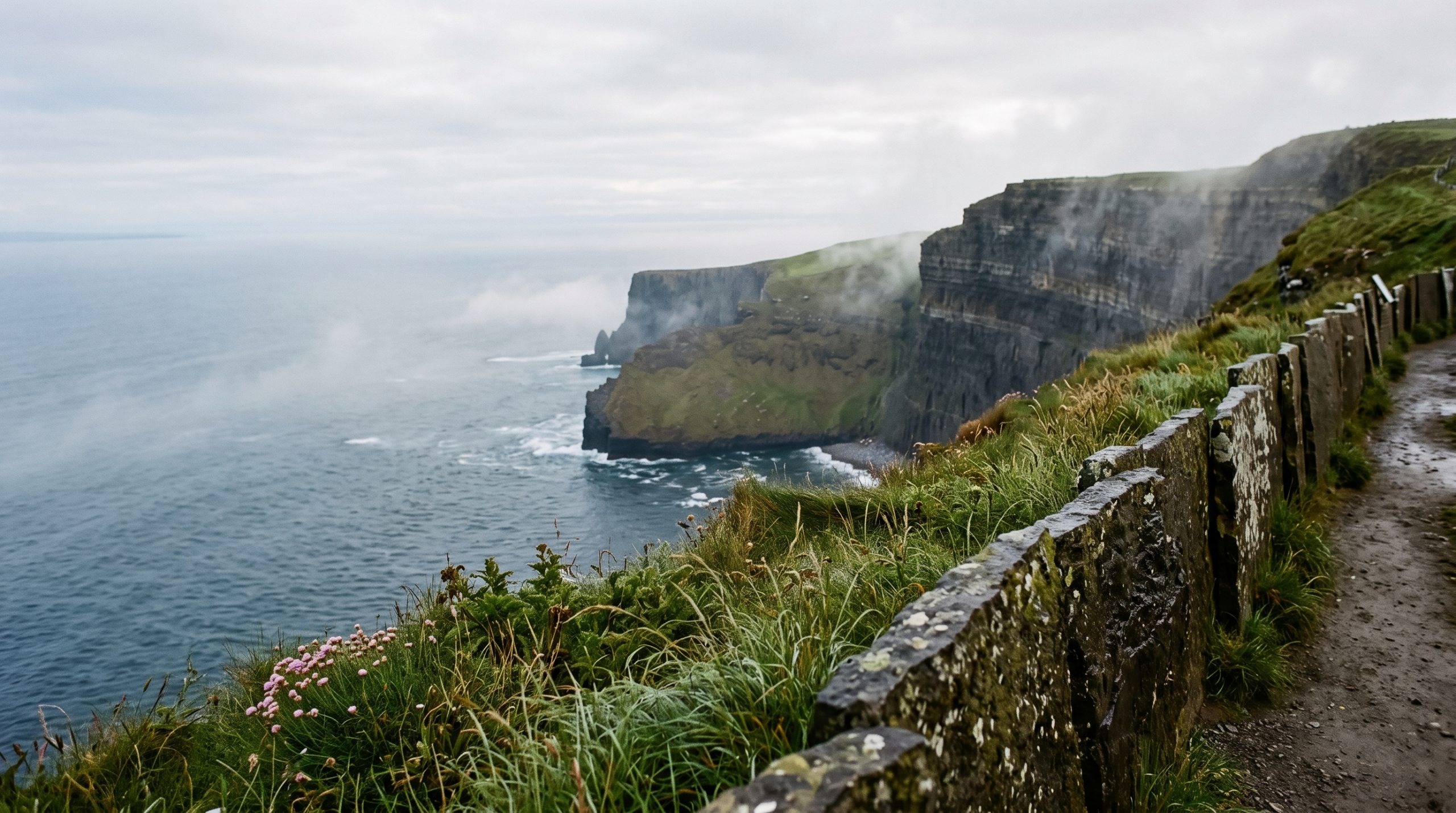
From May to August the Cliffs of Moher Experience stays open until 21:00. On the longest evening of the year the sun does not reach the Atlantic off this coast until a few minutes after 22:00. That hour of daylight sitting outside the gate is the most useful thing anyone can tell you about a ceremony up here, and most couples meet it for the first time when a draft timeline arrives.
The rest of the calendar is stranger still. On 10 September the site closes at 19:00 and the sun sets at 20:05. By the middle of October the two finally agree: the gate opens at 08:00 with sunrise at almost the same minute, and closes at 19:00 with sunset around 18:45. For roughly a fortnight a year, both ends of the day happen while you are standing on the main path with a valid ticket in your pocket.
So this page runs on the clock. Hours first, then who has to say yes, then the fees that are genuinely yours to pay. We work along this coast often enough to say plainly that we have never made a Cliffs of Moher day come together by choosing the location first and hoping the light would cooperate.
What the site allows, and what the state asks
Small ceremonies do happen on the Cliffs of Moher. The Experience runs its own weddings, vow renewals and elopements page, and lists celebrants recognised by the HSE as legal solemnisers. Your party pays admission like every other visitor, the ceremony is agreed with the site beforehand, and Irish law wants three months of notice to a registrar.
The 21:00 gate and the 22:00 sunset
The Experience publishes its hours by month, and they move three times a year. November, December, January and February run 09:00 to 17:00. March, April, September and October run 08:00 to 19:00. May through August run 08:00 to 21:00. The site is closed on 24, 25 and 26 December, and the exhibition inside the centre asks for at least twenty minutes before closing time if you want to see it.
Sunset does not follow that pattern at all. It follows the sun, and Ireland puts the clocks forward on the last Sunday in March and back on the last Sunday in October, which yanks the evening an hour in each direction overnight. Lay the two side by side and the shape of the year becomes obvious.
| Period | Site closes | Sun sets about | Where that leaves the ceremony hour |
|---|---|---|---|
| Mid-November to mid-January | 17:00 | 16:25 to 16:50 | Inside the gate, in the last hour before closing |
| Late January to end of February | 17:00 | 17:20 to 18:10 | Sunset drifts past closing time again |
| March, before the clocks change | 19:00 | 18:15 to 19:00 | Inside, but with almost no margin |
| April | 19:00 | 20:10 to 20:55 | The whole golden hour falls after closing |
| May to August | 21:00 | 21:05 to 22:05 | Later closing, and still not late enough |
| September | 19:00 | 20:25 down to 19:15 | After closing every day of the month |
| 1 to 24 October | 19:00 | 19:15 down to 18:25 | Back inside the gate from about the 6th |
| Late October to mid-November | 19:00, then 17:00 from 1 November | 17:20 down to 16:45 | Golden hour and afterglow both comfortably inside |
Two things follow from that table, and they shape every plan we build here. The first is that the afterglow, the twenty minutes after the sun has gone when the sea turns pewter and the sky behind Hag’s Head goes coral, happens after the gate closes for most of the year. The second is that summer, the season nearly everyone books, is the worst fit of all. A May ceremony inside the ticketed site is an afternoon or early evening ceremony, not a sunset one.
That is not a reason to avoid June. It is a reason to split the day. We put the ceremony inside published hours in the evening off-peak band, which opens at 16:00, and then take the last light onto the free stretches of coast beyond the ticketed area, where access is arranged with local landowners rather than with the Experience and where no closing time applies. Confirming that access in writing for your specific date is our job, not yours. Autumn couples get the simpler version, because in the second half of October the sun does the work inside the gate.
A northwest wall, and the hours it holds light
The cliff line runs southwest to northeast, from Hag’s Head past O’Brien’s Tower and on toward Doolin. That means the faces look out to the northwest, and it is the fact that decides everything about how this place photographs. Just north of the tower the ground reaches 214 metres, or 702 feet, which is the highest point anywhere on the line.
Morning first. The sun comes up inland behind you over the Burren, at around 47 degrees east of north in late June and 130 degrees in December. Either way it is behind the cliffs, so the faces hold no direct light at any point in the morning, in any month. What you get instead is a bright sea, a shaded wall and rim light down the edge of a shoulder or a veil. Figures read cleanly against the water. It is a quieter, cooler, more graphic hour than the postcards suggest, and it is genuinely lovely if you know that is what you are getting.
Evening is when the wall itself lights up, and the direction changes dramatically through the year. In late June the sun drops at about 313 degrees, almost square onto the cliff face, which lights the entire northern stretch at once. At the equinoxes it sets due west and rakes along the wall from the left, so each headland separates from the one behind it and the whole line reads as layers. By the winter solstice it goes down at roughly 230 degrees, behind Hag’s Head, and the faces fall into silhouette while the sky does the work.
Between about 11:00 and 16:00 the sun sits high and the wall goes flat. Grey-green, textureless, no separation between headlands. This is exactly the site’s peak ticket band and exactly when coach traffic is heaviest, which is a rare case of the crowds and the light being wrong at the same time. We do not put a ceremony hour there, and we say so early, because a July couple who assume midday is fine will otherwise book their celebrant for 13:00. You can see what the northwest light actually does to this wall in our published galleries and films, where the difference between an evening frame and a midday one needs no explanation from us.
Three months of notice and a registered solemniser
The legal side of an Irish wedding is administrative rather than difficult. Notice goes to a registrar at least three months before your date, and the person who marries you has to be on the state register of solemnisers. A registrar’s civil ceremony takes place in a registry office or an approved venue rather than on a cliff path, which is why couples who want their legally binding ceremony outdoors here work with a religious or secular solemniser instead. Several of those celebrants appear on the Experience’s own weddings page.
Permit research and logistics guidance are part of every experience we run, alongside the destination and location design, the timeline and the weather alternatives. What we cannot do is pay your government, venue or landowner fees, or your celebrant. Those stay with you, and we tell you what they are before you commit to anything. If the paperwork sequence is new to you, our guide to planning an elopement sets out the order things happen in.
Tickets, the gate rate and which fees stay yours
Admission at the Cliffs of Moher is charged per person and it includes the car park. There is no parking-only ticket, which surprises couples who assume the barrier is a car charge. Booking online is the cheaper route, because turning up without a booking means paying the full gate rate, and the ticket you buy is tied to a time band: off-peak from 08:00 to 11:00, peak from 11:00 to 16:00, off-peak again from 16:00 until closing. Children under 12 go free, up to four per paying adult.
For a small ceremony party that is a modest line in the budget, and it is one of the few places on this coast where the arithmetic is entirely predictable. Our side is predictable too. Guest count does not change our fee, because the number of people affects access, permits, transport and the shape of the timeline rather than the coverage itself, and team travel to Ireland is already included. Coverage comes either as one dedicated photographer or filmmaker for the full day, or as a photographer and filmmaker working it together, and both shapes are set out with what they include on our pricing page.
Standing room, wind and vows you can actually hear
The main path here is a public thoroughfare with a flagstone wall along the seaward side, and there is not much room to step back. Two people covering the same ceremony from the same three metres will end up in each other’s frames unless they have already agreed who takes which side and who moves when. Ours arrive having agreed it. The wind is the other half of the problem: it comes off the Atlantic and straight up the face, so audio for vows means finding a fold of ground just below the skyline rather than the highest point available. Aerials are not something we plan over the viewing platforms, given the seabird colonies and the footfall, so any drone work happens elsewhere along the coast with permission and a window confirmed before it enters the timeline.
Mid-October, hour by hour
Take 15 October as the model, because it is the date the whole calendar points at. Sunrise is 08:04 and the gate opens at 08:00.
- 08:00. In through the car park on the first off-peak tickets of the day, sun coming up over the Burren behind you, the wall in shade and the sea already bright. A scattering of people on the path rather than a full car park.
- 09:30. Out again, before the first coaches. Breakfast, then back to where you are staying to get dressed, which is the sane way round in October.
- 16:00. Return on evening off-peak tickets. The sun is dropping toward 257 degrees, west-southwest, and the headlands have started to separate.
- 17:00. Ceremony, in a fold of ground below the path line where the wind drops enough to record vows properly.
- 18:00 to 18:42. The wall lights up and the light gets low and long. This is the hour the film is built from.
- 18:45. Off site before the 19:00 close, with the afterglow still to come somewhere the clock does not apply.
Shift that plan to July and every line moves. Same coast, same wall, different arithmetic entirely, and it works fine once the ceremony hour stops pretending to be a sunset hour. Our destination guides cover how the same logic plays out elsewhere along the Wild Atlantic Way.
Common questions
Can we hold the ceremony after the visitor centre closes?
Not inside the ticketed site. Either the ceremony sits within published hours and we take the last light onto free coast beyond the site, or you choose a period when sunset already falls before the gate closes: mid-November to mid-January, the first three weeks of March, and October from about the 6th onward.
Do our guests need to buy tickets too?
Yes. Admission is per person and it covers the car park as well, so there is nothing separate to pay for the cars. Children under 12 are free, to a maximum of four per paying adult. Book online and in the right time band, because the gate rate is higher than the online rate.
Is there anywhere to change out of walking boots?
Nothing at the site is set aside for a wedding party, so we build the timeline around you arriving dressed, with a bag in the car. The paths near the centre are flagged and level. Beyond them it is grass, and after rain it is soft grass, which matters if a hem is anywhere near the ground.
Which weeks put both sunrise and sunset inside the gate hours?
Roughly 13 to 24 October, before the clocks go back. Sunrise slides past the 08:00 opening around the 13th and sunset is still ahead of the 19:00 close, so a full first-light-to-last-light day is possible on one ticket band each end. It is the narrowest and most useful window in the Cliffs of Moher year.
What happens if the wind is up on the morning of the ceremony?
We reorder the day rather than fight it. Wind direction decides which side of the headlands we use, and there is lower, more sheltered ground a quarter of an hour up the coast road toward Doolin. Every plan we send carries that alternative already written into it, with the same ceremony hour and a different backdrop.
Choosing the fortnight before the hour
Tell us the month you have in mind and we will tell you exactly what the gate and the sun are doing in it, including the weeks where they disagree. We keep every planning decision in writing rather than on a call, and you will have a reply and an initial brochure inside 24 hours. Our current Ireland availability runs across 2027–2029 on this coast. Check Your Date and we will send back the honest version of your timeline.