When the first cable car down to the ice cave opened in 1988, three steps took you from the cabin door to the surface of the glacier. Three. The staircase that does the same job today runs to roughly 170 steps, and it gets extended as the ice keeps dropping away below the rock.
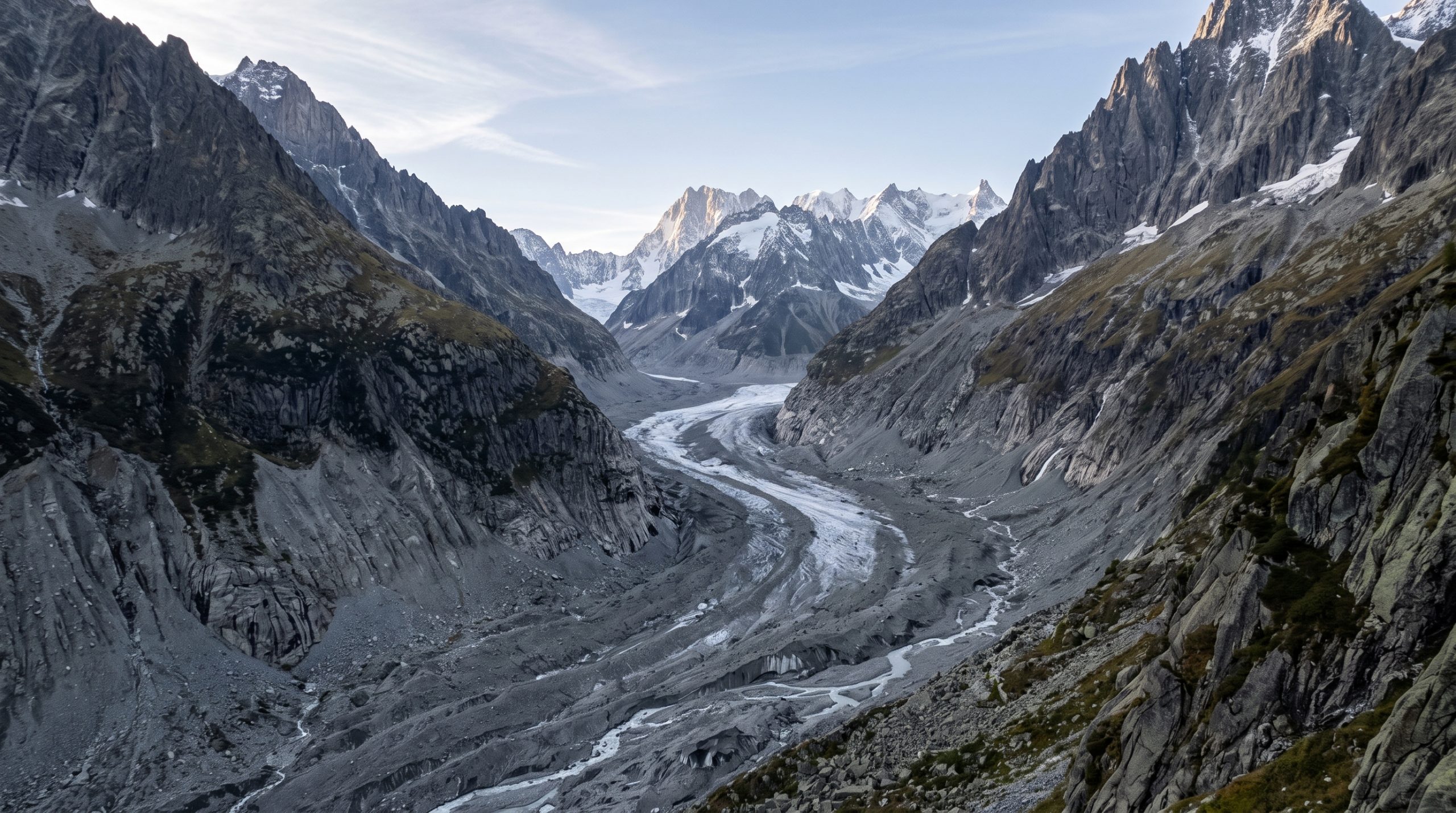
That one number is the story of the Mer de Glace, and it is also the honest answer to what your pictures will hold. Not a white river filling the valley to the brim. A deep granite trough, scoured pale where ice sat within living memory, with France’s largest glacier lying much further below the terrace than the postcards in the Chamonix shops suggest.
It is still a remarkable place to stand and say something to each other. It just rewards couples who know what they are looking at, and who plan around a railway timetable instead of fighting it.
The 77 metres that changed the view
Since 1850 the Mer de Glace has lost roughly two kilometres of length, and at Montenvers the ice thinned by 77 metres between 1990 and 2012 alone. In frame that reads as scale: pale scoured rock, dated markers where the surface used to sit, and a glacier beginning far below the station terrace.
Twenty minutes up, and the hours the railway owns
The Montenvers train leaves from its own station beside Chamonix’s main railway station, and it has been doing that since 1908. It climbs 5.1 km of rack-and-pinion track from 1,035 metres in town to 1,913 metres at Montenvers in about twenty minutes. That is 878 metres of climb you do not have to walk. A return ticket currently runs around €31.50 per adult, the combined ticket that adds the gondola, the ice cave and the Glaciorium costs more, and both sit inside the valley’s summer Multipass if you already hold one.
The timetable is the part that shapes everything else. In high summer the railway runs from about 8am to a last descent in the early evening, with trains every twenty to sixty minutes depending on the queue, and the last departure from Chamonix that still gives you time for the ice cave falls in the middle of the afternoon. The site counted around 450,000 visitors in 2023. Those people do not trickle in. They arrive by trainload, twenty minutes apart, and the first train of the day carries the keenest of them.
So the standard advice to arrive early does not do here what it does on a beach or a mountain road. There is no early. Eight in the morning is the front of the queue, not solitude. What genuinely works is the terrace before the first train and the site after the last one, and both of those come from a decision made months out rather than from an early alarm.
Down the metal steps, past 1990 and 2010
A gondola runs from beside the station down into the trough and lands close to the base of the ice, replacing an older lift that left a much longer walk. From its lower station the route to the ice cave is a staircase of roughly 170 steps of open metal grating, and the rock alongside carries chronological markers showing where the glacier’s surface stood in 1990, in 2000 and in 2010. Nobody needs a glaciologist to read those. You climb down through them.
The cave is re-carved by hand every year, because the ice it is cut into is moving downhill at around thirty metres a year at Montenvers. Blue walls, sanded smooth. Cold that finds its way through a jacket in about four minutes. It is also the one part of the site where the weather outside stops having an opinion.
In wedding clothes, the grating is the detail to know. It is open steel mesh, hostile to a narrow heel and quick to catch a long hem, and the way back is those same 170 steps upward at altitude rather than a stroll. We plan the descent in boots with the dress carried, and we give the climb back roughly double the time a guidebook would allow. There are toilets at the arrival platform up top and a glazed room at the gondola’s lower station, and one of those two is where a change of shoes and a straighten-up realistically happens. The operator states plainly that reduced-mobility access stops above the staircase, which we would rather know in advance than discover on the day.
Two of us working this stretch is a question of physical space before it is anything else. The staircase is barely wider than two people passing, so a photographer and a filmmaker cannot both occupy the good spot; one goes ahead and low, shooting back up the flight, while the other holds a landing above and lets you walk into the frame. Inside the cave the tunnel is single file, so we take turns and keep that sequence tight. Sound is the other constraint, since meltwater runs loud in the trough all summer and the gondola cabins hum overhead, so on an Expedition day the vows and the recorded audio happen somewhere sheltered up top and the ice stays picture.
One dedicated photographer or filmmaker is The Adventure, from $4,900; a photographer and filmmaker working the same day side by side is The Expedition, from $7,900. Both are set out in full on our pricing page.
What the light does in a trough this deep
Montenvers sits on the western flank of the trough at 1,913 metres, looking across the ice and up it. Les Drus rise above the far side, and at the head of the view stands the north face of the Grandes Jorasses, a wall that lives in shade and stays graphite grey while everything around it turns warm. Morning light arrives up the trough from the head of the glacier, so the terrace holds cold blue shade for a while after sunrise and then takes the sun close to head-on. The evening reverses it. The sun drops behind the ridge behind the station, the terrace goes flat early, and the granite opposite keeps the last light long after you have lost yours.
That hands us two entirely different ceremony hours. Early means working into the light up the trough, rims glowing, faces lifted by snow bounce off the far side. Late means the two of you in even shade with a wall of lit granite behind, which is the frame most people carry home from the terrace. A tunnel inside a glacier, meanwhile, does not care what time it is; what changes in there is how many other people are in it with you.
What the retreat does for the pictures is give them scale no lens can fake. The empty trough puts a measurable distance between the two of you and the ice, and that distance is the subject as much as the glacier is. You can see how that reads in finished work on our stories and films. Highlights reach you five days after the day itself, and the full gallery or film lands within three weeks.
The night above the last train
The granite building above the station was built as the Grand Hôtel du Montenvers and still takes overnight guests, with rooms, a small dormitory and food on site. Sleeping up there is the most useful decision available at this location. You are on the terrace while the trough is still empty, and you are also there once the last descent has carried the day’s crowd back down the hill.
The other way in is on foot: about 880 metres of climb out of the valley by the paths past the Buvette des Caillets or the Rochers des Mottets, which at the local reckoning of 300 vertical metres an hour makes a three-hour walk, and steeper going than that sounds because there is almost no flat in it. Both are summer routes, so a spring date gets built around the railway instead.
Vows, paperwork and the thirty-day rule
France keeps marriage in the mairie. A legally binding civil ceremony needs at least one of you to have been resident in the commune for thirty days, and it has to take place in that commune’s town hall, which puts it out of reach for almost everyone flying in for a week. Hence the shape nearly every couple uses here: the legal marriage is signed at home, before the trip or after it, and the ceremony at Montenvers is the one that means something. Your words, someone you trust reading, two witnesses you brought or nobody at all. Our notes on how an elopement actually gets built set out the ordering of all that.
The site itself is privately operated, so what a professional camera team may do up there is the operator’s call rather than a public right, and written confirmation is part of what we sort out before your timeline exists. Aerials work the same way. Drone footage happens where it is legal, cleared and safe, and where it is not cleared for a given morning we say so early and design the film without it. Permit fees, where a location carries them, sit with you; the asking, chasing and paperwork sit with us.
A day here that never touches the staircase
Some couples look at 170 steps of steel grating and know immediately that it is not their morning. Tell us that. There is a full day at this altitude without it: the terrace, the Glaciorium, the balcony trail that runs from Montenvers toward the Plan de l’Aiguille, and the forest path down to Les Planards, about 6.6 km and two and a half hours in shoes you can walk in. If ice underfoot matters more than the view of it, say so and we will tell you which month and which valley location gives you that with less descent. Our destination guides are a decent place to start narrowing it down.
Common questions
Can we really get down to the ice cave in a wedding dress?
Yes, and people do. The staircase is roughly 170 steps of open metal grating, so we walk it in boots with the hem gathered or carried, then change at the top or in the glazed room at the gondola’s lower station. Plan the climb back as slow. It is the ascent, not the descent, that eats time in a long dress.
Is there anywhere at the top to change out of hiking boots?
There are toilets at the train’s arrival platform at 1,913 metres, and the hotel above the station has rooms if you are staying the night, which makes changing straightforward. There is no bridal suite at a glacier station, so we build a realistic ten minutes into the timeline for it rather than pretending it happens on the move.
Can we be on the terrace before the first train arrives?
Only two ways: sleep at the hotel above the station, or walk up the 880 metres from the valley, which takes about three hours. The railway’s first departure in high summer is around 8am, and that train brings company. Staying overnight is the version we recommend when a genuinely quiet ceremony hour matters to you.
Do we need a mountain guide to stand on the glacier itself?
For the open ice away from the built walkways, yes, with equipment, and guides report walking clients steadily further out each season to reach workable ice. Everything in this article happens on the railway, the gondola, the staircase and inside the cave, none of which needs a guide. If you want a frame out on open ice, we add a guide to the plan and that cost sits with you.
Will the ice cave still be open when we marry in 2028?
The cave is cut fresh by hand every year, and the access staircase is lengthened as the surface drops, so the number of steps in 2029 will not be the number today. Our current Chamonix availability runs across 2027–2029, and for this location we confirm the current step count and lift calendar with the operator while your timeline is being drawn.
Choosing your year while the ice keeps moving
Montenvers is one of the few locations where the plan has to account for the ground changing between the booking and the day. That suits us. Send the date you are circling, the hour you want to say your vows, and whether the staircase is in or out, and we will come back with a shape for the day, the lift and railway windows it depends on, and the honest version of what the trough will look like in that month. The full planning trail stays written and easy to revisit, so none of it depends on lining up time zones. If you want a second day in the valley, or a second country after it, that is the Odyssey and we build it as a custom proposal.
You will have a reply and a first brochure within 24 hours, then a tailored proposal; a signed contract and a 30% retainer start the planning. Check Your Date.