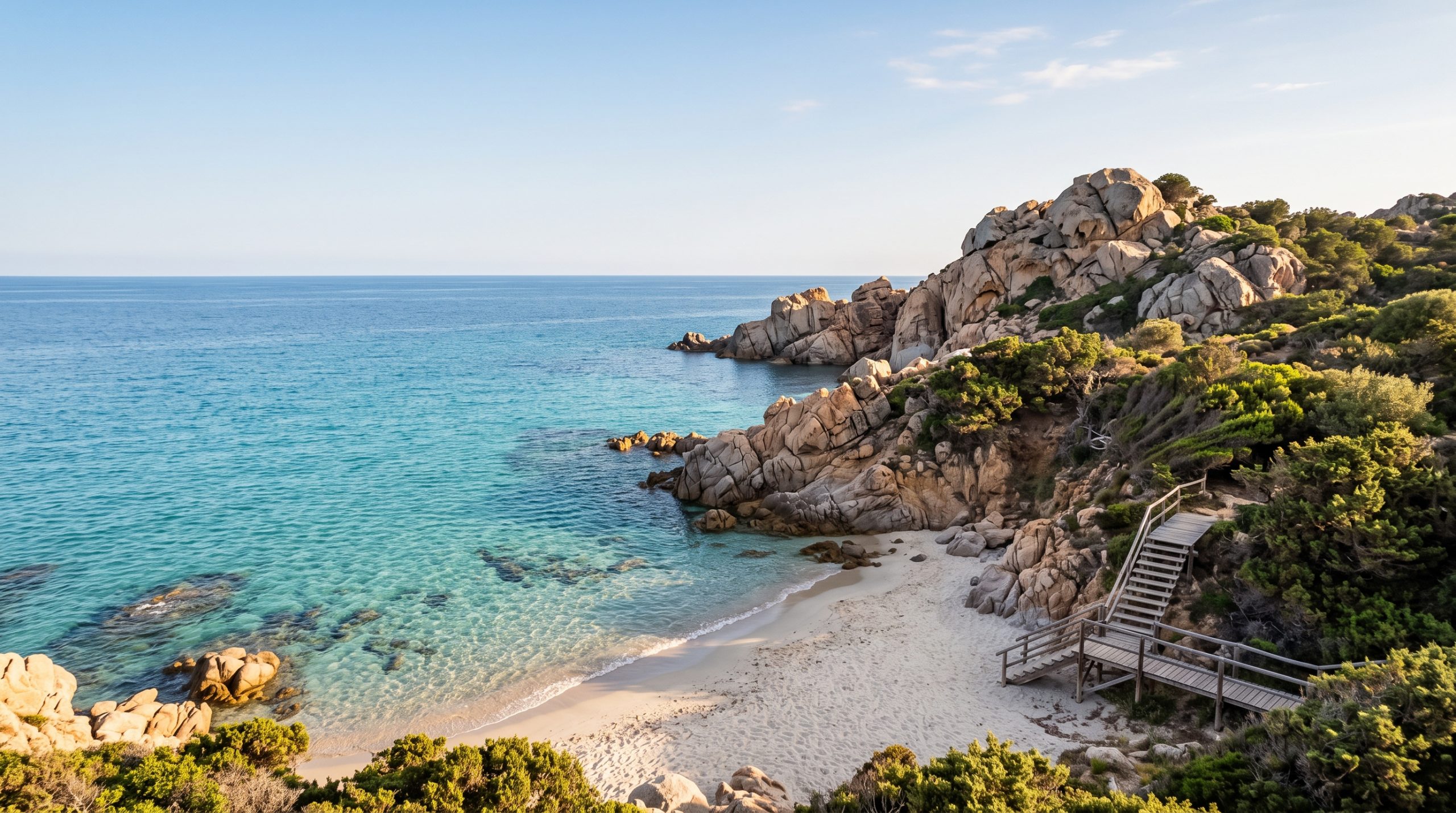
In Arzachena, the comune that governs most of the Costa Smeralda coastline, your date is not held when the office writes back to say the beach is free. It is held when the receipt for the bank transfer reaches the mayor’s staff office. The request on its own does nothing.
That one rule explains most of what follows. There is no island-wide beach wedding permit in Sardinia and no regional application form. Each comune decides which stretches of its own coast are licensed for civil ceremonies, publishes a price for each of them, and runs the booking through its own registry office. Palau lists the little beach at the Piazzetta di Porto Rafael at 1,000 euro. Arzachena starts at 400 euro midweek at an approved private site. Villasimius licenses an old coastal fort and the lighthouse on the Isola dei Cavoli rather than sand.
What follows is the comune side of a Sardinian beach wedding, and the document chain that sits behind it for American couples, in the order you actually meet them.
Sardinia says yes, but only comune by comune
Beach ceremonies are legal in Sardinia wherever the comune has designated that exact stretch as a civil registry site. You apply to that comune, pay its published tariff, and marry within the hours its own regulation allows. The paperwork sits mostly in the six months before the date, and two or three working days of it happen in Italy.
A Sardinian beach permit is manageable, but every comune is its own system
Fiddly. Not hard. Two separate systems are running at once and neither of them knows about the other. The first is the comune’s: which piece of coast it has turned into a registry office, what it charges, and when its celebrant is available. The second is the chain of documents that makes two Americans eligible to marry in Italy at all, which runs through an Italian consulate at home, a US consular officer in Italy, and a Prefettura. Neither system is difficult on its own. They come apart when they are done in the wrong order.
The comune part begins with a list. In Arzachena the giunta authorizes civil marriages and civil unions outside the town hall by setting up one or more separate civil registry offices inside marked areas of beach concessions, hotels and other private property, with a technical commission assessing the venues that apply through a public notice. In practice the beach club or hotel does the applying. You can only marry somewhere that has already been through that process, which is why the honest first question to a comune is not can we marry on the beach but which of your beaches is already on the list.
Regional guidance issued in 2024 settled the principle for Sardinian sand: ceremonies are permitted where the competent comune has authorized precisely identified areas. Private parties and events on the beach are treated separately, so the workable shape is a ceremony on the licensed sand and a celebration at a venue set up to host one. The same logic runs through our other destination elopement guides, where the permission and the party almost never live in the same place.
| Comune | Site | Published tariff |
|---|---|---|
| Arzachena | Approved private site: beach concession or hotel | 400 euro base, 800 euro on Saturdays, Sundays and holidays |
| Arzachena | Palazzo Ruzittu, Piazza Risorgimento | 200 euro base, doubling at weekends |
| Palau | Piazzetta di Porto Rafael beach, east side of Porto Pollo, Porto Mannu, La Sciumara | 1,000 euro |
| Palau | Monte Altura fortress | 800 euro |
| Palau | Other approved sites inland of the water | 500 euro |
| Villasimius | Fortezza Vecchia, Isola dei Cavoli lighthouse, Casa Todde, council chamber | Separate resident and non-resident rates set in a nine-article regulation |
Exact figures move when a giunta revises its tariff sheet. The shape of the sheet does not: a base rate, a multiplier for Saturdays and Sundays, and a higher band for the sites everybody wants. Read the tariff before you fall for the location, because the difference between a Tuesday at 400 euro and a Saturday at 1,000 euro buys a lot of the rest of the day.
From comune request to beach approval: the Sardinian sequence
Start from one assumption that changes everything: neither of you is resident or domiciled in Italy. That removes the Italian banns from your list. Foreign couples living abroad do not post pubblicazioni at the comune. Instead the registrar records a processo verbale under the last paragraph of article 116 of the civil code, in which you both state that no impediment exists between you.
- Certified birth certificate, apostilled. One each, issued by the state that holds the record, carrying an apostille from that state’s Secretary of State. Comuni also ask for an Italian translation certified by the competent Italian consulate.
- Divorce documents, if either of you has been married before. Same apostille, same certified translation, same rule about who is allowed to produce the translation.
- Atto Notorio. A sworn declaration that nothing in the law you live under stands in the way of the marriage. Italian consulates in the United States take it with four attestants, who must be adults with valid photo ID and no family tie to either of you. It is valid for 180 days. It can also be sworn in Italy before a court.
- The sworn statement made in Italy. A Dichiarazione Giurata in front of a US consular officer, made during your trip rather than before it.
- Legalization at the Prefettura. The Ufficio Legalizzazioni authenticates the consular signature. You buy a 16 euro marca da bollo at any tabacchi and hand it in with the document, one stamp per document.
- The declaration of intention to marry. At the comune’s marriage office, with passports and everything above. An interpreter goes with you if you do not speak Italian. The office then gives you an appointment two or three days later, to come back with two witnesses and the interpreter and make the declaration itself.
- The comune’s booking and tariff. Paid the way that particular comune wants it paid. Arzachena takes an international bank transfer and fixes the date once the receipt has reached the mayor’s staff office. Bari Sardo runs payment through the PagoPA portal and checks that both the celebrant and the municipal facilities are free at the hour you asked for.
Our role is photography, film and practical planning rather than legal advice. Confirm the final Sardinia requirements with the authority handling your application.
Work back from the Sardinian beach hour through the comune request
Everything above has a natural order, and the 180-day validity of the atto notorio is what sets the clock. Collect that document too early and it lapses before the ceremony. Collect it too late and you are chasing consular appointments in the same month you are packing.
| Time before the date | What moves | Which office |
|---|---|---|
| 12 months or more | Pick the comune, then the licensed site inside it. Read the regulation for the hours a celebrant will actually work. | Comune, civil registry |
| 6 to 9 months | Ask for the date in writing, pay the tariff, get written confirmation back. | Comune, by transfer or PagoPA |
| Around 6 months | The 180-day window opens. Book the consular appointment for the atto notorio. | Italian consulate in the US |
| 2 to 3 months | Order fresh birth certificates, send them for apostille, then for certified translation. | State vital records, Secretary of State, Italian consulate |
| Wedding week | Sworn statement, then Prefettura legalization, then the documents in front of the registrar. | Three offices, three separate stops |
| 2 to 3 working days out | Return appointment with two witnesses and the interpreter. | Comune, marriage office |
The real minimum is shorter than couples expect. With the atto notorio already in hand, the Italian end can be done inside a working week. The comfortable minimum is different: a date confirmed with the comune six or more months out, the atto notorio sworn inside its window, and the office appointments spread over separate days instead of stacked into one afternoon. That second version is the one we plan to, and it is the version that leaves your ceremony hour free to be chosen for the light rather than for whatever slot is left. If you are at the stage of choosing between coastlines, the planning fundamentals we work through with every couple cover the same ground for anywhere else you are considering.
The details that quietly move your date
None of these are hard to handle once you know they exist. All of them have moved somebody’s date by a week.
- The date is not yours until the money is. Arzachena confirms nothing until the payment receipt is emailed to the mayor’s staff office. Send the receipt the same day you make the transfer, and ask for the confirmation in writing rather than assuming it.
- Saturday is the expensive word. Arzachena’s 400 euro base at an approved private site becomes 800 euro on Saturdays, Sundays and public holidays, and the Palazzo Ruzittu rate doubles the same way. A Thursday ceremony is cheaper, quieter on the sand, and easier for a registrar’s diary.
- The 180-day clock runs quietly. An atto notorio sworn eight months ahead of a summer date has expired by the time anyone looks at it. Work back from the ceremony, not forward from the engagement.
- Paperwork days are travel days. The consular sworn statement, the Prefettura legalization and the comune appointment are three different offices in three different places, and a comune cannot do any part of the first two for you. Build them into the itinerary as real days with real driving time.
- Residency does not help by halves. Bari Sardo applies its non-resident tariff even when one of the two is a resident of the comune. If you were counting on a family connection to the island to change the rate, check the wording of that comune’s regulation first.
- The beach may have a gate of its own. La Pelosa at Stintino caps entry at 1,500 places a day through the comune’s booking portal, checked by QR code at the entrance, with under-twelves exempt from booking, and parking is metered by the hour through the operator the comune appointed. Access rules like these are separate from anything the registry office does, and they shape what time you can be standing on that sand.
Use the Sardinia fees and lead times here as a working estimate rather than a permanent rule; confirm the current numbers with the relevant office before filing.
The symbolic ceremony, done properly
Plenty of the couples we work with in Italy sign the legal paperwork at home, in a county office, a few weeks before the flight. Then they hold the ceremony that actually matters on a Sardinian beach at seven in the morning. We are not offering that as a fallback. For a lot of American couples it is the better plan, and here is the honest accounting of what changes.
What changes: no registrar, so no tariff for a registry site, no consular appointments inside your trip, no interpreter, and no dependence on the hours a comune allows its celebrant to work. You gain the first hour of light, which no Sardinian registry office is going to sell you. Your officiant can be a friend. The words can be entirely yours.
What does not change: you still need the right to be there. An organized gathering on Sardinian sand is not the same as two people swimming, so the practical route is a beach where a concession holder or a hotel can host you, arranged in advance and in writing. The vows do not change. The photographs and the film do not change at all.
Tell us which of the two routes you are leaning toward and we will tell you what it does to the shape of the day, including which comuni are realistic for the hour you want. Send Us a Message with your dates and the stretch of coast you have in mind.
Where our Sardinia planning ends and the comune begins
We handle the destination and location design, the timeline built around light and real travel time, the permit research and the logistics guidance, and the weather alternatives that mean a north-facing cove has a south-facing answer fifteen minutes away. We hold your date against the registrar’s availability rather than the other way around, and we coordinate the ceremony hour with the light in the month you are actually coming, which in a Gallura July is a very different hour from a Gallura October.
What stays with you: the government, venue and landowner fees themselves, your celebrant, accommodation, vendors and the documents. We do not file paperwork and we do not stand in for your consulate.
A registry slot on a beach is short and fixed. When a dedicated photographer and filmmaker work that same window from two positions, nothing has to be traded against anything else: the wide frame of the granite and the water, and the close one of your hands and the registrar’s book, happen at once. If your two witnesses are the only other people there, the ceremony is still covered from both sides without anyone stepping into a frame.
Highlights reach you in five days and the full gallery or film in three weeks. The films and galleries we have published are the clearest way to see how coastal light behaves at the hours we keep recommending, and what a two-person team brings back from a ceremony that lasted twenty minutes. Team travel is included worldwide, the fee does not change with your guest count, and the coverage options are set out on the pricing page.
Common questions
Do we have to be in Sardinia before the wedding day?
Yes, and for more than a night. The comune gives you an appointment to come back two or three days after you present your documents, with two witnesses and an interpreter, to make the declaration of intention to marry. The consular sworn statement and the Prefettura legalization happen before that, elsewhere in Italy.
Can we get married on any beach in Sardinia?
No. A civil ceremony is only valid where the comune has designated that precise area as a civil registry site. Palau lists specific beaches at Porto Rafael, Porto Pollo, Porto Mannu and La Sciumara. Villasimius licenses the Fortezza Vecchia and the Isola dei Cavoli lighthouse instead of sand.
Do we need to post banns in Italy if we live in the States?
No. Pubblicazioni are required when one of you is resident or domiciled in Italy. When neither is, the registrar records a processo verbale under the last paragraph of article 116 of the civil code, in which you both declare that no impediment exists between you.
Do we need an interpreter at the comune?
If you do not speak Italian, yes. An interpreter accompanies you when you present the documents at the marriage office, and again at the return appointment two or three days later when you make the declaration with your two witnesses.
How long is the atto notorio valid for?
180 days from the day it is sworn. Italian consulates in the United States take it with four attestants who are adults, hold valid photo ID and have no family tie to either of you. It can also be sworn in Italy in front of a court.
What does a Saturday cost compared with a Tuesday?
In Arzachena, an approved private site is 400 euro as a base rate and 800 euro on Saturdays, Sundays and public holidays, with the Palazzo Ruzittu rate doubling the same way. Every comune sets its own sheet, so Palau, Villasimius and Bari Sardo all answer this differently.
Can two women or two men have the same ceremony on the beach?
In Italy same-sex couples form a civil union rather than a marriage. The Sardinian comuni that license coastal sites treat the two the same way: Arzachena’s separate registry offices cover marriages and civil unions, and Palau’s tariff sheet prices both at the same beaches.
How many witnesses do we need?
Two adults with valid photo ID at the comune. The atto notorio sworn in the United States is different and needs four attestants who are not related to you. If you are traveling without guests, ask your comune early what it will accept, because that office’s answer is the only one that counts.
Pick the hour, then the beach
Sardinian coastal light in high summer does its best work before eight in the morning, and the comune’s regulation decides which hours a registrar is available. That is the first thing we check for a legal ceremony, and it often decides which comune you should be writing to at all. For a symbolic ceremony the hour is entirely yours, which is why so many of our Sardinian mornings start in the dark.
Everything with us runs in writing. Send the dates you are holding and the stretch of coast you keep coming back to, and you will have a reply and our initial brochure within 24 hours, then a proposal built around your actual timeline. We currently have dates available across the 2027–2029 seasons. Start Your Story.