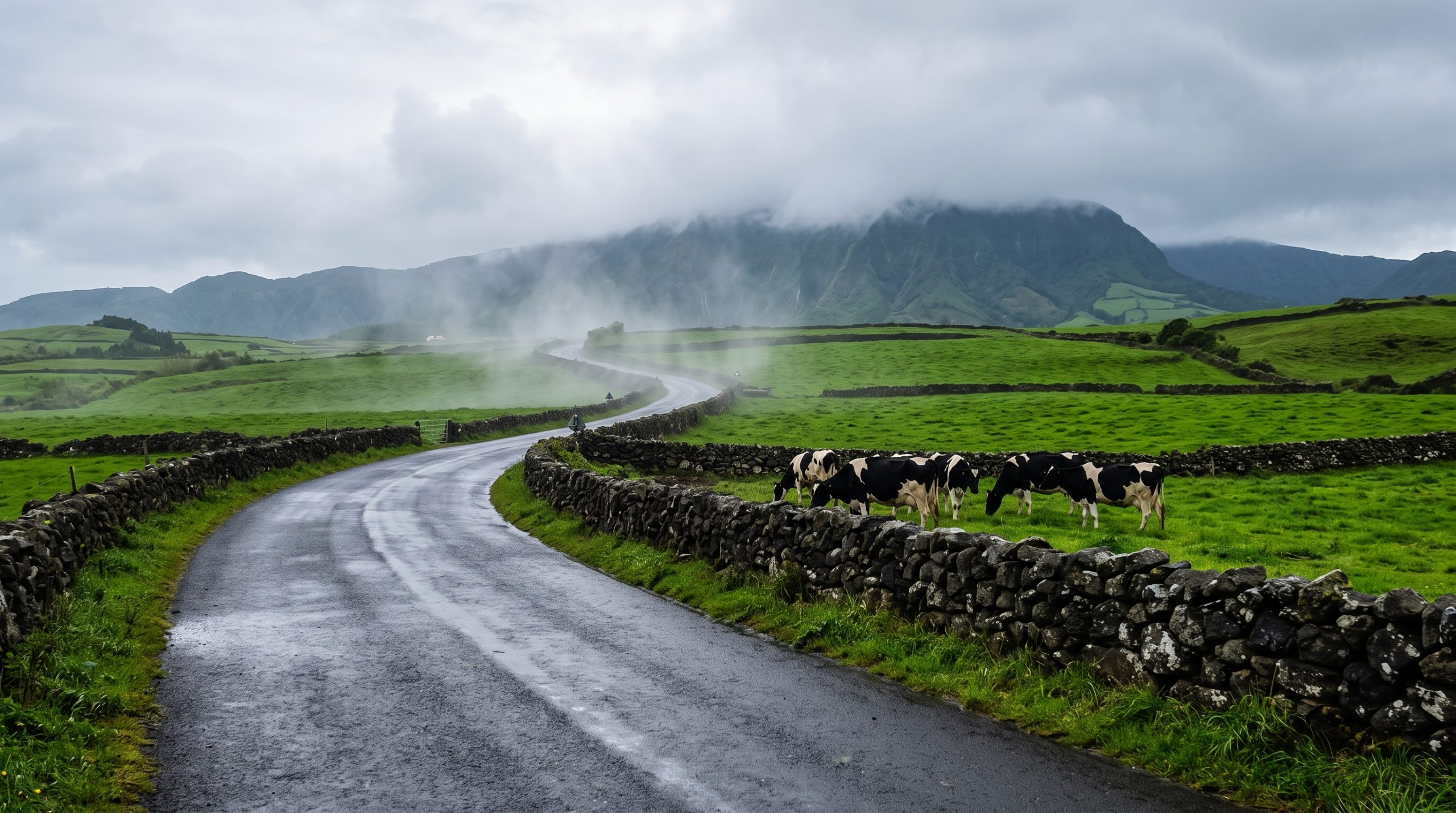
In late June the sun clears the horizon over São Miguel at about 6:20 in the morning and does not go down until a few minutes after nine at night. That is close to fifteen hours of daylight, which sounds like room to spare right up until you try to cross the island at the wrong hour and find the lane ahead of you full of black and white dairy cows walking home to be milked.
The Azores are not a difficult place to drive. Roads are paved, signed and free of tolls, and the island is small enough that everything looks close together on screen. It is the arithmetic that catches couples out. The gap between what a route planner promises and what a drive actually costs in minutes is real, and the finest viewpoints sit high enough to be inside cloud on a morning when the coast below is bright.
This is the version we use when we build a wedding day here: honest times, the two hours a day when the lanes belong to the herds, and what happens when the ridge is grey at the exact hour we planned to be standing on it. If you are earlier in the process than that, the order the planning actually happens in is the better place to start.
Plan on a third more than the map says
São Miguel measures about 65 kilometers end to end, and nothing on it takes as little time as a route planner suggests. Add roughly a third to every leg for hairpins, single-lane village streets and dairy herds, then build the day around the cloud line at 947 meters rather than around distance.
Distances on a 65-kilometer island
São Miguel is the largest island in the archipelago and still only around 65 kilometers long by 16 at its widest. A fast road carries you east out of Ponta Delgada, and then it ends and the real island begins: hedged lanes, blind corners, cobbled village centers where two cars cannot pass, and climbs that gain several hundred meters in a handful of kilometers.
The right-hand column is the one we put in a timeline. It is not padding. It is what the leg costs once you allow for a tractor, a stop that turns into ten minutes, and the fact that nobody drives past a viewpoint without slowing down.
| Leg | Road distance | Route planner | What we schedule |
|---|---|---|---|
| Ponta Delgada airport to the city | about 4 km | 10 min | 25 min with bags |
| Ponta Delgada to the Sete Cidades rim | about 27 km | 35 min | 55 min |
| Ponta Delgada to the Lagoa do Fogo viewpoint | about 25 km | 30 min | 50 min |
| Ponta Delgada to Furnas | about 45 km | 50 min | 1 h 10 |
| Ponta Delgada to Nordeste | about 70 km | 1 h 20 | 1 h 50 |
| Sete Cidades to the Lagoa do Fogo viewpoint | about 45 km | 55 min | 1 h 25 |
| Horta to Madalena on Pico, by ferry | about 8 km of water | 30 min afloat | 1 h 30 door to door |
Two legs deserve saying out loud. Crossing from the Sete Cidades caldera to Lagoa do Fogo means dropping back to the coast and climbing again, so both in one golden hour does not work however close they look. And Nordeste, at the far eastern end, is a beautiful drive that eats three and a half hours in the car alone. It earns a place in a two-day plan, rarely in a one-day one.
Herd hours, twice a day, on the lane you need
Azorean dairy farming works differently from the version most Americans picture. Pastures are small and often steep, so cows are moved between them constantly, and the milking equipment travels to the animals on a trailer rather than the animals walking to a barn. Herds are therefore out on the public lanes around milking, early in the morning and again in the late afternoon.
You do not overtake a herd. You stop, you wait, the farmer nods at you, and it costs a few minutes. The length of the delay is never the problem. The problem is that it lands at 7am and again around 5pm, precisely the two windows a good wedding day wants to be moving in. So we drive the sunrise leg before 6am and the evening leg with a clear half hour of slack in it.
Cloud lives at 900 meters
The viewpoint over Lagoa do Fogo, Miradouro do Pico da Barrosa, sits at 947 meters. On a clear morning you can see the north and south coasts of the island from the same spot. On a great many other mornings you drive up out of sunshine, watch the hedges turn to silhouettes at around 700 meters, and arrive inside a cloud with fifteen meters of visibility.
None of that signals a bad forecast. These are small mountains in the middle of the Atlantic, and they build their own weather and shed it again without warning. Cloud on the high rims often moves through in minutes. We have stood at Barrosa in flat grey for twenty minutes and then watched the whole caldera open like a curtain going up, held it for eight or nine minutes, and lost it again. That half-lit moment as the cloud lifts is the best light this island gives, and how it reads is easier to watch than to describe in our published galleries and films.
So we never plan a single high viewpoint and hope. Every high location in a timeline we build has a low one held in reserve within about twenty-five minutes of driving: a coastal headland, a lane of hydrangeas, a black sand cove. The island is also two-sided in a way that helps enormously. The north coast is frequently clear when the south is closed in, and the reverse happens just as often, so the reserve sits on the opposite shore rather than further along the same one. Our destination guides cover which pairings hold up in which season.
The other habit worth borrowing: check the island webcams before you commit to the climb, not the general forecast. A forecast for Ponta Delgada tells you very little about what is happening 900 meters above it.
The gate on the Lagoa do Fogo road
Private cars are kept off the final climb to the Lagoa do Fogo viewpoint through the middle of the day, roughly from 9am to 7pm, with a shuttle running instead. Read that as a gift rather than an obstacle, because the hours it hands back to drivers are the two hours nobody else wants and every photographer does.
The light math changes month to month, and it decides which end of the day we use.
| When | Sunrise | Sunset | Which window works up high |
|---|---|---|---|
| Mid April | 7:08 | 20:18 | Evening, comfortably |
| Mid May | 6:33 | 20:45 | Evening, comfortably |
| Late June | 6:20 | 21:08 | Evening, two hours of it |
| Mid August | 6:58 | 20:36 | Evening, or a 7am start |
| Mid September | 7:24 | 19:51 | Morning, before the gate |
| Late October | 7:59 | 18:54 | Morning only |
| Late December | 7:54 | 17:27 | Morning only |
In late June the road reopens to cars at 7pm with more than two hours of daylight still to come, so the last light over the caldera belongs to whoever drove up at seven. By mid September sunset has moved back to 19:51 and that same plan gives you around twenty minutes on the ridge, which is not enough to stand in, so we flip the whole day and go up at first light instead. From late October the sun is down before the gate opens, and the high work becomes a morning proposition, full stop.
One more clock detail that trips up American couples: the Azores run one hour behind mainland Portugal, on UTC minus one in winter and UTC in summer. The archipelago changes its clocks with Europe on the last Sunday in October, not with the United States in November. It also means the year’s latest sunrise is not in December at all. It falls in the last week of October, when the sun does not clear the horizon until nearly 8am.
A June day on São Miguel, hour by hour
This is a real shape, built on late June light and on the drive times in the table above rather than on the ones a phone will offer you. Sunrise 6:20. Sunset 21:08. Usable light from about 5:50 in the morning until about 21:40 at night.
- 04:40 Coffee in the dark. Nobody enjoys this part and everybody is glad of it later.
- 04:55 Leave the base. Forty-five minutes to the Sete Cidades rim on empty roads, no herds yet, headlights on most of the way.
- 05:50 First light. The rim viewpoints are yours alone, and the lake below is still holding mist.
- 06:20 Sunrise. This is the hour that separates an Azores elopement from an Azores vacation, and it lasts about ninety minutes.
- 07:30 Off the rim before the first coaches and the first herds. We build in a half hour of slack here and use it most days.
- 08:30 Breakfast, dry clothes, reset. Boots and hems will be wet. They always are.
- 10:00 The flat part of the day. Hard overhead light, full parking lots at the famous viewpoints. We spend it on the drive east, on village streets, on rings and letters indoors.
- 15:30 Cloud check and a real decision. High location, or the coastal alternative. This call gets made once and then everybody commits.
- 17:00 On the road with the second herd hour, already allowed for.
- 18:00 Ceremony on the north coast. Three full hours of light still in the bank, which is what lets vows breathe instead of being rushed.
- 19:00 The Lagoa do Fogo climb reopens to private cars and we start up it.
- 19:30 On the ridge with an hour and a half of light left, the caldera below and the day thinning out.
- 20:15 Golden hour proper, running almost until nine.
- 21:40 Driving down in the blue with the windows open, the lanes finally empty.
Move that day to September and every number shifts by more than an hour, with sunrise at 7:24 and the high work moved to the morning. Move it to December and you get a nine and a half hour day beginning at 7:54, which is lovely to film and a completely different plan.
Getting to Pico, and why we bring two vehicles
The channel between Faial and Pico is the one stretch of Azorean water you can treat almost like a bus route. Atlânticoline runs the crossing from Horta to Madalena in about thirty minutes, several times a day, year round, which makes a two-island wedding day genuinely possible in a way that most island pairs here are not. Vehicle space is booked separately from foot passenger tickets and needs reserving ahead, and rental companies each have their own rules about taking a car off the island it was hired on, so that permission is confirmed before we build a schedule around it.
Our honest advice on that particular crossing is to leave the car behind and hire on the far side. Shipping a vehicle across for a single day adds loading queues at both ends and gains you almost nothing. Pico itself is 2,351 meters, the highest point in Portugal, and the mountain has its own registration desk at Casa da Montanha with a cap on how many people are on it at once, so a summit day is planned separately from a driving day rather than folded into it.
On long-drive islands we usually run two vehicles, and that is the practical reason our photographers and filmmakers come from the same team rather than meeting on the morning. While one of us stays with you, the other can already be forty minutes up the hill finding out whether the ridge is open, and radio back in time to change the plan without changing the hour. Two vehicles also means two full sets of bodies, lenses and audio on the ground, so a long drive is never the single point of failure in the day. Photography, film and the planning behind them are one service with us, and the coverage options are laid out on the pricing page. If you already know roughly when you want to be here, Send Us a Message with the month and we will tell you what the light and the roads are doing then.
Common questions
How long does it really take to drive from Ponta Delgada to Sete Cidades?
About 27 kilometers and 35 minutes on paper. We schedule 55 minutes, and closer to 45 for a pre-dawn run when the roads are empty. The difference is village streets, hairpins on the climb and the fact that the last stretch to the rim is slow by design.
Can we drive our own car up to the Lagoa do Fogo viewpoint?
Yes, outside the middle of the day. Private vehicles are kept off the final climb roughly between 9am and 7pm, with a shuttle running in that window. From April to August the 7pm reopening still leaves real light. From late September onward, first light is the better plan.
How far ahead should we book a rental car in the Azores?
Months rather than weeks, and earlier still if you need an automatic, because the island fleets are mostly manual and the automatics go first for summer dates. A small car is the right call. It fits the lanes, the village centers and the parking areas at the viewpoints, and you will not miss the extra size.
Do we need a four-wheel drive on São Miguel?
No. Everywhere a wedding day realistically goes is paved or a short walk from paved. What matters far more is grip on your feet and a jacket in the car, since the ridge runs colder and considerably wetter than the coast you left half an hour earlier.
Can we do São Miguel and Pico in the same elopement week?
Yes, and it is one of the better two-island combinations here because Faial and Pico are thirty minutes apart by ferry. Allow a travel day between the two rather than trying to fly and shoot on the same date, and expect the character of the two days to be completely different: green calderas on one, black lava and vine walls on the other.
Who gives permission for drone filming in the Azores?
Portugal’s civil aviation authority, ANAC, handles operator registration and publishes the official map of restricted airspace, and protected areas in the Azores can require separate permission from regional authorities on top of that. We confirm the registration, the airspace and any location permission weeks in advance, then plan the aerial sequences around what has actually been approved.
Tell us the hour you want to be standing there
The useful thing to send us is not a location list. It is the hour: sunrise on an empty caldera rim, or nine at night on a ridge in June, or something gentler with a later start. From that we work backward through the drive times, the herd hours and the access windows and build the day so it holds. We keep the whole planning thread in writing, and the first reply and brochure reach you by the next day. We are currently taking elopement dates for 2027–2029, and planning begins once the contract is signed and the 30% retainer is paid. Check Your Date and tell us what you want the morning to feel like.