The wedding season at the top of the Banff Gondola runs from mid-October to mid-June. Read that again if you had August in mind. The summit building on Sulphur Mountain hosts ceremonies and receptions through the months when most couples assume the Rockies are closed for the season, and smaller summer ceremonies have since been added to the calendar. The shape of the year up there is close to the inverse of the shape of the year in the town below.
That one fact changes how the whole day is built. You are not choosing between a 4am alarm and a busy trailhead. You are working with a lift, an operating window, a venue events team and a restaurant on level three of a building at 2,281 metres, and the light you get is the light the schedule allows.
It is not a compromise, just a different set of rules from the ones a lakeshore plays by. Learn them and the summit becomes one of the most straightforward places in Banff National Park to stand up in good clothes and mean every word you say.
Yes, and the season runs backwards
You can marry at the summit of Sulphur Mountain. The Banff Gondola’s own events team hosts ceremonies and receptions in the summit building, with the venue’s wedding season running mid-October through mid-June and smaller summer ceremonies now offered as well. Everyone arrives on the eight-minute gondola ride, 700 metres above the base station.
Eight minutes, 700 metres, one lift
The base station sits at the top of Mountain Avenue, close enough to the townsite that Roam Transit Route 1 runs straight to it from downtown Banff. Parking at the base is limited, and paid from mid-May to mid-October. That matters more than it sounds. On a wedding morning you want the car carrying the dress and the car carrying the camera bags to arrive ahead of the day-visitor traffic rather than circling behind it, so we put the arrival time in the timeline and treat it as fixed.
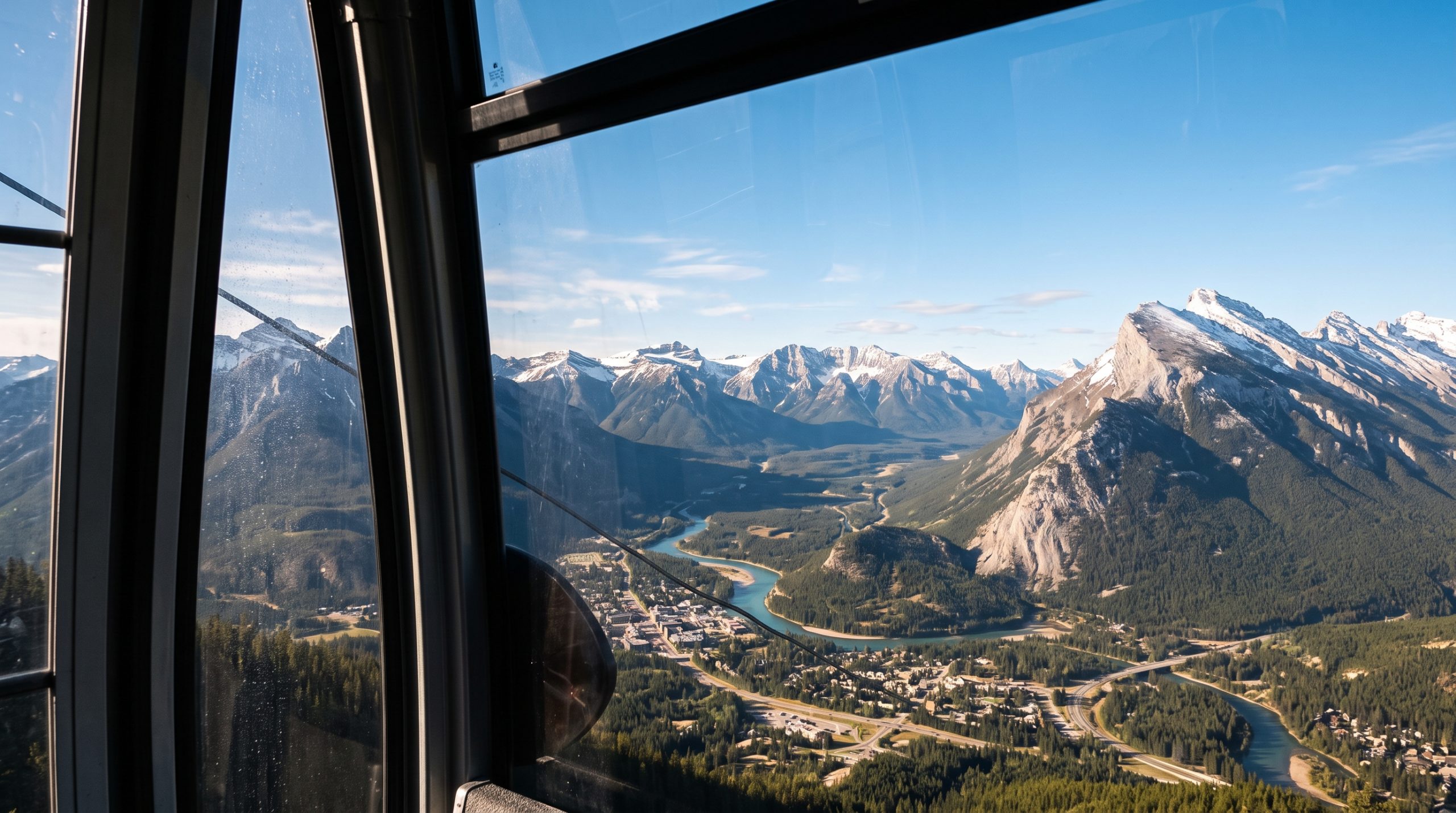
The ride itself covers about 1.6 kilometres of track in roughly eight minutes, climbing 700 metres up a steep mountainside. It is the gentlest approach to any high viewpoint in the park: nobody sweats, nothing gets muddy, hair survives, and a couple who woke up nervous gets eight quiet minutes in a glass box to look at each other instead of at a trail. The last ride down leaves ten minutes before the summit closes, and that is the hard edge of the day. Every hour we plan runs backwards from it.
You can also walk up. The trail to the summit of Sulphur Mountain takes somewhere between an hour and a half and three hours depending on fitness and conditions, which is a fine morning in boots and a poor one in a dress. The version that works is riding up and saving your legs for the boardwalk.
The 500 metres out to Sanson’s Peak
From the summit building, a boardwalk runs 500 metres along the ridge to Sanson’s Peak, where the Sulphur Mountain Cosmic Ray Station National Historic Site and a weather observatory dating to 1903 sit on the rock. Five hundred metres out, the same back, and it is the single best piece of ground here for vows.
In wedding clothes, this is what it is actually like. The surface is built decking with railings, so a hem stays clean and heels do not sink, but the boardwalk climbs and drops along the ridge in flights of wooden steps, and steps in a long dress mean one hand on the rail and someone carrying the train. Nobody wants to do that twice, so we walk it once, with intent, and shoot on the way out and the way back rather than making a second trip. The ridge is fully exposed, which is the real consideration: whatever the wind is doing in the Bow Valley, it is doing more of it up here. A jacket for the walk out and a first look at the far end is a better sequence than shivering through fifteen minutes of portraits on the deck by the doors.
What the light does at 2,281 metres
This is the part most pages about the gondola skip, and it is the part that decides your ceremony hour.
The summit stands 700 metres above the base station and the summit views run a full circle, which means you are never locked into one aspect. Banff townsite lies below to the north with Cascade Mountain behind it. Mount Rundle’s long slabbed ridge runs across the valley to the east. The Spray Valley drains away to the south, and the ranges west of the valley close the circle.
Early, the sun comes up over the eastern peaks and arrives almost horizontally down the valley. The town stays blue and cold in shadow while the boardwalk is already lit, and that contrast between a bright ridge and a dark valley floor is the most distinctive frame the mountain gives you. Late in the day the geometry flips and gets better. The sun drops behind the western ranges, the last of it climbs the face of Mount Rundle and the shoulder of Cascade, and if you stand facing east you get a warm mountain behind you and cool side light on your faces. Turn the other way and you are backlit against the sun dropping behind the Sundance Range. Both work. They are entirely different pictures, taken eight steps apart.
Midday is the weak hour, and we will say so plainly. High sun flattens the terraced ridges, summer haze softens the far peaks into grey layers, and fresh snow on the decks in winter throws enough glare to make skin tones a fight. It is also when the building is busiest. Between the middle of the day and the last hour before closing, take the last hour.
Winter is the surprise. In December the sun never climbs far above the peaks at this latitude, so the whole operating day behaves like one long, slow evening, and the summit sits above a valley full of cold air and low light. From November to April the summit also transforms after dark for Nightrise, a multimedia experience across the building and the boardwalk, which gives an evening a completely different visual register from anything the daytime offers. If you want to see how a mountaintop like this actually reads in a finished gallery and film rather than in a brochure, our published elopement stories and films are the honest version.
Midday is the rush, and arriving early does not work the way you think
On most Banff mornings, being early is the whole strategy. Here it is not, because nobody walks in. Everyone arrives by lift, in batches, from the moment the doors open, so the summit does not have the empty half-hour that a trailhead gives you. What it does have is a rhythm: quiet at the edges of the day, packed in the middle. The operator says as much on its own site, and it matches everything we have seen up there.
So we plan around the geography instead of the clock. The observation decks immediately outside the doors are the busiest square metres on the mountain and we use them for wide establishing frames, not for vows. The far end of the boardwalk is a different world.
Two cameras on a ridge with railings
The boardwalk is wide enough for people to pass and not much more, which is exactly why a photographer and a filmmaker who already work together matter here. Standing side by side, we would be in each other’s frames all afternoon. Instead one of us works close on the decking while the other drops back along the ridge on a long lens, then we swap ends. On an exposed summit the other problem is sound, because wind is the constant at 2,281 metres. The Expedition brings professional audio for the vows, and we pick the sheltered corner of the ridge or the lee of the summit building for the words themselves so that the film has something clean to carry. One full day with a dedicated photographer or a dedicated filmmaker starts at $4,900, and a day with both of them working together starts at $7,900. What sits inside each is set out on our coverage and pricing page.
The couple this summit fits
This place suits couples who want the scale of the Rockies without spending the morning earning it, and couples who want their people there. Grandparents ride up in eight minutes. A friend in dress shoes rides up in eight minutes. Sky Bistro and the Northern Lights Alpine Kitchen are both licensed and both take receptions, so dinner happens at altitude instead of back down in town. Guest numbers change access, permits, transport and the timeline here, never our fee.
It suits you less if what you actually want is solitude and silence. This is an operated venue on a working mountain, with other visitors on the decks and a building behind you, and no hour of the day makes it feel like a private summit. Couples who want no one else in the frame are usually happier down on the valley floor at dawn, with the summit kept as a second location for dinner and last light. That is a normal shape for a day here and one we build often. Tell us which of those two mornings sounds like yours and we will lay the day out accordingly, or say honestly which month gets you closer. Our destination elopement guides cover the wider region, and how an elopement day is put together covers the sequencing before any of it reaches a mountain.
Common questions
Can we get married at the summit in midsummer?
The venue’s stated wedding season runs mid-October through mid-June, with smaller summer ceremonies now offered as well. If your heart is set on July or August, that is a conversation to have with the gondola’s events team very early, and it is exactly the kind of thing we chase down and confirm in writing during planning.
How do our guests get up and back down?
The same way you do, on the gondola. Parking at the base is limited and paid from mid-May to mid-October, so Roam Transit Route 1 from downtown Banff is often the calmer answer for a group. Build the return around the last ride down, which leaves ten minutes before the summit closes.
Can our dog come up to the summit with us?
Not to the top. Pets are welcome on the trails and outdoor areas at the base, but they are not permitted in the gondola cabins or in the summit building, and service animals are the exception. If your dog is part of the day, we give them the valley hour and the summit becomes the half of the day without them.
What happens if cloud sits on the summit?
It does, sometimes, on mornings when the town below is clear. Because the summit is an operated venue rather than a trailhead, we plan a valley-floor hour that stands on its own and keep the summit as the flexible half, then move with the mountain. A ridge in moving cloud is often the better film anyway.
Should we hike up and ride down instead?
The trail takes an hour and a half to three hours depending on fitness and conditions, which is a good morning in boots and a hard one in wedding clothes. If you want the walking, we schedule it as a separate hour in hiking gear before you change, then ride up together for the ceremony.
A day that begins and ends with a lift
The shape we come back to is this: an unhurried start in Banff, layers and boots for the base station, the eight-minute ride, the walk out to Sanson’s Peak while the ridge still has its light, vows at the far end with the valley 700 metres below, then back to the summit building as the sun goes off Mount Rundle and dinner at altitude. Highlights reach you five days later. The full gallery or film follows within three weeks.
We are eight people, photographers and filmmakers who plan together rather than meeting on the morning, and we currently have Canadian Rockies dates open across 2027–2029 now. Every planning step stays in one written thread, at whatever hour suits you: send the inquiry form, and you will have a reply and our brochure within 24 hours, then a proposal built around your dates. Check Your Date and tell us which hour on that ridge you want to be standing there.