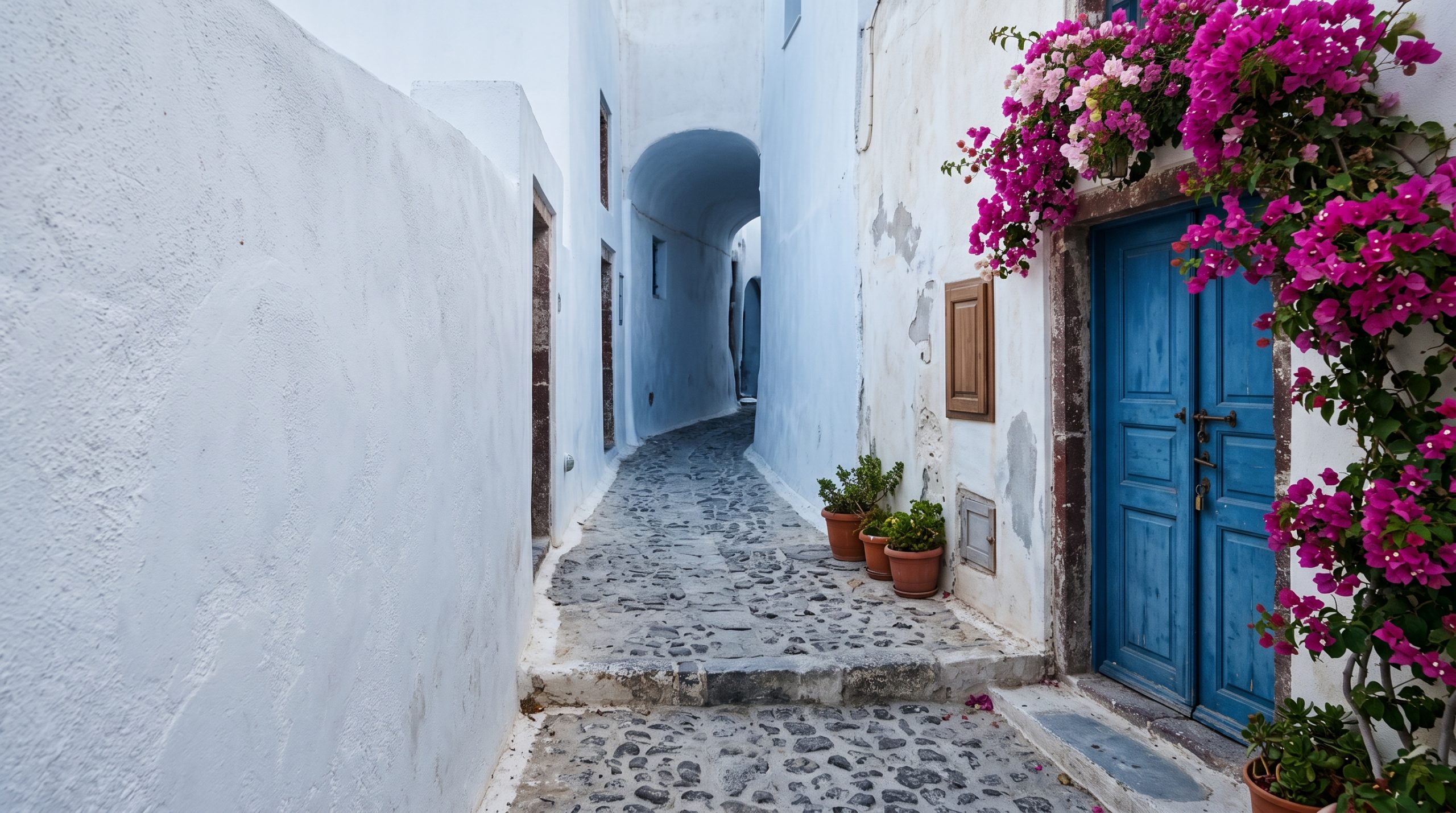
At the northeast corner of Kasteli, the fortified core of Emporio, stands a square stone tower called the Goulas. It went up in the fifteenth or sixteenth century, under Venetian rule, as a strongroom for the village harvest and a place for people to gather behind thick walls. It belonged to a local family, the Darzendas, before it passed into monastery hands, and tradition ties it to the monks of Saint John on Patmos. No coach stops for it. Most people who visit Santorini never learn its name.
Megalochori sits nine kilometers from Fira. Emporio sits twelve. Both are inland, away from the caldera rim entirely, and both are still ordinary working villages where the loudest thing at eight in the morning is a bell tower and a delivery van reversing.
Couples write to us about these two places for one reason. They want the whitewash, the stone underfoot and the arches, and they do not want to share the frame with three hundred strangers in a queue for a sunset.
Vows in the old lanes: what is actually possible
A civil ceremony can be performed anywhere in Greece once the municipality issues your licence, so vows in a Megalochori laneway or inside Emporio’s Kasteli are legally straightforward. The lanes themselves are public village streets, free to walk, with no ticket and no gate. What takes real planning is the hour, the doorways, and who lives behind them.
Kasteli: a village built to be difficult to walk into
Emporio is the biggest village on the island. The 2011 census counted 1,938 residents, and they live on the south side of Santorini at the foot of Profitis Ilias, twelve kilometers from Fira. In the middle of all of that is Kasteli, a medieval settlement whose outer houses were its wall, with everything useful turned inward. The alleys behind that wall were never designed to be walked in a straight line. They fold, double back, run under vaulted passages and open into small courtyards that belong to somebody.
Parts of it are restored and lived in. Parts are not. Walls are patched, some doors have been shut for a very long time, and the stone shows every one of the last five centuries. We like it for exactly that reason. Kasteli photographs like a place rather than a set, and it is the one corner of Santorini where a frame does not immediately read as Santorini.
In wedding clothes, here is the honest version. The ground is stone, worn smooth in the middle and uneven at the edges, and several of the connecting alleys are stepped rather than sloped. A few of the covered passages are low enough that a veil finds the ceiling before you do. Whitewash comes off on fabric, so a long train collects a pale dusting from the walls it brushes, which brushes out later but is worth knowing at the time. Most lanes take one person comfortably. The widest take two. Nobody should be walking more than a couple of hundred meters in shoes they cannot stand in, so we set the timeline to arrive by car at the closest point, change footwear at the edge of the old village, and cover the distance inside Kasteli slowly, because slow is what looks right in there anyway.
The reward for the awkward footing is the light in those vaulted stretches. At midday they are simply dark. In the last stretch of the afternoon, a low sun reaches down the length of the west-facing lanes and lands on one wall, and you get a bright edge on a bare shoulder with soft shade filling in behind it. That is the hour to be inside the Kasteli, not the middle of the day. Our destination guides cover the wider island, but the Kasteli hour is specific enough that we plan the rest of the day backward from it.
Megalochori’s two bell towers, and where the light lands
Megalochori is a ten-minute drive from Fira on a road that runs through vineyards, and it wears a different history from the caldera towns. In the seventeenth century this was a village of wine merchants, traders and landowners, and their mansions still line the main laneways: high walls, tall wooden doors, courtyards you can only half see into. The twin bell towers of Agii Anargyri are visible from most of the village and function as a compass once you are lost in the lanes, which you will be. Inside the church of the Presentation of the Virgin there is a carved wooden iconostasis and icons of the Russian school.
You leave the car in the parking area at the village entrance, and the road then drops gently toward the center. That matters more than it sounds. The walk in is downhill and the walk out is uphill, at the end of a long day, which is why we put the square early in the day and the far lanes late rather than the reverse.
The square is the social heart of the village, shaded by trees and ringed with tavernas. It is also, at midday, flat and busy and not remotely the best thing here. Two turns off it, the lanes narrow and the whitewash starts doing the work: white walls facing each other bounce light back and forth until the shade between them is soft enough to shoot at noon without a single hard shadow on a face. That is unusual, and it is the reason Megalochori tolerates a mid-morning ceremony hour better than almost anywhere else on the island.
For the end of the day, a road leaves the village westward past the Church of the Transfiguration of Christ and reaches a small parking area on the caldera edge, with the Megalochori windmill in one direction and Pyrgos on its hill behind. Ten minutes from the square, and suddenly there is open western sky. Our published galleries and films will show you what the two registers look like side by side: the close, quiet, reflected light of the lanes, and the wide, hard-edged light of a caldera rim at the very end of the afternoon.
The hours these villages belong to the people who live in them
Santorini takes a reported 3.4 million visitors a year, against roughly 20,000 permanent residents. Almost all of that pressure lands in two places, Fira and Oia, and the Oia sunset in particular draws a crowd that has become the island’s least appealing tourist attraction. Neither Megalochori nor Emporio is on that circuit.
That does not make them empty. Small groups do come through Megalochori’s square during the morning, and Emporio’s own visitor guidance tells people to come early or late to dodge the heat and the crowds in the alleys, which is decent advice honestly given. The difference is scale. In Oia, arriving early is no longer enough, because early is when everyone else arrives too. Here, it genuinely works: first light through the first two hours gives you empty lanes in both villages, and the last ninety minutes of the day gives you the same emptiness with better color.
The middle of the day is when these villages close their shutters and the light goes overhead and unkind. We treat that as a feature, not a problem. It is the natural gap in a timeline, the point where you go and eat something, and the reason a full day here does not feel rushed at either end.
One thing to plan around rather than resent: this is a residential village with a functioning parish. Sunday mornings bring bells and people walking to liturgy, and there are days when the village is entirely occupied with its own life. We build around that, and it usually makes the day better than the version we had drawn.
Working two cameras in a lane the width of a doorway
There are eight of us: four photographers, four filmmakers, one team, so the pair assigned to your day has worked together before and does not need to negotiate anything on the morning. That matters here more than on open ground. In a Kasteli passage there is room for one person and one camera, so the two of them trade the lane instead of crowding it, one holding the walk-in from behind while the other is already waiting at the next corner. Stone also does something useful to sound. Voices stay in the alley instead of blowing away, which is why the professional audio on the Expedition captures vows more cleanly in these villages than on any clifftop we work. The Adventure covers one full day with a dedicated photographer or filmmaker from $4,900, the Expedition puts both on the ground together from $7,900, and what each one includes sits on the pricing page. If you want more than one day, or these two villages plus somewhere else entirely, that is the Odyssey, two to seven days, quoted as a custom proposal.
The eight days, the two witnesses, and the forty days after
You do not need to live in Greece to marry in Greece, which is the first thing most couples want confirmed. Each of you submits your own set of documents, and for a couple coming from the United States that means a full birth certificate and a certificate of no impediment, each carrying an Apostille stamp and translated into Greek. The paperwork is presented in person at the town hall of the place where the marriage will happen, which for anywhere on Santorini means the Municipality of Thira.
The licence is generally issued eight days after the application goes in, and it stays valid for six months. Once you hold it, the civil ceremony can take place anywhere in Greece, on the date the mayor sets with you. Bring two witnesses with passports. The ceremony itself is conducted in Greek with an interpreter present, which is shorter and more moving than that sentence suggests. Afterward the marriage has to be recorded at the local registry office, the Lixiarcheio, within forty days, and that registration is the step that actually makes it legal in Greece.
Permit research and logistics guidance are part of every experience we run, so the sequencing, the timing and the questions to ask are ours to handle. The fees are not: government, venue and landowner charges stay with you, along with the celebrant. Plenty of couples sign the legal paperwork at home and keep the lane in Emporio for the vows they wrote themselves, which is a perfectly good plan and one we build often. Our guide on how to elope walks through both routes.
What moves the plan: heat, wind, and the first of July
Megalochori celebrates the feast of Agii Anargyri on the first of July, and the village fills for it. That is a wonderful day to be in the village and a poor day to try to have it to yourselves, so we move the ceremony hour or move the ceremony to Emporio, twelve kilometers away, and come back for the celebration afterward.
High summer heat is the other honest constraint, and it argues for the same hours as the crowds do: early, or late. Aerials run on their own set of conditions. A drone operator in Greece needs registration and an advance filing with the civil aviation authority, and anything over an archaeological site needs separate written permission, so we confirm the window before we design any part of a film around what a camera can see from above. Wind decides the rest on the day, and the alleys are the calmest ground on the island for both audio and small movements of fabric.
Between the two villages you have two entirely different backdrops within a short drive, plus the caldera edge west of Megalochori. Weather alternatives and backup planning are built into the timeline before you arrive, which in practice means you never hear about them.
Common questions
Can I walk the Kasteli alleys in a long dress?
Yes, with a plan. The ground is worn stone, uneven at the edges, and some connecting alleys are stepped. Whitewash marks fabric, so a train collects a pale dusting. We keep the walking distances short, park close, and change footwear at the edge of the old village.
Do we need permission to say vows in a village lane?
The lanes are public streets, and two people saying vows in one is not an event that needs a gate keeper. Courtyards, doorways and churches are a different matter, because they belong to families and to the parish, so we ask first and build the route around the answers.
Will the church bells end up in the film audio?
Sometimes, and we plan for it rather than against it. Bells sound on the hour and around services, and the towers of Agii Anargyri carry a long way across Megalochori. We either place the vows out of their reach or time them so the bells arrive as punctuation.
Is mid-morning early enough in Megalochori, or do we need sunrise?
Mid-morning is usually enough two lanes back from the square, which is the real difference between here and Oia. Sunrise gets you the square itself with nobody in it, plus the low light down the length of the eastern lanes. Tell us which you would rather have.
Where do we get ready, and is there anywhere to change?
Neither village has public facilities for this, so couples get ready where they are staying and drive in. Megalochori’s parking area at the village entrance is a short walk from the square, and in Emporio we bring the car to the nearest point on the road.
Can we cover both villages in one day without rushing?
Comfortably. Megalochori is nine kilometers from Fira, Emporio is twelve, and they are a short drive apart. First light in one, the long middle of the day off your feet, then the second village and the caldera edge in the evening.
What to put in your first message to us
Tell us the month, tell us which of the two villages you keep coming back to, and tell us the honest version of what you want the morning to feel like. If you want to be in an empty Kasteli at sunrise, say so. If you would rather sleep, eat properly and start at four in the afternoon, say that instead, and we will tell you which weeks make that work. We keep every planning decision in writing, at whatever pace suits your time zone: the inquiry form, a reply and an initial brochure inside 24 hours, then a tailored proposal, then a contract and a 30% retainer before planning starts. Highlights reach you five days after the day itself, the full gallery or film three weeks later. Dates are currently open across our 2027, 2028 and 2029 Santorini seasons. Start Your Story.