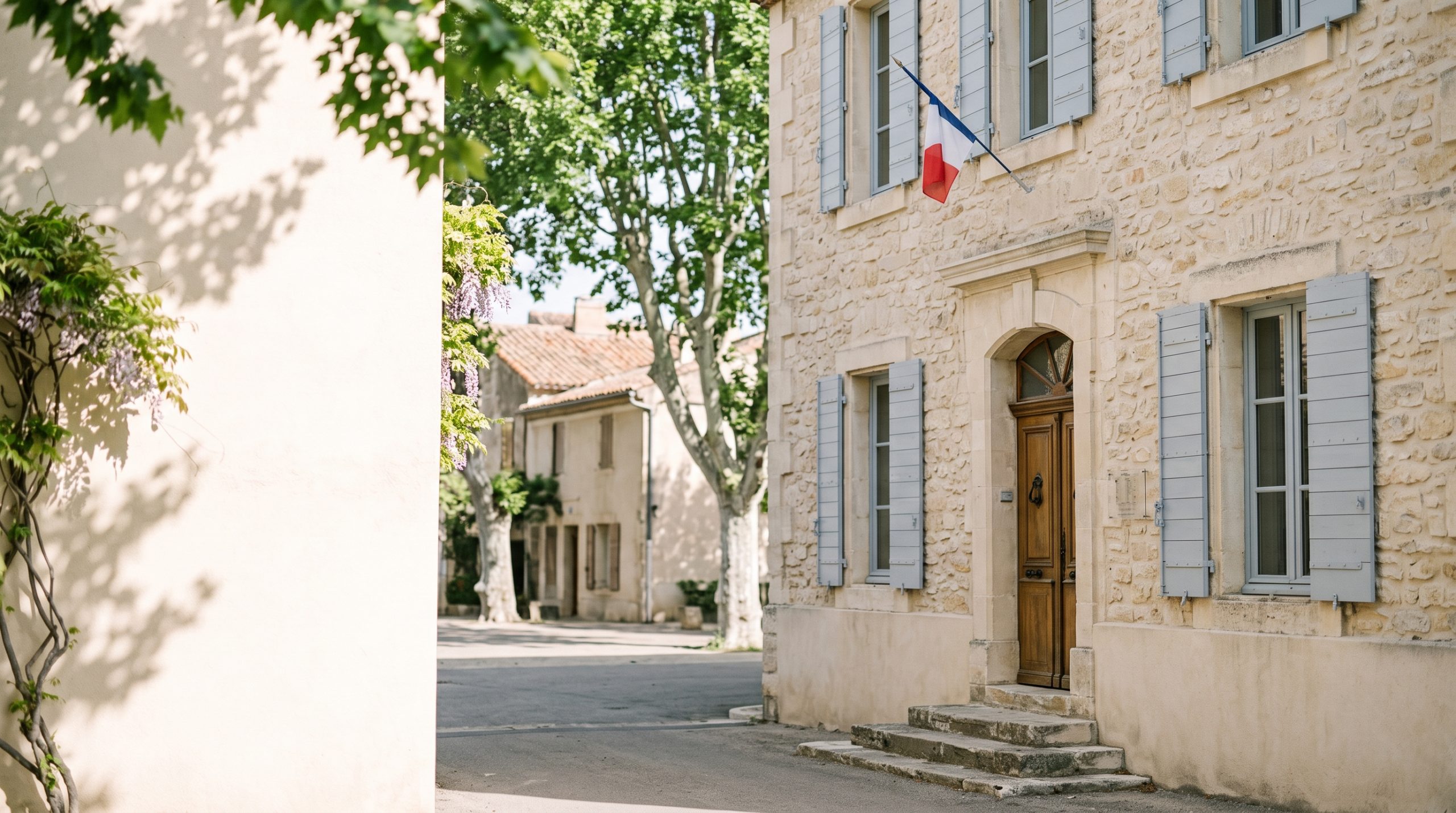
Article 74 of the French Civil Code is one sentence long, and it decides more about a French wedding than any venue tour ever will. A marriage is celebrated in the commune where one of you, or one of your parents, has a domicile or a residence established by at least one month of continuous habitation, counted at the date the banns are published. Everything else follows from that line.
Then Article 64 adds its ten days of banns, posted on the wall of the mairie, before the ceremony can take place at all. Stack the two and you get the number American couples keep running into: forty days in one French town, unbroken, before anybody signs anything.
That is a stay, not a formality. It is also why most of the couples who write to us about Provence, Brittany or the Écrins end up handling the legal side differently and giving France the part that actually matters to them. Below is the whole chain in order, the six places it snags, and the route that skips it cleanly.
Thirty days plus ten: where the forty comes from
French law asks that one of you hold a residence in the commune for at least one month of continuous habitation before the banns are published, and the banns are then posted for ten days. Counted back from the ceremony date, that is forty days in the same French town. Only one partner has to meet it.
The residency rule is a calendar commitment
You will see both thirty days and forty days quoted, sometimes on the same page. They are the same rule counted from two different points, and the office that governs the answer is the mairie applying Article 74: one month of continuous habitation, complete on the day the banns go up, plus the ten days those banns stay up.
So the honest rating splits in two. If one of you can spend six weeks living in a single French commune, this is fiddly but entirely doable, and thousands of foreign couples complete it every year. If your trip is ten days long, a legal French marriage is not realistically on the table, and no venue, planner or amount of goodwill from a mayor changes that. Article 74 has been on the books since 1907 and mairies apply it literally.
The good news is that the second group has a route that costs them almost nothing they care about, and we say more about it further down. It is not a fallback. For couples flying in from the US it is usually the better plan, and it is what a large share of the French days we shoot are built on. If you are still working out the shape of the trip itself, our guide to planning an elopement covers the groundwork that sits underneath either choice.
We are photographers and filmmakers, not lawyers. Rules change and circumstances differ, so confirm the detail with the mairie that would marry you, or with your own consulate, before you book flights.
The documents, in the order you have to collect them
Order matters here more than completeness. Several of these expire, and one of them expires while you wait for the others, so collecting them alphabetically is how couples end up paying twice.
- The mairie’s own list, in writing. Requirements are set nationally but applied locally, and the état civil desk of the commune you have chosen is the only office whose answer counts. Ask for the list by email and keep the reply. Their list will also cover anything particular to you, such as children you already share.
- A full birth certificate for each of you. France wants the long form, the copie intégrale, not a short abstract. A certificate issued abroad has to be less than six months old when the dossier is filed. A certificate issued in France has to be less than three months old.
- An apostille on each birth certificate. France and the United States both work under the Hague apostille system, and a US vital record is apostilled by the Secretary of State of the state that issued it. Two people born in two states means two offices, two fees and two processing queues.
- A sworn French translation of everything not already in French. Not any bilingual friend, and not a translation agency of your choosing. Mairies accept a translation done in France by a court-appointed expert translator listed with a Cour d’appel, or by the consulate of the country that issued the document, or abroad by a French consulate.
- Your attestation of eligibility to marry. French town halls normally ask foreign nationals for a certificat de coutume and a certificat de célibat. Because US marriage records are held by individual states, neither the US Embassy nor any federal authority issues either document for Americans. Instead each of you signs an attestation tenant lieu de certificat de coutume et de célibat, and the Embassy’s position is that the form does not require notarization.
- Passports and proof of the residence. Valid passports for both of you, and a justificatif de domicile that shows the Article 74 residence is real. The registrar is checking that at least one of you has a genuine, continuous link to that commune.
- Your witnesses’ details. Full names, dates and places of birth, occupations and addresses, plus copies of their identity documents. Two witnesses minimum, four maximum, all eighteen or over.
The prices and lead times here are a snapshot. Reconfirm them with the relevant authority before you build flights around them.
Turn the wedding date into a forty-day plan
Work forwards and the forty days looks manageable. Work backwards from a Saturday in June and you can see immediately whether it fits your actual life.
| Counting back from the ceremony | What has to be true by then |
|---|---|
| Nine to twelve months | The mairie has confirmed in writing that it will marry you and has sent its own document list. This is where the whole thing is won or lost. |
| Around five months | Long-form birth certificates ordered, then apostilled, then sworn-translated, in that sequence. The six-month window on a foreign certificate is the reason not to start this earlier. |
| About three months | Many French town halls ask for the completed dossier around here, and some will not fix a firm date until it is in and checked. |
| Day 40 | One of you begins the month of continuous habitation in the commune. Unbroken is the operative word. |
| Day 10 | The month is complete, and the banns go up at the mairie for ten days. |
| Day 0 | The ceremony, two to four witnesses, inside the mairie. The livret de famille is handed over the same morning. |
The real minimum is forty unbroken days in the commune with every document already assembled, apostilled and translated before you fly. The comfortable minimum, and the one we would work to, is a year from first email to ceremony. One more thing worth knowing about the calendar: once the banns have been published, the marriage has to happen within a year under Article 65, so a modest change of date costs you nothing, and a two-year postponement means publishing again.
Six details that decide whether the dossier lands
None of these are exotic. They are simply the points where a foreign couple’s assumptions and French administrative practice do not line up, and every one of them is easier to solve in March than in June.
- The birth certificate clock is shorter than the planning clock. Six months sounds generous until you realise it has to still be valid when the dossier is filed, and the apostille and sworn translation both sit inside that window. Order the certificate too early and you will order it again.
- There is no American certificat de coutume. Some mairies have never processed an American file and will simply repeat the standard requirement. The attestation is the answer, and the Embassy publishes it. If a particular town hall insists on a consular seal on your signature, the notarial fee at the time of writing is fifty dollars per seal, and it is worth settling that question by email early rather than on arrival.
- The translator has to be on a court list. A traducteur assermenté is a court-appointed expert who has sworn an oath before a Cour d’appel, and the stamp is the point. A beautiful translation from a good agency without that registration comes straight back across the desk.
- The banns cannot go up early. They can only be published once the month of habitation is complete, which is precisely why the two periods add rather than overlap. This is the single most common miscalculation we see in emails.
- Some mairies confirm the date only once they have seen you both. The registrar may ask to see the two of you together before the date is fixed, which is an ordinary conversation about your plans. If neither of you speaks French, the officer can require an interpreter, and that cost sits with you.
- The legal ceremony happens in a municipal building. Article 75 puts the marriage at the mairie. A mayor is allowed to designate another municipal building within the same commune for ceremonies, which is how some towns use a hall or a communal château. What no mayor can do is marry you in a private vineyard, on a beach or in a rented farmhouse.
Marrying at home, celebrating in France
Here is the thing nobody selling a French venue will tell you plainly: the ceremony you are imagining, the one on the terrace with the valley going gold behind you, is not the legal event in any version of this. Even for couples who complete the full forty days, the legal event is a room in the mairie at an hour the town chooses, with the registrar reading Articles 212 and 213 aloud on the duties spouses owe one another. That room is often lovely. It is never the terrace.
Which means the split most American couples make is not a compromise at all. You sign at home, in ten minutes, in front of a clerk, weeks or months before you fly. Then you come to France and hold the ceremony you actually planned, wherever a landowner, a commune or a park authority will permit it. A col in the Écrins at first light. A cliff path above the Channel. An olive terrace in the hills behind Nice with the sea flat and silver underneath.
What changes: no forty days, no banns, no sworn translations, no dossier, and no need to hold your ceremony hour against a town hall diary. You choose the hour, which in practice means you choose the light. What does not change: the vows, the rings, the readings, the person officiating, the friends who came, the film, the walk afterwards. Legally you are married before you land. Emotionally, nothing about the day is diminished, and we have never once had a couple say the paperwork was the part they remembered.
One French rule stays relevant even on this route. A religious celebration in France follows the civil marriage rather than replacing it, and a priest or minister will ask to see the civil marriage certificate first. If a church blessing is part of your plan, tell us early and we will find out what that particular parish needs. Our destination elopement guides are a good place to start narrowing down the region before you start narrowing down the commune.
Tell us which shape you want and we will build the timeline around it. Check Your Date.
What we can plan with you, and what remains yours
We plan the day around the constraints rather than pretending they are not there. That means holding your date against the mairie’s own diary, building a timeline from real travel times and the hour the sun actually clears the ridge, researching what each location permits and how aerials are cleared, and keeping a weather alternative that is genuinely good rather than merely dry. All of that is part of every experience, along with team travel worldwide. Photography, film and planning come from one team here, and what each experience covers is set out on our pricing page.
What stays with you: signing, filing and attending. We are not lawyers and we do not submit paperwork on your behalf, and you would not want a photographer who claimed otherwise.
The one place the structure of our team changes the legal day is the hour itself. A town hall sets the ceremony time to suit its own week, often mid-morning, indoors, with hard light coming through tall windows, and it will not wait for you. Because photography and film come from the same eight-person team rather than two suppliers introducing themselves in the car park, we can put a photographer and a filmmaker in that room together, record the vows as sound as well as picture where the coverage includes a filmmaker, and still have both of them standing on a headland for the last hour of light. You can see how those two halves of a French day fit together in our published stories and films. Highlights reach you five days after the day itself, and the full gallery or film three weeks later.
Common questions
Do both of us have to live in France for 30 days, or just one?
Just one. Article 74 asks that one of you, or one of your parents, holds a domicile or residence in the commune established by at least one month of continuous habitation at the date the banns are published. Your partner can arrive later, though in practice most couples doing this stay together.
Is it 30 days or 40 days before the wedding?
Both figures are correct and describe the same rule. Thirty days of continuous habitation must be complete before the banns are published, and the banns stay posted for ten days. Counted back from the ceremony, that is forty days in the commune.
Will a hotel or a holiday rental count as residence at the mairie?
The commune decides what proof it accepts, and it is looking for evidence of a real, continuous link to that town rather than a booking confirmation. Ask the état civil desk in writing exactly which justificatif de domicile they will accept before you pay for six weeks of accommodation.
Can the legal ceremony happen at our château or on the beach?
No. Article 75 places the marriage at the mairie, and a mayor may only designate another municipal building inside the same commune. Private venues and outdoor locations can host everything else, which is most of the day.
Who is allowed to translate our American documents into French?
A court-appointed expert translator registered with a Cour d’appel in France, or the consulate of the country that issued the document, or a French consulate abroad. Translations that arrive without that registration are generally refused, however accurate they are.
We only have each other. Do we still need witnesses?
Yes, for a French civil marriage. Article 75 requires at least two witnesses and allows a maximum of four, related to you or not, and each of them must be eighteen or over. Ask your commune how it handles couples arriving alone.
Will our French marriage certificate be recognized back in the US?
A marriage celebrated by a French officier de l’état civil is a valid marriage, and you are not required to register it with the US Embassy. You are given a livret de famille on the day, and you can order certified copies of the acte de mariage from the mairie afterwards.
Forty days or one morning, both work
Whichever route you take, the decision that shapes the photographs is the same one: which hour of which day you stand where. Send us the region you are drawn to and roughly when, and say which of the two routes you want, and we will come back with a timeline built around the light rather than around the admin. Everything happens in writing, from the first message onward: you will have our reply and the initial brochure within 24 hours, then a tailored proposal, and planning begins once the contract is signed and the 30% retainer is paid. Our France dates are currently open across the 2027–2029 seasons. Tell Us Your Story.